“The unicorn is a mythical beast, but it is also a real animal, a creature of the imagination, and a symbol of something else.”
— Marian reflects on the nature of the unicorn as both literal and metaphorical.

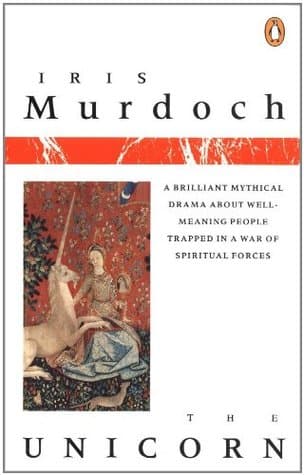
Iris Murdoch (1963)
Genre
Literary Fiction / Mystery
Reading Time
360 min
Key Themes
See below
Sign in to track this book
In a remote Irish castle, a young governess becomes entangled in the unsettling, ritualistic imprisonment of its enigmatic lady, revealing a gothic web of obsession, sacrifice, and the terrifying beauty of delusion.
Marian Taylor, a young English governess, arrives at the remote Gaze Castle, on a bleak, windswept coast. She was hired to teach Hannah Crean, the castle's mistress, though she soon learns Hannah is an adult and Marian's job is more as a companion. Marian is immediately struck by the castle's desolate beauty and the strong sense of mystery and oppression inside. She learns Hannah is a prisoner, confined to the castle by her husband, Peter Crean, who lives elsewhere. The few people living in the castle, including the quiet housekeepers Alice and Violet, and the eccentric German scholar Max Lejour, offer little explanation for Hannah's situation, increasing Marian's curiosity and unease.
Marian slowly learns about Hannah's captivity. She hears from Max Lejour, the resident intellectual, and later from other characters, that Hannah has been confined to Gaze Castle for seven years as punishment for an unspecified past mistake, possibly an affair. Her husband, Peter Crean, visits sometimes but keeps her isolated. The castle becomes a symbol of a prison, and Hannah, a figure of beauty and sadness, is treated with a mix of respect and fear by those around her. Marian begins to feel sympathy for Hannah, seeing her as a victim, and questions the fairness of her long sentence.
Marian goes outside Gaze Castle and meets the few people in the surrounding desolate area. She meets Effingham Cooper, a former lover of Hannah's who lives in a nearby cottage, filled with guilt and a strange devotion to her. She also meets Gerald Scottow, the owner of Riders, a neighboring estate, who seems to act as a 'keeper' or guardian over Hannah and Gaze Castle, enforcing Peter Crean's rules. Scottow is a powerful, manipulative person with an unsettling authority. Marian gets drawn into the complex relationships and past events, finding that everyone seems involved in, or at least affected by, Hannah's imprisonment.
Effingham Cooper, troubled by his past with Hannah and her current suffering, tries to free her. He tells Marian his plan, and she, despite her initial worry, gets involved. Effingham manages to give Hannah a key or a way to escape, but the attempt fails. Hannah, either unwilling or unable to fully commit to freedom, stays at Gaze. This failed escape strengthens the belief among the castle's inhabitants that Hannah's fate is set, and that any help is pointless or dangerous. The incident further shows Hannah's passive role and the almost mythical power of her confinement.
Peter Crean, Hannah's husband and the one who imprisoned her, makes a rare visit to Gaze Castle. His arrival creates strong tension among all the residents. Peter is cold, authoritative, yet strangely sad. He talks to Marian, explaining why he confined Hannah as a form of penance or purification. He shows a deep, twisted love for Hannah, seeing her as a unique, almost sacred being whose mistake needed extreme measures. This visit makes Marian's understanding more complex, as Peter seems less a cruel tyrant and more a tragic figure trapped by his own strict moral code and obsessive devotion.
Max Lejour, the scholar, gives Marian a philosophical and mythical way to understand Hannah's situation. He sees Hannah not just as a wronged woman but as a symbolic figure, a 'unicorn' or a 'goddess' who shows purity and suffering, whose existence justifies the devotion and sacrifice of those around her. Max's interpretations, using classical and mythical references, make Hannah's plight seem more grand and archetypal than a simple domestic drama. This view changes Marian's perception, making Hannah seem both more profound and more distant, a living myth rather than just a woman.
Gerald Scottow, the enigmatic owner of Riders, increasingly influences the events at Gaze. He is shown to be deeply involved in keeping Hannah captive, acting as Peter Crean's enforcer. Scottow is a master manipulator, playing mind games with Marian and the other inhabitants. He seems to enjoy his role and the power he has. Marian realizes that Scottow is not just a guardian but a key player in Hannah's suffering, perhaps driven by his own dark desires or a twisted sense of duty to Peter Crean, his former mentor or lover. His presence adds malicious intent to the already oppressive atmosphere.
A strange 'hunt' or pursuit of Hannah happens within the castle grounds, arranged by Gerald Scottow. During this increasingly surreal event, the true nature of Hannah's 'crime' starts to become clear, though it is never fully stated. It is suggested that her mistake was not just an affair but perhaps something deeper, a betrayal of Peter that involved a deeper psychological or spiritual wound. The 'hunt' becomes a symbolic ritual, a communal re-enactment of her perceived fall. Marian, watching these strange events, feels the reality of Hannah's situation move further into myth and madness.
Driven by an unbearable sense of entrapment and despair, Hannah tries a more forceful escape. This time, she acts with more purpose, though still seeming somewhat detached from the reality of her actions. The escape is chaotic and leads to a confrontation with Gerald Scottow. In the struggle, or perhaps as a result of a deliberate act, Scottow is killed. This event breaks the fragile order of Gaze Castle and increases the tragedy, changing Hannah from a passive victim into an active participant in violence, even if by accident or self-defense. Marian watches the unraveling in horror.
Gerald Scottow's death brings Peter Crean back to Gaze Castle. Peter is devastated by Scottow's death, showing a deep, complex bond between them that Marian had not fully understood. Afterwards, Peter, consumed by grief and a renewed sense of Hannah's 'corruption' or destructive power, takes Hannah away. How she leaves is unclear, but it is strongly suggested that Peter takes her to a remote, desolate cliff edge, where he either kills her or allows her to fall to her death. The 'unicorn' is finally 'sacrificed,' ending her suffering and the strange drama of Gaze Castle.
With Hannah and Peter gone, and the strange spell of Gaze Castle broken, Marian Taylor prepares to leave. The castle is now empty, its oppressive atmosphere replaced by a desolate silence. Marian thinks about the events she has seen, the characters she has met, and the disturbing questions about love, power, and human nature that remain unanswered. She leaves Gaze Castle a changed woman, haunted by the memory of Hannah and the dark, mythical drama that unfolded there. Her time at the castle has been a journey into human obsession and the elusive nature of truth, leaving her with a sense of both horror and a strange understanding.
The Protagonist
Marian transforms from an innocent observer to a disillusioned witness, grappling with the profound moral ambiguities of the human condition.
The Central Figure/Victim
Hannah remains largely static as a symbol of suffering, but her final desperate act reveals a hidden agency leading to her tragic end.
The Antagonist/Complex Figure
Peter's rigid moral framework ultimately leads to his further descent into tragedy and the final destruction of Hannah.
The Antagonist/Supporting
Gerald's manipulation and control intensify throughout the novel until his sudden, violent death shatters the established order.
The Supporting
Max's role is primarily static, serving as a philosophical commentator on the unfolding events.
The Supporting
Effingham's attempts to free Hannah escalate in desperation but ultimately fail, leaving him trapped in his own cycle of guilt and obsession.
The Supporting
Alice and Violet remain static, serving as silent witnesses and guardians of the castle's enduring mystery.
The most obvious theme, shown through Hannah's literal imprisonment at Gaze Castle. Her physical confinement is a comparison for various forms of psychological and spiritual entrapment felt by other characters. Peter Crean is imprisoned by his strict moral code, Effingham by his guilt, and Marian herself becomes psychologically trapped within the castle's strange reality. The novel asks about the nature of true freedom, suggesting that external liberation does not always mean internal release, and that some forms of captivity are self-imposed or even wanted.
““One is always free, even in prison.””
Murdoch blurs the lines between good and bad, showing characters like Peter Crean and Gerald Scottow who are both cruel and complex, sometimes sympathetic. Hannah, the 'victim,' also has a destructive, almost amoral power. The novel suggests that evil is not always clearly defined or externally imposed but can come from twisted love, mistaken ideals, or flaws within human nature. It challenges simple moral judgments, asking the reader to deal with uncertainty.
““Goodness is not a thing. It is a structure, a system of relations.””
The relationships in the novel are driven by intense, often destructive obsessions rather than healthy love. Peter's love for Hannah is possessive and punishing; Effingham's is guilt-ridden and selfish; Gerald's is manipulative and controlling. Hannah herself becomes an object of collective obsession, a 'unicorn' around whom others gather. The novel explores how love, when twisted by ego, guilt, or abstract ideals, can cause deep suffering and moral decay. It questions how pure and selfless human affection is.
““Love, which is a kind of attention, is also a kind of destruction.””
Gaze Castle and Hannah herself have mythical and symbolic meaning. Max Lejour directly calls Hannah a 'unicorn' or a 'goddess,' making her plight more than a personal tragedy. The novel uses elements of fairy tale and classical myth to explore deeper truths about human nature and the archetypal patterns of suffering and sacrifice. This mix of the everyday and the mythical creates an unsettling atmosphere where reality is always changing and open to interpretation, making it hard for Marian and the reader to find objective truth.
““She was not a person, she was a state of being.””
Throughout the novel, Marian tries to understand the true nature of Hannah's 'crime,' the motivations of her captors, and the complex relationships between the characters. Information is broken up, contradictory, and often seen through biased views. The truth remains mostly hidden, never fully revealed or clarified. This theme shows how subjective perception is and how impossible it is to fully understand another person's reality or the complex web of human motivations, leaving the reader with unanswered questions and a sense of deep ambiguity.
““One never knows, never, what another person is really thinking.””
A remote, desolate castle that acts as both a physical prison and a symbolic world unto itself.
Gaze Castle is more than just a location; it is a character in itself. Its extreme isolation on a bleak, windswept coast cuts off its inhabitants from the outside world, intensifying the psychological drama. The castle's ancient, oppressive architecture and its remote surroundings create a claustrophobic atmosphere, reinforcing Hannah's captivity and the feeling of being trapped. It becomes a contained universe where normal moral rules seem suspended, allowing the characters' obsessions and neuroses to fester and escalate without external intervention. The setting is crucial for establishing the novel's gothic and mysterious tone.
While Marian is observant, her emotional involvement and the subjective interpretations of others color the narrative.
Although Marian Taylor is the primary lens through which the story is told, the narrative subtly suggests the unreliability inherent in her perspective. As an outsider, she constantly struggles to interpret the bizarre events and the motivations of the characters, often relying on the biased accounts of others (like Max or Effingham). Her growing emotional entanglement with Hannah and the oppressive atmosphere of Gaze Castle also affect her judgment. The novel leaves many questions unanswered, forcing the reader to question Marian's understanding and highlighting the subjective nature of truth within the story.
Hannah is presented as a mythical 'unicorn,' embodying purity, suffering, and an elusive, destructive beauty.
The unicorn is a central symbolic motif, explicitly referenced by Max Lejour and implicitly woven throughout the narrative. Hannah is portrayed as a rare, beautiful, and vulnerable creature, whose purity and suffering draw others into a web of obsession and desire to possess or 'capture' her. The myth of the unicorn, which can only be tamed by a virgin, reflects Hannah's enigmatic nature and her unique power over men. Her ultimate 'sacrifice' at the end of the novel aligns with the mythical fate of the unicorn, symbolizing the destruction of innocence and the tragic consequences of human obsession and idealization.
An unspecified past transgression that drives the entire plot but is never fully revealed.
Hannah's 'crime' serves as a classic MacGuffin: a plot device that is crucial to the narrative's progression and motivates the characters' actions (Peter's punishment, Effingham's guilt, Marian's curiosity) but whose exact nature is never explicitly defined or fully understood. This ambiguity enhances the mystery and allows Hannah to remain a symbolic figure rather than a fully explained individual. By withholding the specific details of her transgression, Murdoch shifts the focus from the 'what' to the 'why' and the 'how' of human obsession, punishment, and the psychological effects of prolonged suffering.
“The unicorn is a mythical beast, but it is also a real animal, a creature of the imagination, and a symbol of something else.”
— Marian reflects on the nature of the unicorn as both literal and metaphorical.
“We are all prisoners of our own stories, and the only escape is to tell a better one.”
— Hannah contemplates the power of narrative in shaping identity and freedom.
“Love is not a feeling; it is a fact, an act of will, a decision to be responsible for another.”
— Effingham discusses the philosophical nature of love in a conversation.
“The past is not dead; it is not even past. It lives in us, shaping every moment.”
— Marian reflects on the inescapable influence of history and memory.
“To be human is to be haunted by the ghosts of what might have been.”
— Hannah muses on regret and the paths not taken in life.
“Truth is not something we discover, but something we create through our actions.”
— Effingham argues about the nature of truth in a philosophical debate.
“The house was a labyrinth of secrets, each room a chapter in a story no one dared to finish.”
— Description of Gaze Castle, the setting where much of the mystery unfolds.
“We are all actors in each other's dramas, playing roles we never auditioned for.”
— Marian observes the interconnectedness and performative aspects of relationships.
“Solitude is not the absence of others, but the presence of oneself in full clarity.”
— Hannah reflects on the nature of being alone versus loneliness.
“The greatest mysteries are not in the world outside, but in the human heart.”
— Narrator's insight into the central theme of the novel's mystery.
“To forgive is to set a prisoner free and discover that the prisoner was you.”
— A character discusses the transformative power of forgiveness.
“Art is not a mirror to reflect reality, but a hammer with which to shape it.”
— Reference to the role of art and creativity in the characters' lives.
“In the end, we are all just stories waiting to be told, or forgotten.”
— Closing reflection on the ephemeral nature of human existence.
Ready to see how well you understood this book? Take our interactive quiz with 10 questions.
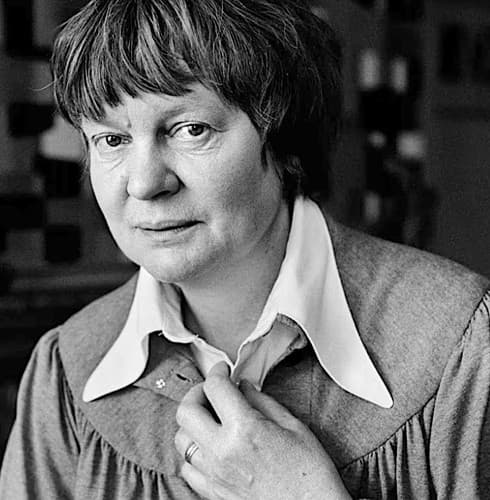
Dame Jean Iris Murdoch was an Irish and British novelist and philosopher. Murdoch is best known for her novels about good and evil, sexual relationships, morality, and the power of the unconscious. Her first published novel, Under the Net (1954), was selected in 1998 as one of Modern Library's 100 best English-language novels of the 20th century. Her 1978 novel The Sea, the Sea won the Booker Prize. In 1987, she was made a Dame by Queen Elizabeth II for services to literature. In 2008, The Times ranked Murdoch twelfth on a list of "The 50 greatest British writers since 1945".







