“The earth was still damp from the morning rain, and the air smelled of wet leaves and the promise of more rain to come.”
— Opening description of the bayou.

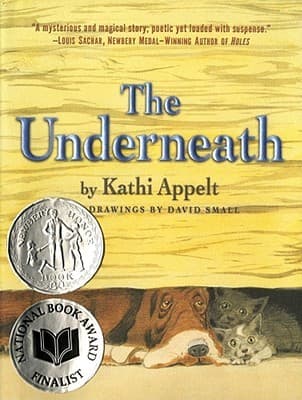
Kathi Appelt (2008)
Genre
Fantasy / Children's / Young Adult
Reading Time
360 min
Key Themes
See below
Sign in to track this book
Beneath a rickety bayou porch, a pregnant calico cat and a chained hound create an unlikely family, their fragile home threatened by a cruel human and a curious kitten whose discovery uncovers generations of secrets and the lasting power of promises.
A pregnant calico cat, recently abandoned, finds herself alone on a Louisiana bayou road. Drawn by a howl, she goes into the cypress forest, finding a large, chained hound named Ranger. Ranger is a lonely, gentle dog, chained to a tree outside the shack of a cruel, one-legged man known as Gar-Face. Despite their natural differences, Ranger offers the cat comfort and a safe place for her kittens: under the porch of Gar-Face's house, a hidden space he calls 'the Underneath.' The cat, desperate and trusting, accepts, seeking shelter from the weather and Gar-Face's potential cruelty.
Underneath the rickety porch, the calico cat, whom Ranger calls 'Mama,' gives birth to three kittens. Two are strong, but the third is small, frail, and quiet, earning him the name 'Puck' from Ranger, who worries about his survival. Mama protects her kittens in their hidden sanctuary. Ranger, from his chained spot, watches over them, sharing stories and warnings about the dangerous world outside, especially Gar-Face, known for his cruel treatment of animals, including using them as alligator bait. The Underneath becomes a temporary safe place for the unlikely family.
Deep within the ancient cypress tree where Ranger is chained, an old lamia named Liesl, cursed and trapped for centuries, watches the new life under the porch. Liesl was once a human girl, transformed into a half-snake, half-woman after breaking a promise to a witch-woman. She now exists as a memory and sorrow, her scales having become the tree's bark. The kittens' arrival, especially Puck, stirs something within her. She also senses a hummingbird, a recurring symbol of beauty and fleeting joy, which often visits the bayou and connects to her past and hope for freedom.
As the kittens grow, their curiosity starts to outweigh their mother's warnings. While the other two are cautious, Puck, the smallest, is the most adventurous. One day, his curiosity leads him to squeeze out from under the porch, venturing into the open. Gar-Face, a cold man with an eye for alligator bait, spots Puck. Ranger, frantic and helpless on his chain, barks desperate warnings, but it is too late. Gar-Face snatches Puck, intending to use him. This act of cruelty shatters the fragile peace of the Underneath and starts a desperate struggle for survival.
Witnessing Gar-Face snatch Puck, Mama, full of maternal fury, attacks the old man. She scratches and bites, forcing him to drop the kitten. However, in his rage, Gar-Face turns on Ranger, beating him severely with a shovel for his perceived involvement and for barking warnings. Ranger is left injured and heartbroken, his spirit crushed by his inability to protect his family. Mama retrieves Puck, unharmed but shaken, and returns to the Underneath, but the incident leaves a deep scar. The family's security is broken, and Ranger's hope dwindles.
The story goes into Gar-Face's past, showing him not just as evil, but as a man consumed by grief and bitterness. Years ago, he had a young daughter named Maybelle, whom he loved deeply. One day, Maybelle disappeared in the bayou, an event that broke Gar-Face's spirit and led to his current reclusive and cruel life. He believes Maybelle was taken by a powerful bayou force, possibly a witch or a monster. His cruelty towards animals, particularly his desire to use them as alligator bait, is a twisted expression of his unresolved grief and his warped sense of justice against the bayou that took his child.
Liesl's story fully unfolds, revealing the promise she broke centuries ago. As a young girl, she was given a shimmering hummingbird by a powerful witch-woman of the bayou. Liesl was meant to protect it and return it, but she became enamored with its beauty and tried to keep it, hiding it. The witch-woman, discovering the broken promise, cursed Liesl, transforming her into the lamia and trapping her within the cypress tree. This curse is a central theme, highlighting the consequences of broken promises and the lasting power of the bayou's magic. Liesl's yearning for freedom is tied to the hummingbird's return.
Despite the previous scare, Puck's adventurous spirit remains strong. As he grows, he ventures farther from the Underneath, exploring the bayou's edges. His explorations lead him to a dangerous encounter with an ancient, scarred alligator, a creature that shows the bayou's raw, untamed power. This encounter highlights the constant danger faced by wild creatures and foreshadows the escalating danger Puck will face. Ranger, still chained and recovering, feels helpless as he watches Puck's explorations, knowing he cannot intervene directly.
The shimmering hummingbird, central to Liesl's curse, reappears in the bayou. Its presence is important, as it represents a potential catalyst for Liesl's release from her centuries-long entrapment. Liesl, watching from within the cypress tree, feels a flicker of hope that her broken promise might be mended, and her transformation reversed. The hummingbird acts as a beacon, drawing together the story's threads and hinting at redemption and change within the magical bayou.
A fierce storm hits the bayou, bringing torrential rain and lightning. A lightning strike ignites a fire in the dry underbrush, threatening Gar-Face's shack, the cypress tree, and the entire bayou. The fire forces Gar-Face to confront his isolation and the immediate danger. Ranger, still chained, is in great peril from the encroaching flames. Mama and her kittens are trapped. The natural disaster acts as a powerful external force, pushing the characters towards a climax where their fates will be intertwined and their true natures revealed in the face of overwhelming adversity.
As the fire rages and the water rises, Puck, driven by curiosity and instinct, again finds himself in immediate danger, close to the fire. Ranger, seeing the kitten's peril and finally unable to bear his helplessness, summons all his strength and, in a desperate act, breaks his chain. Free for the first time in years, he rushes to save Puck. Gar-Face witnesses Ranger's selfless act. This moment of pure, unconditional love and courage from Ranger begins to chip away at Gar-Face's hardened heart, forcing him to confront his own past and choices.
In the chaos of the fire and flood, as Gar-Face helps save the animals and the old witch-woman, the hummingbird's true purpose is revealed. It is a symbol of the promise, a key to Liesl's release. Through a combination of events, perhaps the hummingbird returning to its rightful place or a gesture of true forgiveness, Liesl's curse is finally broken. The ancient lamia transforms, hinting at a return to her human form or a new, free existence. Her release signifies the mending of old wounds and the power of redemption, echoing the story's broader themes.
After the fire and flood, the bayou community, both human and animal, begins to heal and rebuild. The landscape is scarred, but life continues. Gar-Face, deeply affected by Ranger's sacrifice and the collective struggle, experiences a change of heart. He begins to shed his bitterness and isolation, starting to care for the animals and even showing kindness. Maybelle's memory still haunts him, but his cruelty is replaced by quiet remorse and a tentative step towards redemption, suggesting a new, more hopeful chapter for him.
Ranger, having broken his chain and saved Puck, eventually dies from old age, injuries, and the strain of his long, lonely life. His death is peaceful, a final release, but his courageous act leaves a lasting mark on the bayou. He is remembered as a protector and a friend. The Underneath, though no longer a physical hiding place for Mama and her kittens, becomes a symbolic place of memory, resilience, and the lasting power of love and loyalty. Life continues in the bayou, forever changed by the events, but with a renewed sense of connection and hope.
The Protagonist
Ranger begins as a lonely, resigned captive but finds renewed purpose in protecting the kittens, ultimately sacrificing his freedom and life for them.
The Protagonist
From an abandoned, vulnerable stray, Mama transforms into a courageous defender of her family, finding a new sense of belonging.
The Supporting/Catalyst
Puck grows from a tiny, vulnerable kitten into a slightly more aware, but still curious, young cat, surviving through the protection of others.
The Antagonist
Gar-Face begins as a cruel, isolated figure but, through the events of the story, experiences a slow, painful shift towards remorse and a glimmer of redemption.
The Supporting/Mystical
Liesl begins as a trapped, sorrowful entity and finds hope for release through the unfolding events, ultimately achieving freedom from her curse.
The Mentioned
Maybelle's story is a static tragic event that deeply impacts the antagonist's arc, rather than her own.
The Mentioned/Mystical
The witch-woman's arc is historical, establishing the magical framework and consequences within the bayou's past.
The Symbolic/Mystical
The hummingbird's journey from being lost to being rediscovered facilitates the resolution of Liesl's centuries-old curse.
This theme is central to Liesl's story, as her transformation into a lamia and her centuries of entrapment directly result from breaking a promise to the witch-woman. It highlights the impact of one's word and the lasting results of betrayal, especially in a magical world where promises hold great power. The eventual resolution of Liesl's curse is tied to mending this broken promise, emphasizing the importance of making amends and the possibility of redemption. It also subtly influences Gar-Face's journey, as his inability to cope with the 'broken promise' of life after Maybelle leads to his destructive behavior.
“A promise is a powerful thing. It can bind you for a lifetime, or it can set you free.”
The story is full of various forms of love and the deep grief that follows loss. Gar-Face's cruelty comes directly from his unbearable grief over his daughter Maybelle's disappearance. His actions are a twisted attempt to control a world that took something precious from him. Conversely, Mama's fierce maternal love for her kittens, and Ranger's selfless, protective love for the entire feline family, drive their actions and sacrifices. The story explores how love can bring joy and connection, but also how its absence or the pain of its loss can corrupt and isolate. Ranger's loneliness before the cats arrive shows the ache of unfulfilled connection.
“There is nothing lonelier than a cat who has been loved, at least for a while, and then abandoned on the side of the road.”
Despite their different species and circumstances, the characters' lives are deeply connected. Ranger, Mama, Puck, Gar-Face, and Liesl are all linked by the bayou, the cypress tree, and the events that unfold. Ranger's fate is tied to the kittens, and Gar-Face's past affects his current cruelty towards them. Liesl, an ancient spirit, observes and is affected by the new life around her. This theme shows that no creature exists alone; actions and choices ripple through the entire ecosystem, creating a complex web of relationships and consequences. The fire and flood further highlight this, as they force all inhabitants to confront their shared vulnerability and reliance on one another.
“Everything was connected, like the roots of the cypress trees, deep in the dark water.”
While cruelty and bitterness are present, the story ultimately promotes compassion and forgiveness as ways to heal. Ranger's steady kindness towards Mama and her kittens, despite his own suffering, contrasts sharply with Gar-Face's malice. The climax, where Ranger breaks his chain to save Puck, and Gar-Face witnesses this selfless act, marks a turning point for the old man. Through this display of unconditional love and the eventual understanding of his own pain, Gar-Face begins to soften, hinting at a future where he might forgive himself and the bayou, and perhaps be forgiven. Liesl's release from her curse also represents a form of ancient forgiveness, allowing her to heal from her past wrongdoing.
“Sometimes, the hardest thing to do was to let go of the hate, to make room for something else.”
The Louisiana bayou itself is a character in the story, representing both a source of life and danger, beauty and mystery. It is a place where ancient magic lingers, where creatures both ordinary and mythical coexist. The bayou provides refuge in 'the Underneath' but also harbors alligators and other dangers. It is the setting for Liesl's curse and the backdrop for Gar-Face's grief. The bayou's wild nature, its cycles of flood and fire, and its deep, dark waters reflect the wild emotions and hidden histories of the characters, creating an atmospheric and powerful sense of place that influences every part of the story.
“The bayou held its secrets close, like a hand cupping a flickering flame.”
A hidden, safe space beneath the porch.
The Underneath serves as a literal and symbolic sanctuary. Initially, it's the physical hiding place for Mama and her kittens, offering protection from Gar-Face and the elements. Symbolically, it represents a hidden world of safety, love, and family, contrasting sharply with the dangerous world above. It is a place where unlikely bonds are forged and where innocence is temporarily preserved. The violation of the Underneath by Gar-Face signals the shattering of this fragile peace and propels the story's conflict.
A physical and symbolic restraint on freedom and action.
Ranger's chain is a powerful symbol of his captivity and helplessness. Physically, it binds him to the cypress tree, preventing him from directly protecting Mama and her kittens from Gar-Face. Symbolically, it represents the constraints imposed by circumstance, fate, and the cruelty of others. His eventual breaking of the chain in the climax is a moment of profound liberation and sacrifice, signifying the triumph of love and will over physical limitations, and a release from years of suffering.
An ancient, living entity that houses Liesl and witnesses events.
The ancient cypress tree is more than just a setting; it's a living, sentient entity and a repository of history. It physically anchors Ranger's chain and, more importantly, houses the cursed lamia, Liesl, within its bark. It acts as a silent witness to centuries of bayou life and the unfolding drama. Its age and deep roots symbolize the enduring nature of the bayou's magic and the long-lasting consequences of past actions, connecting the ancient curse of Liesl to the present-day struggles of the animals and Gar-Face.
A magical, shimmering bird symbolizing broken promises and potential redemption.
The hummingbird is a recurring motif and a crucial magical element. It was the object of Liesl's broken promise to the witch-woman, leading to her curse. Its presence signifies the magical undercurrents of the bayou and acts as a beacon of hope for Liesl's release. It represents beauty, fragility, and the delicate balance of promises and consequences. Its eventual return and role in Liesl's transformation are a key plot mechanism for resolving the ancient curse and connecting the mystical past to the present narrative.
The natural environment acting as a force of nature and destiny.
The bayou is not merely a backdrop but an active force, almost a character in itself. It provides both refuge and peril, sustenance and destruction. Its cycles of life, death, flood, and fire influence the characters' fates. The bayou embodies mystery and ancient magic, holding the secrets of Liesl's curse and Maybelle's disappearance. It shapes the characters' lives, testing their resilience and ultimately dictating the terms of their survival and transformation. It is a wild, untamed entity that both nurtures and threatens.
“The earth was still damp from the morning rain, and the air smelled of wet leaves and the promise of more rain to come.”
— Opening description of the bayou.
“Loneliness was a cold, hard knot in his belly, and it had been there for a very long time.”
— Describing Gar-Face's enduring isolation.
“There are some things you just know in your bones, even if you can't explain them.”
— Mama Moco sensing danger or truth.
“A promise is a powerful thing, and once you make it, you have to keep it, no matter what.”
— Mama Moco's philosophy on promises.
“Grief was a tricky thing. It could sneak up on you when you least expected it, and it could stay for a very long time.”
— After a loss, contemplating the nature of grief.
“Sometimes the hardest thing to do is to let go of what you think you know, and open yourself up to something new.”
— Couching's internal struggle with change.
“Love was a thread, invisible but strong, connecting them all, even when they were far apart.”
— Reflecting on the bond between characters.
“Every creature has a story, and every story is important, no matter how small.”
— A central theme of the interconnectedness of life.
“The bayou held its secrets close, whispering them only to the wind and the rustling leaves.”
— Emphasizing the mysterious nature of the setting.
“Hope was a tiny spark, easily extinguished, but even a tiny spark could light the way in the darkest night.”
— Characters clinging to hope in difficult times.
“Forgiveness was not about forgetting, but about choosing to let go of the anger and the hurt.”
— A character's journey towards forgiveness.
“Home wasn't just a place; it was the people and the memories you carried in your heart.”
— A character's understanding of home after being displaced.
“Sometimes the most unlikely friendships are the strongest ones.”
— Reflecting on the bond between characters from different species.
“The past was a river, always flowing, always changing, but its currents could still pull you back if you weren't careful.”
— Characters dealing with past traumas and memories.
Ready to see how well you understood this book? Take our interactive quiz with 10 questions.

Biography coming soon.







