“It was not enough to be beautiful; she wanted to be remembered.”
— Jagat is a young woman, contemplating her future and desires beyond mere appearance.

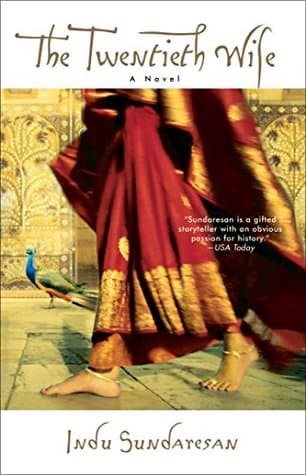
Indu Sundaresan (2002)
Genre
Historical Fiction / Romance
Reading Time
12-15 hours
Key Themes
See below
Sign in to track this book
Born a refugee, Mehrunnisa defies fate and the rigid confines of 17th-century Mughal society to pursue a forbidden love with Prince Salim, ultimately shaping an empire with her brilliance and unyielding ambition.
In 1577, Mirza Ghias Beg and his pregnant wife, Asmat Begam, flee persecution in Persia. They are robbed and left in Kandahar. Asmat gives birth to a daughter, Mehrunnisa, during a harsh winter storm. Believing the child to be a bad omen, they consider abandoning her. However, a passing merchant caravan, led by Malik, takes pity on them and offers help. Malik, impressed by Ghias Beg's intelligence, helps him get a position in Emperor Akbar's court in Fatehpur Sikri. This seemingly miraculous event connects Mehrunnisa's birth to her family's sudden good fortune, setting the stage for her remarkable life.
Growing up in Fatehpur Sikri, Mehrunnisa is a bright and beautiful child. She often watches the rich court life from afar. At eight years old, she attends the wedding celebration of the fifteen-year-old Prince Salim, the heir to the Mughal throne, to his first wife, Princess Manbai. Amidst the grandeur, Mehrunnisa sees the handsome prince. In that moment, a strong belief takes root in her heart: she will one day become Salim's wife, despite the vast social and political difference between them. This early decision foreshadows her lifelong pursuit of this goal.
As Mehrunnisa grows into a stunning young woman, her beauty and intelligence draw attention, including Prince Salim's. He has not forgotten the striking girl from his wedding. Their growing affection becomes clear, alarming Emperor Akbar. He sees Mehrunnisa as unsuitable for his son due to her family's lower status and the political issues. To prevent scandal and secure Salim's future, Akbar arranges Mehrunnisa's marriage to Ali Quli Khan Istajlu, a brave but ambitious Persian adventurer and former nobleman who has recently joined Mughal service. This forced separation is a major turning point, crushing Mehrunnisa's immediate hopes.
Mehrunnisa moves to Burdwan, Bengal, with Ali Quli. He is granted land by Emperor Akbar. Their marriage is difficult; Ali Quli is often away, fighting in military campaigns and prone to jealousy. Mehrunnisa struggles with her new life and her unfulfilled desire for Salim. Despite the unhappiness, she gives birth to a daughter, Ladli Begam. Mehrunnisa focuses on raising Ladli, finding comfort in motherhood and developing her artistic talents, including embroidery and poetry. Her resilience and intelligence continue to show even in these challenging times, as she manages household affairs skillfully.
Prince Salim, frustrated by his father's long reign and his own lack of power, rebels against Emperor Akbar. He establishes a separate court in Allahabad. This period is marked by political tension and small battles. However, after years of conflict and Akbar's declining health, Salim reconciles with his father. Upon Emperor Akbar's death in 1605, Salim takes the Mughal throne, adopting the name Jahangir, meaning 'Conqueror of the World.' His ascension sets the stage for a possible reunion with Mehrunnisa, who has remained in his thoughts.
After becoming Emperor, Jahangir, still having feelings for Mehrunnisa, plans to remove Ali Quli Khan. Jahangir appoints Qutb-ud-din Khan Koka, his foster brother, as the new governor of Bengal. He gives him a secret order to deal with Ali Quli. Ali Quli, known for his fiery temper and independent spirit, refuses to obey Qutb-ud-din's summons and shows open defiance. During a tense meeting, Ali Quli tries to kill Qutb-ud-din. Instead, imperial guards kill Ali Quli. This 'justified' assassination clears the way for Mehrunnisa's return to court and her eventual marriage to Jahangir.
After Ali Quli Khan's death, Mehrunnisa and her daughter, Ladli, are left with nothing. Emperor Jahangir, pretending compassion, summons them to Agra. They are placed under the protection of Empress Ruqaiya Begam, Emperor Akbar's first wife and Jahangir's stepmother, who lives in the imperial harem. Mehrunnisa spends four years in the harem, grieving and observing court life. During this time, she maintains a respectful distance from Jahangir. She skillfully navigates the jealousies and politics of the women's quarters while subtly making her presence felt through her intelligence and artistic talents.
Despite Mehrunnisa's position as a widow in the harem, Jahangir's desire for her remains strong. He sends her gifts, invites her to private gatherings, and makes his intentions clear. However, Mehrunnisa, scarred by her past and wary of becoming just another wife in his large harem, initially resists his advances. She holds him responsible for Ali Quli's death and is careful about trusting her heart. Her dignified refusal only increases Jahangir's determination. He is captivated not only by her beauty but also by her sharp mind, independent spirit, and the challenge she presents.
After a period of persistent courtship and mutual understanding, Mehrunnisa finally accepts Jahangir's love. She recognizes the depth of his devotion and the genuine affection he holds for her, which goes beyond physical attraction. Their shared history and the unique bond they formed in their youth resurface, leading to a deep emotional connection. In 1611, Mehrunnisa and Emperor Jahangir marry in a grand ceremony. She becomes his twentieth and final wife. This union fulfills her childhood prophecy and signals the start of her rise to power within the Mughal Empire.
Upon their marriage, Jahangir gives Mehrunnisa the title 'Nur Mahal' (Light of the Palace). He later changes it to 'Nur Jahan' (Light of the World). This title is unusual for an empress and shows her unique status and the emperor's deep love. Nur Jahan quickly proves to be more than just a beautiful wife. She has extraordinary administrative skills, political insight, and a keen understanding of government. Jahangir, deeply in love and facing declining health, increasingly gives her responsibilities. He allows her to issue imperial decrees, design architecture, and even mint coins in her name, effectively making her the actual ruler of the Mughal Empire.
Nur Jahan's rise to power is unmatched in Mughal history. She forms a powerful group with her father, Mirza Ghias Beg (now Itimad-ud-Daula), and her brother, Asaf Khan. This group effectively controls the government. She is actively involved in state affairs, holding court, receiving petitions, and influencing appointments. Her decisions affect foreign policy, trade, and even military campaigns. She sets trends in fashion and architecture, leaving a lasting mark on Mughal culture. Her intelligence and decisiveness earn her respect, but also create jealousy and resentment among some nobles and even within the royal family, especially from Prince Khurram (later Shah Jahan).
To secure her family's position and influence, Nur Jahan arranges the marriage of her daughter, Ladli Begam, to Jahangir's youngest son, Prince Shahryar. She hopes to elevate him to the throne. This move creates significant tension with Prince Khurram, another son of Jahangir, who is a powerful and ambitious figure already married to Nur Jahan's niece, Arjumand Banu Begam (later Mumtaz Mahal). Khurram sees Nur Jahan's growing power and her promotion of Shahryar as a direct threat to his own succession. This strategic marriage increases the political rivalries within the royal family, setting the stage for future conflicts over the imperial succession.
The Protagonist
Mehrunnisa transforms from a determined young girl with a dream to a powerful and influential empress who effectively governs a vast empire, demonstrating her innate leadership and political prowess.
The Love Interest / Emperor
Salim matures from a rebellious prince to an emperor who, while powerful, finds his greatest strength and solace in the love and political partnership of Mehrunnisa.
The Supporting
Ghias Beg transforms from a destitute refugee to one of the most powerful and respected nobles in the Mughal Empire, largely due to his own merit and his daughter's influence.
The Supporting
Asmat Begam maintains her nurturing and wise nature, witnessing her family's rise from poverty to immense power and providing a stable emotional core.
The Supporting / Antagonist
Ali Quli's arc is one of initial success and valor, followed by increasing defiance and ultimately, a tragic end orchestrated by the emperor.
The Supporting
Ladli's arc is defined by her role as a beloved daughter who becomes a key element in her mother's political strategy, rather than her own independent development.
The Supporting
Asaf Khan rises alongside his sister to become a powerful and influential minister, navigating the complex political landscape of the Mughal court.
The Mentioned / Supporting
Akbar's role is primarily to establish the initial conflict and the political landscape that shapes Mehrunnisa's early life and separation from Salim.
The Supporting / Antagonist
Khurram evolves from a loyal son and powerful prince to a formidable challenger to Nur Jahan's authority, driven by his ambition for the imperial throne.
The main theme is the fated love between Mehrunnisa and Salim, and their belief that destiny will bring them together. Despite forced separation, political schemes, and years apart, their mutual longing continues. Mehrunnisa's childhood decision to marry Salim guides her actions, while Salim's lasting desire for her shapes his decisions as emperor. The novel suggests that true love, even against great odds, can change history, as their eventual union leads to Mehrunnisa's rise to power. Their love is not just romantic but also a deep partnership that sustains and transforms them.
“From that moment, Mehrunnisa knew, with a certainty that settled deep in her bones, that one day she would be his wife. It was a truth as undeniable as the sun's rising.”
The novel explores ambition, especially through Mehrunnisa's journey. Born into poverty, her ambition drives her to seek survival, security, and ultimately, influence. She navigates the complex and dangerous world of the Mughal court with sharp intelligence, transforming from a refugee's daughter to the most powerful woman in the empire. The theme also examines the corrupting or empowering effects of power, as Mehrunnisa's rise creates allies and enemies, and her decisions shape the future of the empire. Her ambition is not just for personal gain, but also for her family's advancement and protection.
“She had learned early that survival was not enough; one had to have influence, a voice that carried weight, a hand that could shape destiny.”
Mehrunnisa's story is a strong look at a woman's ability to act within the male-dominated Mughal society. Despite the limits placed on women, especially those behind the veil, Mehrunnisa defies expectations. She uses her intelligence, beauty, and strategic mind not only to survive but to thrive and eventually rule. The novel shows how she uses her position as empress to exert political influence, issue decrees, and manage state affairs, challenging traditional gender roles. Her journey shows the extraordinary strength and resourcefulness needed for a woman to hold such power in a male-dominated world.
“The veil could hide a woman's face, but it could not hide her mind, nor the power of her will.”
The story constantly explores the tension between predetermined fate and individual choice. Mehrunnisa's birth during a storm and her family's subsequent change in fortune suggest a destined path. Her childhood prophecy of marrying Salim reinforces this idea of an unalterable future. However, her journey also includes times when her intelligence, resilience, and strategic decisions actively shape her circumstances. The novel questions whether she is simply fulfilling a prophecy or actively creating her own destiny through sheer will, suggesting a complex interaction where fate sets the stage, but free will dictates the performance.
“Was it fate that had brought them together, or the relentless will of a girl who dared to dream beyond her station?”
Family relationships are a key part of the political drama. Mehrunnisa's deep loyalty to her parents and brother, Mirza Ghias Beg and Asaf Khan, is a constant motivator. She uses her power to elevate them, forming a powerful group that governs the empire. Conversely, the theme also explores betrayal, especially within the royal family, as princes compete for succession and form alliances that can become treacherous. The arranged marriage of Ladli Begam to Prince Shahryar, and Asaf Khan's subtle alignment with Prince Khurram, highlight the complex and often self-serving nature of family alliances in the pursuit of power.
“For family, one would move mountains; for family, one would make enemies of kings.”
Mehrunnisa's childhood resolution to marry Prince Salim, and her birth coinciding with a reversal of fortune.
From a young age, Mehrunnisa's powerful conviction that she will marry Prince Salim serves as a guiding prophecy throughout the novel. This foreboding creates a sense of destiny, assuring the reader of their eventual union despite the numerous obstacles. Her birth, coinciding with her family's miraculous escape from destitution, also acts as an early sign of her extraordinary fate. This device builds anticipation and frames the narrative as a journey towards an inevitable, albeit hard-won, fulfillment.
The enduring love between Mehrunnisa and Salim, contrasted with her forced marriage to Ali Quli Khan.
While not a traditional love triangle in terms of active choice, the narrative is driven by the implied love triangle between Mehrunnisa, Salim, and Ali Quli Khan. Mehrunnisa's heart belongs to Salim, even during her marriage to Ali Quli. This tension fuels much of the early plot, highlighting the societal constraints on her desires. Ali Quli's presence serves as a constant barrier to the fated lovers, making his eventual removal a pivotal moment that clears the path for Mehrunnisa and Salim's long-awaited union.
The strategic maneuvering, alliances, and betrayals within the Mughal court.
The intricate web of political intrigue within the Mughal court is a constant backdrop and driving force in the novel. From Emperor Akbar's decision to marry Mehrunnisa off to Ali Quli, to Jahangir's orchestration of Ali Quli's death, and Nur Jahan's own strategic alliances and manipulations, the story is rife with machinations. This device creates suspense, reveals character motivations, and demonstrates the high stakes involved in gaining and maintaining power in the empire, especially for a woman like Mehrunnisa.
The women's quarters as a place of both confinement and strategic influence.
The imperial harem, traditionally seen as a place of confinement for women, is depicted as a complex political arena. When Mehrunnisa enters the harem after Ali Quli's death, she doesn't merely languish; she observes, learns, and subtly begins to assert her presence. This device highlights how women, even within seemingly restrictive environments, can wield significant power through alliances, information gathering, and influencing the emperor. It showcases Mehrunnisa's intelligence and adaptability, allowing her to transform a traditional constraint into a springboard for her political ascent.
“It was not enough to be beautiful; she wanted to be remembered.”
— Jagat is a young woman, contemplating her future and desires beyond mere appearance.
“A woman's beauty, like a flower, bloomed and faded. But her mind, that was a garden that could be cultivated forever.”
— Jagat reflects on the transient nature of physical beauty versus the enduring power of intellect.
“Power was a many-headed beast. It could be given, taken, or seized. But it always demanded a price.”
— Jagat observes the intricate dance of power within the Mughal court.
“Love was not a gentle whisper but a roaring fire that consumed everything in its path.”
— Jagat experiences the intensity of her feelings, particularly for Salim.
“The greatest prison was not made of stone and iron, but of expectations and duty.”
— Jagat feels constrained by societal and familial obligations, despite her inner strength.
“To be a woman in the Mughal court was to be a pawn and a queen, often at the same time.”
— Jagat recognizes the dual nature of female existence within the patriarchal court system.
“Sometimes, the strongest sword was a sharp mind, not a sharp blade.”
— Jagat often relies on her intelligence and wit to navigate dangerous situations.
“A woman's silence could be more eloquent than a man's loudest pronouncement.”
— Jagat uses her silence and observation as tools of influence and understanding.
“Fate was a weaver, and humans were but threads in her grand design.”
— Jagat often reflects on the role of destiny in her life and the lives of those around her.
“The heart, like a garden, needed constant tending, or weeds would choke the flowers.”
— Jagat considers the effort required to maintain love and emotional well-being.
“Even in a golden cage, a bird still yearned for the sky.”
— Jagat, despite her lavish surroundings, yearns for a different kind of freedom and fulfillment.
“History was written by the victors, but the whispers of the vanquished could still echo through time.”
— Jagat is aware of the subjective nature of historical narratives and the untold stories.
“To truly know a person, one must watch not what they say, but what they do when no one is watching.”
— Jagat is a keen observer of human nature and motivations within the court.
“Every choice, no matter how small, was a ripple in the vast ocean of time.”
— Jagat often considers the long-term consequences of her decisions and those of others.
Ready to see how well you understood this book? Take our interactive quiz with 10 questions.







