“A lie can run around the world before the truth has got its boots on.”
— A general observation on the speed of misinformation versus truth.

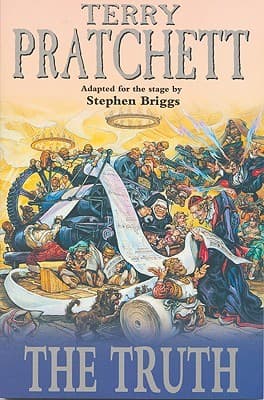
Terry Pratchett (1995)
Genre
Fantasy / Children's / Mystery / Science Fiction / Young Adult
Reading Time
336 min
Key Themes
See below
Sign in to track this book
When a naive young man accidentally invents the printing press and investigative journalism in the chaotic city of Ankh-Morpork, he inadvertently uncovers a royal conspiracy that threatens to ink out the city's very ruler.
William de Worde, a well-born but disinherited young man, comes into possession of a printing press brought to Ankh-Morpork by dwarves. Initially intending to publish a newsletter for the city's gentry, William's venture, 'The Ankh-Morpork Times,' quickly grows. With the help of the energetic vampire photographer Otto Chriek and a cynical dwarf typesetter, Gunilla, William starts reporting on mundane city events. His commitment to factual reporting soon brings him to the attention of more significant, and dangerous, happenings. The initial issues feature trivial news, but the potential for a new kind of information dissemination is clear, setting the stage for radical changes in the city.
Lord Vetinari, the Patrician of Ankh-Morpork, is found in his office next to the body of his secretary, Mr. Boggis, with a smoking crossbow nearby. The evidence is overwhelmingly against him, leading to his immediate arrest and imprisonment in the deepest cells of the city. The city watches in disbelief as the seemingly unshakeable ruler is removed from power. This sudden vacuum of authority creates unease and opportunity, while the official narrative of Vetinari's guilt is quickly established by the city watch, manipulated by unseen forces. The 'Ankh-Morpork Times' reports on the events, initially accepting the official story.
As William and his team continue to publish, they notice inconsistencies in the official story surrounding Vetinari's arrest. A mysterious, charismatic figure named Wolfgang von Uberwald emerges, initially presenting himself as a concerned citizen, but quickly gaining influence. He begins to manipulate public opinion through the newspaper, subtly twisting facts and promoting a narrative that aligns with his agenda. William, though initially charmed, grows suspicious of Wolfgang's motives and his uncanny ability to be at the center of developing events. This marks William's transition from passive reporter to active investigator, as he starts to question the official version of events.
William discovers 'The Truth,' a secret society led by Wolfgang von Uberwald, comprising several influential guild leaders and city figures. Their goal is to overthrow Vetinari and install a more pliable Patrician, and they are using William's newspaper as an unwitting tool to spread their propaganda. Their symbol is a Golden Sword. William learns that 'The Truth' orchestrated the assassination attempt on Vetinari and the framing of him, using a sophisticated double-cross involving lookalikes and carefully planted evidence. The society believes they are acting for the greater good, bringing 'truth' to the city by controlling information.
The criminal duo, Mr. Pin and Mr. Tulip, are introduced as the muscle behind 'The Truth.' They are ruthless, efficient, and surprisingly philosophical in their brutal methods. They are responsible for the assassination of Mr. Boggis and subsequent attempts on Vetinari's life and other key figures. Their distinctive dialogue and casual violence make them memorable and terrifying enforcers. William encounters them indirectly through their actions and later directly, realizing the extent of their involvement and the danger they pose to anyone who uncovers the conspiracy. Their presence highlights the brutal reality behind the seemingly sophisticated plot.
Sacharissa Cripslock, William's sharp and determined society reporter, begins to investigate the details surrounding Vetinari's arrest, specifically focusing on the witnesses and inconsistencies in their testimonies. Her keen observations and persistent questioning lead her to uncover crucial information about the conspiracy. As she closes in on the truth, she is abducted by Mr. Pin and Mr. Tulip, who imprison her in the ancient, forgotten tunnels beneath the city. Her disappearance serves as a stark warning to William about the dangers of his pursuit of the truth, solidifying his resolve to expose the conspirators.
Using his cunning, Lord Vetinari orchestrates his own escape from the deepest dungeon, revealing that his imprisonment was a calculated move to observe his enemies. He joins forces with William and the Watch, who are also closing in on 'The Truth.' The climax takes place at the Ankh-Morpork Mint, where the conspirators plan to officially install their puppet Patrician. A chaotic battle ensues, involving Vetinari's surprising combat skills, the Watch, William, and the printing press itself, which is repurposed as a weapon. During the fray, the truth about the conspiracy is dramatically revealed to the public.
During the chaos at the Mint, William directly confronts Wolfgang von Uberwald. William exposes Wolfgang's methods of manipulation, his use of carefully constructed lies, and his ultimate goal of controlling the city through manufactured 'truth.' Wolfgang, unmasked as a charismatic but ruthless leader, attempts to justify his actions as necessary for the city's future. However, his sophisticated rhetoric crumbles under the weight of the actual facts brought forth by William and Vetinari. The confrontation highlights the central theme of the book: the battle between genuine truth and manufactured reality.
Mr. Pin and Mr. Tulip, the brutal enforcers, are defeated during the climactic confrontation. Mr. Pin is crushed by the very printing press he tried to destroy, a symbolic end for a man who tried to silence the truth. Mr. Tulip, in a darkly comedic turn, is accidentally impaled by a unicorn horn, which he had previously dismissed as a mere 'stick.' Their deaths are a result of their violent lives and the chaotic nature of their involvement in the conspiracy. Their demise ensures the conspirators lose their most effective muscle, clearing the path for justice.
With 'The Truth' exposed and its leaders apprehended, Lord Vetinari is fully restored to his position as Patrician. He acknowledges the role William and the 'Ankh-Morpork Times' played in uncovering the conspiracy. The newspaper, initially a novelty, has now proven its power as a disseminator of information and a check on power. William, now a seasoned investigative journalist, understands the responsibility that comes with his profession. The city, though shaken, begins to recover, and the 'Ankh-Morpork Times' is a new, formidable institution, forever changing information on the Discworld.
In the aftermath, the city grapples with the implications of the conspiracy and the newfound power of the press. William, Sacharissa, Otto, and the rest of the 'Ankh-Morpork Times' staff continue their work, now with a deeper understanding of their influence. They face new challenges, including the public's demand for news, the ethical dilemmas of sensationalism versus factual reporting, and the constant threat of those who would seek to manipulate the truth. William realizes that journalism is not just about reporting facts, but about shaping public discourse and holding power accountable, a never-ending battle for genuine truth.
The Protagonist
Transforms from a sheltered, disinherited noble into the pioneering and morally resolute founder of investigative journalism on the Discworld.
The Supporting/Deuteragonist
Demonstrates his unparalleled cunning by allowing himself to be framed and imprisoned to expose a conspiracy, ultimately reasserting his control.
The Supporting
Evolves from a society reporter to a brave and insightful investigative journalist, proving her mettle under pressure.
The Supporting
Remains largely consistent, providing comic relief and technical expertise while struggling with his vampiric nature.
The Antagonist
Remains a consistently menacing and philosophical villain, ultimately meeting a violent end at the hands of the printing press he sought to destroy.
The Antagonist
Remains a consistently violent and simple-minded enforcer, ultimately meeting a darkly comedic end.
The Antagonist
Revealed as the mastermind behind the conspiracy, his carefully constructed 'truth' is ultimately exposed and dismantled.
The Supporting
Maintains her cynical and pragmatic outlook, but her dedication to the newspaper and its mission quietly grows.
The novel explores the power of the printed word and the field of journalism. William de Worde's 'Ankh-Morpork Times' quickly shows its ability to shape public opinion, expose corruption, and hold power accountable. However, it also highlights the dangers of this power, showing how 'The Truth' attempts to manipulate the newspaper for its own agenda. The theme emphasizes that with the ability to inform comes the responsibility to verify facts, resist sensationalism, and pursue genuine truth, as seen when William realizes the implications of reporting on Vetinari's 'guilt' versus actively investigating it.
“A lie can run around the world before the truth has got its boots on.”
A central conflict of the story is the battle between objective truth and a 'truth' that is created and disseminated for political gain. Wolfgang von Uberwald and 'The Truth' society believe they are bringing a better 'truth' to Ankh-Morpork by controlling information and manipulating narratives. This contrasts sharply with William's early journalistic ethics, which strive for factual accuracy, even if inconvenient. The novel illustrates how easily public perception can be swayed by carefully crafted lies and how difficult it is to uncover and present the unvarnished facts, particularly in a world unused to critical media.
“A newspaper is a device for making the ignorant more ignorant and the crazy crazier.”
The book explores different forms of power and how a city is governed. Lord Vetinari represents a cynical but effective form of benevolent dictatorship, maintaining order through strategic manipulation and a deep understanding of human nature. In contrast, 'The Truth' seeks to seize power through brute force, misinformation, and the installation of a puppet ruler. The narrative questions what constitutes legitimate authority and how a society functions when its leadership is challenged or undermined. Vetinari's calculated response to his own framing highlights his unique approach to maintaining control.
“Chaos is not a pit. Chaos is a ladder.”
The introduction of the printing press and modern journalism represents a significant technological and social advancement on the Discworld. This progress is met with both excitement and resistance. Many traditionalists and those in power are wary of the new medium, fearing its disruptive potential. The older guilds and established authorities struggle to adapt to a world where information can be disseminated quickly and widely. The dwarves' initial reluctance to share their printing secrets, and the conspirators' attempts to control the press, demonstrate the tension between innovation and the desire to maintain the status quo.
“The world was changing. And William de Worde, for the first time in his life, felt he was changing with it.”
Language and the construction of narratives are crucial elements. William's initial struggles with how to write 'news' and the impact of headline choices highlight the power of words. Mr. Pin's philosophical pronouncements and Mr. Tulip's repetitive phrases show how language can be used to justify violence or to simply obscure meaning. Wolfgang von Uberwald's ability to craft a compelling, albeit false, narrative is central to his scheme. The book constantly reminds the reader that the way a story is told can be just as important, if not more so, than the facts themselves, influencing perception and belief.
“The truth isn't just a thing, it's a process. You have to work for it.”
A magical, dwarven invention that revolutionizes communication and information on the Discworld.
The printing press is the central catalyst for the entire plot. It represents technological advancement and the birth of mass media. Its arrival in Ankh-Morpork, facilitated by the dwarves, is what allows William de Worde to create 'The Ankh-Morpork Times.' The press is not merely a tool; it symbolizes the power of information and the ability to disseminate it widely, fundamentally altering how news and ideas spread. Its very existence challenges established power structures and forces the city to confront the implications of a newly informed (or misinformed) populace. It becomes both a weapon and a symbol of truth.
A complex deception involving two identical individuals to frame Lord Vetinari.
This device is crucial to the conspiracy's success in framing Lord Vetinari. 'The Truth' employs two identical individuals (or magically altered ones) to create a convincing, yet false, narrative of Vetinari's guilt. One lookalike is used to appear as Vetinari murdering his secretary, while the real Vetinari is apprehended. This elaborate deception highlights the conspirators' cunning and their willingness to go to extreme lengths to achieve their goals. It also serves as a classic mystery trope that William must unravel, forcing him to look beyond surface appearances and question what he sees.
Magical, instant photographs that provide visual evidence and add a new dimension to reporting.
Otto Chriek's 'iconographs' are the Discworld's equivalent of photographs, created by a flash of light that captures an image. These images are vital to the 'Ankh-Morpork Times,' providing visual proof and adding an unprecedented level of immediacy and realism to the news. While initially used for mundane subjects, the iconographs quickly become crucial pieces of evidence in William's investigation, capturing details that words alone might miss. They represent the power of visual media to influence perception and provide undeniable (or seemingly undeniable) proof, though the book also subtly hints at their potential for manipulation.
The symbolic emblem of 'The Truth' society, representing their fabricated ideals.
The Golden Sword serves as the primary symbol for the secret society, 'The Truth.' It is a physical manifestation of their ideology – a shiny, impressive facade that conceals a corrupt and manipulative core. The sword is a traditional symbol of justice and authority, but in the hands of Wolfgang and his conspirators, it becomes a symbol of manufactured truth and illicit power. Its visual presence in their secret meetings and its implied authority over their members reinforce their self-proclaimed righteousness, even as their actions betray their noble claims. It's a powerful ironic symbol.
“A lie can run around the world before the truth has got its boots on.”
— A general observation on the speed of misinformation versus truth.
“The truth isn't out there. It's in here. It's in you. It's in your head. It's in your heart.”
— William de Worde reflecting on the subjective nature of truth.
“People don't want the truth, they want the story.”
— A cynical view on public interest in news.
“There are some things that cannot be told by words alone.”
— Discussing the limitations of language and journalism.
“Journalism is just a gun. It's only as good as the man behind the trigger.”
— Mr. Pin's cynical view on the power and ethics of journalism.
“The press is like a hydra. You cut off one head, two more grow in its place.”
— Lord Vetinari's observation on the unstoppable nature of the burgeoning press.
“It was a truth universally acknowledged that a man in possession of a good fortune must be in want of a newspaper.”
— A playful nod to Jane Austen, applied to the new desire for news.
“The truth was a weapon, and like all weapons, it needed to be handled with care.”
— William realizing the potential impact and danger of reporting truth.
“You can't print 'the truth' because 'the truth' is what people *want* to believe.”
— A discussion on the subjective nature of truth in the context of public perception.
“History is written by the winners, but the truth is written by the press.”
— A commentary on the shifting power of narrative control.
“A good story is always more important than a fact.”
— Mr. Pin's philosophy on what makes news successful, regardless of veracity.
“The problem with the truth is that it's often inconvenient.”
— A general reflection on why truth is often avoided or suppressed.
“Every time you tell a lie, you kill a little bit of the truth.”
— A moralistic statement on the corrosive effect of dishonesty.
“The world was full of stories, and all of them were true, in their own way.”
— William musing on the multiplicity of perspectives and narratives.
Ready to see how well you understood this book? Take our interactive quiz with 10 questions.
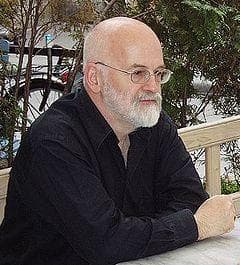
Sir Terence David John Pratchett was an English humorist, satirist, and author of fantasy novels, especially comical works. He is best known for his Discworld series of 41 novels.







