“I don't know how this whole Big Bad Wolf thing got started, but it's all wrong.”
— The wolf introduces his side of the story, challenging the traditional fairy tale.

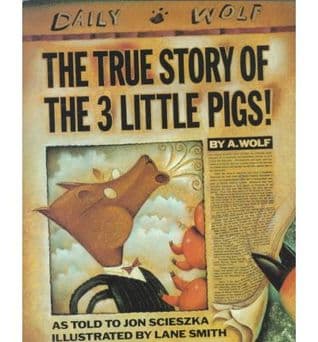
Jon Scieszka (1992)
Genre
Fantasy / Children's
Reading Time
5 min
Key Themes
See below
Sign in to track this book
Finally, the Big Bad Wolf gets to tell his side of the story, revealing a snotty sneeze, a sugar craving, and a serious misunderstanding with three porcine architects.
The story begins with Alexander T. Wolf, or Al, introducing himself as a mild-mannered wolf who has been framed by the media. He claims the entire story of 'The Three Little Pigs' is made up, insisting he was simply in the wrong place at the wrong time, suffering from a bad cold. He wants to set the record straight, stating that the true story is about a sneeze and a sugar craving, not a mean attack. Al says he is not the big, bad wolf everyone believes him to be, and that his reputation has been unfairly hurt.
Al explains that on the day of the incident, he was baking a cake for his granny and had run out of sugar. He decided to ask his neighbor, the first little pig, for a cup of sugar. When he arrived at the pig's straw house, he had a terrible sneeze because of his cold. The sneeze was so powerful it blew the straw house down, killing the pig inside. Al, seeing a perfectly good meal go to waste, decided to eat the pig, thinking it would be rude to leave a dead pig lying around.
Still needing sugar, Al continued to the house of the second little pig, which was made of sticks. He knocked on the door, but the pig inside was rude and would not answer. Al's cold caused another mighty sneeze, which, to his surprise, blew down the stick house. The second little pig also died in the collapse. Again, Al felt it would be a shame to waste a good meal, so he ate the second pig. He says he never meant for the houses to fall or for the pigs to die; it was merely a series of unfortunate accidents combined with his severe cold.
Desperate for sugar, Al arrived at the third little pig's brick house. He explained his problem and asked for sugar, but this pig was even ruder, shouting insults from inside. Al, feeling a sneeze coming, warned the pig, but the pig continued to tease him. The sneeze came, and though it was mighty, the brick house stood firm. However, the police and reporters arrived immediately after the sneeze, having heard the noise. They found Al huffing and puffing, trying to get into the house, and the rest, as Al claims, is history, distorted by the media.
Al recounts how the media instantly sensationalized the story, portraying him as the 'Big Bad Wolf' who deliberately blew down houses and ate pigs. He complains that no one listened to his side of the story or considered his bad cold and his simple need for a cup of sugar. The reporters focused on the huffing and puffing, ignoring the sneezes and the accidental nature of the events. This media frenzy led to his arrest and the widespread belief in the traditional, villainous tale of the Three Little Pigs, which Al strongly denies.
The Protagonist/Narrator
Al attempts to transform from the universally recognized 'Big Bad Wolf' into a misunderstood, innocent individual, but ultimately fails to convince his audience.
The Supporting/Victim
His story arc is brief, serving as the initial catalyst for Al's perceived villainy.
The Supporting/Victim
His death further solidifies Al's reputation as the 'Big Bad Wolf' in the traditional narrative.
The Supporting/Antagonist
He serves as the catalyst for Al's public condemnation, representing the version of events that becomes widely accepted.
The Mentioned
Her role is static, serving as a plot device to establish Al's initial innocent intent.
The Supporting/Antagonists
They are instrumental in creating the 'Big Bad Wolf' narrative, thus shaping public perception.
The entire book is a re-telling of a classic fairy tale from the antagonist's perspective. Al's narrative challenges the reader to consider that there are always two sides to a story. By hearing Al's version, the reader is prompted to question established truths and acknowledge how a change in perspective can completely alter understanding. The familiar story is turned on its head, showing the subjectivity of truth and the power of narrative control.
“"But I'll let you in on a little secret. Nobody knows the real story, because nobody ever heard my side of the story."”
Al frequently blames the media for his troubles, claiming they sensationalized events and twisted his story to create a more exciting, villainous narrative. He argues that the reporters only focused on the 'huffing and puffing' and ignored his cold and his genuine need for sugar. This theme explores how information can be manipulated and how public perception is shaped by what is reported, often without a full understanding of the facts. It critiques the tendency to create dramatic narratives over factual accuracy.
“"The rest, as they say, is history. They railroaded me. The newspapers blew up the whole thing."”
The book challenges the simple portrayal of good and evil found in traditional fairy tales. Al, the supposed 'Big Bad Wolf,' presents himself as a victim of bad luck, a polite individual with a bad cold and a sugar craving. He argues his actions were accidental and practical (eating the dead pigs). This forces the reader to consider whether Al is truly evil or simply misunderstood, blurring the lines between hero and villain and suggesting that 'evil' might sometimes be a matter of perspective or unfortunate events.
“"I'm a pretty calm fellow myself. And I certainly wouldn't hurt a fly."”
A central argument in Al's defense is that his actions were entirely accidental. He attributes the collapse of the pigs' houses to his severe sneezes, not intentional huffing and puffing. He also claims he only ate the pigs because they were already dead, and it would be wasteful not to. This theme explores the difference between unintended consequences and deliberate malice, suggesting that the perception of guilt often depends on whether actions are seen as purposeful or merely unfortunate occurrences.
“"And the next thing you knew, the whole darn straw house fell down. And right in the middle of the pile of straw was the first little pig – dead as a doornail."”
The story is told entirely from the perspective of the wolf, whose version of events contradicts the established fairy tale.
Alexander T. Wolf serves as an unreliable narrator. He presents a detailed, seemingly logical account of events, but his self-serving justifications (e.g., eating the pigs because it would be a 'shame to let a good pig go to waste') and his continuous blaming of his cold and the media make his innocence questionable. The reader is left to decide whether to believe his version or the traditional story, highlighting the subjective nature of truth when filtered through a biased lens.
A classic fairy tale is retold with a significant twist in perspective and plot.
This book is a prime example of a fractured fairy tale. It takes the well-known story of 'The Three Little Pigs' and deliberately alters its core narrative by shifting the point of view to the supposed villain. This subverts reader expectations and encourages critical thinking about familiar stories. By challenging the original, it invites readers to question the simplistic moral lessons often found in traditional tales and explore more nuanced interpretations of characters and events.
Dramatic and situational irony are used to create humor and highlight the wolf's self-deception.
Irony is prevalent throughout the narrative. Situational irony arises from Al's earnest attempts to portray himself as a victim, despite his actions resulting in the death and consumption of two pigs. Dramatic irony is present as the reader, familiar with the original story, knows the 'truth' even as Al tries to convince them otherwise. This creates humor, as Al's justifications often sound absurd in light of the traditional tale, underscoring the gap between his self-perception and his public image.
Animals are given human characteristics and abilities, enabling the narrative.
The story relies on anthropomorphism, depicting pigs who build houses and a wolf who bakes cakes, wears glasses, and speaks eloquently. This device is fundamental to the fairy tale genre and allows for the complex narrative and character motivations to be explored. By attributing human traits to animals, the book can explore themes like justice, perspective, and media bias in an accessible and engaging way for young readers, while still retaining the charm of a fable.
“I don't know how this whole Big Bad Wolf thing got started, but it's all wrong.”
— The wolf introduces his side of the story, challenging the traditional fairy tale.
“It seemed like a shame to leave a perfectly good ham dinner lying there in the straw.”
— The wolf explains why he ate the first pig after the pig's house collapsed.
“I was feeling a little better. But I still didn't have my cup of sugar.”
— The wolf continues his quest after the first incident, showing his persistence.
“The guy was a little rude, but I'm a wolf. I'm not a monster.”
— The wolf defends his actions after the second pig's house falls.
“So I huffed and I snuffed and I sneezed a great sneeze.”
— The wolf describes how he accidentally blew down the houses due to a cold.
“And you know what? That whole 'huff and puff' thing? That was just a bad cold.”
— The wolf clarifies the misunderstanding about his intentions.
“The real story is about a sneeze and a cup of sugar.”
— The wolf summarizes his version of events, emphasizing simplicity.
“I was framed!”
— The wolf claims innocence in the traditional narrative's portrayal.
“But the pigs' houses were so shoddy, they fell down with one little sneeze.”
— The wolf criticizes the pigs' construction skills to shift blame.
“Maybe you should think twice before you believe everything you read.”
— The wolf advises the reader to question traditional stories.
“I was just trying to borrow a cup of sugar for my dear old granny's birthday cake.”
— The wolf explains his original, innocent motive for visiting the pigs.
“And that's the true story. At least, as true as I can remember.”
— The wolf concludes his tale, acknowledging potential bias.
“The pigs made up that 'Big Bad Wolf' stuff to cover up their own bad building.”
— The wolf suggests the pigs fabricated the story to avoid embarrassment.
“It's not easy being a wolf. Everyone thinks you're up to no good.”
— The wolf reflects on the stereotypes and prejudices he faces.
Ready to see how well you understood this book? Take our interactive quiz with 10 questions.
Biography coming soon.







