“The island was a living, breathing thing, and it was hungry.”
— An early description of the island's oppressive atmosphere.

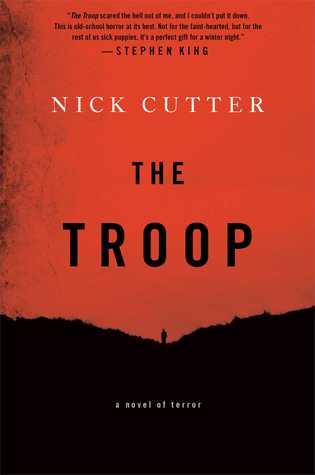
Nick Cutter (2014)
Genre
Thriller / Mystery / Science Fiction
Reading Time
7-8 hours
Key Themes
See below
Sign in to track this book
A scout troop's camping trip turns into a nightmare when an infected stranger unleashes a fast-spreading horror, forcing the boys to fight a parasite, the wilderness, and their own fracturing humanity.
Scoutmaster Tim Riggs leads his five-boy troop (Kent, Max, Ephraim, Shelley, and Newton) to Falstaff Island, a remote, uninhabited island off Prince Edward Island, for their annual three-day camping trip. The boys have different personalities: Kent, the athletic leader; Max, quiet and thoughtful; Ephraim, sensitive and asthmatic; Shelley, the aggressive bully; and Newton, the science-focused introvert. They set up camp, and Tim, a former medical student, checks everything, stressing safety, unaware of the horror that awaits them.
On their first night, a gaunt, skeletal man, shockingly thin and confused, stumbles into their camp. He is clearly ill, suffering from extreme hunger and an unknown sickness. Tim, concerned, tries to help him, offering food and water. However, the man's hunger is unending, and he eats food ravenously, even a live turtle. The boys are disturbed by his look and behavior, especially his unusual sores and his animal-like eating, which suggests something beyond normal illness.
The stranger, who calls himself Frank, quickly gets worse. His body visibly changes, with grotesque worms coming out of his skin. Tim, seeing how serious and contagious the situation is, tries to quarantine Frank in a tent, using his medical knowledge to understand the threat. The boys are terrified, and the reality of their isolation on Falstaff Island becomes clear. This incident starts their horrifying exposure to the bioengineered parasite, later called 'Trojan'.
Panicked by Frank's worsening condition and the lack of communication, Kent, the strongest boy, tries to hike to the island's highest point for a cell signal. On his way, he finds the stranger's abandoned boat and a cooler with vials of the 'Trojan' pathogen, confirming the man carried a biological weapon. On his way back, he meets a now monstrous Frank, who attacks him. Kent escapes, but Frank later dies, his body bursting with worms, leaving a terrifying mess for the boys to find.
Newton, the curious and smart boy, secretly dissects Frank's remains, exposing himself to the parasite. He soon shows symptoms, developing an unending hunger and clear physical decline. The boys, now aware of the contagion, must face the horrifying fact that one of their own is infected. Tim struggles to keep control and protect the uninfected, while the boys' trust in each other begins to break under the immense pressure and fear of the spreading pathogen.
Realizing their problem, Tim leads the boys to search the island for any way to escape or communicate. They find an old, rundown lighthouse, hoping for a radio. Inside, they find more evidence of Frank's presence and the pathogen's origin, including a scientific journal detailing the 'Trojan' project. This discovery confirms they are dealing with a deliberate biological weapon, not just a random illness, increasing their fear and helplessness.
Shelley, already a bully, gives in to paranoia and fear, believing Newton is a threat and that others might be infected. He becomes increasingly violent and unreasonable, attacking Newton and challenging Tim's authority. His actions break the group apart, turning them against each other. This internal conflict, fueled by the external threat, shows how extreme situations can destroy human morality and cooperation.
As the situation gets worse, and with Newton's infection progressing fast, Ephraim, the asthmatic and physically weakest boy, makes a sacrifice. He lures the monstrous Newton away from the others, giving them a chance to escape. His selfless act, despite his physical limits, shows courage amid the horror, though it comes at a terrible personal cost.
Tim, Kent, and Max are the only uninfected survivors. They face a horrifying fight with the fully transformed Newton and later, Shelley, who is also infected and monstrous. The boys must kill their former friends to survive. With the island now a biological hazard, they desperately try to fix Frank's boat, their only hope of escaping Falstaff Island and the spreading contagion before they too get sick.
Tim and Max, the sole survivors, get Frank's boat working and are rescued by the Coast Guard. They are immediately quarantined and questioned by government agents, who reveal the 'Trojan' parasite is a highly classified bioweapon. The agents cover up the incident, calling it a tragic camping accident. Both Tim and Max are left with severe psychological trauma, haunted by what they saw and the friends they lost, forever changed by their experience on Falstaff Island.
The Protagonist
Tim transforms from a confident leader to a traumatized survivor, forced to make impossible choices and witness unspeakable horrors, losing his innocence and faith in order.
The Supporting
Kent's initial confidence gives way to desperation and fear, culminating in his tragic death while trying to protect his friends.
The Protagonist
Max endures unimaginable trauma, witnessing the corruption and loss of his friends, emerging as one of the two survivors, forever scarred.
The Supporting
Ephraim, initially fearful and vulnerable, finds immense courage, sacrificing himself to save his friends.
The Antagonist
Shelley's inherent cruelty and aggression are exacerbated by fear and infection, transforming him into a monstrous antagonist.
The Supporting
Newton's scientific curiosity leads to his infection and transformation, illustrating the dangers of unchecked intellectual pursuit.
The Mentioned
Frank's journey is one of rapid physical decay and monstrous transformation, serving as the initial warning and source of the contagion.
The Mentioned
Not a personal arc, but his scientific creation's impact is the driving force of the plot.
The isolated Falstaff Island, along with the 'Trojan' parasite, quickly removes the veneer of civilization. The boys, at first bound by scout's honor and Tim's authority, fall into paranoia, violence, and self-preservation. Shelley's bullying becomes outright aggression, and even Kent, the natural leader, struggles with moral compromises. This theme is clear when the boys must kill their infected friends, showing how quickly social norms break down under extreme threat.
“What happens when the rules don't apply anymore? When the only thing that matters is staying alive, no matter the cost?”
The book details the psychological impact of the ordeal on the young scouts. What starts as a normal camping trip quickly becomes a nightmarish fight for survival, forcing the boys to face death, make impossible choices, and witness horrors. Max, especially, shows this theme, losing his innocence and leaving the island a deeply traumatized survivor. The boys lose their childhood, replaced by the grim realities of violence and loss, as seen in their forced acts of self-defense against their changed friends.
“They were just boys, but the island had made them something else, something harder and colder.”
Fear is a strong force in 'The Troop,' appearing as both a reasonable response to a deadly threat and a corrupting influence. The fear of infection, isolation, and death drives many characters' actions, both heroic and terrible. It fuels Shelley's paranoia and aggression, turning him against his friends, and it pushes the uninfected boys to make desperate, violent choices. The story explores how fear can strip away humanity, reducing individuals to their most basic instincts, making them as dangerous to each other as the external threat.
“Fear was a virus, too. It spread just as fast, and it consumed just as completely.”
The 'Trojan' parasite is a bioengineered weapon, a result of secret scientific experiments. Dr. Arnie Neudorf's notes detail its design and potential as a bioweapon. This theme highlights the ethical dangers of unchecked scientific ambition and the catastrophic results that can happen when knowledge is used without enough moral oversight. The island becomes a contained experiment gone wrong, showing the destructive potential of such creations when they escape human control.
“They had engineered hunger, perfected it, and set it loose.”
A main conflict for the characters is the constant tension between their desire to survive and their moral compass. Tim, as the adult, struggles to keep order and protect the boys while dealing with the horrible need for extreme measures. The boys must make decisions that go against their previous moral codes, such as abandoning or even killing their infected friends. This theme explores the hard choices individuals make when their lives are at stake, and how far they will go to ensure their own survival, often at the cost of their humanity.
“There were no good choices left, only less terrible ones.”
A remote island trapping the characters with the threat.
Falstaff Island serves as a crucial plot device, creating a sense of inescapable dread and amplifying the horror. Its remoteness ensures that help cannot easily reach the troop, forcing them to confront the escalating threat entirely on their own. This isolation also prevents the contagion from spreading to the mainland, effectively making the island a contained biological horror experiment. The lack of communication and escape routes intensifies the psychological pressure on the characters, highlighting their vulnerability.
A bioengineered organism designed to consume and replicate.
The 'Trojan' parasite is the central antagonist and the driving force of the plot. It is not merely a disease but a sophisticated bioengineered organism designed to induce insatiable hunger and rapid physical deterioration, transforming its hosts into monstrous, worm-filled entities. Its rapid spread and grotesque symptoms create constant tension and body horror. The parasite's origins as a bioweapon add a layer of scientific horror and political intrigue, making the threat both biological and man-made.
Non-linear narrative elements providing context and foreshadowing.
The narrative is interspersed with 'evidence' such as government documents, scientific journal entries, and interview transcripts from the aftermath. These non-linear elements serve multiple purposes: they gradually reveal the origin and nature of the 'Trojan' parasite, provide chilling foreshadowing of the horrors to come, and offer a detached, clinical perspective on the unfolding tragedy. This device builds suspense, deepens the mystery, and grounds the fantastical horror in a veneer of scientific realism.
Visceral depictions of physical transformation and decay.
Body horror is a primary plot device, used to create intense visceral disgust and fear. The descriptions of Frank's and later Newton's and Shelley's physical deterioration, the worms emerging from their skin, and their insatiable hunger are meticulously detailed. This device emphasizes the grotesque, unnatural nature of the 'Trojan' parasite and the complete loss of humanity suffered by the infected, making the transformations profoundly disturbing and terrifying for both the characters and the reader.
“The island was a living, breathing thing, and it was hungry.”
— An early description of the island's oppressive atmosphere.
“Fear was a virus, and it had found a host in each of them.”
— As the boys begin to succumb to paranoia and the infection.
“The rules of civilization were thin, fragile things, easily broken when the right pressure was applied.”
— Reflecting on the breakdown of order among the scout troop.
“Sometimes, the most terrifying things were the ones you couldn't see.”
— A thought about the unseen threat of the worm and the unknown.
“There was a beast in every man, and on this island, it was being fed.”
— As the boys' darker instincts emerge under duress.
“The silence of the island was not peaceful; it was a hungry, waiting silence.”
— Further emphasis on the island's menacing presence.
“Hope was a dangerous thing to hold onto when you were surrounded by despair.”
— One of the boys struggles with the grim reality of their situation.
“The world was a cruel place, and sometimes, it took more than it gave.”
— A somber reflection on loss and tragedy.
“They were just boys, but the island was making men of them, in the worst possible way.”
— Observing the rapid, brutal maturation of the scout troop.
“The infection wasn't just physical; it was burrowing into their minds, twisting them.”
— Highlighting the psychological impact of the parasite.
“Sometimes, the greatest horror was watching someone you loved change into something monstrous.”
— A profound statement on witnessing the transformation of friends.
“Survival was a messy business, and it didn't always leave you whole.”
— Reflecting on the physical and emotional scars of their ordeal.
“The ocean, usually a source of comfort, now seemed an impassable, indifferent barrier.”
— The boys realize their escape route is also a trap.
“In the end, all that mattered was getting off this rock, no matter the cost.”
— The ultimate goal and desperation of the survivors.
Ready to see how well you understood this book? Take our interactive quiz with 10 questions.

Biography coming soon.







