“Someone must have been telling lies about Josef K., for without having done anything wrong he was arrested one fine morning.”
— The very first line of the novel, introducing the protagonist and the central conflict.


Franz Kafka (1992)
Genre
Literary Fiction / Philosophy
Reading Time
9-10 hours
Key Themes
See below
Sign in to track this book
Accused and trapped in a bewildering legal system, Joseph K. faces a terrifying journey toward an unknown end, revealing modern spiritual crises.
On his thirtieth birthday, Joseph K., a chief bank teller, is arrested in his apartment by two agents, Willem and Franz. They do not tell him the charges or take him into custody, leaving him free but aware he is under arrest. Later, he is called for an interrogation on Sunday in a run-down building. Joseph K. confronts the magistrate and a hostile audience, protesting his situation and demanding to know his crime. His speech is met with laughter and a feeling of futility, as he realizes the court follows different rules than he understands.
After his first interrogation, Joseph K. returns home to find the court's influence subtly present. He discovers his building's laundry room has become a court office, and the washerwoman, Frau Grubach, seems to know about his case. He also becomes focused on his neighbor, Fräulein Bürstner, whom he kisses one night, seeking comfort or a distraction. His interactions with her become strained, and he feels a growing sense of isolation and suspicion, as if everyone around him is connected to the legal system that has trapped him.
Joseph K. finds Willem and Franz, the two agents who arrested him, being whipped in a storage room at his bank. The whipper explains they are punished for K.'s complaints and for trying to bribe him. K. tries to intervene, feeling pity and responsibility, but he cannot stop the brutal act. The incident deeply disturbs him, showing the court's unseen power and its willingness to punish. He feels growing shame and the court's reach, even in his professional life, as the whippings happen near his office.
Following his uncle's advice, Joseph K. visits Huld, a lawyer said to be well-connected in the court system. Huld, often ill and in bed, offers K. little practical advice, instead giving long, complex explanations of the court's procedures and its unknowable nature. During his visits, K. meets Leni, Huld's nurse, who becomes romantically involved with him, offering brief intimacy amid his legal problems. However, Huld's approach leaves K. frustrated and hopeless, as the lawyer seems more interested in his own influence than in helping K. win his case.
Joseph K. visits Titorelli, a court painter who lives in a cramped attic studio and is also connected to the court. Titorelli explains three options for an accused man: apparent acquittal, a long delay, or a true acquittal, which he says is impossible. He sells K. identical, gloomy landscape paintings, all showing a misty heath. Titorelli further describes the court's structure, revealing its corruption and the impossibility of truly escaping it. He advises K. to seek a 'long delay' as the most realistic option, implying a true acquittal is out of reach, further deepening K.'s despair and sense of entrapment.
Frustrated by Huld's slow progress, Joseph K. decides to fire him, believing the lawyer is intentionally prolonging his case for personal gain. He wants to take a more active role in his defense, convinced he can achieve a better outcome by directly facing the court. During this time, a manufacturer, a client of K.'s bank, suggests he consult a court advocate, showing how widespread the court's reach is in K.'s professional and social life. K. feels an urgent need to resolve his case, as the constant pressure of the trial begins to affect his work and mental state.
Joseph K. is asked by a client to show an Italian visitor around a cathedral. While waiting, K. is unexpectedly called by a priest, who reveals himself to be a prison chaplain. The chaplain criticizes K. for his attitude toward the court and then tells the parable 'Before the Law,' about a man who waits his entire life to enter the Law, only to be denied at his death. The parable's ambiguous meaning and the chaplain's interpretation leave K. deeply disturbed, highlighting the court's mystery and the individual's powerlessness against its authority. The encounter reinforces K.'s isolation and the futility of his struggle.
The parable of 'Before the Law,' told by the prison chaplain, describes a man from the country who tries to enter the Law but is stopped by a doorkeeper. The man waits for years, growing old, hoping for permission to enter, but is always denied. Just before his death, the doorkeeper tells him the gate was meant only for him and will now close. Joseph K. and the chaplain discuss the parable's meaning, with the chaplain offering interpretations that only confuse K. more. The parable symbolizes the court's inaccessible nature, the individual's futile fight against an arbitrary system, and the paradox of seeking justice within an unjust framework.
As the trial continues, Joseph K.'s performance at the bank worsens. His obsession with his case consumes his thoughts and energy, leading him to neglect his duties and decline professionally. He feels constantly watched and judged, even by his colleagues, and his once careful work habits give way to distraction. The mental burden of the trial, along with constant uncertainty and fear, takes a heavy toll on K.'s well-being, isolating him further and eroding his self-worth. He becomes increasingly paranoid and withdrawn, unable to escape the court's influence.
On the eve of his thirty-first birthday, two men, dressed in black, arrive at Joseph K.'s apartment. Without a word, they lead him through the city to a quarry. K. offers no resistance, seemingly accepting his fate. He sees Fräulein Bürstner in the distance, a brief moment of recognition before his death. At the quarry, the two men lay K. on a stone block. One holds K.'s throat while the other stabs him in the heart. K.'s last word is 'Like a dog!', a final protest against the indignity of his execution, dying without ever understanding his charges or punishment.
The Protagonist
K. transforms from a confident, rational individual into a desperate, confused man, ultimately accepting his fate without ever understanding his crime.
The Supporting
Huld remains static, consistently offering K. little tangible help, embodying the court's unyielding nature.
The Supporting
Leni's character remains consistent, acting as a siren figure who seduces those afflicted by the court.
The Supporting
Titorelli's character remains a static informant, revealing the court's unyielding nature.
The Supporting
Fräulein Bürstner's interaction with K. is brief and then she recedes, representing K.'s dwindling ties to normalcy.
The Supporting
Willem and Franz appear briefly as instruments of the court, then as its victims, demonstrating its pervasive power.
The Supporting
The Examining Magistrate remains a static symbol of the court's distant authority.
The Supporting
The Chaplain serves as a momentary guide and prophet, revealing the court's philosophical depth before K.'s demise.
The novel shows a world run by a confusing bureaucracy. Joseph K. is arrested without knowing his crime, and the court operates with illogical rules, hidden procedures, and unseen authority. The court's offices are in attics and tenements, its officials look like ordinary citizens, and its processes are deliberately unclear, as seen in Huld's complex explanations and Titorelli's cynical advice. This theme highlights the individual's lack of power against an overwhelming, irrational system, reflecting a sense of alienation and meaninglessness in modern life.
“He lived in a state of legal uncertainty, which was the worst possible state for a man who always liked to have things clear.”
Joseph K.'s fight with the court is about guilt and innocence. He maintains his innocence, yet the court's existence and pursuit imply his guilt. The novel never reveals K.'s specific crime, leaving the reader to question if his guilt is inherent, systemic, or from his own anxieties. The parable 'Before the Law' further complicates this, suggesting that access to 'the Law' is always denied, regardless of one's actions. This theme explores the psychological weight of assumed guilt and the impossibility of proving innocence within a system that assumes guilt.
“What was the charge? And who was making it?”
As the trial progresses, Joseph K. becomes more isolated from his colleagues, friends, and even himself. The court's pervasive nature isolates him, making him feel like an outcast. His attempts at connection, like with Fräulein Bürstner or Leni, are often brief or misunderstood. The court's secrecy and the inability to talk openly about his case further deepen his isolation. This theme shows the loneliness of an individual facing an overwhelming, indifferent power, highlighting the breakdown of social bonds and the erosion of personal identity.
“He felt as if he had been cut off from the rest of the world.”
Joseph K.'s journey is a desperate search for meaning and understanding within a meaningless system. He constantly tries to grasp the court's logic, laws, and accusation, but every attempt leads to more confusion. From the ambiguous advice of Huld and Titorelli to the enigmatic parable of 'Before the Law,' K. gets no clear answers. This theme reflects the existential struggle to find sense in a world that often defies rational explanation, leading to frustration and, ultimately, resignation.
“He was trying to get to the bottom of the matter, but the bottom was nowhere to be found.”
The novel explores power and authority, especially how it works in a faceless, bureaucratic state. The court's power is absolute, widespread, and arbitrary, yet its source and structure remain largely unknown. It affects every part of K.'s life, from his apartment to his bank, and its agents can inflict punishment without clear oversight, as seen with the whipper. This theme examines the oppressive nature of unchecked authority and the individual's helplessness when faced with a system that demands obedience without offering transparency or justice.
“The Law, according to the priest, was not something that could be manipulated or understood by ordinary men.”
The entire narrative serves as an allegory for modern existential anxiety and bureaucratic oppression.
Kafka's 'The Trial' functions as a powerful allegory, where the mysterious court and Joseph K.'s inexplicable arrest symbolize the individual's struggle against overwhelming, incomprehensible forces in modern society. It can be interpreted as an allegory for the legal system, totalitarian regimes, religious guilt, or the inherent absurdity of existence. The lack of specific details about K.'s crime allows the reader to project various interpretations onto the narrative, making it universally resonant as a depiction of alienation and powerlessness.
The story is told primarily from Joseph K.'s perspective, limiting the reader's understanding to his experiences.
The narrative is presented largely through Joseph K.'s limited perspective, meaning the reader only knows what K. knows or perceives. This technique heightens the sense of mystery and confusion surrounding the court and K.'s case. Since K. never fully understands the charges or the court's workings, neither does the reader. This creates a powerful sense of empathy with K.'s frustration and bewilderment, as the arbitrary nature of the legal system is experienced directly through his subjective, increasingly paranoid viewpoint.
Various elements, like the court's locations and characters, carry symbolic weight.
Kafka employs rich symbolism throughout the novel. The court's offices in attics and tenements symbolize its hidden, oppressive, and degraded nature, permeating ordinary life. The cramped, dusty spaces reflect the suffocating bureaucracy. The characters, such as the distant Huld and the cynical Titorelli, symbolize different aspects of the court's inaccessibility and corruption. The parable 'Before the Law' is a central symbol, representing the unattainable nature of justice and the Law itself. These symbols contribute to the novel's allegorical depth and its exploration of existential themes.
The events unfold with a logic that resembles a nightmare, blurring the lines between reality and the absurd.
The novel maintains a pervasive dreamlike atmosphere, characterized by illogical events, shifting realities, and a sense of inescapable dread. K.'s arrest, the court's procedures, and the behavior of its officials often defy rational explanation, mirroring the disorientation and anxiety experienced in a nightmare. This atmosphere enhances the feeling of absurdity and helplessness, as K. navigates a world where the rules are constantly changing or are entirely unknown. The dreamlike quality makes the terrifying events feel both real and surreal, intensifying the psychological impact on the reader.
“Someone must have been telling lies about Josef K., for without having done anything wrong he was arrested one fine morning.”
— The very first line of the novel, introducing the protagonist and the central conflict.
“He lived in a country, after all, that was a state of peace, all the laws were in force, who dared to molest him in his own lodging?”
— Josef K.'s initial thoughts on his arrest, highlighting his disbelief and sense of security.
“The law is a spiderweb, and a spiderweb is for spiders.”
— A metaphor used by the student to describe the nature of the legal system.
“What kind of men are these? What are they talking about? What world are we in? Is this a dream?”
— Josef K.'s internal monologue as he tries to comprehend the bewildering initial interrogation.
“It is not necessary to accept everything as true, one must only accept it as necessary.”
— The priest's advice to Josef K. in the 'Before the Law' parable, concerning the nature of authority.
“Logic is doubtless unshakable, but a man who wants to live will not be able to resist it.”
— Josef K. reflecting on the futility of pure logic in the face of an irrational system.
“The only thing that is certain is that a man who has not been arrested cannot be a defendant.”
— Josef K. attempting to assert a basic logical principle against the absurd reality of his situation.
“You are making a mistake, for you are not a defendant, you are only a human being.”
— Leni's plea to Josef K., emphasizing his humanity over his role in the trial.
“The Court wants nothing from you. It receives you when you come and it dismisses you when you go.”
— The painter Titorelli explaining the indifferent and impersonal nature of the Court.
“The Court doesn't want you, it seizes you.”
— A more forceful statement by Titorelli, contrasting with the previous quote, about the Court's true nature.
“But the doorkeeper is mighty and cannot be bribed.”
— From the parable 'Before the Law', describing the unwavering guardian of the law.
“A man who wants to live will not be able to resist it.”
— Josef K. contemplating the overwhelming power and inevitability of his situation.
“Like a dog!”
— Josef K.'s final thought as he is executed, expressing his humiliation and dehumanization.
“The Court is not a place for discussion, but for judgment.”
— A statement made by one of the officials, highlighting the Court's lack of transparency and dialogue.
Ready to see how well you understood this book? Take our interactive quiz with 10 questions.
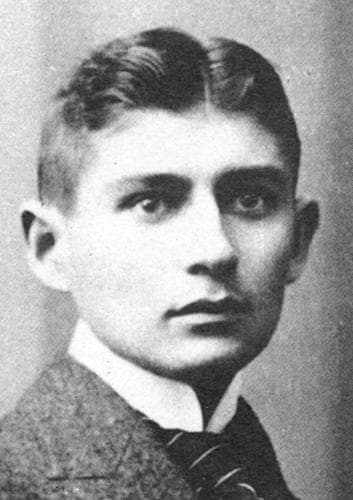
Franz Kafka was a German-speaking Bohemian novelist and short-story writer based in Prague, who is widely regarded as one of the major figures of 20th-century literature. His work fuses elements of realism and the fantastic. It typically features isolated protagonists facing bizarre or surrealistic predicaments and incomprehensible socio-bureaucratic powers. It has been interpreted as exploring themes of alienation, existential anxiety, guilt, and absurdity. His best known works include the novella The Metamorphosis and novels The Trial and The Castle. The term Kafkaesque has entered English to describe absurd situations like those depicted in his writing.







