“It was as if the world had ended, and he was the only one left.”
— Mark's initial feeling of isolation after the plane crash.

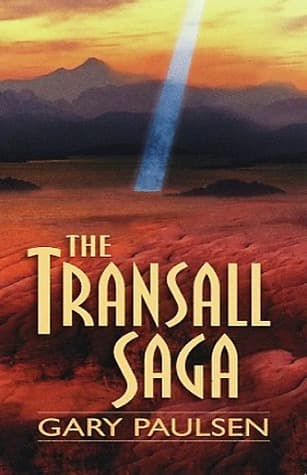
Gary Paulsen (1998)
Genre
Fantasy / Children's / Science Fiction / Young Adult
Reading Time
250 min
Key Themes
See below
Sign in to track this book
Stranded in a prehistoric, alien-like world after a blinding flash, teenage Mark is thrust into a desperate struggle for survival among warring tribes, forging unexpected bonds and unlocking latent powers while relentlessly searching for a way back to his own time on Earth.
Mark Harrison, a thirteen-year-old boy, goes on a solo camping trip in the New Mexico desert, seeking solitude and adventure. On his second night, while observing the stars, a blinding, multi-colored beam of light descends from the sky and engulfs him. He feels a strange pressure and then loses consciousness. When he awakens, he finds himself in a radically different environment. The stars are unfamiliar, the sun is a different color, and the vegetation is alien. His compass and watch no longer function, and his surroundings are completely foreign, leading him to believe he has been transported to another planet or dimension.
Mark quickly realizes his situation and begins to adapt. He uses his survival skills to find food and water, constructing a shelter and fashioning basic tools. He observes strange, deer-like creatures and learns to hunt. One day, while exploring, he stumbles upon a group of small, green-skinned humanoids, the first intelligent life he has encountered. They are primitive and hostile, attacking him with spears. Mark, using his ingenuity and a makeshift sling, manages to fend them off, but the encounter leaves him shaken and reinforces the dangerous nature of his new world. He understands he must remain cautious.
After several months of solitary survival, Mark is captured by a more advanced, but still primitive, tribe known for their red eyes and a rigid social structure. He is taken to their village and initially held captive, subjected to their strange customs and language. While imprisoned, he meets Ally, a young woman from the tribe who shows him kindness and helps him understand their ways. Despite the language barrier, they form a bond. Ally teaches him about the tribe's rituals, their fear of the 'star-watchers' (the green-skinned people), and the general dangers of their world. Mark, in turn, tries to share knowledge from his own time.
Over time, Mark earns the trust of the red-eyed tribe, particularly after demonstrating his knowledge and skills, such as improving their hunting techniques and creating more efficient tools. He becomes a respected member, even participating in their hunts and ceremonies. However, the world is full of inter-tribal conflict. The green-skinned 'star-watchers' are a constant threat, and tensions escalate, leading to skirmishes and raids. Mark witnesses the brutal realities of primitive warfare, struggling with his own moral compass while trying to protect his new community, especially Ally.
A prophecy among the tribes speaks of a 'star-child' who will bring either great destruction or great peace. Because of his sudden appearance and strange origins, Mark is identified as this star-child. To settle a long-standing dispute and prevent further warfare between the red-eyed people and another powerful tribe, a grand contest is proposed. Mark, despite his reluctance and fear, is chosen to represent his tribe in this dangerous trial. The contest involves navigating a perilous wilderness, outwitting rivals, and facing unknown challenges, all under the watchful eyes of the warring tribes.
During the contest, Mark faces treacherous terrain, cunning traps, and fierce rivals from other tribes. He relies on his wits, his improved survival skills, and the knowledge he gained from his own time. As he progresses, he begins to experience strange sensations and abilities he never possessed before. He develops heightened senses, an intuitive understanding of the environment, and a surprising strength and agility. These emerging powers, which he initially struggles to control, prove crucial in overcoming obstacles and outmaneuvering his opponents, leading him to question the true nature of his transformation and his connection to this world.
As Mark nears the end of the contest, he discovers the secret of the green-skinned 'star-watchers.' They are not merely primitive savages but survivors of a highly advanced civilization that was decimated long ago. They are the guardians of ancient technology, including the very beam of light that transported Mark. He learns that the beam is a dimensional transporter, and this 'planet' is actually Earth, far in the future after a catastrophic event reset civilization. The green-skinned people, through their ancient knowledge, have been observing and occasionally interacting with the emergent primitive tribes.
Mark finally confronts the leader of the star-watchers, an ancient, almost ethereal being. Through a form of telepathic communication, the star-watcher reveals the full history: a devastating war in Mark's own time led to humanity's near extinction, and the survivors, including their ancestors, created the Transall system—a hidden network of advanced technology designed to preserve knowledge and occasionally 'reset' or guide humanity's re-emergence. Mark realizes he wasn't randomly transported; the beam was a deliberate act, part of a larger, long-term plan to introduce new genetic material and potentially accelerate human development.
The star-watchers, recognizing Mark's unique blend of past knowledge and newly acquired abilities, present him with a choice. He can use the Transall system to return to his own time, accepting that he would be leaving this future Earth and Ally behind forever. Alternatively, he can choose to stay in this future, using his knowledge and powers to guide the developing tribes, helping them rebuild a more peaceful and advanced civilization. This decision weighs heavily on him, as it means forsaking either his past life or his new connections and potential destiny.
After much deliberation, considering his bond with Ally and the red-eyed tribe, and understanding the impact he could have, Mark makes the difficult decision to stay in the future. He chooses to embrace his role as the 'star-child,' dedicating himself to uniting the tribes, fostering peace, and sharing his knowledge to help them advance. He becomes a legendary figure, guiding humanity's resurgence from its primitive state. The book concludes with Mark, now an adult, observing the progress of the world he helped shape, having found his true purpose and home in the distant future.
The Protagonist
From a bewildered boy seeking to return home, Mark transforms into a mature leader who chooses to stay and guide humanity's future, embracing his unique powers and destiny.
The Supporting
Ally grows from a supportive friend to a trusted partner for Mark, representing the hope and future of her people.
The Supporting
The Star-Watcher Leader acts as the ultimate revealer of truth and the catalyst for Mark's final decision, ensuring the continuation of humanity's guided evolution.
The Supporting/Antagonistic
Their role shifts from perceived antagonists to the revealers of the world's true history and the facilitators of Mark's destiny.
The Supporting
The tribe evolves from an isolated, warring group to one guided towards peace and progress by Mark.
The Mentioned
They serve as a representation of the broader tribal conflicts that Mark seeks to resolve.
The Mentioned
They represent the life Mark leaves behind, allowing his full transformation into a future leader.
Mark's journey is one of self-discovery. Transported to an alien future, he is stripped of his familiar identity and forced to redefine himself. He grapples with being an outsider, then an integrated member of a tribe, and finally the 'star-child' of prophecy. The discovery of his latent powers and the true history of Earth forces him to confront who he is meant to be, culminating in his choice to embrace a new identity as a leader and guide for future humanity, rather than clinging to his past self. This theme is central to his personal growth and the narrative's resolution.
“He was no longer Mark, the boy from New Mexico. He was something new, something born of this strange, beautiful, and terrifying world.”
From the moment Mark arrives in the future, survival is his paramount concern. He must quickly adapt to an unfamiliar environment, learn to hunt, find shelter, and defend himself against dangerous creatures and hostile tribes. His existing camping skills are tested and honed, but he also learns new ways of living from the primitive people he encounters. This theme shows human resilience and ingenuity in the face of extreme adversity. Mark's ability to not only survive but thrive and eventually lead shows his adaptability and the innate human drive to persist.
“Survival was a constant, nagging thought, a cold wind that never ceased to blow across his mind.”
The book explores the cyclical nature of civilization, showing a future Earth where advanced society has collapsed, and humanity has reverted to primitive tribalism. The revelation of the Transall system and the Star-Watchers reveals a deliberate, long-term effort to guide humanity through this cycle. Mark, with his knowledge from the past, becomes a catalyst for accelerating the next rise of civilization. This theme prompts reflection on humanity's capacity for both destruction and rebirth, and the importance of preserving knowledge and learning from past mistakes to build a better future, rather than repeating the same destructive patterns.
“This wasn't another planet. This was Earth. His Earth, but so far in the future it was alien.”
As Mark integrates into the red-eyed tribe and later learns of his role as the 'star-child,' he is increasingly burdened with responsibility. He feels responsible for protecting Ally and his new tribe from rival groups and dangers. The ultimate choice presented by the Star-Watcher Leader — to return home or stay and lead — forces him to confront the responsibility of guiding an entire future civilization. His decision to stay demonstrates an acceptance of this burden and a commitment to using his unique position and powers for the greater good, solidifying his transformation into a true leader.
“He could run, or he could try to make a difference. The choice, he knew, was not really a choice at all.”
A mysterious beam of light that transports Mark through time.
The Transall Beam is the central plot device that initiates Mark's journey. It is a multi-colored light that appears to 'snatch' him from his present time in the New Mexico desert and transport him to a distant future. Initially presented as an unexplained phenomenon, it is later revealed to be a highly advanced piece of technology, part of the 'Transall system,' designed by a past advanced civilization to transport individuals and potentially introduce new genetic material or knowledge to guide humanity's re-emergence. It serves as both the catalyst for the conflict and the potential means of resolution.
An ancient prophecy that foretells Mark's arrival and role.
The 'star-child' prophecy is a narrative device used by the primitive tribes to explain Mark's sudden appearance and his unusual abilities. It provides a framework for the tribes to accept Mark and for him to be chosen for the grand contest. This prophecy elevates Mark's status from a mere outsider to a figure of destiny, creating a sense of preordained purpose for his journey. It also serves to build suspense and drive the plot forward, as Mark's actions are seen through the lens of fulfilling this ancient prediction, whether for good or ill.
The challenge of communication between Mark and the tribes.
The language barrier is a significant plot device that highlights Mark's isolation and the challenges of cultural integration. Initially, Mark cannot understand the green-skinned people or the red-eyed tribe, leading to misunderstandings, fear, and a slow, arduous process of communication. This device emphasizes his vulnerability and the effort required to build trust and connection. Over time, his learning of their language, often with Ally's help, symbolizes his adaptation and growing bond with the new world, making his eventual leadership more impactful as he can truly communicate and influence.
The setting of the story, revealing Earth after a catastrophic event.
The revelation that the 'alien planet' Mark is on is actually Earth, far in the future after an apocalyptic event, is a crucial plot twist. This post-apocalyptic setting serves to explain the primitive state of humanity and the existence of advanced hidden technology. It transforms the story from a simple alien encounter into a profound commentary on humanity's capacity for self-destruction and rebirth. This device adds depth to the themes of civilization cycles and responsibility, grounding Mark's fantastical journey in a cautionary tale about his own past.
“It was as if the world had ended, and he was the only one left.”
— Mark's initial feeling of isolation after the plane crash.
“The stars were different here, and the silence was deeper than any he had known.”
— Mark observing the night sky in the new world.
“Hunger was a new kind of pain, a constant, gnawing presence.”
— Mark's struggle with finding food in the wilderness.
“He learned to read the land, to speak its language without words.”
— Mark adapting to his environment and developing survival skills.
“Fear was a cold hand, but curiosity was a burning flame.”
— Mark's internal conflict when encountering the unknown.
“Sometimes, the only way to find yourself is to get utterly lost.”
— A reflection on Mark's journey of self-discovery.
“He was a boy from another time, another world, and yet he was here.”
— Mark grappling with his identity in the new reality.
“The future was not a place to go, but a thing to be built.”
— Mark's realization about shaping his destiny.
“Love, he found, was a language spoken in all times, in all worlds.”
— Mark's relationships with the people he meets.
“The past was a whisper, the present a shout, and the future an echo.”
— Mark's perception of time's fluidity.
“He carried the weight of two worlds, but also their strength.”
— Mark's dual identity and the burden/benefit it brings.
“The greatest journey is not across land or sea, but within the heart.”
— A thematic statement about Mark's internal growth.
“Even in the deepest wilderness, humanity finds a way to blossom.”
— The emergence of community and civilization in the new world.
“He was no longer just Mark, the boy who fell from the sky. He was Mark, the man who stood on the earth he had made his own.”
— Mark's transformation and acceptance of his new life.
Ready to see how well you understood this book? Take our interactive quiz with 10 questions.

Biography coming soon.







