“There are no accidents. Only events whose causes have not yet been discovered.”
— Early on, a recurring theme about the nature of fate and causality.

Genre
Thriller / Fantasy / Mystery / Science Fiction
Reading Time
327 min
Key Themes
See below
Sign in to track this book
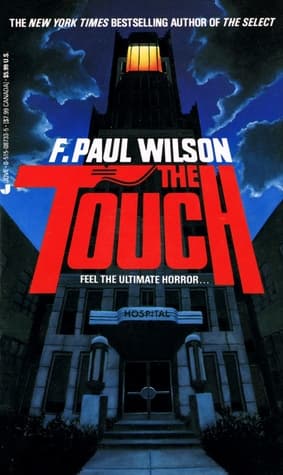
A small-town doctor's miraculous gift of healing with a touch unravels his life, revealing a sinister, ancient power that demands a terrifying price.
Dr. Alan Bulmer, a family physician in his early forties, experiences an inexplicable shift during a routine physical examination of Mrs. Peterson, a patient with rheumatoid arthritis. As he places his hand on her, he feels an intense warmth and energy. Mrs. Peterson immediately reports her pain is gone and she can move her joints again. Alan is stunned, thinking it a placebo effect or spontaneous remission. However, similar incidents with other patients, including a child with leukemia, confirm he can now instantly heal any illness with a simple touch, though this power is limited to one hour each day.
Alan struggles to accept his new ability with his scientific background. He tries to keep it secret, fearing ridicule and professional ruin. But the dramatic cures are impossible to hide, especially as healed patients spread the word. His wife, Elaine, becomes distant and suspicious, unable to understand or accept the changes in their lives. His practice suffers as he tries to manage the influx of desperate patients while sticking to his one-hour daily limit. Alan feels immense pressure, torn between his medical ethics and the desire to help, while also trying to protect his fragile personal life.
Despite Alan's efforts, news of his healings spreads quickly, turning his quiet practice into a circus. The medical community is skeptical, and some colleagues accuse him of being a fraud. His marriage to Elaine worsens, strained by constant demands, public scrutiny, and Alan's own turmoil. Amid this chaos, he meets Sylvia Nash, a wealthy socialite intrigued by his story. Sylvia, a sophisticated and mysterious woman, offers him support and understanding, a contrast to Elaine's growing resentment. She also introduces him to her Vietnamese gardener, Ba, who seems to know about Alan's power.
Ba, Sylvia Nash's quiet gardener, approaches Alan with an unsettling idea. He reveals he has seen a similar power in his homeland, which he calls 'Dat-tay-vao,' meaning 'the touch.' Ba explains this power is not a gift but a parasitic entity, a 'shadow' that attaches to people, giving them healing abilities in exchange for feeding on their life force and emotional energy. He warns Alan that the Dat-tay-vao always comes with a terrible price, draining its host physically and spiritually, eventually consuming them. Alan, though disbelieving at first, is disturbed by Ba's earnest accounts.
At his lowest point, with his marriage failing and his reputation ruined, Alan receives an unexpected offer from Senator James McCready. McCready, a powerful figure with a family medical foundation, expresses interest in scientifically investigating Alan's abilities. He offers Alan resources, a controlled environment, and his foundation's international backing, promising to validate his gift if it is real. Feeling he has nothing to lose and desperate for a rational explanation and a chance to legitimize his power, Alan accepts McCready's offer, unaware of the senator's true motives.
Alan moves into the McCready Foundation, a lavish, modern facility, where he undergoes extensive medical and psychological evaluations. He takes various tests to measure and understand his healing power, all under the watchful eye of Dr. Arlen, the foundation's lead scientist. While the environment is initially stimulating, Alan quickly senses an underlying tension and an almost cult-like devotion to Senator McCready among the staff. He notices McCready's uncanny interest in the specifics of Alan's daily healing hour, and a subtle manipulation of his schedule, creating unease despite the outward professionalism.
Sylvia Nash, who has grown closer to Alan, becomes his main confidante within the foundation. She provides emotional support and helps him navigate the complex politics of the McCready organization. Meanwhile, Ba, Sylvia's gardener, continues to appear, offering cryptic warnings about the Dat-tay-vao. He explains that the entity thrives on despair and feeds on the energy exchanged during healing, subtly corrupting its host. Ba's persistence, along with his knowledge of ancient Vietnamese lore, begins to make Alan question his power and the foundation's intentions.
As Alan looks deeper into the foundation's operations, he notices inconsistencies and suspicious activities. He discovers that Senator McCready's interest in his healing power is not purely good. McCready has been secretly using the foundation to research and perhaps even copy the Dat-tay-vao, specifically to prolong his own life and the lives of certain wealthy individuals. Alan realizes he is not a patient or a subject, but a tool, a source of power McCready intends to exploit. The senator's ultimate goal is to control the Dat-tay-vao, achieving immortality for himself and his elite circle.
Armed with the terrifying truth, Alan confronts Senator McCready, who reveals his ruthless ambition and the full extent of his plan to harness the Dat-tay-vao. McCready admits to manipulating Alan from the beginning, isolating him from his family and using his power for his own ends. With the help of Sylvia, who is horrified by McCready's true nature, and Ba, who provides crucial knowledge and guidance, Alan attempts a daring escape from the heavily guarded foundation. The escape is dangerous, as McCready's security forces pursue them relentlessly, determined to prevent Alan and his power from leaving.
As they flee, Ba reveals the ancient, dangerous ritual needed to break the connection between Alan and the Dat-tay-vao. He explains that the ritual requires a profound sacrifice, not just of Alan's power, but of a part of his very being, to fully break free from the parasitic entity. The ritual is complex and perilous, and Ba warns that failure could result in Alan's death or permanent enslavement to the Dat-tay-vao. Alan, though terrified, understands this is his only chance to reclaim his life and prevent his power from being exploited by McCready. He agrees to the ritual, preparing for the ultimate cost.
McCready and his forces close in on Alan, Sylvia, and Ba, leading to a desperate, climactic confrontation. Alan, weakened but determined, must make a final stand against McCready, who will do anything to regain control of the Dat-tay-vao. The battle is not just physical but also a struggle for Alan's soul, as he fights to resist the dark influence of the entity while trying to protect Sylvia and Ba. The climax involves a desperate attempt to complete the ritual amidst the chaos, with Alan's life hanging in the balance and the fate of the Dat-tay-vao's power about to be decided.
After the confrontation, Alan survives, though forever changed. The Dat-tay-vao is severed or neutralized, and his healing power is gone. McCready's empire is exposed and dismantled, though the full extent of his influence may never be entirely eradicated. Alan must now accept the loss of his ability and the trauma he has endured. He begins rebuilding his life, trying to reconnect with his estranged wife, Elaine, and grappling with the knowledge of the dark forces he encountered. He emerges a different man, wiser and more grounded, but forever marked by 'The Touch' and its terrible price.
The Protagonist
Alan transforms from a skeptical, overwhelmed doctor into a man who understands and confronts the true, darker nature of his power, ultimately choosing to sacrifice it for his freedom and humanity.
The Supporting
Sylvia evolves from an intrigued observer to a courageous and committed ally, risking her own safety to help Alan escape and expose McCready.
The Supporting
Ba remains a consistent source of ancient wisdom and unwavering support, guiding Alan through the darkest aspects of his journey.
The Antagonist
McCready's true villainous nature is gradually revealed, culminating in his desperate attempts to control Alan and his power.
The Supporting
Elaine's arc shows the tragic dissolution of a marriage under extreme, supernatural pressure, as she is left behind by Alan's extraordinary journey.
The Supporting
Dr. Arlen transitions from an objective scientist to a morally compromised figure, revealing the dangers of ambition unchecked by ethics.
This theme explores the idea that extraordinary abilities, especially supernatural ones, come with a significant cost. Alan's healing power, initially a gift, quickly unravels his life, destroying his marriage, alienating colleagues, and threatening his soul. Ba's warnings about the Dat-tay-vao feeding on its host embody this theme, showing that such power is not freely given but extracted at a deep personal expense. The novel shows that true power often demands sacrifice, and some gifts are curses, as seen in Alan's decision to give up his ability.
“The Dat-tay-vao always comes with a price, Doctor. It feeds on you, little by little, until there's nothing left.”
The novel pits Alan's scientific, rational view against the inexplicable, supernatural reality of his healing power. Alan, as a doctor, first tries to find a medical explanation for his abilities, refusing to accept the 'miraculous.' This conflict is complicated by Ba's ancient, almost spiritual understanding of the Dat-tay-vao, which offers a non-scientific explanation Alan slowly accepts. Senator McCready's attempts to 'scientifically' control and copy the power also reflect this tension, showing how science can be corrupted when trying to harness forces beyond its grasp. The theme explores the limits of human understanding and the uncomfortable truths beyond the rational.
“My mind, my scientific training, screamed at me that it was impossible. But my hands... my hands knew a different truth.”
This theme appears most strongly through Senator James McCready, who represents the darkest aspects of ambition and control. McCready, already a powerful political figure, seeks to acquire Alan's healing ability for personal gain and immortality. He manipulates, deceives, and sacrifices others to achieve his goals, showing how immense power can corrupt even those who seem to act for the public good. The Dat-tay-vao itself is a corrupting force, subtly influencing Alan and offering a seductive path that ultimately drains his humanity.
“Immortality, Doctor. That's the ultimate power. And you, my dear Alan, are the key.”
Alan's sudden acquisition of healing power deeply alters his sense of self and isolates him from his former life. His identity as a 'normal' doctor, husband, and community member shatters. His marriage collapses, his colleagues distance themselves, and he becomes an object of desperate hope and intense scrutiny. This isolation is worsened by the unique nature of his gift, which no one truly understands except Ba. The novel shows how an extraordinary ability can lead to deep loneliness and the erosion of one's former self.
“I was no longer Alan Bulmer, the family doctor. I was 'The Touch,' a phenomenon, a miracle worker, a freak.”
The supernatural entity that grants and consumes Alan's healing power.
The Dat-tay-vao is the central plot device, a parasitic, unseen entity that attaches itself to Alan, granting him the ability to heal but also feeding on his life force and despair. It serves as the mystical explanation for Alan's power, distinguishing it from a divine gift and imbuing it with a sinister, dangerous nature. The Dat-tay-vao drives the conflict, as Alan struggles to understand and ultimately sever his connection to it, while McCready seeks to control and exploit it. It is the catalyst for all major events and character motivations.
A crucial constraint on Alan's healing power, creating tension and moral dilemmas.
The daily one-hour limit on Alan's healing ability is a critical plot device that creates immense tension and moral pressure. It forces Alan to make agonizing choices about who to heal and who to turn away, highlighting the ethical burden of his power. This limitation also makes him vulnerable and exploitable, as McCready carefully manipulates his access to patients during this specific window. It underscores the idea that even miraculous power is not boundless and comes with severe restrictions that complicate its use and amplify its personal cost.
A sophisticated medical facility that serves as a gilded cage and a front for exploitation.
The McCready Foundation is a pivotal setting and plot device. It initially appears as a legitimate scientific institution offering Alan a chance to understand his power, but it quickly transforms into a luxurious prison. The foundation's resources and scientific veneer are a smokescreen for Senator McCready's true agenda: to research, control, and exploit the Dat-tay-vao for his own immortality project. It provides the controlled environment necessary for Alan's 'study' while simultaneously isolating him and allowing McCready to monitor and manipulate his activities, serving as the primary antagonist's lair.
Ancient knowledge and cryptic prophecies that guide Alan towards the truth.
Ba's knowledge of the Dat-tay-vao, derived from ancient Vietnamese lore, functions as a crucial expositional and prophetic plot device. His initial warnings, though initially dismissed by Alan, gradually become undeniable truths. Ba provides the non-scientific framework necessary for Alan (and the reader) to understand the true, malevolent nature of his gift and the dire consequences of its use. His guidance throughout the story, culminating in the ritual to sever the connection, is essential for Alan's eventual escape and resolution. He represents the wisdom outside of Western scientific understanding.
“There are no accidents. Only events whose causes have not yet been discovered.”
— Early on, a recurring theme about the nature of fate and causality.
“The past is never dead. It's not even past.”
— A character reflecting on the lingering influence of historical events and personal history.
“Power corrupts, and absolute power corrupts absolutely. But what if the power is absolute good?”
— A philosophical question posed regarding the nature of the healing power.
“Sometimes the greatest miracles are the ones that go unnoticed.”
— Considering the subtle ways the 'touch' affects the world.
“Fear is the oldest and strongest emotion of mankind, and the oldest and strongest kind of fear is fear of the unknown.”
— Describing the primal reactions to the inexplicable events.
“The universe doesn't care about your plans. It has its own.”
— When human efforts are thwarted by larger, unseen forces.
“Every secret has a life of its own, and sometimes it doesn't want to stay buried.”
— Regarding the uncovering of ancient secrets related to the 'touch'.
“Healing is not always about curing. Sometimes it's about making peace with what cannot be cured.”
— A more nuanced understanding of the 'touch's' capabilities and limitations.
“Ignorance is not bliss when it leaves you vulnerable.”
— A character realizing the danger of not understanding the supernatural forces at play.
“The greatest truths are often hidden in plain sight.”
— As the characters piece together clues from seemingly mundane details.
“There are more things in heaven and earth, Horatio, than are dreamt of in your philosophy.”
— An allusion made when confronted with the supernatural elements, highlighting the limits of human understanding.
“Sometimes, the cure is worse than the disease.”
— A warning about the potential negative consequences of tampering with powerful forces.
“Belief is a powerful weapon, for good or ill.”
— Discussing how faith and conviction play a role in the unfolding events, both positively and negatively.
“The line between miracle and curse is often a matter of perspective.”
— When the 'touch' has both beneficial and terrifying implications.
Ready to see how well you understood this book? Take our interactive quiz with 10 questions.

Biography coming soon.







