“When you light a candle, you also cast a shadow.”
— Ged's teaching to Arha about the nature of light and darkness.

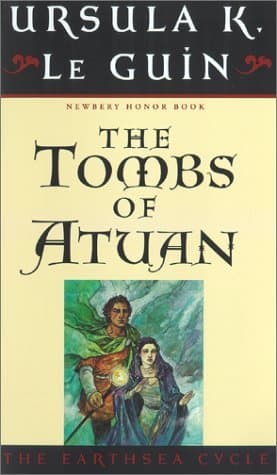
Ursula K. Le Guin (1971)
Genre
Fantasy / Science Fiction / Young Adult
Reading Time
180 min
Key Themes
See below
Sign in to track this book
A young woman, stripped of her name and confined as high priestess to ancient powers in a labyrinthine tomb, finds her desolate life upended by a wizard seeking stolen treasure, who ultimately offers her a perilous path to freedom.
Tenar, a young girl from the Kargad Lands, is born the night the old High Priestess of the Tombs of Atuan dies. This event marks her as the chosen reincarnation of the Priestess, destined to serve the Nameless Ones. At age five, she is taken from her parents, and her name, Tenar, is removed, replaced by 'Arha,' meaning 'the Eaten One.' She is brought to the Place of the Tombs, a desolate complex of temples and underground labyrinths. Her childhood is spent in strict training under Kossil, Priestess of the Godking, and Thar, Priestess of the Twin Gods. Arha learns the rituals, the Tombs' history, and, most importantly, the dark pathways of the Undertomb, the Nameless Ones' domain.
As Arha grows, her life is defined by the Tombs' strict, unchanging routines. She oversees sacred ceremonies, including the sacrifice of prisoners in the Black House. Her closest companions are Thar and Kossil, who have different views on their worship. Thar, old and frail, genuinely respects the Nameless Ones and teaches Arha ancient lore and labyrinth secrets. Kossil, however, is practical, more concerned with the Godking's political power and the temples' wealth, often dismissing the Nameless Ones' true power. Arha feels a growing isolation and dissatisfaction with her fate, yet she finds a strange comfort in her role's absolute authority and dark majesty.
During a patrol of the Undertomb—a vast, dark maze of tunnels, chambers, and abysses known only to her—Arha senses a foreign presence. Following faint sounds and disturbances in the oppressive darkness, she discovers an intruder: a young, dark-skinned man with a staff, a wizard. This is Ged, a sorcerer from the Archipelago, who seeks the legendary Ring of Erreth-Akbe, a powerful artifact hidden deep within the Tombs. Arha, filled with fear, anger, and curiosity, traps him by collapsing a tunnel, sealing him in a hidden chamber. She decides to keep his presence secret from Kossil and Thar, sensing a unique chance.
Arha keeps Ged imprisoned in the labyrinth, visiting him secretly. She brings him water and meager food, but also torments him psychologically, threatening him with the Nameless Ones and the Tombs' dark punishments. Ged, though weak, remains calm and speaks to her of light, the outside world, and true magic, which contrasts sharply with her existence's death and darkness. He explains his purpose: to get the Ring of Erreth-Akbe, which he believes can help fix a great rift in the world. Their conversations slowly challenge Arha's beliefs and her absolute faith in the Nameless Ones. She finds herself drawn to his stories and the promise of a world beyond the Tombs, even as she keeps her authority over him.
As Arha spends more time in the Undertomb with Ged, her behavior becomes erratic and secretive. She neglects some duties and avoids Kossil and Thar more often. Kossil, always watchful and politically smart, notices these changes. She suspects Arha is hiding something, perhaps dabbling in forbidden magic or trying to gain more power within the temple. Kossil's suspicion grows into an open challenge when she questions Arha's recent actions and her strange focus on the dark places. Arha feels the pressure, knowing that if Kossil discovers Ged, both their lives would be lost, and the Tombs' ancient secrets would be exposed to the Godking.
Old Thar, the Priestess of the Twin Gods and Arha's main mentor in the ways of the Nameless Ones, weakens further and dies. Her death leaves Arha feeling alone and vulnerable. Thar had been a link to the Tombs' ancient, spiritual aspects, and her passing removes a moderating influence, leaving Arha more exposed to Kossil's ambitious plans. In her grief and isolation, Arha's inner conflict grows. She is torn between her lifelong devotion to the Tombs and the Nameless Ones, and the appealing possibility of freedom and a different life that Ged represents. Thar's death pushes Arha toward a decisive action regarding Ged and the Ring, realizing she can no longer keep things as they are.
Driven by an unexplained urge, Arha decides to get the Ring of Erreth-Akbe. She navigates the deepest, most sacred, and dangerous parts of the Undertomb, places where even she rarely goes. She finds the hidden chamber, a small, dark room, and uncovers the ancient, broken ring. It is a simple, heavy circlet, half gold and half silver, with a faint inscription. She returns to Ged with the Ring, showing it to him. He explains its importance: it is a legendary artifact, belonging to the ancient hero Erreth-Akbe, and has the power to unite the divided lands of the Archipelago and the Kargad Empire. The Ring symbolizes balance and unity, a sharp contrast to the Tombs' darkness and division.
With the Ring, Arha decides to help Ged escape. She leads him through the labyrinth, using her knowledge of its passages and her ability to navigate in absolute darkness. As they move, Ged uses his magic, not to attack, but to bring light and clarity, showing the paths and ancient carvings. Their actions, especially removing the Ring, seem to awaken the Nameless Ones, or perhaps simply trigger instability in the ancient structures. The earth shakes, and the Tombs begin to collapse. Arha, for the first time, feels genuine fear for her life, but also a strange sense of freedom as her world literally falls apart.
Navigating falling debris and shifting ground, Arha and Ged race toward the surface. They pass through the main temple, now in ruins, and encounter Kossil, who is overwhelmed by the destruction. Arha feels no pity, only a strong will to escape. They emerge from the collapsing Tombs into the starlight, finding themselves on the desolate plain outside. For the first time she can remember, Arha sees the moon and stars, a sight that overwhelms her with its beauty and vastness. Ged, seeing her change, asks her true name. She hesitates, then remembers and says, 'Tenar.' She has shed the identity of Arha, the Eaten One, and is reborn, ready to face the unknown world with Ged.
Tenar and Ged leave the ruined Tombs, beginning their long journey across the vast, dry Kargad Lands. Ged, still weak from his ordeal, relies on Tenar's knowledge of the land and her practical skills. They travel slowly, facing the harsh environment and the dangers of a world Tenar barely knows. Ged shares more about the Archipelago, his own life, and the larger world, gradually expanding Tenar's understanding beyond the Tombs' narrow confines. Tenar, in turn, adapts to the freedom and uncertainty of her new life, learning to trust Ged and to embrace her own identity. Their destination is the Archipelago, where Ged hopes to use the Ring of Erreth-Akbe to restore balance.
The Protagonist
Tenar transforms from Arha, a prisoner of darkness and tradition, to Tenar, a free woman who chooses her own path and reclaims her true self.
The Supporting
Ged endures captivity and uses his wisdom and patience to bring light to Tenar and retrieve the Ring, furthering his mission to restore balance.
The Antagonist
Kossil remains static, representing the entrenched, worldly power that ultimately crumbles with the Tombs.
The Supporting
Thar's role is to pass on the traditions and secrets of the Tombs to Arha before her death, leaving Arha to make her own choices.
The Antagonist
The Nameless Ones remain a constant, terrifying presence, their power diminishing only when their chosen priestess abandons them and their domain is destroyed.
The Supporting
Manan's arc is one of unwavering loyalty to Arha, eventually leading to his demise with the Tombs.
The main theme is Tenar's journey to reclaim her true identity after her name and self are taken at a young age. As Arha, she is a vessel for the Nameless Ones, defined only by her role. Her interactions with Ged and the outside world force her to question who she is beyond the 'Eaten One.' Remembering and reclaiming her name, Tenar, is a strong symbol of her freedom and self-acceptance, showing that true identity is chosen, not forced. This is clear when she leaves the Tombs and Ged asks her name, and she finally says 'Tenar,' shedding the burden of Arha.
“"A name is a great thing. It is yours. You are Arha, the Eaten One. But you were Tenar once. That was your name. What is your name now?"”
This theme is a literal and metaphorical core of the novel. The Tombs of Atuan are a place of constant darkness, both physically (the Undertomb) and spiritually (the worship of the Nameless Ones, death, and fear). Ged, the wizard, represents light and reason, bringing actual light into the labyrinth's darkness and metaphorical light into Tenar's understanding. Their struggle represents the conflict between ignorance and knowledge, oppression and freedom, and ultimately, life and death. Tenar's choice to leave the Tombs is a move from darkness into the light of the outside world, ending with her seeing the stars for the first time.
“"Darkness is the world. Light is only a fire, by which the world is seen. The world is dark, and the light is fire. The fire is not the world."”
Tenar is born into a life of captivity, not just physically within the Tombs, but spiritually and psychologically. Her role as Arha ties her to ancient rituals, a predetermined fate, and the Nameless Ones' malevolent will. Ged, though a prisoner himself, represents true freedom—freedom of thought, movement, and choice. The story explores the nature of true freedom, which is not just the absence of physical chains but the liberation of the mind and spirit. Tenar's journey is a gradual process of breaking free from her upbringing's psychological chains, ending with her physical escape from the collapsing Tombs.
“"Only in silence the word, only in darkness the light, only in dying life: bright is the hawk's flight on the empty sky."”
The Tombs of Atuan, ancient and full of tradition, also show how power and strict adherence to tradition can corrupt. The priestesses hold immense, unquestioned power over life and death, leading to a stagnant, fear-driven society. Kossil shows this, prioritizing political influence and material gain over spiritual devotion. The traditions themselves, especially human sacrifices, are barbaric and serve to maintain fear and control rather than genuine worship. The Tombs' destruction can be seen as a necessary cleansing, freeing the land from a long-standing, corrupting influence.
“"Power is a heavy thing. It is not for the light-hearted."”
A vast, lightless underground maze that serves as both a sacred space and a prison.
The Undertomb is a complex, lightless labyrinth beneath the Tombs of Atuan, known only to Arha. It functions as a sacred domain of the Nameless Ones, a burial place, a treasury, and a prison. For Arha, it is both her sanctuary and her ultimate cage, embodying her identity as 'the Eaten One.' Its darkness and intricate passages symbolize her isolated, convoluted inner world and the impenetrable traditions she serves. It serves as the primary setting for Arha and Ged's interactions and the site of their escape, which ultimately leads to its destruction.
A powerful, broken artifact sought by Ged, symbolizing unity and balance.
The Ring of Erreth-Akbe is a legendary, broken artifact, half gold and half silver, hidden deep within the Tombs. It represents ancient power, unity, and balance, capable of mending rifts in the world. For Ged, it is the object of his quest, a tool to restore harmony. For Tenar, its discovery and her act of giving it to Ged signify her breaking away from the darkness and embracing a larger purpose. Its dual nature (gold and silver, broken yet powerful) reflects the balance of light and darkness, and the potential for wholeness that lies beyond the Tombs.
Ancient, malevolent deities representing primordial darkness and chaos.
The Nameless Ones are the unseen but ever-present deities of the Tombs, embodying primordial darkness, chaos, and death. They are a powerful plot device, driving Arha's devotion and fear, and providing the central conflict against Ged's light and order. Their malevolent influence permeates the Tombs, making it a place of dread and stagnation. Their 'presence' and the fear they inspire are what keep Arha bound to her role, and their eventual 'awakening' during the escape leads to the physical destruction of the Tombs, symbolizing the collapse of the old, dark order.
The ritualistic removal of Tenar's birth name and the imposition of 'Arha'.
The act of taking Tenar's name and giving her 'Arha' (the Eaten One) is a crucial plot device that establishes her loss of identity and her symbolic death to her former self. This ritual immediately sets up the central conflict of her personal journey: reclaiming her true self. It signifies her complete assimilation into the cult of the Nameless Ones, making her a vessel rather than an individual. Her eventual reclamation of 'Tenar' at the end of the book is a powerful symbolic act of self-determination and rebirth, marking her true liberation.
“When you light a candle, you also cast a shadow.”
— Ged's teaching to Arha about the nature of light and darkness.
“To shut your eyes is to be blind; to open your eyes is to see.”
— Arha reflecting on her own willful ignorance and the choice to confront truth.
“The dark cannot be banished, but it can be made to serve.”
— Ged explaining the relationship between light and shadow, and the potential for transformation.
“A man who knows his name cannot be hurt.”
— Ged's assertion about the power of true names, though in this context, it's about self-knowledge.
“Freedom is a heavy load, a beautiful burden, a dream dreamed by exiles.”
— Arha's internal thoughts as she begins to contemplate leaving the Tombs.
“Only in silence the word, only in darkness the light, only in dying life: bright the hawk's flight on the empty sky.”
— A central verse from the Creation of Éa, often quoted by Ged.
“To be the hand, the instrument, the tool of the Nameless Ones, that was all she was, all she had been since she was five years old.”
— Arha's internal monologue about her role and identity as Tenar.
“A thing is what it is, and not another thing.”
— Ged's simple yet profound statement about the nature of reality.
“She had thought there was no other life, no other world but this one. Now she knew there was.”
— Arha's realization as she experiences the world outside the Tombs for the first time.
“One cannot be a master until one is a servant.”
— A principle of wizardry that Ged embodies and subtly teaches.
“Fear is the only dark place.”
— Ged's insight into the true nature of the 'darkness' Arha has served.
“The way home is never the shortest way.”
— Ged to Arha, implying the journey of self-discovery and freedom is complex.
“She was not Arha, the Eaten One, she was Tenar.”
— Arha's reclaiming of her true name and identity at a pivotal moment.
“To unmake what has been made, to undo what has been done, that is the way to the heart of the world.”
— A reflection on the destructive and creative forces, and the power of change.
Ready to see how well you understood this book? Take our interactive quiz with 10 questions.
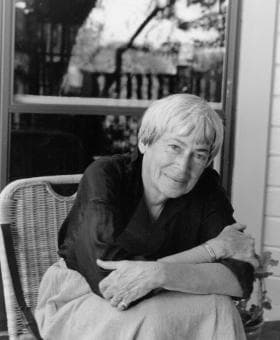
Ursula Kroeber Le Guin was an American author best known for her works of speculative fiction, including science fiction works set in her Hainish universe, and the Earthsea fantasy series. She was first published in 1959, and her literary career spanned nearly sixty years, producing more than twenty novels and over a hundred short stories, in addition to poetry, literary criticism, translations, and children's books. Frequently described as an author of science fiction, Le Guin has also been called a "major voice in American Letters". Le Guin said she would prefer to be known as an "American novelist".







