“Families are messy. Immortal families are eternally messy.”
— Percy reflects on the complicated relationships among gods and demigods.

Rick Riordan (2006)
Genre
Fantasy / Children's / Young Adult
Reading Time
240 min
Key Themes
See below
Sign in to track this book
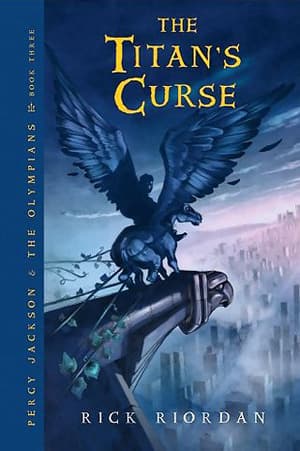
As the son of Poseidon, Percy Jackson must lead a perilous quest to rescue a goddess and his missing friend, Annabeth, all while facing a monstrous prophecy that warns not all of his demigod companions will return alive.
Percy Jackson, Annabeth Chase, and Thalia Grace, along with Grover Underwood, go to Westover Hall, a boarding school in Maine, to find two demigods, Nico and Bianca di Angelo, who have been hidden from the mythological world. They quickly discover the school's vice-principal, Dr. Thorn, is a manticore. During a battle, Dr. Thorn tries to capture the di Angelos. Just as he is about to throw Annabeth off a cliff, the goddess Artemis and her Hunters arrive, saving them. Annabeth, however, falls off the cliff with Dr. Thorn, seemingly to her death. Artemis and her lieutenant, Zoë Nightshade, offer Bianca a place among the Hunters, which she accepts, much to Nico's dismay. Artemis then goes off to hunt a dangerous monster, leaving Zoë in charge of getting the demigods back to Camp Half-Blood.
At Camp Half-Blood, Percy is upset about Annabeth's disappearance and cannot join the Hunters. He learns that Artemis is missing while hunting a rare and powerful monster that could destroy Olympus. Chiron explains that the monster is believed to be the Ophiotaurus, a creature whose sacrifice grants immense power. Zoë Nightshade, leading the Hunters, is chosen to lead a quest to find Artemis and stop the monster. The Oracle of Delphi delivers a new prophecy: 'Five shall go west to the goddess in chains, one shall be lost in the land without rain, the bane of Olympus shows the trail, campers and Hunters combined prevail, the Titan's curse must one endure, and one shall perish by a parent's hand.' The quest party is to consist of Zoë, Bianca, Grover, Thalia, and a fifth member.
Despite being forbidden to go on the quest due to the prophecy, Percy is determined to find Annabeth and help Artemis. He secretly follows the quest party, which consists of Zoë Nightshade, Bianca di Angelo, Grover Underwood, and Thalia Grace, as they leave Camp Half-Blood. He eventually reveals himself and, after some resistance from Zoë, is allowed to join, fulfilling the prophecy's 'five' requirement. The group travels by van, driven by Apollo, to Washington D.C., where they visit the National Air and Space Museum. There, they are attacked by the Nemean Lion, which Percy defeats, allowing them to skin it for its impenetrable pelt. This victory marks Percy's official, albeit unofficial, inclusion in the quest.
The quest party travels through the desert, reaching the 'junkyard of the gods' in New Mexico, a vast and dangerous wasteland filled with discarded magical artifacts. Bianca di Angelo, tempted by a Mythomagic figurine for her brother Nico, disobeys Zoë's warning and takes a statue of Hades from a display, triggering a dormant giant, Talos. Talos awakens and attacks the group. During the battle, Bianca enters the giant's inner workings to destroy it from within. She succeeds in disabling Talos but is crushed by its falling parts, fulfilling the prophecy: 'one shall be lost in the land without rain.' Her sacrifice impacts the group, especially Nico, who later expresses anger at Percy for not protecting her.
After Bianca's death, the remaining quest members continue their journey. In Cloudcroft, New Mexico, they are captured by Dr. Thorn, the manticore, who has survived their earlier encounter. He brings them before Luke Castellan and a general, who is revealed to be the Titan Atlas, father of Zoë Nightshade. They discover that Atlas has escaped his prison and is holding Artemis captive, forcing her to hold up the sky in his place. Luke's plan involves using the Ophiotaurus to gain power and overthrow the Olympians. Percy, Thalia, and Grover manage to escape with the Ophiotaurus, leaving Zoë behind with her father and Luke.
Percy, Thalia, and Grover, along with the Ophiotaurus they've named Bessie, continue their journey, reaching the Hoover Dam. Skeletal warriors, minions of Hades, pursue them, sent to retrieve Bessie. During their escape, they receive help from Rachel Elizabeth Dare, a mortal girl who can see through the Mist and recognize the monsters. She distracts the warriors, allowing the demigods to escape. They also receive advice from the spirit of a dam tour guide, who points them towards San Francisco. Percy leaves Bessie in the care of naiads at the dam, hoping to keep the creature safe from the Titan's forces.
The group arrives in San Francisco, where they find Annabeth has been held captive by Luke's forces. They infiltrate the headquarters of the Titan army, Mount Tamalpais, which is the Garden of the Hesperides. There, they find Artemis, forced to hold up the sky, and Annabeth, who was captured by Luke after falling from Westover Hall and was held prisoner. Zoë, having escaped Atlas, rejoins them. They plan to free Artemis and stop Luke and Atlas. Percy learns that Luke intends to sacrifice the Ophiotaurus to gain ultimate power.
A battle erupts on Mount Tamalpais. Percy takes the sky from Artemis, allowing her to fight Atlas. Thalia confronts Luke, battling him near a cliff. Zoë fights her father, Atlas, with a poisoned blade. During the fight, Atlas tricks Percy into temporarily holding the sky again, but Artemis quickly reclaims it. Zoë is mortally wounded by her father, fulfilling the prophecy: 'one shall perish by a parent's hand.' As she dies, Artemis turns her into a constellation in the sky. Percy battles Atlas and manages to trick him back under the sky, restoring his eternal punishment. Thalia defeats Luke, who falls from the cliff, but his fate remains uncertain. The battle results in the rescue of Artemis and Annabeth, but at a heavy cost.
The heroes return to Mount Olympus with the Ophiotaurus. The gods meet to discuss the events and the looming war with the Titans. The Ophiotaurus is entrusted to Poseidon, who places it in his palace to prevent its power from being misused. The gods praise the heroes but also debate their fate. Zeus considers killing Percy and Thalia due to their parentage and the prophecy about the 'child of the Big Three.' However, Artemis and Poseidon defend Percy, and Thalia declares her intention to join the Hunters, thus immortalizing herself and preventing her from fulfilling the prophecy. This decision shifts the burden of the prophecy onto Percy, making him the potential 'child of the Big Three' who could either save or destroy Olympus.
At Camp Half-Blood, Percy and Annabeth attend a memorial for the fallen heroes. Nico di Angelo, still grieving for Bianca, expresses anger towards Percy for not protecting his sister. He reveals his ability to summon skeletal warriors, confirming his identity as a son of Hades. Overwhelmed by his powers and the truth about his parentage, Nico flees Camp Half-Blood. Percy realizes the implications of Nico's heritage and the danger he poses if he falls under the influence of the Titans. Luke is alive and still working for Kronos, the true mastermind behind the Titan's Curse. The book ends with the looming threat of the Titan war, and Percy understanding that the fate of Olympus now largely rests on his shoulders, with the prophecy of the 'child of the Big Three' still unresolved.
The Protagonist
Percy grows from a reactive hero to one who actively seeks to influence events, accepting his role in the larger conflict.
The Supporting
Annabeth endures captivity, demonstrating resilience and continuing to be a strategic mind even when imprisoned.
The Supporting
Thalia grapples with her destiny and ultimately chooses to defy it by joining the Hunters, gaining a new purpose.
The Supporting
Grover continues his personal quest for Pan while supporting his friends, facing his fears and growing in bravery.
The Supporting
Zoë learns to trust and respect males, particularly Percy, before making the ultimate sacrifice for her goddess and friends.
The Supporting
Bianca seeks independence and a new identity, ultimately sacrificing herself for her brother and the quest.
The Supporting
Nico transforms from an innocent child to a grieving, powerful demigod grappling with his dark heritage.
The Supporting
Artemis is captured and rescued, demonstrating her resilience and compassion for her followers.
The Antagonist
Luke continues his descent into villainy, serving Kronos and orchestrating attacks against Olympus.
The Antagonist
Atlas temporarily escapes his eternal punishment, only to be tricked back into it by Percy and Artemis.
Identity and destiny are central, especially for the children of the Big Three (Percy, Thalia, Nico) who are constantly reminded of the prophecy that foretells one of them will either save or destroy Olympus. Thalia deals with her destiny by choosing to become a Hunter, thus taking herself out of the prophecy. Bianca seeks her own identity by joining the Hunters, separate from her brother. Nico discovers his true parentage and the immense power that comes with it, forcing him to confront who he truly is. Percy continually struggles with the weight of expectation and his place in the mythological world.
“'Five shall go west to the goddess in chains, one shall be lost in the land without rain, the bane of Olympus shows the trail, campers and Hunters combined prevail, the Titan's curse must one endure, and one shall perish by a parent's hand.'”
Loyalty drives many characters. Percy's loyalty to Annabeth and Artemis pushes him to defy orders and embark on the quest. Zoë Nightshade's loyalty to Artemis ultimately leads to her sacrifice. Bianca di Angelo sacrifices herself to save her friends and to obtain a gift for her brother Nico. The Hunters' loyalty to Artemis is a defining characteristic, as is Grover's loyalty to Percy. The book shows that heroism often involves selflessness and making difficult sacrifices for those you care about or for a greater cause, even when it costs them their lives.
“'Stars,' Zoë whispered. 'I can see the stars again, my lady.'”
Family relationships, both biological and chosen, are explored. Zoë's tragic relationship with her father, Atlas, who she betrayed millennia ago and who ultimately kills her, shows the deep divisions within mythological families. Luke's betrayal of his former friends, Annabeth and Thalia, and his allegiance to Kronos, shows the pain of broken bonds. The bond between Bianca and Nico di Angelo is a powerful force, with Bianca making a sacrifice for her brother. The broader 'family' of Camp Half-Blood and the Olympians deal with internal conflicts and external threats, showing how family dynamics can be a source of both strength and vulnerability.
“'I was a daughter of Atlas. I was a Hesperid. I was Zoë Nightshade. I was not a hero. I was a Hunter.'”
Prejudice is an underlying theme. Zoë Nightshade and the Hunters distrust and dislike males, which Percy must overcome to earn their respect. This prejudice slowly breaks down as Percy proves himself to be a worthy ally. The fear and suspicion surrounding the children of the Big Three (Percy, Thalia, Nico) due to the prophecy also show how preconceived notions can lead to unfair judgment. The book advocates for looking beyond initial impressions and judging individuals based on their actions and character.
“'You saved us,' Thalia said. 'You saved Annabeth. You didn't give up.'”
The Oracle's prophecy hangs over the entire quest, guiding, confusing, and ultimately fulfilling its predictions. Characters constantly interpret and misinterpret its lines, adding suspense and a sense of predetermined fate. The prophecy concerning the 'child of the Big Three' creates pressure on Percy and Thalia, shaping their decisions and actions. The tragic deaths of Bianca and Zoë fulfill specific lines, showing the inescapable nature of fate in the mythological world. This prophecy drives much of the conflict and character development.
“'The Titan's curse must one endure, and one shall perish by a parent's hand.'”
A cryptic verse guiding the quest and foreshadowing events.
The Oracle of Delphi delivers a five-line prophecy at the beginning of the quest, which serves as a roadmap for the heroes. Each line foreshadows a key event, a character's fate, or a crucial turning point. It creates suspense and a sense of impending doom, as the characters try to decipher its meaning and avoid its more dire predictions. The prophecy drives the plot forward and highlights the theme of destiny versus free will, as characters' actions often inadvertently lead to its fulfillment.
A mythological creature whose sacrifice grants immense power.
The Ophiotaurus, a cow-serpent creature, is a powerful MacGuffin. Its sacrifice is said to grant the power to defeat the Olympians, making it a crucial target for Luke and Kronos. Percy's decision to protect the creature, whom he names Bessie, from falling into the wrong hands is a central conflict. It represents a weapon of mass destruction that could tip the scales in the war, and its safe delivery to Olympus is a major objective for the heroes, symbolizing the prevention of ultimate evil.
A long-standing prophecy concerning the children of Zeus, Poseidon, and Hades.
This overarching prophecy, introduced in previous books but taking center stage here, states that a child of one of the 'Big Three' gods will reach the age of sixteen and make a decision that will either save or destroy Olympus. It creates immense tension and suspicion around Percy, Thalia, and later Nico. Thalia's decision to join the Hunters removes her from the prophecy's direct path, effectively placing the full burden onto Percy, which sets up major conflicts for future books. It's a powerful narrative device for character motivation and world-building.
An immortal group of maidens who renounce men and follow Artemis.
The Hunters are a significant plot device, introducing a new faction and set of rules into the demigod world. Their immortality, their fierce loyalty to Artemis, and their disdain for males create internal conflict within the quest party. Bianca's decision to join them is pivotal, leading to her independence and ultimately her tragic death. Thalia's choice to join them at the end of the book is a critical turning point, as it effectively removes her from the Big Three prophecy and ensures her immortality, thus shaping the future trajectory of the series.
The literal burden of holding up the sky.
The 'Titan's Curse' refers to the punishment inflicted upon Atlas: holding up the sky. This literal curse becomes a central plot point when Artemis is forced to take his place, and later when Percy temporarily takes it on. It is a powerful symbol of immense burden and sacrifice. The act of holding the sky is portrayed as excruciatingly painful and mentally taxing, representing the heavy responsibilities and suffering that come with fighting for Olympus. It is also the specific 'curse' mentioned in the Oracle's prophecy that 'one must endure'.
“Families are messy. Immortal families are eternally messy.”
— Percy reflects on the complicated relationships among gods and demigods.
“Even strength must bow to wisdom sometimes.”
— Athena advises Percy on strategy during a conflict.
“The most dangerous flaws are those which are good in moderation.”
— Annabeth discusses the nature of fatal flaws in heroes.
“A kind act can sometimes be as powerful as a sword.”
— Percy learns about the impact of compassion in their quest.
“You deal with mythological stuff for a few years, you learn that paradises are usually places where you get killed.”
— Percy's cynical observation about seemingly idyllic locations.
“Sometimes mortals can be more horrible than monsters.”
— Reflecting on human cruelty encountered during their adventures.
“Bravery doesn't mean you're not scared. It means you go on even though you're scared.”
— Percy encourages a fellow demigod facing fear.
“The world was collapsing, and the only thing that really mattered to me was that she was alive.”
— Percy's thoughts when reunited with Annabeth after a perilous event.
“A true hero isn't measured by the size of his strength, but by the strength of his heart.”
— Chiron teaching about heroism to the demigods.
“Monsters are a part of life. A very, very annoying part.”
— Percy's humorous take on the constant threats they face.
“Change is the nature of the universe. Even for gods.”
— A discussion about the evolving roles of deities.
“Sometimes you have to do what's right, even if it's hard.”
— A moral dilemma faced by the characters during their quest.
“The hardest battles are fought within.”
— Reflecting on internal struggles and personal growth.
“Hope is a powerful weapon. Perhaps the most powerful of all.”
— A moment of inspiration during a dark time in the story.
Ready to see how well you understood this book? Take our interactive quiz with 10 questions.
Biography coming soon.







