“All for one, and one for all; that is our motto.”
— Spoken by the Musketeers, embodying their camaraderie.


Alexandre Dumas (2014)
Genre
Historical Fiction
Reading Time
1200 min
Key Themes
See below
Sign in to track this book
In 17th-century Paris, D'Artagnan and his Musketeer friends, Athos, Porthos, and Aramis, navigate royal plots, stolen diamonds, and deadly duels to protect the Queen's honor from Cardinal Richelieu and the cunning Milady.
Young D'Artagnan, a spirited Gascon, leaves his home for Paris, determined to join the King's Musketeers. His journey is interrupted in Meung when he fights a mysterious nobleman, later revealed as the Comte de Rochefort, and is shamed. Rochefort, with a beautiful but sinister woman (Milady de Winter), steals D'Artagnan's letter of recommendation to M. de Tréville, the Captain of the Musketeers. In Paris, D'Artagnan finds Tréville, who, despite the missing letter, is impressed by his courage. However, D'Artagnan's impulsive nature leads him to accidentally offend three famous Musketeers – Athos, Porthos, and Aramis – scheduling duels with each of them for that day.
As D'Artagnan prepares for his first duel with Athos, Porthos and Aramis arrive for their scheduled fights. Before the duels can begin, Cardinal Richelieu's Guards, led by Jussac, appear and try to arrest the Musketeers for illegal dueling. D'Artagnan, a King's Guard, is impressed by the Musketeers' spirit and joins them against the Cardinal's men. Together, the four bravely fight off the larger number of Cardinal's Guards, earning M. de Tréville's admiration and strengthening their bond. This event marks the start of D'Artagnan's friendship with the three Musketeers.
D'Artagnan falls in love with Constance Bonacieux, Queen Anne of Austria's seamstress and confidante. Constance tells D'Artagnan about a serious problem: the Queen gave diamond studs to her secret lover, the Duke of Buckingham, and King Louis XIII, urged by Cardinal Richelieu, now demands she wear them at an upcoming ball. Richelieu hopes to expose the Queen's affair and disgrace her. D'Artagnan, with Athos, Porthos, and Aramis, volunteers to travel to England to retrieve the studs from Buckingham. This is a dangerous journey, with dangers planned by the Cardinal's agents.
The four friends begin their dangerous mission to London. Along the way, Cardinal Richelieu's agents ambush them repeatedly. Porthos is wounded in a duel, Aramis is injured, and Athos is delayed by a false accusation and ambush. D'Artagnan alone continues, reaching England. There, he discovers that Milady de Winter, following Richelieu's orders, has already stolen two of the twelve diamond studs from Buckingham. The Duke quickly has replacements made, and D'Artagnan returns to France with the complete set, saving the Queen's honor and stopping Richelieu's immediate plan.
After D'Artagnan's successful return and the Queen's rescue, he learns Constance Bonacieux has been taken by Richelieu's agents. He dedicates himself to finding her. Meanwhile, Milady de Winter, exposed as a spy and dangerous enemy, targets D'Artagnan and those close to him. She plans to poison Constance Bonacieux, who is hiding in a convent. D'Artagnan and the Musketeers arrive too late; Constance dies in D'Artagnan's arms, a victim of Milady's ruthless revenge. This event hardens D'Artagnan's hatred for Milady and his resolve to bring her to justice.
The King and Cardinal Richelieu lead the siege of the Huguenot stronghold of La Rochelle. During this time, Milady de Winter, now working closely with Richelieu, is sent to England with orders to kill the Duke of Buckingham, who is preparing to send aid to the besieged city. Richelieu gives her a blank letter of marque, which she can fill in to authorize her actions. Unbeknownst to him, Athos possesses a similar document that could implicate Richelieu. Milady's mission to England sets the stage for her eventual downfall, as her past starts to catch up with her.
Athos, recognizing Milady from a past meeting, tells his friends her true identity and criminal history. He recounts how, as a young nobleman, he married her without knowing her past. He found a brand on her shoulder – the mark of a common criminal – and, believing her beyond redemption, tried to execute her by hanging. She survived and continued her life of deceit. This revelation confirms the Musketeers' understanding of Milady's dangerous nature and their shared determination to stop her, for the Queen, for D'Artagnan, and for justice.
The Musketeers, now fully aware of Milady's evil plans, try to capture her. They succeed in trapping her, but her charm and manipulative skills are strong. She manages to trick her guard, Felton, a Puritan officer, convincing him that Buckingham is a tyrant and corrupt person who deserves to die. Felton, influenced by her lies and his own strict moral code, becomes her unwitting accomplice. Milady escapes and immediately continues her mission to kill the Duke of Buckingham, setting the stage for one of the story's most important assassinations.
Milady de Winter, having escaped and manipulated Felton, arrives in England. She convinces Felton to kill the Duke of Buckingham, giving him a false story of the Duke's supposed crimes and tyranny. Felton, believing he acts rightly, stabs Buckingham to death. This act achieves Richelieu's main goal regarding the Duke, removing a major obstacle to his political ambitions and showing Milady's chilling effectiveness as an agent of chaos and death. News of Buckingham's death spreads throughout France and England.
Upon learning of Buckingham's assassination and Milady's role, the Musketeers, along with Lord de Winter (Milady's brother-in-law) and the executioner of Lille (who recognizes Milady from her past crime), pursue her relentlessly. They corner her near a secluded river. There, they hold an impromptu trial, presenting strong evidence of her crimes: the poisoning of Constance Bonacieux, the attempted murder of D'Artagnan, the assassination of Buckingham, and her past criminal record. Milady is found guilty by her accusers, and the executioner carries out the sentence, beheading her by the river, ending her violent actions.
After Milady's execution, the Cardinal's agents arrest D'Artagnan. However, Richelieu, impressed by D'Artagnan's courage and skill, and perhaps seeing an opportunity to recruit such a talent, gives him a blank commission as a lieutenant in the Musketeers. Despite the Cardinal's past dislike, he acknowledges D'Artagnan's loyalty to the King and his effectiveness. D'Artagnan offers the commission to Athos, who declines, suggesting D'Artagnan is more deserving. D'Artagnan accepts, finally achieving his dream of becoming a Musketeer and solidifying his place alongside his loyal friends. The four friends continue their adventures, having faced and overcome great dangers.
The Protagonist
From a provincial hothead, d'Artagnan matures into a seasoned and respected Musketeer, proving his courage, loyalty, and intelligence.
The Supporting
Athos confronts his past trauma by actively pursuing justice against Milady, finding a measure of closure.
The Supporting
Porthos remains largely consistent in his jovial and loyal nature, always ready for a fight or a feast.
The Supporting
Aramis maintains his dual ambitions, demonstrating both his martial prowess and intellectual depth throughout the adventures.
The Antagonist
Richelieu maintains his position of power, even recognizing and utilizing d'Artagnan's talents by the story's end.
The Antagonist
Milady descends further into villainy, ultimately meeting a violent end at the hands of those she wronged.
The Supporting
Constance's brief arc sees her as a loyal confidante turned tragic victim of political machinations.
The Supporting
King Louis XIII remains largely a figurehead, his power often overshadowed by Richelieu's influence.
The Supporting
Queen Anne endures constant political pressure, relying on her allies to maintain her dignity and position.
The Supporting
Buckingham's devotion to Queen Anne leads to his tragic demise, becoming a victim of political and personal vendettas.
The novel centers on the strong loyalty the four Musketeers share. Their motto, 'All for one, and one for all,' shows their commitment to each other, even when facing death. This theme is clear in D'Artagnan's willingness to duel with Athos, Porthos, and Aramis, only to immediately join them against the Cardinal's Guards. Their dangerous journey to England to retrieve the Queen's diamonds, where each Musketeer risks his safety for the mission's success, further highlights this bond. Their collective pursuit of Milady de Winter for Constance's murder is driven by this deep loyalty.
““All for one, one for all, that is our motto!””
The pursuit of justice, often mixed with personal revenge, is a major theme. D'Artagnan's initial quest for justice against Rochefort for his humiliation quickly turns into a deeper, personal vendetta against Milady de Winter after she orchestrates Constance Bonacieux's murder. Athos's revelation of Milady's past crimes and his own history with her transforms the pursuit into a collective act of retribution. The informal trial and execution of Milady by the river, while outside the law, is shown as a necessary act to avenge her many victims and restore moral order.
““It is not for us to judge, but to execute.””
The novel is filled with the political schemes of 17th-century France, especially the power struggle between King Louis XIII and his ambitious chief minister, Cardinal Richelieu. Richelieu's constant efforts to strengthen royal power and his plots against Queen Anne and the Duke of Buckingham drive much of the story. The Musketeers, despite their loyalty to the King, often unintentionally thwart the Cardinal's plans, showing the complex web of loyalties and rivalries within the court. The stolen diamond studs affair is a prime example of how personal relationships become tools in a larger game of political control.
““The King is a mere shadow. I am the reality.””
Honor is very important for the noble characters in the story, especially D'Artagnan and the Musketeers. D'Artagnan's initial duels start from perceived insults to his honor or that of his horse. The entire mission to retrieve the Queen's diamonds is undertaken to protect her honor and reputation, which Richelieu's schemes threaten. For Athos, his past trauma regarding Milady comes from the deep dishonor he felt upon discovering her criminal past. Characters often risk their lives to uphold their word or defend their good name, showing the social importance of honor in their world.
““A gentleman without honor is a dead man.””
An object that drives the plot forward.
The Queen's diamond studs serve as the central MacGuffin in the early part of the novel. Their theft and the urgent need to retrieve them propel d'Artagnan and the Musketeers on their perilous journey to England. The studs themselves have no inherent value to the plot beyond being a catalyst for action; their importance lies entirely in the political and personal stakes attached to them by Queen Anne, the Duke of Buckingham, and Cardinal Richelieu. They create a ticking clock and a clear objective for the protagonists, allowing for numerous adventures and encounters with the antagonists.
A seductive, dangerous woman who entraps and manipulates men.
Milady de Winter perfectly embodies the femme fatale archetype. Her beauty, charm, and intelligence are consistently used to manipulate men, from the Count de Wardes to Felton, and even d'Artagnan himself initially. She is ruthless and utterly amoral, using her sexuality and cunning as weapons to achieve her objectives, whether it's stealing the diamonds, assassinating Buckingham, or exacting revenge. Her seductive power makes her an incredibly dangerous adversary, as she is able to turn allies against each other and corrupt those around her, making her a formidable and memorable villain.
A document that grants unchecked authority, used for both good and ill.
The blank commission is a crucial plot device used by Cardinal Richelieu. It is a document signed by the Cardinal, allowing the bearer to fill in the details of a mission, granting them unchecked authority for potentially nefarious deeds. Milady uses one to authorize Buckingham's assassination. However, Athos later acquires a similar blank commission from Milady, which d'Artagnan ultimately uses to secure his promotion to lieutenant, turning a tool of villainy into an instrument of reward and justice. This device highlights the arbitrary nature of power and how it can be wielded by different characters for opposing purposes.
Characters assume false identities or use disguises to achieve their aims.
Mistaken identity and disguise are employed several times to advance the plot and create tension. D'Artagnan, for example, uses disguises to approach Milady and gather information, and to travel incognito to England. Milady herself operates under various aliases and maintains a deceptive facade to conceal her true nature and criminal past. These devices allow characters to move through enemy territory, gather intelligence, or escape capture, adding layers of intrigue and suspense to the narrative as characters constantly try to discern friend from foe.
“All for one, and one for all; that is our motto.”
— Spoken by the Musketeers, embodying their camaraderie.
“It is not the eye that sees, but the heart.”
— A philosophical observation on perception and emotion.
“Life is a storm, my young friend. You will bask in the sunlight one moment, be shattered on the rocks the next. What makes you a man is what you do when that storm comes.”
— Athos offering wisdom and perspective on life's challenges to D'Artagnan.
“The merit of all things lies in their difficulty.”
— A reflection on the value derived from overcoming challenges.
“Never go back on your word.”
— A simple yet profound principle of honor and integrity.
“One for all, and all for one!”
— The famous rallying cry of the Musketeers.
“If I am not for myself, who will be for me?”
— A moment of self-reflection and personal responsibility.
“Friendship is but a name, fidelity but a word.”
— Milady de Winter's cynical view on human relationships.
“The greatest dangers are those which are not seen.”
— A warning about hidden threats and unseen enemies.
“Love is the most terrible, and also the most generous, of all the passions; it is the only one which includes in its dreams the happiness of someone else.”
— A nuanced description of the complex nature of love.
“Courage is a virtue, but prudence is a gift.”
— Highlighting the importance of both bravery and good judgment.
“Trust no one, not even yourself.”
— A reflection of the pervasive mistrust and deception in the narrative.
“He who is not courageous enough to take risks will accomplish nothing in life.”
— Encouraging boldness and the willingness to face risks for success.
“We are not always what we seem to be, and the most dangerous people are often those who appear most harmless.”
— A contemplation on appearances versus reality and hidden dangers.
Ready to see how well you understood this book? Take our interactive quiz with 10 questions.
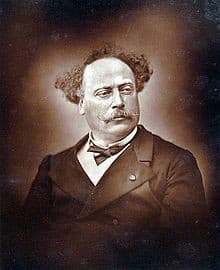
Alexandre Dumas, also known as Alexandre Dumas père, was a French novelist and playwright.







