“The Thing is not a monster. It is a survivor.”
— A character reflects on the alien's nature during a tense moment.

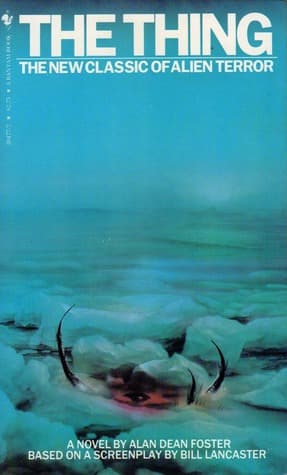
Alan Dean Foster (1982)
Genre
Fantasy / Science Fiction
Reading Time
180 min
Key Themes
See below
Sign in to track this book
In the desolate, icy grip of Antarctica, a shapeshifting alien terror hunts a claustrophobic crew, turning their isolated outpost into a chilling maze of paranoia and bloody survival.
The story opens at U.S. National Science Institute Station Four, a remote Antarctic research outpost. Helicopter pilot J.R. 'Mac' MacReady and his team investigate a Norwegian research station nearby. It has been destroyed, its inhabitants dead or missing. They discover a massive, ancient spacecraft buried deep in the ice, along with a frozen, non-human organism. The Norwegians had tried to thaw and study the creature, which led to their demise. MacReady's team brings the frozen 'Thing' back to their own station for analysis, unaware of the horror they have just unleashed.
Back at Station Four, the research team, led by Dr. Copper, examines the frozen creature. Despite MacReady's warnings about the danger, they decide to thaw it for study. The alien, a shapeshifting organism, quickly reanimates and escapes its containment. It infiltrates the kennel, where it attacks and assimilates the station's sled dogs, transforming them into grotesque copies. The men discover the scene, realizing the creature can perfectly imitate other life forms, making it impossible to distinguish friend from foe.
After the dog kennel incident, the team is on high alert. Bennings, one of the researchers, is left alone for a moment and becomes the Thing's first human victim. The crew discovers a partially assimilated Bennings trying to escape, and MacReady incinerates it. This event destroys any remaining sense of security, as the men realize the creature can now look and sound exactly like one of them. Paranoia grips the station, with everyone suspecting everyone else. MacReady takes command amidst growing chaos.
As distrust grows, MacReady assumes leadership. He proposes a desperate plan: a blood test. He theorizes that because each individual cell of the Thing is an independent organism, it will react violently to external heat. MacReady ties up the remaining crew members and draws their blood. He then uses a heated wire to touch each blood sample. The samples belonging to those assimilated by the Thing writhe and recoil, revealing Norris and then Palmer as the creatures. Both are incinerated, further reducing the dwindling crew.
The Thing, still hidden among them, sabotages the station's generator and the radio equipment, cutting off all communication and power. Garry, the station commander, and Nauls, the cook, discover this. The men realize they are now completely isolated in the harsh Antarctic environment, with no way to call for help and no heat to survive the impending blizzard. The creature's actions show a higher intelligence and a desperate attempt to prevent its detection and spread, amplifying the terror of their situation.
With the station freezing, MacReady, Childs, and Garry go into the generator room to restore power. They discover the Thing has created a grotesque, multi-limbed organism from the assimilated parts of various crew members and dogs. It is trying to build a small escape craft. A desperate battle ensues, with the men using flamethrowers to combat the monstrous entity. During the confrontation, Fuchs, one of the researchers, is attacked and assimilated, further reducing their numbers and showing the Thing's relentless pursuit of survival and propagation.
Realizing the Thing cannot be contained, MacReady forms a plan: they must destroy the entire station, along with the Thing, to prevent it from reaching civilization. He tells the remaining survivors—Childs, Garry, and Nauls—to gather explosives and fuel. The group rigs the entire complex with dynamite and barrels of gasoline. They understand this is their only chance to stop the alien threat, even if it means sacrificing themselves. The desperate measure shows the threat the creature poses.
As the explosives are set, the Thing reveals itself in its most massive and grotesque form, an amalgamation of all its assimilated victims. MacReady, armed with a flamethrower and a detonator, confronts the creature in a final stand. He activates the detonator, setting off a chain reaction of explosions that engulf the entire station in flames. The Thing is consumed by the inferno, its screams echoing amidst the explosions. MacReady narrowly escapes the collapsing structure, witnessing the complete destruction of Station Four.
Amidst the smoldering ruins of the station, only MacReady and Childs emerge as the sole survivors. They huddle together in the freezing Antarctic night, exhausted and wounded, watching the last embers of their base fade. With no communication, no shelter, and plummeting temperatures, their future is bleak. An ambiguity hangs over their final interaction, as they share a bottle of Scotch. The possibility that one of them, or both, could still be the Thing, leaves an unease, ending the story on a note of uncertainty and unresolved dread.
The Protagonist
Transforms from a cynical observer to a decisive, self-sacrificing leader willing to make the ultimate choice to protect humanity.
The Supporting
Initially confrontational and skeptical, he eventually aligns with MacReady, becoming one of the final two survivors, whose true nature remains ambiguous.
The Supporting
Begins as a scientific authority, but his curiosity leads to disaster and his eventual demise.
The Supporting
Relinquishes command under duress, becoming a loyal follower in the fight against the alien.
The Supporting
From a rational scientist, he descends into paranoia, becoming a victim and then an active agent of the Thing.
The Supporting
Initially a laid-back character, he is tragically revealed to be an assimilated Thing.
The Supporting
A seemingly quiet member of the crew, revealed to be one of the earliest assimilated victims, demonstrating the Thing's insidious nature.
The Supporting
Develops from a seemingly minor character to a courageous participant in the fight for survival.
The central theme of the story is the extreme paranoia and distrust that infects the isolated Antarctic research team. Once the Thing's mimetic abilities are understood, every character becomes a potential alien, leading to suspicion, accusations, and violence among the men. This theme is clear in scenes like the blood test, where MacReady forces the men to prove their humanity, and Blair's descent into madness, fearing everyone around him. The inability to distinguish friend from foe erodes camaraderie, leaving the survivors isolated even when surrounded.
“Nobody trusts anybody now. And we're all very tired.”
The narrative explores the desperate struggle for survival against an alien entity that threatens not just the individual characters, but all of humanity. The Thing is an existential threat, capable of consuming and replicating all life. The characters make increasingly extreme decisions, from incinerating their own colleagues to destroying their entire station, to prevent the creature's spread. This theme shows the lengths humans will go when faced with an enemy that cannot be reasoned with or contained, where failure means the end of life as they know it.
“If we're gonna make it, we're gonna have to do it alone.”
The Thing's ability to perfectly imitate and assimilate its victims raises questions about what it means to be human and the fragility of identity. Once assimilated, a person's physical form, memories, and personality are all mimicked, yet their essence is gone. This theme is explored through the horror of seeing familiar faces transform into monstrous aliens, and the thought that one's own companions might no longer be themselves. The final ambiguous ending, with MacReady and Childs, leaves the question of their humanity unresolved, showing the ultimate loss of identity.
“It's imitating us, right? So it's gonna be us. It's gonna be one of us.”
The extreme isolation of the Antarctic setting is a powerful backdrop for the horror. The harsh, unforgiving environment of perpetual ice and snow not only traps the characters with the alien but also contributes to their psychological breakdown. Cut off from all outside help, the station becomes a claustrophobic cage where the external environmental hostility mirrors the internal threat. The loss of heat and communication due to the Thing's sabotage further emphasizes their desperate, hopeless situation, making escape impossible and heightening the stakes.
“We're hundreds of miles from anything. We're not getting out of here.”
The central antagonist, capable of perfect imitation and assimilation.
The Thing itself is the primary plot device, a shapeshifting alien organism that can perfectly assimilate and imitate any living creature it comes into contact with. This ability drives the entire plot, creating the core conflict of paranoia and distrust. Its mimetic nature makes it impossible for the characters to identify the threat, forcing them into extreme measures like the blood test and ultimately leading to the destruction of the station. It is a perfect engine for psychological horror and suspense.
A desperate and gruesome method to identify the assimilated.
MacReady's blood test is a crucial plot device that ratchets up the tension and provides a temporary, albeit horrifying, solution to the problem of identifying the Thing. The theory that each cell of the alien is an independent organism that will react to heat allows for a dramatic and visually impactful scene where the creature is exposed. This device not only reveals hidden Things but also forces the characters to confront the gruesome reality of the alien's nature, further fueling their fear and distrust.
The remote and hostile setting that traps the characters.
The U.S. National Science Institute Station Four in Antarctica functions as a critical plot device. Its extreme isolation cuts the characters off from any hope of external rescue or communication, creating a claustrophobic and inescapable environment. The harsh weather conditions and vast, empty landscape amplify the sense of dread and hopelessness, ensuring that the characters are truly alone with the monstrous alien, forcing them to rely solely on themselves and their dwindling resources.
A strategic move by the Thing to ensure its survival and spread.
The Thing's deliberate sabotage of the station's radio equipment and generator is a pivotal plot device. By cutting off all communication and power, the alien isolates the survivors completely, plunging them into darkness and extreme cold. This act forces MacReady and his team into a desperate confrontation, as restoring power becomes essential for survival, leading directly to the discovery of the Thing's escape craft and the final battle.
“The Thing is not a monster. It is a survivor.”
— A character reflects on the alien's nature during a tense moment.
“In the cold, nothing is what it seems.”
— Describing the Antarctic setting and the paranoia it fosters.
“Trust is a luxury we can't afford anymore.”
— Spoken as the team realizes anyone could be infected.
“It doesn't want to conquer. It wants to become.”
— Analyzing the Thing's goal of assimilation.
“The only way to be sure is to burn it all.”
— A pragmatic solution to contain the threat.
“We're not fighting an enemy. We're fighting a reflection.”
— Commenting on how the Thing mimics its victims.
“In this place, the cold is the only thing you can trust.”
— Highlighting the harsh, deceptive environment.
“Every man is an island now, surrounded by a sea of doubt.”
— Describing the breakdown of team cohesion.
“It learns from us, becomes us, and then it's too late.”
— Warning about the Thing's adaptive abilities.
“Fear is the real monster here.”
— A character observes how paranoia drives their actions.
“We brought the end of the world with a block of ice.”
— Reflecting on the discovery of the alien in the ice.
“There are no heroes in the snow, only survivors.”
— A grim assessment of their situation.
“The Thing doesn't hate. It just is.”
— Philosophizing about the alien's lack of malice.
“You can't kill what's already part of you.”
— Facing the horror of internal contamination.
Ready to see how well you understood this book? Take our interactive quiz with 10 questions.

Alan Dean Foster is a prolific American author known for his extensive work in science fiction and fantasy. He is particularly celebrated for his novelizations of major films, including "Alien," "The Thing," and "Star Wars: A New Hope." Foster has authored numerous original novels, such as the "Pip and Flinx" series, earning him a dedicated readership and recognition within the genre.







