“Sometimes you want things to change so badly, you can't even stand to be in the same room with the way things actually are.”
— Suzy reflecting on her desire to understand her friend Franny's death.

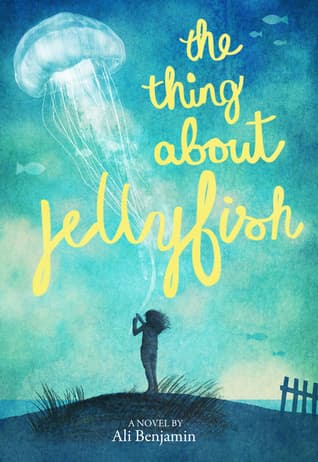
Ali Benjamin (2015)
Genre
Children's / Young Adult
Reading Time
300 min
Key Themes
See below
Sign in to track this book
A heartbroken twelve-year-old travels the world to prove a rare jellyfish sting, not an accident, killed her best friend, finding wonder and hope in her scientific pursuit of grief.
Twelve-year-old Suzy Swanson learns from her parents that her former best friend, Franny Jackson, drowned during her summer vacation. Suzy is shocked and confused, then becomes silent at home and school. She refuses to speak to her parents, her brother Aaron, or her teachers. Internally, Suzy deals with the sudden, inexplicable loss, unable to accept it as a simple accident. She begins to research jellyfish, convinced that a rare, venomous species caused Franny's death. She believes that 'things do not just happen' without a logical, scientific cause.
Driven by grief and a need for a scientific explanation, Suzy forms a detailed hypothesis: Franny was stung by an Irukandji jellyfish, a tiny, deadly species found in tropical waters. She gathers information about these jellyfish, their symptoms, and their habitats. Her research takes over her life, providing an escape from the emotional pain of Franny's death and awkward social interactions. Suzy plans to travel to Australia, where Irukandji jellyfish are found, to find a leading marine biologist, Dr. Jamie Seymour. She hopes he can confirm her theory and provide the 'reason' she desperately seeks.
Suzy starts seventh grade, remaining silent. Her teachers are concerned, and her former friends, including Sarah and Molly, avoid her. Suzy finds comfort in her scientific observations, especially of Justin Maloney, a quirky boy in her class who is also somewhat of an outcast. Justin, initially the subject of Suzy's 'field notes' due to his unusual habits, eventually becomes the only person she communicates with, through written notes. He understands her need for space and her unique way of processing the world, offering a quiet, non-judgmental presence in her isolated life.
Throughout her journey, Suzy has flashbacks to her friendship with Franny, showing their complex relationship and eventual split. She remembers their shared childhood, their secret language, and their interest in the natural world. The flashbacks show how Franny began to change in sixth grade, becoming more interested in boys, makeup, and fitting in with a popular crowd, the 'A-Listers.' Suzy felt left behind and misunderstood, struggling to adapt to Franny's changing interests. This led to a painful, unspoken separation that was never resolved before Franny's death.
To reach Dr. Seymour, Suzy realizes she needs money for her trip. She starts by selling her possessions, including cherished toys and books, at a yard sale. She also considers more ambitious plans, like asking for donations. Her brother, Aaron, helps by giving her an old globe. Suzy researches flight paths, hotel costs, and the exact location of Dr. Seymour's lab. Her silent dedication to this elaborate plan becomes her only focus, giving her a sense of purpose and control in a world that feels chaotic and unfair.
Suzy decides to visit the local aquarium to get more information about jellyfish. There, she meets Dr. Evans, a marine biologist who works with various jellyfish species. Suzy, still silent, presents her research and hypothesis through written notes. Dr. Evans, impressed by Suzy's dedication and knowledge, gently explains that an Irukandji jellyfish is unlikely to be in the temperate waters where Franny drowned. This encounter creates the first significant doubt in Suzy's theory, forcing her to consider that her scientific explanation might be wrong.
Suzy's brother, Aaron, worried about her long silence and strange behavior, tries to connect with her, leaving notes and attempting conversations, but Suzy does not respond. Meanwhile, Justin remains a quiet, supportive presence. He shares his own observations about the world, his struggles with his parents, and his interest in space. Their silent communication through notes deepens their unique bond. Justin never pushes Suzy to speak, but simply supports her, understanding her need for her own process.
For a school project, Suzy chooses to present on jellyfish, using it to subtly support her theory. During her presentation, she shows a video of Irukandji jellyfish, intending to convey their danger. However, the emotional weight of her grief, the frustration of her silence, and the pressure become too much. Suzy finally breaks her silence, blurting out her anger and confusion about Franny's death, saying she believes 'things do not just happen.' This outburst shocks her classmates and teachers, but it also marks a step in her healing.
After her outburst at school, Suzy feels she must see Franny's mother. She visits the Jackson home, and in a raw, emotional conversation, Franny's mother tells her the truth: Franny had been struggling to fit in and trying to impress her new friends. She had gone swimming at night, alone, in a risky attempt to prove herself. Franny's mother gently explains that Franny's death was a tragic accident, a result of poor judgment and the pressures of adolescence, not a rare jellyfish sting. This revelation shatters Suzy's scientific explanation, forcing her to face the messy, painful reality of grief.
With her scientific theory disproven, Suzy is left with the raw, emotional pain of loss. She slowly begins to accept that sometimes, things just happen, and not everything has a neat, scientific explanation. She starts to speak again, first to Justin, then to her family. She visits Franny's grave and finally allows herself to mourn openly. Suzy realizes that while the world can be unpredictable and unfair, it is also full of wonder and connection. Her journey, initially driven by a need for scientific closure, ultimately leads her to emotional acceptance and a new appreciation for the people and mysteries of life around her.
The Protagonist
Suzy transforms from a girl trapped by grief and a need for scientific certainty into one who accepts the messy, inexplicable nature of life and finds her voice again.
The Supporting
Franny's character is static, revealed through flashbacks, showcasing her shift from a kindred spirit to a typical middle schooler seeking social acceptance.
The Supporting
Justin remains a steadfast and understanding friend, providing consistent support for Suzy without undergoing significant personal change within the narrative.
The Supporting
Aaron tries to understand and connect with his sister, eventually finding ways to support her as she begins to heal.
The Supporting
They learn to navigate their daughter's unique grieving process and are relieved when she finally begins to speak and heal.
The Supporting
They remain minor characters, serving as a catalyst for Franny's changing social dynamics.
The Mentioned
Does not have an arc, serves as Suzy's distant goal.
The Supporting
Does not have an arc, serves as a catalyst for Suzy's re-evaluation.
The main theme is Suzy's grief after Franny's unexpected death. Suzy cannot accept the randomness of the event, so she becomes silent and obsessively seeks a scientific explanation. Her journey shows the many ways people process loss, moving through denial, anger, and eventually, acceptance. The book explores how grief can isolate, but also how expressing and sharing it helps healing, as seen when Suzy finally breaks her silence and faces the truth.
“Things don't just happen. There has to be a reason.”
The novel explores how childhood friendships change and face challenges. Through flashbacks, Suzy remembers the strong bond she shared with Franny, and the painful process of growing apart as Franny changed in middle school. This theme shows how friendships can shift, and the heartbreak when one friend moves on while the other struggles to keep up. It also touches on the pressures of conformity and finding identity during adolescence, showing how these factors can strain even the closest bonds, leaving unresolved feelings amplified by loss.
“It was like she was a different species. A new, more popular species.”
Suzy, a scientifically-minded girl, believes every event must have a logical, explainable cause. Her quest to prove Franny's death was due to a rare jellyfish sting is an attempt to bring order to a chaotic, emotional reality. This theme contrasts the human need for scientific understanding with the messy, often irrational nature of emotions and the unexplainable parts of life and death. Ultimately, Suzy learns that not everything can be neatly categorized or explained by science, and that sometimes, accepting uncertainty and embracing emotional truth is necessary for healing.
“I needed the truth to be clean, to be knowable, to be something I could write down in a notebook.”
Suzy's journey, initially about Franny, becomes an exploration of her own identity. Her silence is a coping mechanism, but also a way to retreat into her unique self, free from social expectations. Through her research, her observations of others like Justin, and her eventual confrontation with the truth, Suzy begins to understand who she is without her friendship with Franny. She learns to value her own way of seeing the world and to find her voice, not just literally, but in asserting her own feelings and understanding of life.
“Maybe what I was doing wasn't running away. Maybe it was running toward.”
Allows deep immersion into Suzy's unique internal world and scientific thought process.
The story is told entirely from Suzy's point of view, immersing the reader in her internal monologue, scientific observations, and emotional struggles. This perspective is crucial for understanding her self-imposed silence and her logical, often detached, way of processing grief. It allows the reader to witness her detailed research, her flashbacks, and her gradual emotional awakening, making her journey intensely personal and empathetic. Without this close perspective, her actions might seem eccentric, but through her eyes, they become understandable.
Reveals the history and nuances of Suzy and Franny's friendship.
Interspersed throughout the main narrative, flashbacks provide glimpses into Suzy and Franny's past friendship, from their early childhood bond to the painful unraveling in middle school. These memories are essential for understanding the depth of Suzy's loss and the complexities of her unresolved feelings. They highlight the contrast between their earlier closeness and their later estrangement, adding layers to Suzy's grief and her need to understand 'why' things happened the way they did, both in their friendship and in Franny's death.
Represents the elusive, beautiful, and dangerous aspects of life and grief.
Jellyfish serve multiple symbolic functions. Initially, they are Suzy's scientific explanation for Franny's death, representing her need for a logical, external cause for inexplicable pain. As the story progresses, jellyfish also symbolize the beautiful yet dangerous, mysterious, and often uncontrollable aspects of life and the natural world. Their transparency and lack of a central brain reflect the elusive nature of understanding and the messiness of emotions. Ultimately, they become a symbol of acceptance of the unknown and the wonder that exists even amidst sorrow.
A physical manifestation of her grief and a coping mechanism.
Suzy's self-imposed silence is a central plot device. It isolates her from others, forcing her to process her grief internally and communicate in non-traditional ways (like notes with Justin). It symbolizes her inability to verbalize her pain and her refusal to accept the 'randomness' of Franny's death. The eventual breaking of her silence is a pivotal moment in her healing process, signifying her readiness to confront her emotions and reconnect with the world. It also highlights the different ways children cope with trauma.
“Sometimes you want things to change so badly, you can't even stand to be in the same room with the way things actually are.”
— Suzy reflecting on her desire to understand her friend Franny's death.
“I used to think that if you just paid close enough attention, you could see the world as it really is. But now I think maybe the world is just a collection of things that don't make sense.”
— Suzy grappling with the randomness of tragedy.
“The thing about jellyfish is that they're mostly water. They don't have brains or hearts or bones. They just drift, and they sting, and sometimes they glow.”
— Suzy's scientific observation about jellyfish, metaphorically linked to human emotions.
“Maybe there are no true friends. Maybe there are only people who haven't disappointed you yet.”
— Suzy's cynical thought after Franny's death and their friendship's unraveling.
“Silence isn't empty. It's full of answers.”
— Suzy learning to listen and reflect in the aftermath of loss.
“I wanted to believe that if I could just find the right fact, it would explain everything.”
— Suzy's obsession with scientific facts to make sense of Franny's drowning.
“Grief is a kind of weather. It comes and goes, and sometimes it storms.”
— Suzy describing the unpredictable nature of mourning.
“The world is full of invisible strings, connecting everything to everything else.”
— Suzy contemplating the interconnectedness of life and events.
“Sometimes the bravest thing you can do is keep going, even when you don't know where you're going.”
— Suzy's realization about resilience in the face of uncertainty.
“Words are like jellyfish: beautiful, but they can sting.”
— Suzy reflecting on the power and pain of communication.
“You can't un-know a thing. Once you know it, it's part of you forever.”
— Suzy on the permanence of knowledge and experience.
“Maybe the point of life isn't to find answers, but to learn how to live with the questions.”
— Suzy's growing acceptance of life's mysteries.
“The ocean doesn't care about your plans. It just is.”
— Suzy comparing the indifferent vastness of the ocean to life's unpredictability.
“Friendship is a fragile thing, like a jellyfish. It can be beautiful one moment and gone the next.”
— Suzy musing on the transient nature of relationships.
Ready to see how well you understood this book? Take our interactive quiz with 10 questions.

Dan Gemeinhart
4.5

Kate O'Hearn
4.4

Jeanne Birdsall
4.4

Jen Wang
4.4

Wendelin Van Draanen
4.3

John Marsden
4.3

Chris Van Allsburg
4.3

Jennifer A. Nielsen
4.2