“All that a man had to do was to die well, and that was a thing that a man could do.”
— Reflecting on the stoicism and grim determination of soldiers facing death in combat.

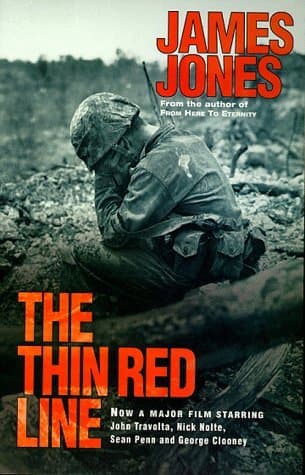
James Jones (1962)
Genre
Historical Fiction
Reading Time
12-15 hours
Key Themes
See below
Sign in to track this book
On Guadalcanal, 'The Thin Red Line' shows how brutal combat strips C-for-Charlie Company of meaning, leaving only a raw fight for survival and identity.
C-for-Charlie Company, a U.S. Army rifle company, arrives on Guadalcanal. The men, including Privates Witt, Bell, Doll, and Fife, along with Captain James Stein and First Sergeant Eddie Welsh, are initially confused by the humid jungle and the strong feeling of isolation. They are part of a larger force sent to relieve the tired First Marine Division. The story quickly shows the company's different personalities and the tension between enlisted men and officers, especially the cynical First Sergeant Welsh and the ambitious Captain Stein. The men know the dangers ahead, even without direct combat yet.
C-for-Charlie Company receives orders to advance on Hill 209, a Japanese stronghold. The march through the thick jungle is hard, marked by heat, constant watch, and the mental strain of waiting for an unseen enemy. Captain Stein, wanting to prove himself, pushes his men hard, causing resentment among some privates. First Sergeant Welsh, a veteran, acts tough but protects his men, often disagreeing with Stein about tactics and soldier welfare. Private Bell, thinking of his wife, struggles with war's reality, while Private Witt, rebellious but kind, often clashes with authority, seeking deeper meaning in the brutality.
The company first meets Japanese forces while trying to take Hill 209. The initial attack faces strong resistance, leading to many casualties. Combat's raw reality shatters any illusions the men had. Privates are killed and wounded, and the battle's chaos is clear. First Sergeant Welsh acts bravely, exposing himself to enemy fire to rally his men and help the wounded. Captain Stein, though shaken, tries to keep control, but the strong Japanese defense forces the company to dig in and regroup. The men understand the enemy's resolve and the high cost of the fight.
The fight for Hill 209 becomes a long and brutal struggle. C-for-Charlie Company repeatedly tries to dislodge the Japanese, facing machine gun fire, grenades, and banzai charges. The men endure constant shelling and sniper fire, leading to exhaustion and fear. Private Doll, a skilled but increasingly hardened machine gunner, becomes key to the company's defense. Private Fife, a more cynical soldier, watches the horror with a detached air. The company's morale shifts between grim resolve and despair as they see comrades fall. The jungle itself becomes an enemy, with its heat, insects, and constant ambush threat.
Constant exposure to death and extreme violence affects C-for-Charlie Company's men deeply. Private Bell's longing for his wife becomes an agonizing obsession, blurring reality and memories. Captain Stein struggles with the pressure of command, making decisions that weigh on him. First Sergeant Welsh, though tough, carries his men's suffering. Some soldiers show signs of combat fatigue and mental breakdown, questioning their fight's purpose and their lives' value. The camaraderie among the men, from shared hardship, becomes a vital, though fragile, way to cope with fear and despair.
After weeks of brutal fighting and heavy losses, C-for-Charlie Company is relieved from Hill 209. The survivors are physically and mentally shattered, their faces showing the horrors they saw. Fresh troops replace them, who, despite initial enthusiasm, soon grasp the grim reality of battle. Charlie Company's men, though safe for now, find it hard to adjust to normal life. Combat's sounds, smells, and images are burned into their minds, making rest and recovery difficult. The arrival of replacements highlights war's relentless nature and the expendability of individual lives.
Behind the lines, C-for-Charlie Company tries to recover and reorganize. The men do routine tasks, clean weapons, and try to find rest. However, combat's psychological scars are clear. Private Bell remains consumed by thoughts of his wife, struggling to connect his war experiences with his pre-war life. Private Witt, always seeking meaning, observes the men and world with a philosophical eye, often clashing with First Sergeant Welsh's cynical view. Captain Stein deals with the aftermath of his command decisions and the loss of his men. The brief break offers little true peace, as the men know they will return to battle.
Despite their exhaustion, C-for-Charlie Company is ordered back to the front lines as the Guadalcanal battle continues. The men, now hardened veterans, face renewed combat with grim acceptance and dread. The island landscape has become a familiar, yet terrifying, backdrop to their struggle. The command structure remains, with Captain Stein and First Sergeant Welsh continuing their strained working relationship. The return to the front emphasizes the Pacific War's relentless, grinding nature, where companies return to battle after short rests, further eroding soldiers' spirits and sense of purpose.
In Guadalcanal's final stages, C-for-Charlie Company takes part in the last major offensives to secure the island. Fighting remains fierce, though Japanese forces are depleted and desperate. The weary men push forward, driven by survival instinct and a desire for the war to end. Private Witt, in a selfless act, tries to help a wounded Japanese soldier, but other Japanese troops kill him. His death is a sad moment, showing war's futility. The company, having endured great hardship, sees the Japanese defeat and Guadalcanal's securing, but the victory costs each survivor deeply.
With Guadalcanal secured, C-for-Charlie Company's survivors prepare to leave. The island, once a terrifying battlefield, now holds grim memories and a sense of a finished mission. The men are forever changed, their innocence lost, and their views on life altered. First Sergeant Welsh, still gruff, shows a deeper, unspoken care for his men. Captain Stein reflects on his command and the sacrifices made. The men leave the island, carrying combat's lasting marks, the bonds made in war, and lingering questions about their suffering and survival. The war, for them, is not over in their minds.
The Supporting
Welsh remains largely consistent in his pragmatic approach, but his actions reveal a deepening, if unspoken, bond with his men and a growing weariness with the senselessness of war.
The Protagonist
Witt begins as an idealist seeking truth, and while he faces the grim realities of war, he ultimately makes a profound, self-sacrificing choice that reflects his core values.
The Supporting
Stein's initial ambition gives way to a more somber and reflective understanding of the immense, often tragic, responsibilities of command.
The Supporting
Bell's initial hope of returning home becomes increasingly challenged by the trauma of war, leading to a profound internal struggle between his past and present.
The Supporting
Doll transforms from a regular soldier into a highly effective, but increasingly desensitized, combatant, reflecting the dehumanizing effects of war.
The Supporting
Fife's cynicism deepens as he witnesses the absurdities and horrors of war, yet he remains a survivor, adapting to the harsh realities.
The Supporting
Tall remains largely static, driven by his ambition, embodying the detachment of higher command from the grunt's perspective.
The Mentioned
Mazzi's arc is cut short by an arbitrary death, serving as a stark illustration of war's randomness.
The novel clearly shows combat's visceral, chaotic, and often pointless brutality. Descriptions of gore, death, and constant fear remove any romantic ideas of war. Soldiers become tools of killing and survival, their identities lost in the shared violence. Constant exposure to death desensitizes many, while others fight to keep their humanity. The physical and mental toll is clear in every character, from privates' exhaustion to officers' moral dilemmas. The jungle itself becomes an oppressive, hostile force mirroring inner struggles.
“When compared to the fact that he might be dead tomorrow, everything was pointless. Life was pointless. Whether he looked at a tree or not was pointless. It just didn't make any difference.”
Amidst the violence, many characters, especially Private Witt, ask big questions about life, death, and why they suffer. Witt actively seeks beauty and connection, even trying to talk to a wounded Japanese soldier, a sharp contrast to the surrounding brutality. Other characters, like Private Bell, hold onto memories of home and love to find meaning beyond the immediate horror. The novel explores how people try to build or keep a sense of purpose when faced with an environment designed to take it away, whether through philosophy, personal ties, or simply a grim will to survive.
“Maybe all men got one big soul where everybody's a part of. Maybe everybody's in it and it's in everybody.”
The novel examines the difficult and morally unclear aspects of wartime leadership. Captain Stein struggles with the immense pressure of command, balancing objectives with his men's lives, often causing inner conflict and clashes with First Sergeant Welsh. Welsh shows a different kind of leadership—one from experience and a fierce, if gruff, loyalty to his soldiers, often questioning his superiors' decisions. The novel highlights the great gap between high-level strategic decisions by distant officers like Lieutenant Colonel Tall and the brutal realities faced by men on the ground, showing the often fatal results of ambition and incompetence.
“They were all just 'troops' to the brass, expendable units in a grand design.”
Despite individual mental struggles, a strong camaraderie develops among C-for-Charlie Company's men. This bond, formed in shared hardship and mutual reliance, becomes a key way to cope with fear and isolation. Soldiers depend on each other for survival, comfort, and a sense of normal life. However, the novel also stresses the deep isolation in each soldier's war experience. Each man faces his own fears, memories, and inner demons alone, even when surrounded by comrades. Private Bell's inner world, dominated by thoughts of his wife, shows this deep personal isolation within the group struggle.
“They were all alone in it, each man for himself, and yet they were bound together by something stronger than any rope.”
Guadalcanal itself is a powerful enemy, as much as the Japanese forces. The thick, humid jungle, with its heat, rain, dangerous creatures, and harsh land, constantly tests the soldiers' endurance and sanity. The natural environment is not just a backdrop but an active part of the suffering, making combat's physical and mental toll worse. The jungle's indifference to human struggle underscores the larger theme of how little individual lives matter when faced with overwhelming forces, both natural and man-made. The constant fight against nature adds another layer of brutality to the war experience.
“The jungle was an enemy, too, as deadly and relentless as any Japanese.”
The narrative frequently switches between the internal thoughts of various characters.
James Jones employs a shifting, omniscient point of view that delves deep into the minds of multiple characters within C-for-Charlie Company. This technique allows the reader to experience the war from diverse perspectives—from the philosophical musings of Private Witt and the marital longings of Private Bell, to the command anxieties of Captain Stein and the cynical pragmatism of First Sergeant Welsh. This constant shift provides a multifaceted and intimate portrayal of the psychological impact of war, revealing the individual fears, hopes, and moral struggles that coexist within the collective experience of combat. It emphasizes that while they fight together, each man's war is uniquely personal.
Extensive use of characters' unvoiced thoughts and reflections.
A significant portion of the novel is dedicated to the detailed internal monologues of its characters. These lengthy passages reveal the soldiers' deepest fears, their attempts to rationalize the horrors they witness, their memories of home, and their philosophical ponderings on life and death. For instance, Private Bell's mind is often consumed by fantasies of his wife, while Captain Stein grapples with his command decisions. This device allows Jones to explore the psychological landscape of war with profound depth, highlighting the disconnect between outward stoicism and inner turmoil, and emphasizing the individual mental battles fought alongside the physical ones.
Authentic and often vulgar language reflects the harsh realities of military life.
The novel uses highly realistic and often vulgar dialogue, including frequent profanity, to accurately depict the language spoken by soldiers in combat. This authentic language serves to immerse the reader in the raw, unvarnished reality of military life and combat. It reflects the stress, fear, frustration, and camaraderie of the men, and helps to establish their distinct personalities and backgrounds. The blunt, unpolished speech contrasts sharply with any idealized notions of warfare, reinforcing the novel's commitment to portraying the grimy, brutal truth of the soldiers' experiences without euphemism or romanticism. It's an integral part of the novel's unflinching realism.
The natural environment of Guadalcanal acts as a character and a symbolic force.
The jungle of Guadalcanal is not merely a setting but a powerful symbolic force in the novel. It represents an indifferent, hostile, and primordial force that constantly tests the soldiers. Its oppressive heat, dense undergrowth, unseen dangers, and pervasive humidity mirror the psychological weight of the war itself. The jungle embodies chaos, untamed nature, and the sense of being lost and insignificant within a vast, deadly environment. It strips away civilization and forces the men back to basic instincts, serving as a constant reminder of their vulnerability and the brutal, animalistic aspects of their struggle against both the enemy and the elements.
“All that a man had to do was to die well, and that was a thing that a man could do.”
— Reflecting on the stoicism and grim determination of soldiers facing death in combat.
“Nobody never wins a war. Not really.”
— A cynical observation about the ultimate futility and cost of war, regardless of who is declared victor.
“The only thing that made sense was to stay alive, and the only way to stay alive was to kill.”
— The brutal logic of survival in the jungle, where the act of killing becomes a necessity for self-preservation.
“They were all in it together, but they were all in it alone.”
— Describes the paradox of camaraderie and individual isolation felt by soldiers in combat.
“Every man was a coward in his heart, and the trick was to keep it from showing.”
— Explores the universal fear experienced by soldiers and the societal pressure to conceal it.
“War was a great big, complicated, dirty, stinking thing, and it had a life of its own.”
— A vivid description of war as a monstrous, autonomous entity that consumes all within its path.
“The jungle was a living, breathing thing, and it was always trying to kill you.”
— Personifies the natural environment of Guadalcanal as an active, malevolent force against the soldiers.
“You couldn't ever really tell what was going on, not really, not from your own little corner of it.”
— Highlights the limited perspective of individual soldiers in the chaos of battle, unable to grasp the larger strategic picture.
“The only thing that really mattered was the next breath, the next step, the next moment.”
— Emphasizes the focus on immediate survival and the loss of long-term perspective in intense combat situations.
“It was impossible to hate your enemy when you were too busy trying to stay alive.”
— Suggests that the primal instinct for survival often overrides ideological hatred in the heat of battle.
“What was courage anyway? Just the ability to keep on going when you wanted to stop.”
— A pragmatic and unromantic definition of courage, emphasizing perseverance over innate bravery.
“The rain was a living thing too, and it was as much an enemy as the Japanese.”
— Further illustrates the hostile environment of the jungle, where even the weather becomes a formidable adversary.
“All you could do was to put one foot in front of the other and try to stay alive.”
— A simple, yet profound, summation of the daily struggle and determination of soldiers in a brutal war.
Ready to see how well you understood this book? Take our interactive quiz with 10 questions.

James Jones may refer to:







