“A good detective must have a sharp mind and a sharp eye.”
— Flavia Gemina explains her approach to solving mysteries.

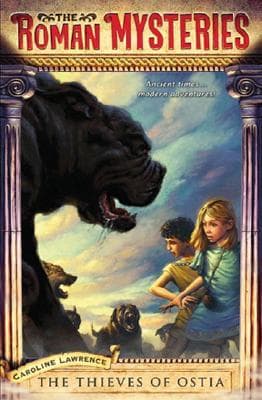
Genre
Children's / Historical Fiction / Mystery / Young Adult
Reading Time
160 min
Key Themes
See below
Sign in to track this book
In ancient Ostia, a Roman girl and her friends solve a canine murder mystery, uncovering secrets and finding justice.
The story begins in Ostia, 79 A.D., with Flavia Gemina, a Roman girl, mourning her dog, Myrtilla. She finds Myrtilla dead in the street and thinks she was poisoned. Soon after, more dogs in her neighborhood die in similar ways, alarming residents. Flavia, observant and curious, wants to find out what happened. She suspects a crime, not a natural illness. Her investigation starts with asking neighbors and looking for clues in Ostia. This first tragedy makes Flavia a detective, a rare role for a girl at that time.
Flavia's world grows with new neighbors. Jonathan, a Jewish boy from Jerusalem, moves in next door with his family. He is smart and educated, though shy at first. Soon after, Nubia, a young Christian slave girl from Africa, arrives in Ostia with her master, a merchant named Gemellus. Nubia is bright and observant, despite her difficult situation. Flavia is drawn to their different views and quickly becomes friends with Jonathan and Nubia. Their varied backgrounds and skills will be helpful as they solve the mystery of the dying dogs. This new friendship group forms the core of the young detectives.
While investigating a dog's death at a baker's shop, Flavia, Jonathan, and Nubia meet Lupus, a mute beggar boy who lives on Ostia's streets. Lupus is a resourceful child who uses gestures to communicate. He often appears with his wolf-dog, Faustus, who survived the mysterious dog deaths. Lupus knows the city's hidden places and can move around unseen, making him a useful part of the detective team. Though he cannot speak, Lupus is intelligent and perceptive, often noticing details others miss. His addition completes the group of young investigators.
The four children start combining their observations and skills. Jonathan, with his sharp mind, helps figure out that the dogs are not dying from a natural illness but are being poisoned on purpose. They find a dark, bitter substance near the dead dogs. Lupus, through his silent watching, often points them to important places or details. Nubia, with her senses, notices the almond smell, a common poison ingredient. Their combined efforts lead them to believe someone is spreading poison, possibly rat poison, in Ostia. This changes the mystery from accidents to a deliberate crime.
As the investigation continues, the children start to find possible suspects. They learn that the dogs are dying near certain places, suggesting a pattern. They consider people who might want to harm dogs, like those annoyed by barking or those who might benefit from their deaths. They also notice the poison seems to be in food scraps, showing a planned method. The children follow leads, ask shopkeepers, and watch suspicious behavior, slowly building a picture of the culprit. Their teamwork is important, with each child adding their unique talents to the puzzle.
During their investigation, the children watch the busy Ostia market. They notice that the poisoned food scraps often have traces of a specific meat or bread sold by certain vendors. Lupus, with his street knowledge, is good at tracking where discarded food comes from. Jonathan uses his knowledge of Roman business to suggest who might be selling such items. Nubia, with her sense of smell, helps identify the scent of the poisoned food. They start to focus on one area of the market, thinking the poisoner is a vendor or someone connected to one.
Through deduction and observation, the children identify the poisoner: a baker named Caudex. They find out Caudex was angry because stray dogs kept raiding his bakery and stealing bread, costing him money. To protect his business, he put poison in bread scraps and left them for the dogs. The children confront Caudex with their evidence. Caudex at first defends himself, then admits what he did, explaining his frustration. His reason, though understandable, does not excuse the harm he caused to Ostia's pets.
After Caudex's confession, Flavia's father, a respected ship owner, learns of the crime. Caudex is arrested and faces the law. The children, feeling accomplished and relieved, also make sure the dead dogs get a proper burial, giving closure to the owners. This act of kindness shows their empathy. Ostia's streets are safe for dogs again, and the community is thankful for the young detectives. The experience strengthens the bond between Flavia, Jonathan, Nubia, and Lupus, making them a close group of friends and problem-solvers.
With the mystery solved and justice done, Flavia, Jonathan, Nubia, and Lupus think about their adventure. They see the strengths each person brought to the investigation – Flavia's leadership and curiosity, Jonathan's intelligence, Nubia's senses and empathy, and Lupus's street smarts and observation skills. Their success makes them more confident and gives them a taste for solving mysteries. The story ends with the four friends knowing this is probably the first of many mysteries they will solve together in Ostia, establishing them as the 'Roman Mysteries' team.
The Protagonist
Flavia transforms from a grieving pet owner into a determined and capable young detective, discovering her talent for solving mysteries.
The Supporting
Jonathan grows from a quiet newcomer into a confident and essential member of the detective team, valuing friendship and adventure.
The Supporting
Nubia finds friendship and purpose, moving from a position of vulnerability to an empowered member of a detective team.
The Supporting
Lupus finds belonging and a voice (through his actions) within the group, moving from solitary survival to collaborative friendship.
The Antagonist
Caudex is revealed as the perpetrator, his actions leading to his apprehension and the resolution of the mystery.
The Supporting
He provides the authority figure necessary to resolve the conflict legally, affirming his daughter's capabilities.
The Supporting
Pulchra consistently provides a grounding and caring presence for Flavia throughout her adventures.
The Mentioned
Faustus's survival is a key motivator for Lupus, and his continued presence symbolizes the resolution of the threat.
The Mentioned
His role primarily establishes Nubia's social status and circumstances.
The main theme is the friendship between Flavia, Jonathan, Nubia, and Lupus. Despite their different social positions, religions, and backgrounds (Roman noble, Jewish immigrant, African slave, and mute street orphan), they work together. Their skills – Flavia's leadership, Jonathan's intelligence, Nubia's senses, and Lupus's street smarts – are all needed to solve the mystery. This shows that different perspectives and teamwork are stronger than individual efforts. Their bond grows with each clue, showing the strength of unity.
““They were an unlikely quartet: a Roman girl, a Jewish boy, an African slave girl, and a mute beggar boy. But together, they were formidable.””
The children want to find the truth about the dog deaths because they believe in justice. They think harming animals is wrong and the person responsible should be held accountable. This theme looks at the moral side of actions, even those done out of frustration, and how important it is to find truth and fairness. The children's search for justice for the dogs and their owners teaches them about responsibility and the results of crime.
““It wasn't just about the dogs, thought Flavia. It was about right and wrong.””
The book shows the social structure of ancient Rome, with clear differences between citizens, foreigners, and slaves. However, the friendships among Flavia, Jonathan, Nubia, and Lupus go beyond these barriers. Flavia, a freeborn Roman, befriends a Jewish boy, an African slave, and a beggar, challenging her society's norms. This theme shows that human connection and a shared goal can bridge gaps of class, ethnicity, and status, promoting understanding among different people. Their interactions show the values of empathy and equality.
““In the face of a mystery, their differences melted away. They were simply friends, working towards a common goal.””
At its core, the book is a mystery, so observation and deduction are very important. The children gather clues, notice small details, and use logic to solve the puzzle of the dying dogs. Jonathan's intelligence, Nubia's senses, Lupus's silent observations, and Flavia's ability to put information together are all key to their detective work. This theme celebrates critical thinking, attention to detail, and the scientific way of investigating, encouraging readers to think analytically.
““Every detail counted, no matter how small. A broken amphora, a strange smell, a footprint in the dust – all were pieces of the puzzle.””
A group of young protagonists solving a crime, often underestimated by adults.
The core plot device is the use of a quartet of child protagonists as detectives. Flavia, Jonathan, Nubia, and Lupus, despite their youth and varied social standings, are the primary investigators. This device allows for fresh perspectives, as they notice details adults might overlook and navigate the city in ways adults cannot. Their being children also creates a sense of vulnerability and ingenuity, as they must rely on their wits and teamwork rather than authority, making their eventual success all the more satisfying. It also allows for the exploration of themes like friendship and overcoming social barriers.
The use of 79 A.D. Ostia as a vibrant and integral backdrop to the mystery.
The entire story is set in the ancient Roman port city of Ostia in 79 A.D. This historical setting is not merely a backdrop but an active element of the plot. Details of Roman life, customs, architecture, and social structures are woven into the narrative, providing clues and shaping character interactions. For example, the presence of slaves like Nubia, the multi-ethnic population including Jonathan's Jewish family, and the daily routines of a Roman port city are integral to the story's authenticity and the challenges faced by the children. The setting enriches the mystery, offering a vivid and educational experience.
Misleading clues or suspects used to divert the reader's attention.
As a mystery novel, 'The Thieves of Ostia' employs red herrings to keep readers guessing. The children initially consider various individuals or explanations for the dog deaths before arriving at the truth. For example, they might suspect someone who dislikes dogs in general or a rival baker. These diversions serve to build suspense, complicate the investigation, and make the eventual reveal of the true culprit, Caudex, more impactful. This device encourages readers to engage in the detective process alongside the characters, making their own deductions and reconsidering initial assumptions.
A pet whose survival and connection to a character drives part of the plot.
Lupus's wolf-dog, Faustus, serves as a significant animal companion. Faustus's survival of the mysterious poisonings makes the case deeply personal for Lupus and provides a direct link to the victims. The fact that Faustus is a survivor also provides a unique perspective on the poison, as the children can observe his reactions or lack thereof. The bond between Lupus and Faustus highlights themes of loyalty and protection, and Faustus often acts as a silent, observant presence that sometimes leads the children to clues or points of interest.
“A good detective must have a sharp mind and a sharp eye.”
— Flavia Gemina explains her approach to solving mysteries.
“Friendship is the greatest treasure of all.”
— Reflection by Flavia after solving the mystery with her friends.
“Even in a busy port like Ostia, secrets can be hidden in plain sight.”
— Observation about the setting and mystery.
“Courage isn't the absence of fear, but acting despite it.”
— Encouragement to a friend during a dangerous moment.
“The past always leaves clues for those who know how to look.”
— Discussing how history helps solve the present mystery.
“Sometimes the smallest detail can unravel the biggest mystery.”
— Highlighting the importance of attention to detail in detective work.
“In Ostia, everyone has a story, and not all of them are true.”
— Comment on the diverse and sometimes deceptive characters in the port city.
“Trust must be earned, not given freely.”
— Advice about dealing with suspicious individuals in the investigation.
“A mystery is like a puzzle; each piece must fit perfectly.”
— Analogy used to describe the process of solving the case.
“Justice may be slow, but it always finds its way.”
— Reflection after the thieves are brought to justice.
“The sea brings both fortune and misfortune to our doors.”
— Observation about life in the port city of Ostia.
“Curiosity is the first step to discovery.”
— Encouraging inquiry and exploration in the mystery.
“In the end, it's not just about finding the thief, but understanding why.”
— Moral insight gained from solving the mystery.
Ready to see how well you understood this book? Take our interactive quiz with 10 questions.

Caroline Lawrence is a British author celebrated for her "The Roman Mysteries" series, which immerses young readers in ancient Rome. Her engaging historical fiction, including "The Thieves of Ostia," is praised for its blend of adventure and historical accuracy, making complex periods accessible and exciting for a younger audience. Lawrence's work is a staple in school libraries and has been translated into numerous languages.

Dan Gemeinhart
4.5
Kate O'Hearn
4.4

Jeanne Birdsall
4.4

Jen Wang
4.4

Wendelin Van Draanen
4.3

John Marsden
4.3

Chris Van Allsburg
4.3
Jennifer A. Nielsen
4.2