“I can steal anything.”
— Gen's confident claim to the Magus upon their first meeting.

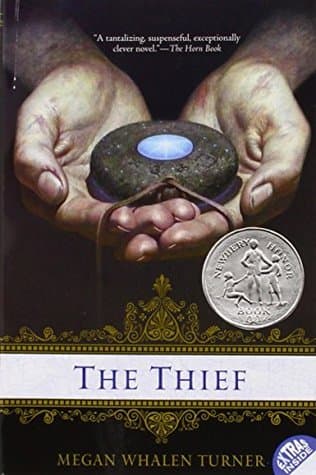
Megan Whalen Turner (1996)
Genre
Fantasy / Romance
Reading Time
280 min
Key Themes
See below
Sign in to track this book
A clever thief, saved from the gallows by a scholar seeking an ancient relic, begins a dangerous quest where his true goals are as mysterious as the old gods whose stories guide them.
Gen, a young man known for stealing and disrespect, is in the king's prison in Sounis. The King's Scholar, a powerful and strict man, visits him and offers him freedom. The Scholar needs a skilled thief for a dangerous trip to find a legendary ancient treasure. Despite Gen's first doubts and his reputation for being difficult, the Scholar, with his students Sophos and Ambiades, and a soldier named Sejanus, takes Gen from his cell. Gen is immediately chained and treated with a mix of scorn and respect for his past actions. The journey starts, full of uncertainty for Gen, who doubts the Scholar's real reasons.
The Scholar, Sophos, Ambiades, Sejanus, and Gen begin their hard journey through Sounis's rough land. Gen, though chained, is a constant annoyance and source of entertainment. He tries to escape several times, each more daring than the last, but none work. He also steals small items from the group, like Sophos's belt knife, only to return them later, showing his skill and testing their patience. During their travels, the Scholar and Sophos tell stories of the old gods and goddesses, especially the trickster god Eugenides, which Gen listens to with interest, often adding his own disrespectful comments.
As the group goes on, they find a patrol of Mede soldiers, showing how close they are to the powerful Mede Empire and the region's political instability. The Scholar, seeing the danger, tells everyone to hide. Gen, even in chains, is surprisingly good at hiding. This meeting shows the political risks of their mission, as the Medes are rivals to Sounis and their presence suggests a larger conflict. The Scholar explains that the treasure they seek is not just valuable but also important for strategy, possibly able to change the region's power balance. This event adds urgency and danger to their quest.
The way to the treasure leads them into dark, dangerous caves known for confusing echoes and hidden dangers. Inside, the group faces falling rocks and narrow paths. Here, Gen's skills, beyond just stealing, start to show. He has a strange sense of direction, a sharp awareness of his surroundings, and an ability to go through difficult land easily, even while chained. He uses his sharp eyes to see unstable rocks and his quickness to cross dangerous gaps, often guiding the others. The Scholar, though still careful, begins to admit Gen's practical use beyond just opening locks.
Throughout their journey, Sophos, the Scholar's careful student, keeps telling the detailed myths of the old gods and goddesses, focusing on the trickster god Eugenides. These tales provide a background to their hard travels, often serving as entertainment and cultural learning. Gen, however, often interrupts with cynical remarks and sharp questions, twisting the stories to fit his own mischievous nature or to subtly mock Sophos and the Scholar's seriousness. His comments often compare the gods' actions to the human flaws he sees in his companions, showing a sharp mind and a deep, though unusual, understanding of human nature.
Their quest brings them to a legendary place, a ruined temple believed to hold an oracle. To continue, they must solve a complex riddle or face bad results. The Scholar, despite his great knowledge, struggles with the cryptic verses. Sophos and Ambiades also try, but fail. It is Gen, surprisingly, who solves the riddle. His unusual thinking and his deep understanding of human motivations and tricks let him see through the oracle's misleading words. His solution not only opens the way forward but also highlights his unique intelligence, much to the Scholar's growing, if unwilling, surprise.
As they get closer to the treasure, the group faces an unexpected danger from within. Ambiades, the Scholar's other student, shows his true, disloyal nature. Driven by ambition and greed, he tries to betray the Scholar and take the treasure for himself. In the fight, Ambiades attacks Gen, badly hurting his leg. This betrayal shocks the group and puts Gen's life at risk, showing the dangers not only from outside enemies but also from those in their own group. The Scholar and Sophos must confront Ambiades, stopping him from reaching his selfish goal.
Despite his painful leg injury, Gen insists on continuing, understanding the critical importance of their mission. When they reach the final room where the treasure is hidden, they find it protected by an intricate, old lock that the Scholar cannot understand. It is Gen, using his great thieving skills, who takes charge. With focused determination and amazing dexterity, even while hurt, he works the complex tumblers and mechanisms. His skill is clear as he eventually opens the old lock, giving them access to the legendary treasure.
Inside the chamber, the group finally sees the legendary treasure. It is not a pile of gold or jewels, but something much more important: the Stone of Attolia. This old artifact is not just valuable; it is a symbol of rightful rule, a relic deeply connected to the region's history and myths. Its discovery confirms the Scholar's research and the strategic importance of their quest. The Stone of Attolia is believed to give legitimacy to its owner, and getting it back has big effects for the political situation in Sounis and its neighbors.
With the Stone of Attolia in hand, Gen changes in a surprising way. He drops his act as the simple, rude thief and reveals his true identity: he is Eugenides, the long-lost heir to the Attolia throne, and, by extension, the living form of the trickster god from the old myths. His entire journey, his imprisonment, his thieving actions, and his seeming weakness were all part of a complex plan to get back his heritage and the Stone. The Scholar, Sophos, and Sejanus are left in shock as Gen, no longer chained or hurt, stands revealed in his full, powerful form.
With his true identity known and the Stone of Attolia with him, Eugenides, the newly recognized King of Attolia, gets ready to return. The Scholar, Sophos, and Sejanus, at first shocked, accept the deception and promise their loyalty. Sophos, who admired Gen's wit, now serves Eugenides with even more respect, understanding his deep character. Sejanus, the soldier, sees the true power and legitimacy of his new king. The journey back shows a big change in how they relate, as the former prisoner now leads his amazed companions, ready to take back his kingdom and challenge the political order.
The Protagonist
Gen transforms from a seemingly reckless thief into a revealed king, demonstrating his true power, intelligence, and the depth of his long-hidden identity.
The Supporting
The Magus's initial skepticism and disdain for Gen evolve into grudging respect, and finally, stunned loyalty upon the revelation of Gen's true identity.
The Supporting
Sophos learns to appreciate different forms of intelligence and leadership, shifting from intellectual admiration to loyal service for Gen.
The Antagonist
Ambiades's ambition leads to his betrayal and downfall, serving as a cautionary tale.
The Supporting
Sejanus's initial role as Gen's guard transforms into that of a loyal soldier to his newly revealed king.
The Mentioned
Not applicable, as he is a background character.
The Mentioned
Not applicable, as he is a mythical figure whose stories are told.
The novel explores identity, especially how it can change, be hidden, and finally shown. Gen's whole act as an insolent thief is a carefully built disguise, a clever trick to reach his main goal. This theme shows in his constant misdirection, his seemingly careless behavior, and his ability to change how people see him. The difference between who Gen seems to be and who he truly is (Eugenides, the King of Attolia) drives the story, making characters and readers look past surface appearances. The stories of the trickster god Eugenides constantly echo this theme, hinting at the main character's true nature and methods.
“"He was a thief, not a fool. It was only the fools who didn't steal when they could get away with it."”
The book looks at what true power and good leadership mean. The Scholar represents traditional, intellectual power, using knowledge and authority. However, Gen (Eugenides) shows a different kind of power: one from cleverness, adaptability, and a deep understanding of people and strategy. His leadership is not about force or clear command, but about subtle manipulation, foresight, and a willingness to take unusual paths. Getting the Stone of Attolia, a symbol of rightful rule, further shows that true power can be inherited, earned, and sometimes, cleverly reclaimed through ways that go against normal expectations.
“"There is no point in being a king if you can't be a trickster."”
A repeated theme is the difference between academic knowledge and practical wisdom. The Scholar has vast scholarly knowledge, able to read old texts and understand complex history. Sophos shares this intellectual side. However, Gen, despite his lack of formal education, shows a deep, natural wisdom – an understanding of human nature, a talent for solving problems in real life, and an ability to read situations and people. His 'street smarts' often prove more valuable than the Scholar's book learning in navigating the dangerous journey and solving practical problems, like the oracle's riddle or the final lock. This contrast highlights that different kinds of intelligence have different values.
“"Knowledge is a fine thing, but wisdom is better."”
The novel mixes ancient mythology into its story, blending legend and reality. The constant telling of tales about the gods, especially the trickster god Eugenides, is not just background detail; it acts as a strong hint of future events and a comment on heroism and leadership. The fact that Gen is revealed to be the living form of the mythical Eugenides suggests that legends are not just stories, but can be living truths, shaping the present and future. This theme explores how old stories influence current events and how people can take on classic roles.
“"The gods had a way of turning up in the most unexpected places."”
The story is primarily told from Gen's perspective, but his true intentions are hidden.
While not a first-person narrative, the story is heavily filtered through Gen's actions and sarcastic commentary, making him an unreliable source of information regarding his own deeper motives. The reader is led to believe Gen is merely an insolent thief, much like the other characters. His true identity and the elaborate nature of his plan are concealed until the very end, creating a massive surprise. This device relies on misdirection and carefully curated information, making the reader complicit in the deception alongside the other characters.
Tales of the trickster god Eugenides subtly hint at Gen's true identity.
Throughout the journey, Sophos frequently recounts myths about the gods, particularly the cunning and deceptive trickster god Eugenides. These stories, with their themes of cleverness, disguise, and unexpected reveals, serve as powerful and pervasive foreshadowing. Gen's own actions and personality often mirror those of the mythical Eugenides, leading the reader (and some characters) to draw parallels without fully understanding their significance until the climactic revelation of Gen's true identity as the living King Eugenides of Attolia.
The treasure that drives the plot, but its true significance changes.
The Stone of Attolia functions as a MacGuffin, initially presented as a valuable ancient treasure the Magus seeks for the King of Sounis. Its precise nature and power are initially vague, serving primarily as the object that propels the characters on their dangerous journey. However, its significance evolves; it is revealed to be not just a valuable artifact but a symbol of legitimate rule, essential for Eugenides to reclaim his throne. This transformation from a generic 'treasure' to a specific political and ancestral artifact adds depth to its role.
Gen's sharp, often sarcastic, exchanges with other characters mask his true intelligence.
Gen's dialogue is characterized by constant sarcasm, irreverence, and quick wit. This serves as a significant plot device, both entertaining the reader and contributing to his persona as an insolent, but clever, thief. His banter often distracts from his true intelligence and strategic thinking, making his eventual revelation more surprising. It also allows him to subtly gather information, test the reactions of others, and maintain control of situations without appearing to do so, all while appearing to be merely a nuisance.
“I can steal anything.”
— Gen's confident claim to the Magus upon their first meeting.
“The gods do not often give us what we want, but they give us what we need.”
— The Magus reflecting on the nature of divine intervention and destiny.
“If you are going to steal, steal something worth stealing.”
— Gen's internal monologue about the nature of his thievery.
“It is not always the strongest who win, but the one who is most determined.”
— Gen's reflection on the qualities needed for success against overwhelming odds.
“A good thief is not just a thief; he is an artist.”
— Gen's personal philosophy on the skill and artistry involved in his craft.
“Sometimes the best way to hide something is in plain sight.”
— A strategic observation made by Gen regarding deception.
“There are always other ways, if you are clever enough to find them.”
— Gen's belief in problem-solving and finding alternative solutions.
“The gods are fickle, and their favor can turn on a whim.”
— A cautionary thought about relying too heavily on divine intervention.
“You can never truly know a person until you see what they will do when they think no one is watching.”
— Gen's insight into human nature and true character.
“Fear is a powerful tool, but it can also be a weapon against the one who wields it.”
— Gen's understanding of the double-edged nature of fear.
“Even the cleverest traps have a weakness, if you know where to look.”
— Gen's confidence in his ability to overcome obstacles and outsmart opponents.
“It is not the size of the dog in the fight, but the size of the fight in the dog.”
— A metaphorical statement about courage and inner strength.
“Every lie contains a kernel of truth, otherwise it would not be believed.”
— Gen's understanding of the construction of believable deception.
“Sometimes the greatest treasure is not gold or jewels, but knowledge.”
— Gen's realization about the true value of information and understanding.
“The world is full of wonders, if you only open your eyes to see them.”
— A broader philosophical reflection on observation and appreciation.
Ready to see how well you understood this book? Take our interactive quiz with 10 questions.

Biography coming soon.







