“The past is never dead. It's not even past.”
— A recurring theme in the book, emphasizing how historical events and secrets continue to influence the present.

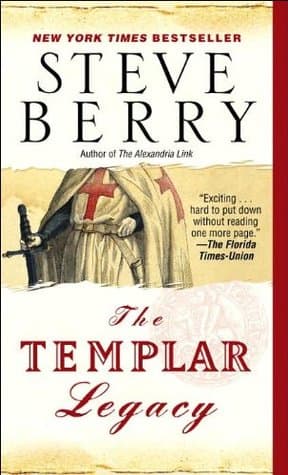
Steve Berry (2006)
Genre
Thriller / Historical Fiction / Mystery
Reading Time
600 min
Key Themes
See below
Sign in to track this book
A retired Justice Department operative returns to a global chase to uncover the Knights Templar's true, world-altering secret, hidden beneath centuries of myth and murder.
Cotton Malone, a former Justice Department operative who now runs a bookstore in Copenhagen, is pulled back into his old life when his former boss, Stephanie Nelle, is attacked in Denmark. Stephanie is not on a government mission but is looking for the lost treasure of the Knights Templar. She has important clues, including a coded message from a recently deceased relative, and is trying to get into a secret vault. The attackers, led by Raymond de Roquefort, also want the Templar treasure and think Stephanie has a key piece of information. Cotton, despite wanting a quiet life, helps Stephanie and realizes the situation is more serious than just old artifacts.
After the attack, Stephanie tells Cotton that her mission is connected to her family's long history with the Knights Templar and a secret passed down through generations. Their first clue leads them to the Château de Montségur in France, a historical fortress of the Cathars, who were connected to the Templars. They find an old cipher and a hidden compartment, narrowly escaping de Roquefort's agents who are close behind. The pursuit becomes more intense, with Cotton's past training helping him avoid capture and protect Stephanie. The clues suggest the Templar treasure is not money but something more important and dangerous, hidden in plain sight.
The clues from Montségur lead Cotton and Stephanie to Italy, specifically to the Vatican. They learn the Templar mystery is deeply connected to the Catholic Church and a secret group called the Society of Saint-Clair, which has protected the Templar legacy for centuries. De Roquefort, a high-ranking member of this society, is a zealous fundamentalist who believes he is meant to control the Templar secret. Inside the Vatican archives and hidden rooms, Cotton and Stephanie decode more messages, learning that the Templar treasure involves a theological secret that could change Christianity. They meet Cardinal Francesco Malebranche, who is also involved in the Templar quest, but with different goals.
As the chase continues across Europe, from old French churches to hidden Italian crypts, the true nature of the Templar treasure, called the 'Sangreal,' starts to appear. It is not gold or jewels, but a collection of old texts and artifacts that challenge basic Christian beliefs, specifically about Jesus Christ's divinity. The texts suggest that Jesus was married to Mary Magdalene and had descendants, a secret the Church has fiercely protected and hidden for centuries. This explains de Roquefort's fanaticism – he plans to use this knowledge to create a new, purer form of Christianity, believing it is his divine right. Cotton and Stephanie realize they are not just looking for treasure but for a truth that could destabilize the world.
The final clues lead Cotton and Stephanie to a remote place in the Pyrenees mountains, near the border of France and Spain, where the Sangreal is thought to be hidden. De Roquefort and his armed agents are already there, ready to take the treasure. A tense and violent fight begins. Cotton, using his combat skills and strategy, fights to protect Stephanie and keep de Roquefort from getting the dangerous secret. The location itself has old Templar symbols and hidden mechanisms, showing how much effort the Templars put into hiding their legacy. During the battle, the historical importance of the site becomes clear, connecting to the larger story of the Templars' persecution.
During the confrontation, Cotton and Stephanie manage to get into the hidden room where the Sangreal is kept. They find not a single artifact, but a large archive of documents, scrolls, and old texts – the true treasure of the Knights Templar. These documents contain explosive historical and theological information about Jesus, Mary Magdalene, and their descendants, carefully preserved for centuries. It becomes clear that the Templars, more than just Crusaders, were guardians of this secret, which they tried to protect from those who would use or destroy it. De Roquefort, angry, makes a final attempt to claim the archive for himself, believing it is his destiny.
De Roquefort's true plans are revealed: he intends to use the Sangreal to expose the Catholic Church's historical inaccuracies, dismantle its authority, and establish a new, fundamentalist Christian order based on his reading of the Templar revelations. He believes this will cleanse the world and bring about a new era. His fanaticism comes from a strong belief that he is an heir to the Templar legacy and chosen to make this change. He sees Cotton and Stephanie as obstacles to his mission, ready to remove anyone who stands in his way. The moral dilemma of revealing such a world-changing truth weighs on Cotton and Stephanie.
A fierce struggle for control of the Templar archive follows. Cotton, using his quick thinking and combat skills, outmaneuvers de Roquefort's remaining forces. Stephanie, without combat training, helps secure the documents. The climax involves a desperate fight inside the old room, with the fate of religious history at stake. Cardinal Malebranche, who has been watching, intervenes at a key moment, showing his own complex reasons and his wish to see the truth handled responsibly. The archive itself represents the great power and danger of hidden historical knowledge.
In a final confrontation, Cotton Malone defeats Raymond de Roquefort, ending his actions and stopping him from taking the Templar archive. De Roquefort's fanaticism leads to his defeat. With the immediate threat gone, Cotton, Stephanie, and Cardinal Malebranche must decide what to do with the Sangreal. They decide to keep the most controversial parts of the archive secret, to prevent global chaos and religious unrest, but to allow scholars limited access to other historical documents. This compromise tries to balance seeking truth with the need for societal stability, recognizing the deep effects of the Templar legacy.
With the Templar crisis resolved, Cotton Malone returns to his life as a bookseller in Copenhagen, but the experience has changed him. Stephanie Nelle continues her work, now with a deeper understanding of her family's history and the secrets they guarded. The Sangreal remains hidden, its most controversial truths locked away, but its existence has a lasting impact. The events show that history is often more complex and altered than commonly thought, and that some truths are too dangerous for the world. Cotton thinks about the line between revelation and destruction, and the enduring power of old mysteries.
The Protagonist
Cotton transitions from a retired operative seeking tranquility to a reluctant hero who embraces his past skills to protect those he cares about and prevent a global catastrophe.
The Supporting
Stephanie's personal quest for family history evolves into a mission to protect a world-altering truth, forcing her to confront the dangerous implications of her discoveries.
The Antagonist
De Roquefort's unwavering fanaticism leads him to increasingly desperate and violent acts, ultimately resulting in his downfall as he attempts to seize absolute control over the Templar secret.
The Supporting
Malebranche shifts from a cautious observer and protector of the Church's secrets to a pragmatic participant, ultimately helping to ensure the Templar truth is managed responsibly rather than exploited.
The Mentioned
Gary's character remains largely static as a symbol of Cotton's personal stakes, serving as a motivation for Cotton's actions.
The Supporting
Cassiopeia's initial self-interest in the Templar treasure evolves into a more collaborative effort, as she recognizes the greater danger posed by de Roquefort.
The Mentioned
The Templars' historical role is gradually reinterpreted throughout the novel, revealing them as custodians of a world-altering truth rather than simply a wealthy military order.
The Mentioned
Her historical portrayal is challenged and redefined by the Templar documents, shifting from a traditional biblical figure to a central figure in a suppressed lineage.
The novel explores how history, especially religious history, is often changed or hidden on purpose. The 'Sangreal' questions basic Christian beliefs, making characters and readers wonder about accepted stories. Conflict comes from the struggle between revealing a truth that could upset society and keeping a comforting, but possibly false, existing situation. The book suggests that 'truth' is powerful and dangerous, and handling it requires great responsibility. This is clear in the Templar's efforts to hide their archive and the discussion about revealing it.
“"History is written by the victors. But sometimes, the vanquished leave behind their own version."”
A main theme is the tension between real faith and strict religious rules. Raymond de Roquefort shows the extreme side of rules, willing to destroy the current Church to enforce his 'purer' view of Christianity. On the other hand, characters like Cardinal Malebranche try to protect the Church while acknowledging truths that could weaken it. The Templar's secret itself forces a re-evaluation of what 'faith' means when historical facts go against old doctrines, raising questions about how belief holds up when faced with radical revelations.
“"What good is faith if it cannot withstand the truth?"”
The book highlights the lasting effects of secrets and legacies passed down through families. Stephanie Nelle's family connection to the Templars and her inherited clues show how old mysteries can affect modern lives. The Templars themselves carried the heavy burden of protecting the 'Sangreal' for centuries, and their actions still shape events today. The story looks at the moral implications of inheriting such a burden – whether to reveal, protect, or use these powerful secrets, and the personal cost of each choice.
“"Some secrets are meant to stay buried. Not for protection, but for preservation."”
The struggle for power and control drives the novel. Raymond de Roquefort wants to use the Templar secret to gain ultimate control over the Christian world. The Catholic Church, through Cardinal Malebranche, works to keep its established power structure. The Templars, in their time, also had great power. The 'treasure' itself is not money but a source of power – the power to rewrite history, change beliefs, and control people. The conflict shows how individuals and institutions will go to great lengths to get or stop the spread of such strong influence.
“"Knowledge is power, Cotton. And some knowledge can destroy empires."”
A series of interconnected historical puzzles that guide the protagonists.
The entire plot is driven by a meticulously crafted trail of cryptic clues, ciphers, and historical artifacts left behind by the Knights Templar and Stephanie's ancestors. These clues, embedded in ancient documents, architectural features, and historical sites across Europe, lead Cotton and Stephanie from one location to the next. This device serves to unfold the mystery gradually, engaging the reader in the intellectual challenge of deciphering the Templar's secrets alongside the characters. It also allows for the exploration of various historical locations and their connections to the Templar legacy, building suspense and intrigue with each solved puzzle.
The central object of desire, whose true nature is revealed to be far more significant.
The 'Sangreal' (the Templar treasure) functions as a classic MacGuffin, initially presented as a legendary lost wealth, but gradually revealed to be something far more profound and dangerous: an archive of documents detailing a suppressed theological truth about Jesus and Mary Magdalene. This device propels the plot forward by creating a clear objective for both protagonists and antagonists. Its evolving nature adds layers of suspense and raises the stakes, transforming a simple treasure hunt into a race to control a world-altering historical revelation, thereby subverting initial expectations about the nature of the 'treasure'.
A covert organization guarding and manipulating the Templar legacy.
The Society of Saint-Clair is a shadowy, centuries-old secret society that has been intertwined with the Templar legacy since its suppression. This device provides a modern-day antagonist (Raymond de Roquefort) and a complex network of allies and enemies. It allows for the continuation of the Templar mystery into the present day, demonstrating how ancient power struggles and ideological conflicts persist. The society's internal divisions and competing agendas add depth to the conspiracy, showing that even within a single organization, there can be conflicting interpretations of a shared history and purpose.
Cotton Malone's initial desire for a quiet life contrasted with his exceptional skills.
Cotton Malone embodies the 'reluctant hero' archetype. He has deliberately retired from his dangerous past as a Justice Department operative, seeking a peaceful life as a bookseller. However, his deep loyalty to Stephanie Nelle and his inherent sense of justice compel him back into action. This device highlights Cotton's internal conflict between his desire for normalcy and his undeniable capability for espionage and combat. It makes his heroic actions more compelling, as they stem from a sense of duty rather than a thirst for adventure, and allows for character development as he accepts his true nature.
“The past is never dead. It's not even past.”
— A recurring theme in the book, emphasizing how historical events and secrets continue to influence the present.
“There are some secrets that refuse to stay buried.”
— Cotton Malone reflecting on the nature of the Templar secret and its persistent resurfacing.
“Faith is a powerful thing, Malone. It can move mountains, and it can start wars.”
— A character discussing the dual nature of faith in the context of the Templar Knights and their legacy.
“History is written by the victors, but the truth often lies with the vanquished.”
— A reflection on the hidden narratives and suppressed truths surrounding historical events, particularly the Templar's fate.
“Sometimes the greatest treasures are not gold or jewels, but knowledge.”
— Cotton Malone realizing the true value of the Templar archive and its historical implications.
“The line between conviction and obsession is often thinner than we'd like to admit.”
— A character observing the fanaticism of those pursuing the Templar secret.
“What if everything you've been taught about the past is a lie?”
— A provocative question posed to Cotton, challenging his understanding of established history.
“Power corrupts, and absolute power corrupts absolutely. But absolute secrecy can be just as insidious.”
— Discussing the dangers of hidden power and the long-term effects of keeping profound secrets.
“Sometimes, the only way to protect the future is to confront the past.”
— Cotton Malone's motivation for unraveling the Templar mystery, despite the personal danger.
“The world is full of shadows, Malone. Some are cast by the light, others by the darkness within us.”
— A philosophical observation on human nature and the hidden aspects of history.
“Every secret has a cost. The longer it's kept, the higher the price.”
— Highlighting the consequences and sacrifices involved in maintaining profound historical secrets.
“Justice isn't always about what's legal. Sometimes it's about what's right.”
— A character grappling with moral dilemmas and the pursuit of a higher form of justice.
“The greatest trick the devil ever pulled was convincing the world he didn't exist. The greatest trick history pulls is convincing us it's all settled.”
— A cynical but insightful remark on the deceptive nature of both evil and historical narratives.
“There are no coincidences, only patterns we haven't yet recognized.”
— Cotton Malone's analytical approach to the unfolding mystery, connecting seemingly disparate events.
Ready to see how well you understood this book? Take our interactive quiz with 10 questions.

Biography coming soon.







