“He knew then that what he had done for the Agency had not been for the Agency at all, but for himself, for his own sense of honor and rightness.”
— Paul Christopher's internal reflection on his motivations for his espionage work.

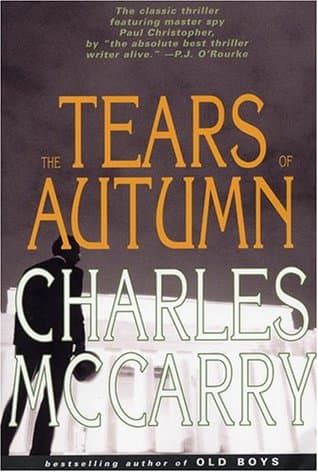
Charles McCarry (1975)
Genre
Thriller / Historical Fiction / Mystery
Reading Time
276 min
Key Themes
See below
Sign in to track this book
A former agent, haunted by the truth behind a president's assassination, defies his government and a secret group, traveling across continents to expose a conspiracy that could shatter international order.
In Paris, Paul Christopher, a skilled CIA agent, is contacted by a dying former associate, who gives him a coded message. This message, with his own network and instincts, leads Christopher to an unsettling conclusion: President John F. Kennedy's assassination was not the work of one gunman, but a carefully planned event with far-reaching effects. He begins to piece together information, suggesting a deep conspiracy beyond the accepted story. Christopher's first investigation is secret, as he senses the extreme sensitivity and danger of his new theory.
Christopher's early findings, though unconfirmed, reach his superiors at the Agency. Recognizing the explosive nature of his theories, which threaten to disrupt foreign policy and the heroic image of the fallen president, Christopher is told to stop his investigation. He is warned of serious consequences if he continues. However, driven by a commitment to truth and duty, Christopher cannot obey. He decides to resign from the CIA, leaving the organization that defined his career, to pursue his dangerous quest for the truth freely.
Paul Christopher travels to Zurich, a center of international finance and secrecy. Using his understanding of secret financial networks and old contacts, he begins to trace a complex money trail that he believes funded the assassination. His investigation leads him to specific Swiss bank accounts, carefully hidden to obscure their true owners. He finds evidence of large transfers made to various shell corporations and individuals, suggesting a well-funded and organized operation. This financial digging confirms his suspicion that the plot was far more elaborate than publicly acknowledged, involving powerful, wealthy groups.
In Rome, Christopher investigates the complex web of political and religious power. He finds connections between a secret, ultra-conservative group within the Vatican and individuals who seem to have played a role in spreading propaganda related to the assassination. This group, he learns, had strong anti-Kennedy feelings, viewing his policies as dangerous. Christopher discovers evidence of funds being sent through religious charities to influence public opinion and discredit the former president, suggesting a sophisticated ideological part of the conspiracy, aimed at controlling the story after the assassination.
Christopher's journey takes him to the Congo, a region affected by Cold War politics. Here, he uncovers important evidence linking the assassination to Kennedy's foreign policy decisions regarding the Congo's independence and its mineral wealth. He discovers that powerful European colonial interests, threatened by Kennedy's support for Patrice Lumumba and a more independent Africa, saw the American president as an obstacle. These groups, with ties to intelligence agencies and mercenary groups, had a strong financial and political reason to remove Kennedy, adding a geopolitical dimension to the plot.
In Saigon, amid the growing conflict in Vietnam, Christopher uncovers another disturbing part of the conspiracy. He finds links between elements involved in the assassination and the profitable Southeast Asian opium trade, which was tied to various intelligence operations and criminal groups. He learns that certain powerful figures, fearing Kennedy's potential withdrawal from Vietnam and his efforts to stop the drug trade, saw his removal as essential to protecting their large illegal profits and influence. This connection reveals a complex web of economic and criminal interests working together to cause the president's death.
As Paul Christopher gets closer to the truth, the risks increase. He becomes a target for both the secret figures behind the assassination and, strangely, his former employers at the CIA, who see his independent investigation as a dangerous problem. Christopher faces many attempts on his life, from anonymous threats to direct attacks, forcing him to use all his espionage skills to survive. He is constantly on the run, using fake names and evasive moves, showing the immense power and reach of those who want to keep the truth hidden and prevent him from exposing their secrets.
Through careful deduction and putting together different clues from his global travels, Christopher finally identifies the main group responsible for planning President Kennedy's assassination. He uncovers a group of powerful, connected individuals from different areas: unhappy intelligence operatives, wealthy industrialists with colonial interests, and right-wing ideologues. Their motive, he concludes, was a mix of fear – fear of Kennedy's policies, his challenge to existing power structures, and his perceived weakness against communism. They saw his removal as necessary to protect their vision of America and global order.
The full weight of Christopher's discovery affects him. The truth he has uncovered is not just about who killed Kennedy, but why – revealing a conspiracy so vast and so deeply rooted in power that its exposure would destroy public trust, destabilize international relations, and change the perception of American history. He understands that the official story, however flawed, serves a purpose in maintaining order. The implications are devastating, not only for the legend of the dead president but for the stability of the nation and its foreign policy.
Having uncovered the complete, horrifying truth, Paul Christopher faces a difficult choice: what to do with this knowledge. He understands that revealing the full extent of the conspiracy would cause chaos, possibly leading to widespread disappointment and political instability. The truth, in this case, might be more destructive than the lie. He struggles with his personal moral code, which demands honesty, against the practical understanding of the catastrophic consequences. The burden of this unspeakable truth weighs heavily on him, forcing him to consider the greater good versus individual justice.
In a deeply personal decision, Paul Christopher chooses not to fully expose the conspiracy he has uncovered. He understands that the world is not ready for such a devastating truth, and that revealing it would cause more harm than good. Instead, he chooses a more subtle form of justice, ensuring that certain individuals involved face consequences, though not public ones. He sacrifices his own desire for vindication for what he sees as the greater stability of the nation and the world. His journey ends not with a grand public reveal, but with a quiet, personal resolution, forever marked by the secrets he carries.
The Protagonist
Christopher transforms from a dedicated agency operative into an independent truth-seeker, ultimately choosing to bear the burden of a devastating secret for the perceived greater good.
The Antagonist/Supporting
The Agency's role shifts from a supportive employer to an obstructive force, illustrating the conflict between individual truth and institutional preservation.
The Mentioned
Not applicable, as he is a historical figure and the subject of the investigation.
The Antagonist
Their collective plot is gradually revealed and understood by Christopher, demonstrating the pervasive nature of their influence.
The Supporting
Not applicable, as their role is primarily to initiate Christopher's journey.
The Supporting
Not applicable, as they are a collective of minor characters serving a specific plot function.
This theme explores whether a devastating truth should be revealed if it would cause more harm than good. Christopher's journey is driven by his commitment to truth, but as he uncovers the full extent of the conspiracy, he struggles with the catastrophic implications of revealing it. The book suggests that certain illusions, like the heroic legend of a fallen president, might be necessary for societal stability, even if based on a lie. This is clear in Christopher's decision to suppress the full scope of his findings, prioritizing national stability over complete transparency.
“The truth, in this case, might be more destructive than the lie.”
The novel shows how unchecked power, whether political, financial, or ideological, can lead to extreme acts of violence and manipulation. The assassination of JFK is shown not as a random act, but as a calculated move by powerful individuals and groups who felt threatened by his policies. The conspirators, representing various forms of entrenched power (colonial interests, intelligence factions, right-wing ideologues), act without punishment, believing their goals justify the means. Christopher's investigation exposes the dark side of global power structures and their willingness to remove obstacles to maintain control.
“Power, like a river, will always find its lowest level, and often, its most ruthless.”
Paul Christopher's main conflict comes from his personal moral code clashing with the demands of his former employer, the CIA. His conscience makes him seek the truth, even when the institution he served tells him to stop. This theme highlights the struggle of an individual to maintain integrity and follow their internal compass when faced with powerful institutional pressure to conform or stay silent. Christopher's resignation is a direct result of this conflict, showing his commitment to his principles, even at great personal cost and danger, as he chooses truth over loyalty.
“He lived by and for the truth, and his internal compunctions forced him to the heart of the matter.”
The novel emphasizes that major historical events are often products of complex, interconnected global forces rather than isolated incidents. Christopher's journey across Paris, Zurich, Rome, the Congo, and Saigon reveals how the assassination was influenced by a mix of international interests: Swiss banking secrecy, Vatican politics, European colonial ambitions in Africa, and the Southeast Asian drug trade. This global scope shows that conspiracies are rarely limited to one nation or motive, but rather combine different geopolitical, economic, and ideological threads. The interconnectedness of the plot highlights the complex web of global power.
“The threads of the conspiracy stretched across continents, each knot tied to a different, hidden agenda.”
The central object of desire that drives the protagonist's actions.
The 'truth' about JFK's assassination functions as the primary MacGuffin in 'The Tears of Autumn.' It is the ultimate goal that propels Paul Christopher's relentless global investigation. While the specific details of the conspiracy are gradually revealed, the driving force for Christopher and the narrative is the pursuit of this hidden knowledge. The MacGuffin's power lies not just in its content, but in its ability to motivate Christopher to defy his former agency, risk his life, and travel the world, providing the essential framework for the plot's progression and suspense.
A hero who operates independently, often against powerful organizations.
Paul Christopher embodies the 'lone wolf' archetype. After resigning from the CIA, he operates entirely outside official channels, relying solely on his skills, contacts, and personal resources. This device heightens the tension and stakes, as Christopher faces not only the assassins but also his former agency, which views him as a rogue element. His isolation emphasizes his moral conviction and makes his journey more perilous, as he lacks institutional support and protection. This archetype allows for a deeper exploration of individual conscience against systemic pressure.
The protagonist travels to multiple international locations, each revealing a new piece of the puzzle.
The novel utilizes a 'geographic odyssey' as a key plot device. Christopher's journey takes him through Paris, Zurich, Rome, the Congo, and Saigon. Each location serves as a distinct chapter in his investigation, where he uncovers a specific facet of the conspiracy – be it financial, ideological, colonial, or criminal. This device not only provides a rich, international backdrop but also systematically builds the complexity of the conspiracy, demonstrating its global reach and intricate interconnections. It allows the author to explore diverse political and cultural landscapes relevant to the plot.
False clues or leads that distract from the true nature of the conspiracy.
Throughout his investigation, Christopher encounters various forms of misdirection and red herrings. These are deliberate attempts by the conspirators, or even by the Agency, to obscure the true nature of the plot and deflect suspicion. These might include planted evidence, misleading rumors, or individuals who seem significant but are ultimately minor players. This device serves to complicate Christopher's quest, increase suspense, and highlight the intricate layers of deception that surround such a high-stakes conspiracy. It forces Christopher (and the reader) to constantly re-evaluate information and question apparent truths.
“He knew then that what he had done for the Agency had not been for the Agency at all, but for himself, for his own sense of honor and rightness.”
— Paul Christopher's internal reflection on his motivations for his espionage work.
“The truth was not a single thing, but a collection of shadows, shifting and changing with the light.”
— Paul Christopher contemplating the elusive nature of truth in his investigation.
“There are some things you carry with you, like a disease, and they never quite go away.”
— Christopher's thoughts on the lasting impact of his experiences and secrets.
“He understood that the world was not made of good people and bad people, but of people who did good things and people who did bad things, and often the same people did both.”
— Christopher's nuanced view of human morality in the face of complex situations.
“The past was a weapon, and everyone in this game knew how to use it.”
— Reflecting on how historical events and personal histories are manipulated in the world of intelligence.
“Loneliness was the professional hazard of his chosen life, a constant companion, like his shadow.”
— Paul Christopher's acceptance of the isolation inherent in his work.
“Every secret kept was a small death, a piece of himself he buried.”
— Christopher's introspective moment about the personal cost of maintaining secrets.
“The greatest trick the devil ever pulled was convincing the world he didn't exist, and the second greatest was making everyone believe in a single, simple motive.”
— Paul Christopher's cynical view on the complexity of motives behind events.
“He had learned that loyalty was a fragile thing, easily broken by fear or ambition.”
— Christopher's experience with betrayals and shifting allegiances.
“The answers were always there, if you knew how to look, and if you dared to see what they showed you.”
— Christopher's approach to investigation and the courage required to face difficult truths.
“Sometimes, the only way to find the truth was to become part of the lie.”
— Paul Christopher's immersion into the world of deception to uncover facts.
“The silence was sometimes more eloquent than any words, especially when it was the silence of a man who knew too much.”
— Christopher observing the unspoken knowledge and hidden truths in others.
“Justice, he thought, was a word used by those who had the power to define it.”
— Paul Christopher's cynical perspective on the concept of justice in the world of intelligence.
“The world was a stage, and he was merely an actor, playing a part he hadn't written.”
— Christopher's feeling of being controlled by larger forces and predetermined roles.
Ready to see how well you understood this book? Take our interactive quiz with 10 questions.







