“I am not a genius. I am a third-grader.”
— Clementine reflects on her identity after feeling pressured to be exceptional.

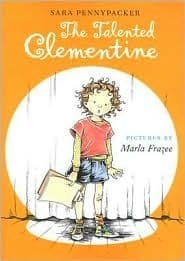
Sara Pennypacker (2007)
Genre
Children's
Reading Time
120 min
Key Themes
See below
Sign in to track this book
A third-grader thinks she has no talent for the school show, but she finds her unique gift for observation and problem-solving in a surprising way.
Clementine, a third-grader, is at school when her teacher announces a joint third and fourth-grade talent show called 'Talent-palooza.' Clementine worries because she believes she has no talents. Her best friend, Margaret, has many abilities and has already made an alphabetized list of them. Clementine feels a growing sense of panic as her classmates discuss their acts, from singing to magic tricks. She tries to think of anything she might be good at, but nothing comes to mind, making her feel like an 'un-talented' person.
Trying to find a talent for the show, Clementine tries several things. She tries juggling with oranges but only makes a mess. She attempts to play the flute, which makes unpleasant squeaks. She even thinks about doing a magic trick but realizes she lacks the skill. Her younger brother, whose main talent seems to be making a mess, is no help. Clementine watches Margaret practice her impressive talents, which only makes Clementine feel more inadequate and frustrated, making her search seem pointless.
Margaret, Clementine's best friend, has many accomplishments. She has an organized, alphabetized list of her talents, from 'Acting' to 'Zoology facts.' This constant display of Margaret's abilities highlights Clementine's perceived lack of talent, making Clementine feel worse about herself. Margaret, though kind, often unintentionally makes Clementine feel more inadequate by showing her skills or suggesting talents Clementine clearly does not have. This situation increases Clementine's need to find something she can do for 'Talent-palooza' and avoid public embarrassment.
During her struggle to find a talent, Clementine meets Mr. Ruben, the school janitor, a kind and observant man. While Clementine feels down, Mr. Ruben talks with her. He does not offer a direct solution to her talent show problem but gives a different idea, suggesting that talents are not always what people expect or what is obvious. His calm manner gives Clementine some comfort and a thought that perhaps her talent might be something unusual, though she still cannot figure out what it could be.
In her usual way of trying to 'fix' things, Clementine accidentally causes some small problems at school. She tries to help Mr. D'Matz with a projector and breaks it. She tries to help set up for the talent show and makes a mess. These incidents lead her to an unplanned visit with Principal Rice. Instead of being scolded, Principal Rice, who understands Clementine's good intentions, talks with her in a way that, while not directly about the talent show, touches on Clementine's unique way of seeing the world and her often misguided but earnest attempts to help.
The night of 'Talent-palooza' arrives, and Clementine still has no act ready. She feels anxious as she watches her classmates perform their varied talents. Margaret performs a ballet routine, getting applause. Clementine tries to be unnoticed, hoping no one will see her lack of participation. The pressure grows as the show continues, and she feels more exposed and embarrassed, convinced that everyone will realize she is the only third-grader without a talent, confirming her deepest fears.
During the 'Talent-palooza,' a small problem happens: the projector for some acts stops working. Amidst the confusion, Clementine, without thinking, steps forward. She does not sing or dance, but instead, she uses her quick thinking and unique view to tell funny, observational stories about the school, her friends, and her own attempts to find a talent. Her unplanned storytelling engages the audience, making them laugh and forget about the technical problems. She shows an unexpected talent for connecting with an audience with her genuine and humorous stories.
Clementine's spontaneous storytelling, full of her humor and honesty, is a success. The audience, initially distracted by the projector issue, becomes engrossed in her stories. Laughter fills the auditorium, and when she finishes, the room erupts in applause. To her surprise, she receives a standing ovation. This moment is a revelation for Clementine, as she realizes that her unique way of seeing the world and her ability to tell stories in an entertaining way is a valuable and appreciated talent, one that truly belongs to her.
After the talent show, Clementine feels a sense of triumph and relief she had not thought possible. She realizes that her talent was not something she had to force or learn, but rather an inherent part of who she is: her ability to make people laugh, to tell stories, and to find humor in everyday life. Her friends, Margaret included, and her teachers express their admiration for her unexpected and genuine performance. Clementine no longer feels like an 'un-talented' person but rather a unique individual with a valuable skill. She accepts her true self, understanding that not all talents fit into conventional categories.
The Protagonist
Clementine begins feeling like a talentless washout but discovers her unique gift for storytelling and self-expression, leading to self-acceptance.
The Supporting
Margaret remains consistently talented, serving as a foil for Clementine's journey of self-discovery.
The Supporting
He consistently supports his students, including Clementine, throughout the talent show preparations.
The Supporting
He provides quiet, consistent wisdom, subtly guiding Clementine's perspective on talent.
The Mentioned
Her brief appearance reinforces the idea that Clementine's intentions are good, even when her actions are clumsy.
The Supporting
He consistently acts as a typical younger sibling, providing minor domestic challenges for Clementine.
The main theme is Clementine's journey to understand who she is and what makes her special. At first, she judges her worth by typical talents, which makes her feel inadequate. Her struggle to find a talent for the 'Talent-palooza' makes her look beyond common definitions of skill. Her discovery of her ability to tell stories and entertain others shows that her true identity is in her unique perspective and humor, not in learned abilities. This journey shows how important it is to recognize one's authentic self.
“Maybe a talent wasn't something you had to practice. Maybe it was just… you.”
The book questions common ideas of what 'talent' means. Clementine initially believes talent must be something performed, like singing, dancing, or playing an instrument. Margaret's list of traditional talents supports this idea. However, through Clementine's struggle and the unexpected end of the talent show, the story shows that talent can be unconventional, personal, and natural. Her ability to tell engaging stories and connect with an audience through humor proves that 'talent' includes more than just learned skills; it includes personality and unique ways of interacting with the world.
“A talent isn't always what you think it is, Clementine. Sometimes, it's just… being you.”
Clementine's strong wish to find a talent is linked to her need to feel accepted and to belong among her peers. Her fear of being the 'un-talented' one causes much of her anxiety. The story shows how self-acceptance is not about meeting outside expectations but about embracing one's unique qualities. When Clementine spontaneously shares her stories, she is not trying to fit a mold; she is simply being herself. The positive response from the audience gives her a sense of belonging and confirms her true self, showing that acceptance comes from authenticity.
“I wasn't a washout. I was just a Clementine.”
The friendship between Clementine and Margaret is a central part of the story, exploring how comparisons can affect self-esteem. Margaret, with her many obvious talents, is a constant, though unintentional, contrast to Clementine's perceived shortcomings. While Margaret is a good friend, her many skills make Clementine feel inadequate. The book explores the challenges of friendship when one feels less capable than the other, and how true friendship supports individual strengths rather than causing competition.
“Margaret had so many talents, she had to alphabetize them to keep them straight. I had zero.”
The catalyst for Clementine's internal and external conflict.
The announcement of the joint third and fourth-grade talent show serves as the primary inciting incident. It immediately sets Clementine's goal (to find a talent) and her central conflict (her perceived lack of talent). This external event forces Clementine into a journey of self-reflection and action, driving the entire narrative forward as she desperately tries various activities and grapples with her self-worth. Without this announcement, Clementine's internal struggle might not have been externalized or resolved.
A recurring symbol representing conventional talent and Clementine's perceived inadequacy.
Margaret's meticulously kept, alphabetized list of her numerous talents acts as a concrete symbol throughout the book. It visually represents the traditional, recognizable skills that Clementine believes she lacks. This list serves as a constant reminder and a measuring stick against which Clementine unfairly compares herself, intensifying her feelings of being a 'washout.' Its presence highlights the theme of comparison and the pressure to conform to typical definitions of talent.
Provides insight into Clementine's unique perspective and humorous observations.
The story is told from Clementine's first-person perspective, allowing readers direct access to her thoughts, anxieties, and humorous observations. Her distinctive voice is filled with wit, charm, and a slightly chaotic logic, which is ultimately revealed to be her true talent. This narrative device is crucial for character development, as it allows the audience to understand her inner turmoil and appreciate her unique way of seeing the world, foreshadowing her eventual success as a storyteller.
The turning point that creates an opportunity for Clementine's true talent to emerge.
The unexpected malfunction of the projector during the 'Talent-palooza' acts as a critical turning point and a deus ex machina of sorts. It creates a sudden void and a need for immediate entertainment, removing the pressure of a pre-planned act. This moment of crisis allows Clementine's spontaneous and authentic talent for storytelling and humor to emerge naturally, without her consciously 'performing.' It's the perfect setup for her to demonstrate her true abilities in an unforced and impactful way.
“I am not a genius. I am a third-grader.”
— Clementine reflects on her identity after feeling pressured to be exceptional.
“Sometimes I think my brain is like a popcorn popper.”
— Clementine describes her creative, scattered thoughts.
“My brother is a vegetable. I mean, he eats like one.”
— Clementine humorously complains about her brother's picky eating habits.
“I have a lot of talents. Just not the ones people expect.”
— Clementine asserts her unique abilities despite others' expectations.
“Adults are always saying 'be yourself,' but then they get mad when you are.”
— Clementine observes the contradiction in adult advice.
“My best friend Margaret is like a dictionary. She knows everything.”
— Clementine admires her friend's knowledge.
“If you can't find something to be good at, make something up.”
— Clementine's creative solution to feeling untalented.
“My dad says I have a 'unique perspective.' I think that means I'm weird.”
— Clementine interprets her father's comment about her outlook.
“Sometimes the best talent is just paying attention.”
— Clementine realizes the value of observation.
“I don't want to be a star. I just want to be Clementine.”
— Clementine declares her desire for authenticity over fame.
“Margaret says I have a 'vivid imagination.' I think that means I tell good stories.”
— Clementine takes pride in her storytelling ability.
“Being a kid is hard work. Nobody tells you that.”
— Clementine reflects on the challenges of childhood.
“My mom says I'm 'full of surprises.' I hope that's a good thing.”
— Clementine wonders about her mother's description of her.
“You don't have to be good at everything. Just be good at being you.”
— Clementine learns an important lesson about self-acceptance.
Ready to see how well you understood this book? Take our interactive quiz with 10 questions.

Dan Gemeinhart
4.5

Kate O'Hearn
4.4

Jeanne Birdsall
4.4

Jen Wang
4.4

Wendelin Van Draanen
4.3

John Marsden
4.3

Chris Van Allsburg
4.3
Jennifer A. Nielsen
4.2