“Yeah, I know. I’m a demigod. My dad is some kind of Norse god. I’m an einherji. I’m dead. And I’m going to Valhalla. And my life sucks.”
— Magnus Chase's internal monologue shortly after his death and meeting Samirah.

Rick Riordan (2015)
Genre
Fantasy / Children's / Young Adult
Reading Time
600 min
Key Themes
See below
Sign in to track this book
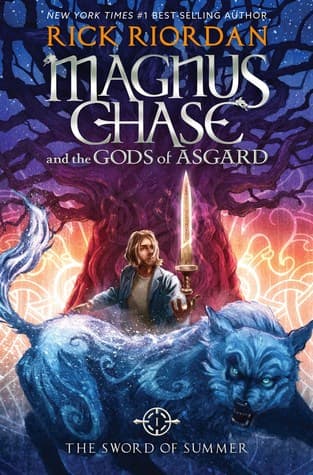
After dying heroically and being whisked away to a Norse afterlife, a sarcastic teenage Magnus Chase must embrace his demigod heritage to prevent Ragnarok, even if it means teaming up with a talking sword and a motley crew of mythological misfits.
Magnus Chase, a sixteen-year-old orphan, has lived on the streets of Boston for two years since his mother's death. He survives with his friends Blitz and Hearth, pickpocketing and scavenging. On his birthday, his uncle Randolph, whom his mother had warned him to avoid, tracks him down. Randolph reveals Magnus's true heritage as a son of a Norse god and tells him that a powerful ancient sword, Sumarbrander (Sumar), has been lost in Boston Harbor for centuries. Before Magnus can fully process this, a fire giant, Surt, attacks the Longfellow Bridge, seeking the sword to begin Ragnarok. Magnus tries to protect innocent bystanders from Surt's fiery attack.
During the confrontation on the Longfellow Bridge, Magnus confronts Surt, who searches for the Sword of Summer. In an attempt to buy time for civilians and distract the giant, Magnus sacrifices himself, impaling Surt with a shard of glass before being consumed by the giant's fire and falling into the icy Charles River. His death is not the end. He awakens in a grand hall, tended to by a Valkyrie named Samirah al-Abbas (Sam). She explains that his heroic death has qualified him for Valhalla, the afterlife for valiant warriors chosen by Odin. Sam takes him to the Hotel Valhalla, a luxurious, ever-rebuilding mansion in Asgard.
At his first feast in Valhalla, Magnus meets the einherjar, chosen warriors who train daily and die spectacularly, only to be resurrected for dinner. He meets his hallmates, including the giant-slayer Halfborn Gunderson and the shieldmaiden Mallory Keen. His arrival, however, is controversial. The Norns, the Fates of Norse mythology, appear and declare that Samirah al-Abbas chose Magnus prematurely. They say his death was not heroic enough for Valhalla. They proclaim that he is a 'wolf-son' and that his presence means a great evil is coming; he will fail to retrieve the Sword of Summer, thus hastening Ragnarok.
Because of the Norns' pronouncement and the 'unworthiness' of Magnus's death, Samirah al-Abbas is stripped of her Valkyrie wings and banished from Valhalla. Despite the skepticism of the other einherjar and the gods, the goddess Freyja, Valhalla's manager, gives Magnus a quest: he must find and retrieve the Sword of Summer himself, as it is now with Surt. If he fails, Ragnarok will begin. Magnus, bewildered and still adjusting to his new reality, accepts. He realizes his life, even in death, is now tied to the fate of the Nine Worlds.
Magnus, aided by his new einherjar friends, Halfborn and Mallory, escapes Valhalla. He uses one of the hotel's magical doors, which only those on a quest can open. He finds himself back in Boston and quickly reunites with his former homeless friends: Blitzen, a dwarf who cares about fashion, and Hearthstone, a deaf elf who communicates through runic sign language. They reveal they are not ordinary mortals but magical beings who have watched over him. They agree to help Magnus on his quest to find the Sword of Summer, as they also want to prevent Ragnarok.
The trio, with the now-mortal Samirah, travels to Nidavellir, the realm of the dwarves, through a magical portal. They seek a new weapon for Magnus, as the Sword of Summer is still missing. In Nidavellir, they meet Blitzen's father, Bilí, and navigate dwarven society, where craftsmanship and fashion are important. They learn about the dangers of the realm and the importance of precise dealings with dwarves. Blitzen, using his knowledge of dwarven fashion, secures a magical chainmail shirt for Magnus, which is crucial for his protection.
During their quest, Magnus and his companions encounter Thor, the god of thunder, who is more interested in watching TV than world-saving. Thor, while initially dismissive, eventually offers some cryptic advice and a warning about Loki's manipulative nature. It becomes clear that Loki, the god of mischief, is pulling strings behind the scenes. He orchestrates events and uses various figures to further his agenda. This adds another layer of complexity to Magnus's quest, as he realizes he is not just fighting giants but also navigating divine politics and deception.
The group eventually finds the Sword of Summer, Sumarbrander, not in a grand temple or a giant's lair, but in Randolph Chase's apartment. It is revealed that Randolph, under Loki's influence, had tried to find the sword himself, believing it was his birthright. The sword, which can transform into a small runic pendant, is sentient and chooses Magnus as its wielder, recognizing him as the rightful son of Frey. This moment confirms Magnus's connection to his divine heritage and the sword's power.
The quest ends in a confrontation with the monstrous Fenris Wolf, who is chained on an island. Loki's plan is revealed: he intends to free Fenris and bring about Ragnarok. Magnus, Sam, Blitzen, and Hearthstone, along with Sumar, must work together to prevent Fenris's escape. The battle is fierce, testing their combined strengths and loyalties. Magnus learns to wield Sumar effectively, understanding its sentience and power. The fight highlights the grave consequences of Loki's plans and the power of the mythical creatures they face.
Through strategy and the group's combined efforts, Magnus re-binds Fenris Wolf using the magical rope Gleipnir, a prophesied task. However, the victory has a cost. Hearthstone sacrifices a significant portion of his life force to use powerful magic during the battle, weakening him severely. The Norns' prophecy about Magnus being a 'wolf-son' and being involved in Fenris's binding is fulfilled. The true meaning of his role in preventing Ragnarok remains unclear. The event leaves the group shaken but victorious, with Fenris temporarily contained.
After re-binding Fenris and preventing a premature Ragnarok, Magnus returns to Valhalla as a recognized hero. The gods, especially Odin, acknowledge his bravery and the importance of his actions. Samirah al-Abbas is reinstated as a Valkyrie, her honor restored. Magnus is now fully accepted as an einherji, but he carries the weight of his experiences and the knowledge of Loki's ongoing schemes. He realizes that his death was only the beginning of a larger, more dangerous journey within the Nine Worlds, and that his purpose is far from over.
The Protagonist
Magnus transforms from a reluctant, bewildered demigod into a capable hero who accepts his destiny, understanding his unique role in the Norse pantheon and his connection to the Sword of Summer.
The Supporting
Sam faces public disgrace and banishment from Valhalla, only to regain her honor and status through her unwavering loyalty and crucial assistance in Magnus's quest.
The Supporting
Blitz demonstrates his unique value beyond traditional dwarven expectations, proving that his 'unconventional' skills are just as vital as combat prowess.
The Supporting
Hearthstone confronts his past traumas and sacrifices greatly for his friends, showcasing his immense power and loyalty, solidifying his role as a crucial magical asset.
The Supporting
Jack rediscovers his purpose and joy in battle as he finds a worthy and compassionate wielder in Magnus, embracing his role in preventing Ragnarok.
The Antagonist
Loki's schemes are partially thwarted but he remains a persistent, dangerous threat, his influence growing as the series progresses.
The Supporting
Randolph's desperation and ambition lead him to become a pawn in Loki's game, ultimately contributing to the dangers Magnus faces.
The Antagonist
Surt serves as the initial major threat, whose defeat prevents the immediate onset of Ragnarok, but his presence foreshadows future apocalyptic events.
The novel explores how family, both biological and chosen, shapes identity. Magnus grapples with memories of his mortal mother and the revelation of his divine parentage as a son of Frey. He finds a new 'family' in his friends, Blitzen and Hearthstone, and later in his hallmates in Valhalla, who accept him despite his unusual circumstances. Samirah's identity is challenged by her lineage as a daughter of Loki and her devout Muslim faith, forcing her to reconcile seemingly opposing aspects of herself. The idea of family extends beyond blood, emphasizing loyalty and acceptance.
““Family is not always blood. It's the people in your life who want you in theirs. The ones who accept you for who you are. The ones who would do anything to see you smile, and who love you no matter what.””
Heroism is central, especially in Valhalla. Magnus's initial death, though seemingly accidental, is seen as heroic because he selflessly protected others. The book challenges traditional notions of a 'warrior's death,' suggesting that bravery can appear in many forms, not just on the battlefield. Characters like Hearthstone make sacrifices, using their life force for the greater good, showing that heroism often comes with a personal cost. The story questions what truly makes a hero in a world of gods and monsters.
““Sometimes, the only way to start a new life is to die.””
The characters often face prejudice based on their lineage or appearance. Samirah, as a daughter of Loki, is constantly viewed with suspicion, even by other gods and Valkyries, despite her loyalty. Blitzen, a dwarf who loves fashion, is an outcast in his own society, seen as 'un-dwarflike.' Hearthstone, a deaf elf, carries the burden of his family's judgment. Magnus himself is initially seen as an 'unworthy' einherji. The story advocates for judging individuals by their actions and character rather than by their heritage or perceived differences. It promotes themes of acceptance and understanding.
““Just because someone is from a certain family doesn't mean they'll be just like the rest of them.””
The Norns' prophecies and the impending Ragnarok create a sense of destiny. Magnus is told he is a 'wolf-son' and that he will fail, yet he makes choices that defy these predictions. The characters struggle with fate, trying to carve their own paths while knowing that powerful, ancient forces are at play. Loki's manipulations further blur the lines, as characters like Randolph believe they are acting freely but are actually pawns in a larger scheme. This theme explores whether individuals can truly alter their predetermined future or if their choices are merely steps on a destined path.
““The Norns have spoken. You will fail. Ragnarok will come.””
The overarching apocalyptic event that drives the primary conflict.
Ragnarok, the 'Twilight of the Gods,' serves as the central looming threat. The prophecy dictates a series of events leading to the destruction of the Nine Worlds, including the freeing of Fenris Wolf and the battle between gods and giants. This device creates a constant sense of urgency and high stakes, as Magnus and his companions are continually working to delay or prevent its onset. It also frames the importance of the Sword of Summer and Magnus's role as a son of Frey, directly connecting his personal journey to the fate of the cosmos.
A powerful, talking sword that chooses its wielder and aids in battle.
The Sword of Summer, Sumarbrander (Jack), is not just a weapon but a character in itself. Its sentience, ability to talk, and distinct personality (boastful, loyal, sometimes annoying) make it a unique plot device. It guides Magnus, offers advice, and actively participates in battles. Its ability to transform into a pendant allows for concealment and ease of transport. Jack's presence ensures that Magnus always has a magical, albeit opinionated, ally, and its power is crucial for overcoming many obstacles, particularly in the confrontation with Fenris Wolf.
The secret heritage of characters as children of Norse gods, granting them unique abilities.
The device of divine parentage is central to the series, explaining Magnus's healing powers (son of Frey) and Samirah's ability to be a Valkyrie (daughter of Loki). It provides the characters with their inherent strengths and weaknesses, as well as their connections to the mythical world. This heritage also fuels much of the conflict, as the gods' intricate family trees and rivalries directly impact the demigods' lives, often thrusting them into dangerous quests and political schemes beyond their control. It grounds the fantastical elements in a personal context for the protagonists.
A magical afterlife where valiant warriors train and are resurrected daily.
The Hotel Valhalla serves as a primary setting and a unique plot device. It is an afterlife for einherjar, warriors who died heroically and are resurrected daily to train for Ragnarok. This setup allows for continuous combat and character development without permanent death, creating a distinct dynamic for the einherjar. The hotel's magical properties, such as its ever-changing rooms and portals to other realms, facilitate travel and provide a base of operations for Magnus. It represents both a reward and a responsibility for the chosen warriors.
“Yeah, I know. I’m a demigod. My dad is some kind of Norse god. I’m an einherji. I’m dead. And I’m going to Valhalla. And my life sucks.”
— Magnus Chase's internal monologue shortly after his death and meeting Samirah.
“The world is full of amazing things you haven’t seen yet. Don’t ever let anyone tell you otherwise.”
— Randolph Chase encouraging Magnus about the world.
“Some stories don't have a clear beginning, middle, and end. Life is about not knowing, having to change, taking the moment and making the best of it, without knowing what's going to happen next.”
— Magnus reflecting on the unpredictable nature of his new life.
“Blame it on the gods. They're a bunch of dysfunctional, self-obsessed, power-hungry jerks.”
— Hearthstone commenting on the Norse gods' behavior.
“A good sword is like a good friend. It'll stick with you to the end, and if you take care of it, it'll take care of you.”
— Blitz talking about the importance of good equipment, personifying the sword.
“The dead don't stay dead in Valhalla. We just get better at it.”
— Halfborn Gunderson explaining the nature of einherjar.
“If you're going to be a hero, you have to accept that sometimes you're going to get hurt. And sometimes you're going to fail.”
— Samirah al-Abbas giving Magnus a dose of reality about heroism.
“Magic is not about what you can see. It's about what you believe.”
— Hearthstone, through sign language, explaining the nature of runic magic.
“Sometimes you have to do the brave thing, even if you're terrified. Especially if you're terrified.”
— Magnus steeling himself for a difficult task.
“The gods don't give you what you want. They give you what you need.”
— Mimir offering a philosophical perspective on divine intervention.
“Being homeless taught me a lot. Like how to disappear. How to survive. How to be invisible.”
— Magnus reflecting on his past life on the streets.
“Family isn't always blood. It's the people who want you in their life; the ones who accept you for who you are.”
— Magnus coming to terms with his new friends as his chosen family.
“There's nothing more dangerous than a god who thinks he's doing you a favor.”
— Loki's deceptive nature being a recurring theme, often implied by other characters.
“You can't choose your family, but you can choose your friends. And sometimes, your friends are more family than your actual family.”
— Blitz giving advice to Magnus about his companions.
Ready to see how well you understood this book? Take our interactive quiz with 10 questions.

Biography coming soon.







