“The best thing for being sad is to learn something.”
— Merlyn teaching Wart about the value of education

Genre
Fantasy / Children's / Historical Fiction / Young Adult
Reading Time
360 min
Key Themes
See below
Sign in to track this book
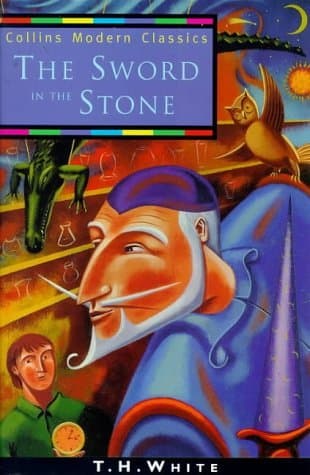
Before he was king, a young boy named Wart learns important life lessons from an eccentric wizard Merlyn, who transforms him into various animals.
Arthur, called Wart, is an orphan living with Sir Ector at the Castle of the Forest Sauvage. He is a squire to his older foster brother, Kay. One day, while hunting, Wart loses an arrow. Searching for it, he finds a cottage. Inside, he meets Merlyn, an old wizard who lives backward in time, with an owl named Archimedes. Merlyn knows Wart will arrive and knows his destiny, announcing he will be Wart's tutor. Sir Ector is unsure at first, but Merlyn shows his magic, convincing Ector to let him stay and teach Wart and Kay.
Merlyn starts Wart's education by turning him into animals, teaching him about different lives and rules. First, Wart becomes a fish in the moat. He learns about the brutal power of the pike, Mr. P, and the dangers of tyranny. Later, Merlyn turns Wart into a merlin (a type of falcon) and sends him to the Mews. There, Wart goes through a tough initiation into the hawk society, learning about courage, discipline, and self-control from the peregrine falcon, Cully. These changes prepare Wart for future responsibilities.
Wart's education continues when Merlyn turns him into an ant. He experiences the strict, shared, and military society of ants, where individual thought is suppressed. This shows the dangers of totalitarianism and losing personal freedom. After this, Wart becomes a wild goose. He flies with a flock, experiencing the freedom of migration and their natural society, which relies on cooperation and shared responsibility rather than forced obedience. He learns about how geese do not fight and the beauty of living with nature.
Wart and Kay go into the Forest Sauvage and meet Robin Wood (Robin Hood) and Maid Marian. They help Robin save some of his men and children held by the giant dog-boy, Galapas, and the evil Morgan le Fay. During this, Wart learns about justice and the complexities of good and evil. Meanwhile, King Pellinore, a funny knight, keeps hunting the Questing Beast. His dedication, even if his quest is absurd, gives Wart a look at chivalry and perseverance.
Merlyn's last animal transformation for Wart is into a badger. The badger teaches Wart about life's origins and the special gift of human intellect. The badger tells a story about how creatures chose their forms and defenses, with humans choosing to build and invent. This lesson highlights the responsibility that comes with human intelligence and its potential for both creation and destruction. Soon after, Sir Ector announces that Kay will be knighted, and Wart will be his squire, marking the end of their carefree childhood and the start of serious duties.
Sir Ector, Kay, and Wart travel to London for a New Year's Day jousting tournament. Kay, now a knight, wants to compete but forgets his sword at their lodgings. He sends Wart back to get it. When Wart arrives, the inn is locked and empty. Worried about helping his foster brother, Wart looks for another weapon. He sees a sword in an anvil in a churchyard, with words saying whoever pulls it out will be the King of England.
Thinking the sword is for Kay, and not understanding the words, Wart tries to pull it from the stone. After several tries, he calls on the animal friends he made—the fish, the hawk, the ant, the goose, and the badger—who appear as spirits to encourage him. With their quiet support, Wart pulls the sword out easily. He brings it to Kay, who knows its importance and falsely claims to have pulled it. But Sir Ector sees through Kay's lie and asks Wart to do it again, which he does.
When Wart pulls the sword again, the lords and knights, at first doubtful of a boy becoming king, accept him. Despite his humble nature, Wart is crowned King Arthur. Merlyn appears, revealing Wart's true parentage as King Uther Pendragon's son, and that he had always known his destiny. He explains his purpose was to teach Arthur for his future role. With his task done, Merlyn prepares to leave Arthur, as his backward timeline means he must return to the past, leaving Arthur to face his future as king.
The Protagonist
Wart transforms from an unassuming, uneducated boy into a wise and just king, guided by Merlyn's lessons and his own inherent goodness.
The Supporting
Merlyn fulfills his predetermined role as Arthur's educator, guiding him to kingship before departing to his past.
The Supporting
Kay struggles with his own ambition and jealousy before ultimately accepting Arthur's rightful place as king.
The Supporting
Sir Ector transitions from a simple country knight to the first loyal subject of the new King Arthur, accepting his foster son's destiny.
The Supporting
Archimedes remains a constant, wise presence, aiding in Arthur's education and symbolizing the wisdom imparted by Merlyn.
The Supporting
King Pellinore continues his eternal quest, a steadfast if comical representation of the old chivalric order.
The Supporting
Robin Wood continues his fight for justice in the forest, representing an alternative form of leadership and morality.
The Supporting
Maid Marian remains a steadfast and skilled partner to Robin Wood, contributing to their cause of justice.
The Mentioned
Mr. P remains a static representation of tyrannical power, a cautionary lesson for Wart.
The book's main theme is Wart's education by Merlyn. Through animal transformations, Wart learns about different types of rule, the nature of power, social structures, and the need for empathy and wisdom. These are not just academic lessons but experiences, preparing him for the complex duties of kingship. Merlyn's philosophy stresses learning as the best pursuit, shaping Arthur to be a fair and wise ruler.
“The best thing for being sad,' replied Merlyn, beginning to puff and blow, 'is to learn something. That is the only thing that never fails. You may grow old and trembling in your anatomies, you may lie awake at night listening to the disorder of your veins, you may miss your only love, you may see the world around you devastated by wicked madmen, or know your honour trampled in the sewers of baser minds. There is only one thing for it then — to learn. Learn why the world wags and what wags it. That is the only thing which the mind can never exhaust, never alienate, never be tortured by, never fear or distrust, and never dream of regretting. Learning is the only thing for you. Look what a lot of things there are to learn.'”
Through Wart's animal transformations, T.H. White explores different forms of power and rule, from the brutal rule of Mr. P the pike to the rigid ways of the ants, and the cooperative ways of the geese. Each experience offers a different view on leadership, power misuse, and the best way to govern. These lessons are important for Arthur as he tries to create a fair and peaceful kingdom, contrasting with the 'might is right' idea common in his time.
“He did not know that he was to be the greatest king that ever was. He did not know that he was to be the founder of the Round Table and the bringer of peace to Britain. He did not know that he was to be called Arthur.”
The book looks at justice and chivalry in complex ways. Robin Wood shows a kind of natural justice, fighting tyranny outside the law. King Pellinore, though funny, shows the persistent search for chivalric ideals. Wart's own sense of fairness and his lessons on power balance prepare him to create a new kind of chivalry—one based on justice, mercy, and reason, not just force.
“The Queen of the Ants was a sort of head mistress, and she had about a hundred thousand pupils who all thought the same thing. They had to.”
Arthur's journey of self-discovery and his destiny is a main theme. At first an ordinary orphan, Wart slowly understands his potential and his role as king. Merlyn's presence and his unique view of time are central, as he guides Arthur toward a future he already knows. Pulling the sword from the stone shows his true identity, changing him from an unknown boy to the legendary King Arthur.
“The Wart was one of those people who do not have to be taught to be good. He was good, and he was gentle, and he was kind, and he was interested in everything.”
Merlyn's magical ability to turn Wart into various animals.
This is the primary pedagogical device used by Merlyn to educate Wart. By transforming him into a fish, hawk, ant, and goose, Wart gains firsthand experience of different social structures, power dynamics, and philosophies of life. These immersive lessons are crucial for shaping his understanding of governance, empathy, and the responsibilities of leadership, providing a unique and memorable way for the future king to learn about the world.
The wizard's unique ability to live life in reverse.
Merlyn's ability to live backwards in time means he remembers the future, rather than the past. This provides him with foreknowledge of Arthur's destiny and allows him to meticulously prepare the young boy for his role as king. It also creates a sense of pathos, as Merlyn knows he must eventually leave Arthur. This device adds a layer of fatalism and predestination to the narrative, while also providing a unique perspective on history and the unfolding of events.
A legendary artifact that signifies rightful kingship.
The sword embedded in the anvil is the ultimate symbol of Arthur's destiny and divine right to rule. It acts as a magical test, revealing the true king not through strength or lineage alone, but through a predetermined, almost mystical, act. Its presence at the tournament serves as the climactic plot point that transitions Wart from a humble squire to the prophesied monarch, solidifying his identity and setting the stage for his future reign.
A mystical and dangerous setting that serves as a backdrop for adventure and learning.
The Forest Sauvage is more than just a geographical location; it's a symbolic space where magic, danger, and adventure intertwine. It's where Wart first encounters Merlyn, where he meets Robin Wood and Maid Marian, and where many of his animal transformations take place. The forest represents the wild, untamed aspects of the world, full of both peril and profound natural wisdom, acting as a crucible for Wart's character development and a source of wonder.
“The best thing for being sad is to learn something.”
— Merlyn teaching Wart about the value of education
“Everything not forbidden is compulsory.”
— Merlyn explaining the nature of the world to Wart
“There is only one thing for it then—to learn.”
— Merlyn encouraging Wart to embrace learning
“The bravest people are the ones who don’t mind looking like cowards.”
— Merlyn discussing courage with Wart
“It is not the oath that makes us believe the man, but the man the oath.”
— Merlyn on trust and integrity
“The world is full of obvious things which nobody by any chance ever observes.”
— Merlyn pointing out human oversight
“Education is experience, and the essence of experience is self-reliance.”
— Merlyn explaining his teaching philosophy
“The only cure for sadness is to learn something.”
— Merlyn repeating his advice to Wart
“We can only be said to be alive in those moments when our hearts are conscious of our treasures.”
— Merlyn on appreciating life's gifts
“The thing which is important is the thing which is not seen.”
— Merlyn teaching about inner qualities
“It is not power that corrupts but fear. Fear of losing power corrupts those who wield it and fear of the scourge of power corrupts those who are subject to it.”
— Merlyn discussing power and corruption
“The destiny of man is in his own soul.”
— Merlyn on self-determination
“To learn is to change.”
— Merlyn summarizing the purpose of education
“The world is a comedy to those that think, a tragedy to those that feel.”
— Merlyn reflecting on perspective
Ready to see how well you understood this book? Take our interactive quiz with 10 questions.

Biography coming soon.







