“As long as we are content with what we have, and make the best of it, we shall be happy.”
— Early in their island life, as they begin to explore and make do with their situation.

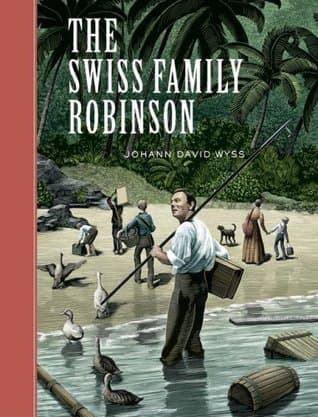
Johann David Wyss (1979)
Genre
Children's / Historical Fiction / Young Adult
Reading Time
450 min
Key Themes
See below
Sign in to track this book
Shipwrecked on an island, the Robinson family uses their skills to build a self-sufficient home, facing challenges with cleverness and determination.
A Swiss pastor, his wife, and their four sons (Fritz, Ernest, Jack, and Francis) are on a ship going to a new colony when a storm hits. The rest of the crew and passengers leave the ship, seemingly leaving the Robinson family alone. With their father's resourcefulness and faith, they tie together a raft from tubs and barrels. They load it with food and tools, including a dog and some farm animals, and make a dangerous trip to a nearby tropical island. After reaching shore, they set up a temporary camp, thanking God for their safety and starting to look at their surroundings and immediate needs.
The family begins exploring their new environment. Fritz, the oldest, is a good hunter, providing food. Ernest, who likes to learn, identifies different plants and animals. Jack, the adventurous middle son, wants to explore, while young Francis, the youngest, is curious and sometimes mischievous. They find many useful plants, including gourds for containers and coconuts for food and drink. They also find various animals, some familiar and some new. The father stresses the importance of faith, hard work, and learning in their new life, making sure the boys learn practical skills and scientific knowledge.
Knowing the danger from wild animals, the family decides to build a more permanent and safe home. They find a large banyan tree with strong branches, good for a treehouse. Using tools saved from the ship and their cleverness, they build a comfortable, elevated home. This new house keeps them safe from predators and gives them a good view of their surroundings. They also start a garden, planting seeds saved from the ship, aiming to grow their own food. The mother, Elizabeth, manages their household and cooking.
Over time, the family continues to explore the different areas of their island. They find a cave which they name 'Falconhurst' and later decide to make it their winter home, furnishing it with saved items and natural materials. They meet many animals, some of which they tame, like a buffalo they name 'Grizzly' and an onager. They also find useful things like rubber trees, sugar cane, and different types of wood for building. Each son uses his skills on these trips, with Fritz often leading the hunting, Ernest providing plant knowledge, and Jack showing good agility.
During one of his solo hunting trips, Fritz finds signs of another person. Following a trail, he finds a note and eventually rescues a young Englishwoman named Jenny Montrose, who had been shipwrecked on a nearby island and left by pirates. He brings her back to the family, who welcome her. Jenny quickly joins the family, bringing new ideas and skills. Her arrival provides companionship, especially for the mother, and adds a new element to the family's isolated life, possibly starting a romance between her and Fritz.
With Jenny's arrival and time passing, the family continues to build their island colony. They set up different outposts, including a 'Farm' where they keep their tamed animals and grow large gardens. They also decide to build a larger, more sea-worthy boat, a pinnace, hoping it might one day help them return to civilization or at least explore further. This big project requires much effort and cleverness, using the many trees and their combined skills in carpentry and engineering. Building the boat becomes a main focus for the whole family.
Hoping for rescue or contact with the outside world, the family, especially the father, decides to send a message in a bottle. They write a detailed account of their survival and location, hoping it will reach someone. They continue their daily routines of farming, hunting, and exploring, always watching the horizon. The boys grow into capable young men, each learning skills needed for their survival and the success of their settlement. Jenny, fully recovered, helps the family's well-being and education.
Years after their shipwreck, a European ship, the 'Lizard,' led by Captain Littlestone, finds the island. The ship had found the family's message in a bottle. The ship's arrival creates a difficult choice for the Robinsons. They have built a successful, self-sufficient colony, and the island has become their home. The idea of returning to civilization brings mixed feelings, especially for the younger boys who have known little else but island life. The captain and his crew are amazed by the family's cleverness and their settlement.
After much discussion, the family makes their decisions. Fritz, now a young man, decides to return to Europe with Jenny to marry and live in society. Ernest, wanting more education, also chooses to return. Jack, though at first unsure, decides to go with them, perhaps looking for adventure. Francis, the youngest, wants to stay with his parents. The pastor and his wife, along with Francis, decide to remain on the island, having grown fond of their self-made home and feeling a desire to continue their unique life. They say an emotional goodbye to those leaving.
The pastor, Elizabeth, and Francis continue their lives on the island, happy with their decision to stay. They keep farming, building, and exploring, now with a stronger sense of permanence and purpose. They think about their journey, their faith, and the strength of their family. The island remains their home, showing human endurance, cleverness, and the ability to find happiness in unexpected places. They continue to do well, content in their self-sufficient life and the natural beauty around them.
The Protagonist
From a bewildered shipwreck survivor, he transforms into the wise and capable governor of a thriving island colony, ultimately choosing to remain in his self-made paradise.
The Supporting
She adapts from a traditional homemaker to a pioneer woman, essential for the family's comfort and emotional stability, ultimately choosing to stay on the island.
The Supporting
He matures from a daring youth to a responsible young man, eventually choosing to return to civilization with Jenny to start his own family.
The Supporting
He develops his intellectual prowess and eventually chooses to return to Europe to pursue further education and a life of scholarship.
The Supporting
He grows from a playful, adventurous boy into a capable young man, eventually choosing to return to civilization with his brothers for new experiences.
The Supporting
He grows up on the island, embracing it as his true home, and ultimately chooses to remain there with his parents.
The Supporting
From a shipwrecked survivor, she finds a new family and love, eventually choosing to return to Europe with Fritz.
The Mentioned
His role is primarily as a plot device, bringing the outside world to the Robinsons and offering them a choice.
The Robinsons' survival and success come from their great cleverness. From tying together a raft from barrels to building a treehouse, making tools, growing crops, and taming animals, the family constantly invents and adapts. The father's wide knowledge and the sons' practical skills allow them to turn a basic existence into a comfortable and productive colony. This theme appears in their creation of candles, rubber shoes, flour, and even a boat, all from the island's resources, showing human endurance and creativity.
“''Necessity is the mother of invention,' said my father, 'and you see, my children, how many things we have already learned to do by her teaching.'”
The family's strong religious faith is a constant source of strength and guidance. The father, a pastor, often says their survival and good luck are due to God. Prayer, Bible readings, and moral lessons are part of their daily lives. This faith helps them keep hope when things are hard, provides values, and encourages them to be thankful for their blessings. It supports their positive outlook and their belief that they are not truly alone, even on an island, as God watches over them.
“'Let us thank God, my children, who has so wonderfully preserved us, and brought us to this place of safety.'”
Education is very important to the Robinson family. The father teaches his sons about plants, animals, geography, and practical skills, making their island a living classroom. Ernest's interest in learning, in particular, shows the value of knowledge. This theme suggests that intelligence and learned skills are as important for survival as physical strength. The family's ability to identify useful plants, understand animal behavior, and use scientific principles directly helps them build a sustainable life on the island.
“'Knowledge is power, my boys, and with it, we can conquer many difficulties.'”
The Robinson family's strength is in their unity and cooperation. Every member, from youngest to oldest, gives their unique skills and efforts for the group's good. The father leads and shares knowledge, the mother manages the home, and each son develops specific skills (hunting, intellect, agility, observation). Their ability to work together, solve problems, and support each other is key to overcoming challenges and building a thriving community. This theme highlights the importance of family connections in survival.
“'United we stand, divided we fall, my children. Remember that our strength lies in our love and cooperation.'”
The story explores the relationship between people and nature. The family must learn to manage their environment, using its resources while also protecting themselves from its dangers. They adapt to the island's climate, learn about its plants and animals, and turn raw nature into a livable and productive home. Nature also offers beauty, abundance, and lessons in harmony. The Robinsons' journey shows humanity's ability to adapt, innovate, and live with the wilderness.
“'This island, though wild, is a true garden of Eden if we but know how to cultivate it.'”
A classic backdrop for survival and ingenuity.
The deserted island serves as the primary stage for the entire narrative. It forces the Robinson family to rely solely on their wits, salvaged materials, and the island's natural resources. This setting isolates them from civilization, highlighting their self-sufficiency and resourcefulness. The island itself is depicted as a rich and diverse ecosystem, providing both challenges (wild animals, unknown plants) and bountiful resources (timber, fruit, animals, minerals), making it a dynamic character in its own right and driving the plot forward through exploration and discovery.
A traditional means of communication and a catalyst for rescue.
The message in a bottle is a classic plot device used to connect the isolated family with the outside world. It represents their enduring hope for rescue and acts as the direct means by which Captain Littlestone's ship eventually discovers them. This device builds suspense and anticipation throughout the story, as the family continues their life on the island while holding onto the possibility of being found. Its success ultimately forces the family to confront the choice between their established island paradise and a return to European society.
A treasure trove of tools and resources for survival.
The wrecked ship, initially a symbol of disaster, transforms into an invaluable resource for the Robinsons. Its hold contains tools, seeds, livestock, weapons, books, and various provisions that are crucial for the family's immediate survival and long-term development. The repeated trips to the wreck allow the family to acquire everything from carpentry tools to gunpowder, accelerating their progress from mere survival to building a sophisticated colony. It functions as a deus ex machina of sorts, providing essential items that would be impossible to create from scratch.
Each son embodies a distinct personality and skill set.
The four Robinson sons represent distinct archetypes, each contributing a different strength to the family's survival and exploration. Fritz is the brave hunter/adventurer, Ernest the intellectual/naturalist, Jack the agile/mischievous explorer, and Francis the innocent/beloved youngest. This differentiation allows for a wide range of activities and discoveries, as each son's unique talents are utilized. It also provides opportunities for character development and highlights the importance of diverse skills in a cooperative environment, making the family a microcosm of society.
“As long as we are content with what we have, and make the best of it, we shall be happy.”
— Early in their island life, as they begin to explore and make do with their situation.
“God grant that we may all find a safe harbor after the storms of life.”
— A prayer offered after surviving the shipwreck.
“Necessity is the mother of invention.”
— Often repeated as they devise new tools and solutions for their survival.
“The greatest joy of life is to be able to do good.”
— When discussing the satisfaction of helping others or making improvements to their camp.
“It is not what we have, but what we do with what we have, that determines our success.”
— Reflecting on their progress and the materials they've utilized from the wreck.
“Education is the best provision for the journey to old age.”
— The father emphasizes the importance of teaching his sons various skills and knowledge.
“Patience and perseverance overcome all difficulties.”
— When faced with challenging tasks, such as taming animals or building structures.
“Every day brought its new duties and its new pleasures.”
— Describing the rhythm of their daily life on the island.
“The true wealth of a family consists not in its possessions, but in the love and harmony that bind its members together.”
— A reflection on their family bonds amidst their isolated existence.
“Where there is a will, there is a way.”
— Encouraging his sons when they doubt their ability to complete a difficult task.
“We are not alone, even in the wilderness, if we have God for our companion.”
— The father's spiritual comfort and belief in divine presence.
“To be truly happy, one must have both work and recreation.”
— Discussing the balance needed for a fulfilling life, even on a deserted island.
“A good book is a true friend, always ready to entertain and instruct.”
— When they discover books among the salvage from the ship.
“The most important thing is to learn to adapt to circumstances.”
— A key lesson learned through their many adjustments to island life.
Ready to see how well you understood this book? Take our interactive quiz with 10 questions.

Biography coming soon.
Dan Gemeinhart
4.5
Kate O'Hearn
4.4

Jeanne Birdsall
4.4

Jen Wang
4.4

Wendelin Van Draanen
4.3

John Marsden
4.3

Chris Van Allsburg
4.3
Jennifer A. Nielsen
4.2