“You are all a lost generation.”
— Gertrude Stein's remark to Hemingway, used as an epigraph for the novel.

Ernest Hemingway (2022)
Genre
Historical Fiction
Reading Time
256 min
Key Themes
See below
Sign in to track this book
After World War I, a jaded American journalist navigates his complex feelings for the untamable Lady Brett Ashley among the cafes of Paris and the bullfighting festivals of Spain, showing the disillusionment of the 'Lost Generation'.
The novel begins in Paris in the early 1920s with Jake Barnes, an American journalist and World War I veteran. Jake describes his daily life of drinking, dining, and socializing with other expatriates. He details his platonic but deep love for Lady Brett Ashley, a beautiful and charming British socialite. Jake's war injury has left him impotent, preventing a physical relationship with Brett, despite their feelings for each other. He recounts Brett's restless nature and her many relationships, including her engagement to Mike Campbell, a heavy-drinking Scotsman. Jake often observes his friends, especially Robert Cohn, a wealthy American writer and former boxer, who is infatuated with Brett.
Robert Cohn, a wealthy American writer who funds a literary magazine, is a well-meaning but often naive and insecure character. He recently had a short affair with Lady Brett Ashley, which left him deeply in love and convinced she loves him. This infatuation causes much tension in the group, as Cohn constantly pursues Brett and expresses his feelings, often looking foolish. Jake, while sympathetic, finds Cohn's romantic idealism and inability to understand the group's cynical ways irritating. Cohn's presence and open adoration for Brett create awkwardness and resentment, especially from Mike Campbell, Brett's fiancé, who openly dislikes Cohn.
Lady Brett Ashley is an independent and modern woman, always surrounded by admirers and moving between relationships. She is engaged to Mike Campbell, but her affections are divided, and she often seeks out Jake Barnes, with whom she shares a deep emotional bond. Despite their mutual love, Jake's war wound prevents a physical relationship, causing deep longing and frustration for both. Brett's inability to commit to one man, along with her desire for excitement, drives much of the story. Her relationships, including the one with Cohn, are often short-lived and impulsive, leaving hurt feelings and jealousy among her male companions.
Jake Barnes and his friend Bill Gorton, an American writer, decide to leave Paris for a fishing trip in Spain. They travel to Bayonne, then by bus into the Pyrenees, arriving in Burguete, near Pamplona. This journey changes the novel's mood, offering a temporary escape from the emotional complexities of Paris. The two men enjoy simple companionship, fishing in the Irati River and having lighthearted conversations. This break shows a different side of Jake's character – his appreciation for nature and male friendship, providing a brief rest before the entire group reunites for the fiesta in Pamplona, bringing all the unresolved tensions with them.
Jake and Bill Gorton go on their fishing trip in the Spanish countryside, finding a temporary escape from their Parisian emotional turmoil. They spend several days in Burguete, fishing for trout in the clear, cold streams of the Irati River. During this time, they engage in simple, masculine activities, drinking wine, eating good food, and discussing their lives with camaraderie. This period is peaceful and beautiful, contrasting with their decadent Paris life. The fishing trip is a restorative break, allowing Jake to escape his unrequited love for Brett and his social circle's frustrations.
Jake and Bill arrive in Pamplona and are soon joined by Brett, Mike Campbell, and Robert Cohn. The city is preparing for the San Fermín fiesta, a week-long celebration with bullfights and running with the bulls. The atmosphere is lively and chaotic, filled with music, dancing, and endless drinking. The group's arrival in Pamplona intensifies existing tensions. Cohn's pursuit of Brett becomes more obvious and embarrassing, leading to increased animosity from Mike. Brett, in turn, is attracted to the excitement and attention, further fueling the jealousy among the men. The fiesta setting provides a backdrop for their escalating emotional conflicts.
During the fiesta, the group attends several bullfights. There, they meet Pedro Romero, a young, talented, and handsome bullfighter. Romero shows integrity, courage, and artistry that impress Jake and captivate Brett. His disciplined approach to bullfighting contrasts with the expatriate group's aimless hedonism. Brett, drawn to his passion, becomes intensely infatuated with him. This new attraction further complicates the strained relationships in the group, particularly angering Robert Cohn, who sees Romero as a rival, and upsetting Mike Campbell, Brett's fiancé.
Robert Cohn's love for Brett reaches a breaking point when she begins an affair with Pedro Romero. Consumed by jealousy, Cohn confronts Brett, then Mike Campbell, and finally Jake, accusing them of helping Brett's relationship with Romero. His frustration leads to violent outbursts. Cohn physically assaults Mike and then Jake, beating them both severely. He also confronts Romero, beating him, though Romero, despite being injured, maintains his dignity and still performs heroically in the bullring. These confrontations show the raw emotions and destructive nature of Cohn's unrequited love, further alienating him from the group and highlighting their moral decay.
After the violent confrontations, Brett, despite her initial guilt and the group's disapproval, decides to leave Pamplona with Pedro Romero. She is drawn to his youth, passion, and authenticity, which she finds lacking in her own life and among her friends. Her departure marks a turning point in the fiesta and the group's dynamics. Mike Campbell, defeated, leaves Pamplona, while Bill Gorton also departs. Jake remains, feeling a complex mix of sadness and resignation. The affair with Romero, though brief, symbolizes Brett's ongoing search for meaning and her ultimate inability to find it within her current social circle.
Following Brett's departure with Romero and the violent incidents, the fiesta ends, and the group disperses. Mike Campbell leaves Pamplona, broken by Brett's actions. Bill Gorton also departs, leaving Jake alone to reflect on the events and his emptiness. Jake travels to San Sebastián, seeking peace. He tries to enjoy swimming and relaxing, but the emotional scars of the fiesta and his love for Brett remain. This period shows Jake's deep isolation and his struggle to find meaning in a world that often seems indifferent to his suffering.
After some time alone in San Sebastián, Jake receives a telegram from Brett, asking him to come to Madrid. She has left Pedro Romero, realizing she was corrupting him and their relationship could not last. Jake immediately travels to her. They meet and discuss her decision to let Romero go, with Brett showing a rare moment of self-awareness. She admits she couldn't ruin him. They spend some time together, riding in a taxi, where Brett says, "Oh, Jake, we could have had such a damned good time together." Jake's reply, "Isn't it pretty to think so?" captures their tragic love and the futility of their desires, ending the novel as they acknowledge the impossibility of their relationship.
The Protagonist
Jake learns to accept the limitations of his love for Brett and finds a degree of stoic resignation regarding his circumstances, embracing a code of conduct in an otherwise chaotic world.
The Deuteragonist
Brett moves through various relationships, ultimately realizing the destructive patterns in her life and making a conscious, albeit painful, decision to protect Pedro Romero from her influence.
The Antagonist/Supporting
Cohn's naive idealism is progressively shattered by the group's cynicism and Brett's rejection, leading to violent outbursts and his eventual isolation.
The Supporting
Bill remains largely static, serving as a foil and a stable companion for Jake, offering a brief respite from the novel's central romantic drama.
The Supporting
Mike's character deteriorates throughout the novel as his alcoholism and jealousy intensify, culminating in his complete defeat and departure after Brett leaves with Romero.
The Supporting
Romero remains steadfast in his principles and art, briefly allowing Brett into his world before she recognizes her corrupting influence and leaves him, preserving his purity.
The Mentioned
N/A
The Supporting
N/A
The novel portrays the 'Lost Generation' – young adults disillusioned by World War I and searching for meaning in the post-war era. This theme appears in the characters' aimless lives, heavy drinking, superficial relationships, and constant search for distraction. Jake's impotence reflects this emotional emptiness. The characters cannot form lasting connections, seeking fleeting pleasures that leave them empty. The contrast between their pleasure-seeking lifestyle and Pedro Romero's traditional values highlights their lost state.
““You’re an expatriate. You’ve lost touch with the soil. You get precious. Fake European standards have ruined you. You drink yourself to death. You become obsessed with sex. You spend all your time talking, not working. You are an expatriate, see? You hang around cafés.””
The central theme of unrequited love, especially between Jake and Brett, is tied to Jake's war-induced impotence. This physical wound symbolizes a deeper emotional emptiness within the 'Lost Generation.' Despite their deep affection, their love can never be fully realized, causing constant frustration and pain. Brett's inability to commit to Jake due to this physical barrier leads her into destructive relationships, while Jake silently endures his longing. The theme explores the tragic irony of deep love that cannot be fulfilled conventionally, showing the emotional scars of war.
““Oh, Jake,” Brett said, “we could have had such a damned good time together.” “Isn’t it pretty to think so?””
The novel explores different ideas of masculinity, especially after the war when traditional ideas of heroism were challenged. Jake's impotence directly affects his sense of masculinity and his ability to have a 'normal' relationship. Robert Cohn's pursuit of Brett and his violent outbursts are a desperate attempt to assert his masculinity. In contrast, Pedro Romero embodies a strong, traditional masculinity based on courage, discipline, and integrity, especially in the bullring. His 'afición' (passion for bullfighting) represents an authentic code of honor that contrasts with the aimless behavior of the expatriate men.
““Bull-fighting is not a sport. It is a tragedy. A man who is not a matador may not be an aficionado. He may be a aficionado, but he cannot be an aficionado. The aficionado is one who has a passion for bull-fighting. He is one who has a knowledge of bull-fighting. He is one who has a respect for bull-fighting.””
The characters constantly seek pleasure through drinking, parties, and casual sex, using these activities to escape their inner emptiness and disillusionment. The constant travel between Paris and Spain, and the energy of the fiesta, distract them from their internal struggles. This pleasure-seeking lifestyle, however, offers only temporary relief, as the underlying pain always returns. The characters are caught in a cycle of seeking external stimulation to fill an internal void, showing that escapism is not a long-term solution to existential angst.
““I can’t stand it to think my life is going so fast and I’m not really living it.””
Characters who live by a strict personal code of honor, courage, and grace under pressure.
Hemingway's 'Code Hero' is exemplified by Pedro Romero. This device highlights characters who face life's challenges with dignity, self-control, and a specific set of moral principles, often in the face of chaos or meaninglessness. Romero's disciplined performance in the bullring, his stoicism after being beaten by Cohn, and his commitment to his art embody this code. Jake Barnes, to a lesser extent, also strives to live by a code, seeking authenticity and integrity in his actions and observations, especially in contrast to the emotional excesses of his friends. This device serves to contrast ideal behavior with the 'Lost Generation's' moral decay.
Jake's physical wound symbolizes the spiritual and emotional barrenness of the Lost Generation.
Jake's war injury, which leaves him physically impotent, is a powerful symbol throughout the novel. On a literal level, it prevents him from having a conventional relationship with Brett, driving much of the romantic conflict. Symbolically, it represents the emotional, spiritual, and creative impotence of the 'Lost Generation' as a whole. The war has left them unable to truly connect, to find lasting meaning, or to 'produce' anything of substance beyond fleeting pleasures. This device underscores the theme of disillusionment and the profound damage inflicted by the war, extending beyond physical wounds to the very soul.
The chaotic, vibrant Spanish festival as a microcosm of the characters' lives and a catalyst for conflict.
The week-long Fiesta of San Fermín in Pamplona serves as a crucial plot device. Its frenetic energy, constant drinking, and blend of sacred tradition with violent spectacle mirror the chaotic and often destructive lives of the expatriate characters. The fiesta acts as a pressure cooker, intensifying pre-existing tensions and bringing latent conflicts to the surface, particularly between Cohn, Mike, and Brett. The bullfights, with their themes of death, courage, and artistry, provide a stark contrast to the characters' aimless existence and introduce Pedro Romero, a figure of authentic passion and honor, further highlighting the group's moral and emotional disarray.
Physical travel as a means of seeking escape, self-discovery, or confirming internal states.
The characters' repeated journeys, from Paris to Spain, and within Spain (e.g., Jake and Bill's fishing trip, Jake's trip to San Sebastián, Brett's call from Madrid), serve as a significant plot device. These physical movements often parallel their internal quests for meaning, escape, or resolution. The fishing trip offers Jake and Bill a temporary respite and a taste of authentic living, while the journey to Pamplona plunges them back into chaos. Brett's final journey to Madrid and her call to Jake signify a moment of self-awareness and a desire for closure, confirming that physical escape alone cannot solve their deeper emotional problems.
“You are all a lost generation.”
— Gertrude Stein's remark to Hemingway, used as an epigraph for the novel.
“It is awfully easy to be hard-boiled about everything in the daytime, but at night it is another thing.”
— Jake Barnes reflecting on his emotional state at night.
“How are you going to get to be a serious drunk?”
— Bill Gorton jokingly asking Jake Barnes.
“Oh, Jake, we could have had such a damned good time together.”
— Brett Ashley's lament to Jake Barnes about their unfulfilled relationship.
“No; I don't like it. It's too big.”
— Lady Brett Ashley's assessment of Cohn's bullfighting interest.
“I can't stand it to think my life is going so fast and I'm not really living it.”
— Robert Cohn expressing his dissatisfaction with his life.
“I did not care what it was all about. All I wanted to know was how to live in it.”
— Jake Barnes's internal thought about life's complexities.
“Enjoying living was learning to get your money's worth and knowing when you had it.”
— Jake Barnes's reflection on how to live well.
“It was like a fiesta. It was like a dream.”
— Jake Barnes describing the atmosphere of the San Fermín festival.
“Nobody ever lives their life all the way up except bull-fighters.”
— Jake Barnes's observation about the intensity of bullfighters' lives.
“The world was not a pleasant place to be. The world was a good place to buy in.”
— Jake Barnes's cynical view of the world.
“Going to another country doesn't make any difference. I've tried all that. You can't get away from yourself by moving from one place to another.”
— Robert Cohn's realization about escaping internal problems.
“You know it makes me feel rather good deciding not to be a bitch.”
— Brett Ashley's comment after sending Romero away.
“I can't stand to think my life is going so fast and I'm not really living it.”
— Robert Cohn expressing his dissatisfaction with his life (repetition from earlier, but a very notable quote).
“It was a good morning, and there was a good feeling to the day.”
— Jake Barnes's simple appreciation for a pleasant day.
Ready to see how well you understood this book? Take our interactive quiz with 10 questions.
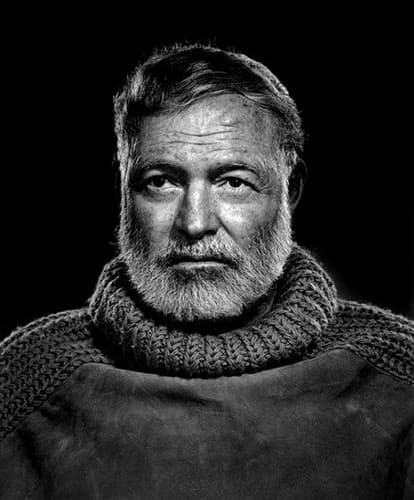
Ernest Miller Hemingway was an American novelist, short-story writer, and journalist. His economical and understated style—which included his iceberg theory—had a strong influence on 20th-century fiction, while his adventurous lifestyle and public image brought him admiration from later generations. Hemingway produced most of his work between the mid-1920s and the mid-1950s, and he was awarded the 1954 Nobel Prize in Literature. He published seven novels, six short-story collections, and two nonfiction works. Three of his novels, four short-story collections, and three nonfiction works were published posthumously. Many of his works are considered classics of American literature.







