“It was as if she had been made ready for a journey, and now the journey was about to begin.”
— Kate Brown's initial feeling of change and liberation at the start of her summer.


Doris Lessing (1973)
Genre
Literary Fiction
Reading Time
236 min
Key Themes
See below
Sign in to track this book
Kate Brown's perfectly ordered life as a wife and mother unravels, sending her on a journey through affairs and friendships, where she confronts a darker self she never knew.
Kate Brown, a beautiful and capable middle-aged woman, has spent twenty years as a devoted wife and mother, managing her household and family. As summer begins, her four children – Michael, Hugh, Bridget, and Andrew – all plan to leave home, some for jobs, others for travel. Her husband, Michael, a successful doctor, is also busy with work and a new interest in a younger colleague, Dorothy. Kate first feels confused, a void left by her usual duties. This sudden emptiness, however, also starts a feeling of freedom and a hidden desire for more than her organized domestic life.
While her husband Michael is away, his friend and colleague, Jeffrey, contacts Kate with an unusual request. He needs someone to go with a dying young man, Richard, on a trip to Turkey for medical care. Jeffrey believes Kate's calm manner and practical skills make her a good choice. Surprised by the offer, which takes her outside her traditional role, Kate accepts. This decision is her first big step away from her identity as 'Mrs. Michael Brown' and shows a willingness to try new experiences, quietly astonishing her family and friends.
Kate travels to Turkey with Richard, giving him company and care during his last months. During this time, she dyes her hair blonde, a symbol of change and a break from her old image. She takes on a new, more adventurous self, having a brief affair with a younger man, surprising herself and quietly disapproved by some around her. This time away from her familiar world lets Kate try different parts of her personality, exploring desires and freedoms she had long suppressed. She feels a deep change, shedding the 'good wife and mother' identity.
After Richard's death, Kate returns to London. However, she cannot easily go back to her previous life. Her children are still scattered, and her husband, Michael, is more distant, his affair with Dorothy now clearer, though unspoken. Kate feels deeply alienated, like a stranger in her own home. The blonde hair, which felt freeing in Turkey, now seems out of place and even childish in her familiar surroundings. She realizes her change abroad has made her unable to simply resume her old role, and she feels a growing unease and unhappiness.
In London, Kate meets Maureen, a young, free-spirited woman working in a bookshop. Maureen is not tied by societal expectations, living a bohemian life, and showing a youthful independence that deeply fascinates Kate. Maureen becomes a kind of guide for Kate, showing her the possibilities of a life lived outside normal limits. Through Maureen, Kate sees a different kind of freedom, one not tied to a relationship or a specific role, but to an inner self-sufficiency. Maureen's carefree attitude further encourages Kate's own desire for self-discovery and freedom.
Kate moves into a small, rented room in London, cutting ties with her family and former life. She experiences a time of intense loneliness and aimlessness. The freedom she wanted starts to feel less like liberation and more like an emptiness. She struggles with simple tasks, often forgetting where she is or what she is doing. Her blonde hair, once a symbol of rebellion, now feels like a disguise, a mask that keeps her from truly seeing herself. She feels increasingly isolated, questioning identity and sanity, as the outside world seems to fade.
During this isolation, Kate starts having strong, repeated dreams and visions of a large, shaggy bear. The bear is a primal, instinctual creature, representing her subconscious, untamed self, or a deeper connection to nature and instinct she has long suppressed. The bear appears to her not as a threat, but as a silent companion, a guide through her inner wilderness. These visions become more vivid and real, blurring the lines between waking and dreaming, further confusing Kate and pushing her deeper into her internal world.
Kate's detachment from reality grows. She neglects her appearance, hygiene, and often forgets to eat. Her behavior becomes erratic and confusing to those around her, including Maureen, who tries to help but cannot connect with her. Kate's psychological state worsens, marked by deep confusion, memory loss, and an inability to function in the outside world. She is no longer just unhappy; she is having a full mental breakdown, a complete unraveling of her former self, leading to a state of near-catatonic withdrawal.
Eventually, one of Kate's children, Bridget, finds her in a very bad state. Alarmed by her mother's appearance and behavior, Bridget contacts her siblings and father. The family, though confused and somewhat upset by Kate's choices, must face how serious her condition is. They arrange for her to be admitted to a mental hospital, where she receives medical care. This intervention is a turning point, as Kate is removed from her self-imposed isolation and put into a structured environment, though her internal journey is not over.
Inside the hospital, Kate slowly and painfully begins to recover. A nurse cuts off her blonde hair, a symbolic act of shedding the false self and the illusion of superficial freedom. Through therapy and the structured environment, she gradually starts to regain her memory and a sense of self. This recovery is not a return to her old identity, but a painful process of bringing together the different parts of herself – the wife, the mother, the adventurer, the lost woman – into a more authentic, though deeply changed, individual. She emerges with a deeper understanding of herself, born from her breakdown.
The Protagonist
Kate transforms from a dutiful wife and mother into a woman who deliberately dismantles her old identity, experiencing profound disorientation and a mental breakdown, ultimately emerging with a new, more integrated understanding of herself.
The Supporting
Michael remains largely static, representing the conventional world Kate abandons, but is forced to react to the consequences of her radical transformation.
The Supporting
Maureen serves as a catalyst and mirror for Kate's aspirations, remaining largely unchanged herself, but influencing Kate's perception of freedom.
The Supporting
Richard's journey is one of decline towards death, but his need for care indirectly initiates Kate's transformation.
The Supporting
Bridget moves from self-absorbed independence to a position of concern and action regarding her mother's well-being.
The Mentioned
The bear's presence intensifies as Kate's mental state deteriorates, acting as a guide through her internal wilderness, and recedes as she begins to recover.
The main theme is Kate Brown's journey to find her true self beyond being a wife and mother. After her children leave and her husband becomes distant, Kate finds an emptiness, which makes her shed her old identity. This happens when she dyes her hair blonde and takes a caregiving role in Turkey, then later moves into a rented room, purposely taking apart her former life. Her freedom, however, leads to deep confusion and a question of what 'self' means without outside definitions.
“She was learning to be free. She was learning to be nothing.”
As Kate seeks freedom, her sense of self begins to break down, leading to a mental breakdown. This theme explores how fragile identity is and the psychological effects of cutting ties with one's established roles and societal structures. Kate's growing confusion, memory loss, and inability to function in the outside world – shown by her neglect of her appearance and the vivid bear visions – illustrate this breakdown. Her journey suggests that true freedom might first require a painful process of un-becoming, where the old self must die before a new one can appear.
“She was losing her boundaries, her shape, her definition.”
The novel questions the nature of freedom, especially for women, and whether it truly brings happiness or just a different kind of suffering. Kate's first experiences of freedom, like her affair in Turkey, are exciting. However, after returning to London and purposely isolating herself, her 'freedom' turns into deep loneliness, confusion, and mental illness. The book suggests that freedom without connection, purpose, or a stable inner self can be as limiting as, if not more devastating than, the restrictions of traditional roles. True liberation, it implies, is not just the absence of outside chains, but an inner state of wholeness.
“This freedom, she had discovered, was a kind of vacancy.”
The novel examines the societal expectations placed on women, especially those of Kate's generation, to be wives and mothers above all else. Kate's careful management of her household and family's needs for twenty years shows how widespread these roles are. Her rebellion is a direct response to the suffocating limits of these expectations. Her family and friends' reactions to her change, from confusion to concern, show how deeply ingrained these gender roles are, and how hard it is for a woman to stray from them without facing judgment or misunderstanding.
“She had been a good wife, a good mother. What else was there?”
Kate's changing hair color signifies her evolving identity.
Kate's decision to dye her hair blonde while in Turkey is a powerful symbol of her desire to shed her old identity and embrace a new, more adventurous self. It represents a deliberate break from her 'respectable' past as Mrs. Michael Brown. As her mental state deteriorates, the blonde hair becomes increasingly disheveled and out of place, symbolizing the superficiality of her adopted freedom and her growing confusion. Finally, when she is in the hospital, a nurse cuts off the blonde hair, marking a symbolic shedding of her false self and the beginning of a more authentic, albeit painful, recovery.
A recurring dream and hallucination symbolizing Kate's suppressed primal self.
The bear that appears in Kate's dreams and hallucinations functions as a powerful archetypal symbol. It represents her primal instincts, her wild and untamed subconscious, and a deep connection to nature and the non-rational aspects of existence that she has long suppressed. The bear is a silent, powerful presence, guiding her through her internal wilderness during her mental breakdown. Its presence underscores the novel's exploration of the deeper, often terrifying, aspects of the human psyche when stripped of societal conditioning.
The physical environment mirrors Kate's psychological journey.
The settings in the novel are not merely backdrops but actively reflect Kate's internal state. Her comfortable, ordered family home initially represents her constrained domestic life. The exotic, transient environment of Turkey allows her to experiment with a new, freer identity. Her rented room in London, small and isolated, mirrors her increasing loneliness and mental deterioration. Finally, the sterile, structured environment of the mental hospital represents both her confinement and the necessary space for her slow, painful process of healing and reintegration of self.
“It was as if she had been made ready for a journey, and now the journey was about to begin.”
— Kate Brown's initial feeling of change and liberation at the start of her summer.
“She was no longer needed. The thought came to her with the force of a revelation.”
— Kate realizing her children are grown and her traditional role as a mother is diminishing.
“The dark was not a threat, but a promise of a different kind of seeing.”
— Kate's evolving perspective on the 'dark' period of her life, seeing it as an opportunity.
“She felt herself dissolving, not into nothingness, but into a wider, more fluid state.”
— Kate's experiences of depersonalization and a sense of merging with her surroundings.
“The feeling of being a woman, a wife, a mother, was a garment she could shed.”
— Kate contemplating shedding her societal roles and expectations.
“What was real? The ordinary world, or the world of her inner sensations?”
— Kate questioning the nature of reality as her internal experiences become more vivid.
“She was learning to be without, which was a different kind of being.”
— Kate adapting to a life without her usual responsibilities and comforts.
“The world outside was a reflection of the world inside, and vice versa.”
— Kate's growing awareness of the interconnectedness of her inner and outer worlds.
“She was not losing her mind, she was finding it.”
— Kate's realization that her disorienting experiences are a path to deeper self-understanding.
“The wild horse was herself, her untamed, fundamental self.”
— Kate's recurring dream imagery of a wild horse, symbolizing her instinctual nature.
“All her life she had been looking after other people. Now she was looking after herself.”
— Kate's shift in focus from caregiving to self-care and introspection.
“There was a knowledge that bypassed words, a knowing in the blood and bone.”
— Kate's experience of intuitive, non-verbal understanding.
“The freedom she had craved was not a freedom from, but a freedom to.”
— Kate's evolving understanding of true liberation as an active state of being.
“She was becoming a stranger to herself, and that was a good thing.”
— Kate embracing the process of shedding old identities and becoming someone new.
Ready to see how well you understood this book? Take our interactive quiz with 10 questions.
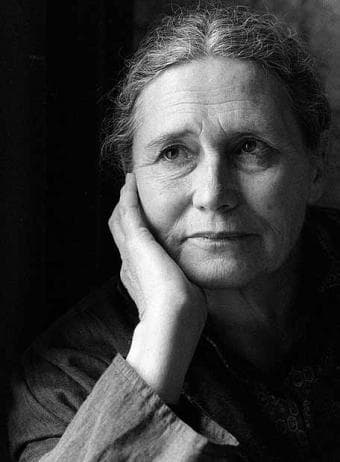
Doris May Lessing was a British-Zimbabwean novelist. She was born to British parents in Iran, where she lived until 1925. Her family then moved to Southern Rhodesia, where she remained until moving in 1949 to London, England. Her novels include The Grass Is Singing (1950), the sequence of five novels collectively called Children of Violence (1952–1969), The Golden Notebook (1962), The Good Terrorist (1985), and five novels collectively known as Canopus in Argos: Archives (1979–1983).







