“All the cats in the neighborhood used to come and hang around my door, all the great poets and painters and musicians and madmen.”
— Leo describing his apartment as a hub for artists and bohemians.


Genre
Literary Fiction / Romance
Reading Time
120 min
Key Themes
See below
Sign in to track this book
In the smoky, jazz-filled underground of 1950s San Francisco, a Beat writer deals with a short, passionate affair that shatters his ideas about love, race, and the power of his writing.
The story begins with Leo Percepied, a 30-year-old writer, visiting 'The Place,' an underground jazz club in San Francisco. He watches the bohemian crowd—poets, artists, musicians, and drifters—who make up the 'Subterraneans.' One night, he sees Mardou Fox, a 20-year-old Black woman with striking eyes and a nervous energy. She is with another man at first, but Leo is immediately drawn to her unconventional beauty and mysterious manner. He talks to her, and they feel an immediate, strong connection, marked by honesty and a shared sense of being outsiders. This first meeting sets the stage for their intense affair, which forms the main part of the story.
After their first meeting, Leo and Mardou start a fast romance. They spend their days and nights together, moving between Leo's apartment, smoky jazz clubs, and late-night walks through San Francisco. Leo is fascinated by Mardou's free spirit, her vulnerability, and her unique way of seeing the world. He calls her a 'mad angel,' a muse who inspires his writing and his being. Their relationship has extreme emotional swings: moments of deep tenderness are often followed by jealousy, anxiety, and misunderstandings, mostly caused by Leo's insecurities and Mardou's own complex emotions. Their love becomes almost a spiritual experience for Leo, a search for ultimate connection.
Leo and Mardou's relationship exists within San Francisco's 'Subterranean' world. They spend time with a colorful group of people: poets like Adam Moorad, painters like Yuri Gligoric, and other intellectuals and outcasts. Their days are unplanned, filled with talks about art, philosophy, and life, often with alcohol and marijuana. Leo observes and takes part in this scene, feeling a sense of belonging. Mardou, while part of this world, often feels like an outsider even among them, her race and emotional state adding layers to her experience. The atmosphere is one of creative energy, but also underlying despair and a constant search for meaning.
As their affair deepens, Leo's worries and possessiveness become more noticeable. He constantly worries about Mardou's past, her other relationships, and her loyalty, putting his own fears onto her. Mardou, who values her independence and emotional space, feels increasingly stifled by Leo's intensity. She starts to pull away, becoming more distant. Her occasional disappearances and need for alone time are seen by Leo as rejection, feeding his paranoia and making him cling tighter. This creates a growing gap between them, turning their initial passionate connection into a source of mutual pain.
To strengthen their bond, Leo and Mardou decide to move into an apartment together. However, instead of bringing them closer, the constant closeness makes their existing tensions worse. Leo's mood swings become more extreme, shifting between adoration and suspicion. Mardou, in turn, becomes more unpredictable and prone to emotional outbursts, often disappearing for hours or days without explanation. Their shared living space becomes a battleground for their individual issues, filled with arguments, silences, and a growing sense of despair. The idea of a stable, shared life falls apart under the weight of their emotional baggage and inability to truly communicate.
During a vulnerable moment, Mardou slowly starts to tell Leo about her difficult past. She talks about a troubled childhood, experiences with abuse, and a history of unstable relationships. These revelations help Leo understand some of the reasons for Mardou's guardedness, her need for independence, and her emotional fragility. However, even with this understanding, Leo struggles to accept her past with his idealized image of her. The weight of her experiences, combined with his own insecurities, continues to create friction in their relationship, even as he feels a deeper sense of empathy for her.
The problems in Leo and Mardou's relationship grow. Mardou's disappearances become more frequent and longer, often without explanation, leaving Leo in agonizing suspense. He tries desperately to hold onto her, but his efforts often backfire, pushing her further away. The joy and passion that once defined their affair are replaced by melancholy. They continue to meet, sometimes out of habit, sometimes out of lingering affection, but the intensity of their initial connection has faded, replaced by a quiet, painful acceptance that their time together is ending.
After a particularly difficult period of on-again, off-again interactions, Mardou decides to leave Leo for good. She is not unkind, but firm in her decision to seek a life free from the emotional chaos and possessiveness that marked their relationship. She expresses a need for her own space, her own identity, and a simpler existence. Leo is devastated but also understands, to some extent, that her departure is necessary for her well-being. This moment marks the end of their passionate affair, leaving Leo to deal with the deep sense of loss and emptiness that Mardou's absence creates in his life.
After Mardou leaves, Leo is in deep despair and self-reflection. He rethinks their entire relationship, analyzing every interaction, every word, every missed chance. He grapples with his own part in their breakup, acknowledging his insecurities, his possessiveness, and his tendency to idealize and then smother the people he loves. His writing, which he hoped would bring understanding, now seems pointless. He feels a deep loneliness and an inability to function without the intense passion Mardou brought into his life, realizing that he is always seeking a connection that always seems to escape him.
Even after she officially leaves, Mardou occasionally reappears in Leo's life, sometimes by chance, sometimes on purpose. These brief encounters are bittersweet, reminding Leo of what they once had and the pain of its loss. She is like a ghost, haunting his present and stopping him from fully moving on. Each encounter reopens old wounds and rekindles a flicker of hope, only to be put out again. These intermittent appearances highlight Leo's continued obsession and his struggle to find closure, showing the lasting impact Mardou has had on him and his writing.
As time passes, Leo starts to see a pattern in his life and relationships. He understands that his intense search for love, while exciting, often leads to the same outcome: loss and despair. He sees that he is always drawn to passionate, often unstable, relationships, only to be left with a sense of emptiness. He questions the nature of his desire, realizing that the ultimate fulfillment he seeks through others or through his writing remains out of reach. This realization is both a moment of clarity and a source of deep sadness, as he faces the repeating nature of his emotional life.
The novel ends with Leo still lonely, but with a deeper, though painful, understanding of himself. Mardou is gone, and her absence leaves a void. However, this void also forces him to confront his own inner world, his need for intensity, and his struggle with being alone. He recognizes that his pursuit of passion, while leading to heartbreak, is also a part of him and his artistic process. The ending is not one of resolution or happiness, but of a quiet, sad acceptance of his complex nature and the lasting, yet fleeting, beauty of human connection.
The Protagonist
Leo starts as a man yearning for a profound, all-consuming love, and though he finds it, his insecurities and possessiveness ultimately lead to its demise, leaving him with a melancholic self-awareness of his own cyclical desires.
The Love Interest / Catalyst
Mardou begins as a mysterious, captivating figure who enters Leo's life with a raw vulnerability, and through the relationship's turmoil, she ultimately asserts her independence and leaves to find her own peace.
The Supporting
Adam remains a consistent, supportive friend, his arc primarily serving to highlight Leo's emotional journey.
The Supporting
Yuri serves as a background character, his arc unchanging, representing the broader artistic community.
The Mentioned
Her character is static, serving as a reference point for Leo's past romantic history.
The Mentioned
Not applicable, as she is only a mentioned character.
The Protagonist
The narrator's arc mirrors Leo's, moving from passionate intensity to a state of melancholic, self-aware resignation.
Leo Percepied wants an all-encompassing, almost spiritual, connection with another person. He sees love as a way to find meaning, believing it can fill his inner emptiness. His relationship with Mardou Fox is this ultimate quest, where he tries to merge completely with her. This theme appears in his intense passion, his possessiveness, and his deep despair when the connection fails, as seen in his agonizing thoughts after Mardou leaves, where he questions the pointlessness of his lifelong search.
“I was looking for some new kind of human being, a new kind of love, a new kind of life.”
While exciting at first, Leo and Mardou's love quickly becomes obsessive and destructive. Leo's deep need for connection turns into suffocating possessiveness and jealousy, stemming from his own insecurities. He idealizes Mardou too much, then struggles with her independence and complex past. This theme is clear in their growing arguments, Mardou's increasing need to escape, and Leo's admitted role in driving her away. The very intensity that brings them together ultimately separates them, leaving both hurt.
“I was becoming a monster of love, a monster of jealousy, a monster of self-pity.”
The novel shows the 'Subterranean' world of postwar San Francisco, a place of poets, artists, musicians, and drifters living outside mainstream society. This lifestyle involves late nights, jazz music, drugs, free love, and intense discussions. While it offers camaraderie and artistic freedom, it also shows a deep sense of separation from mainstream culture. Characters like Leo and Mardou are outsiders seeking meaning. Even within this community, individuals, especially Mardou due to her race and past, feel further isolated, showing that belonging is often temporary and conditional.
“We were the subterraneans, the ones who were underground, the ones who were lost.”
Leo Percepied is a writer, and his creative process is closely tied to his emotional life. The novel explores the idea that intense experience, especially suffering and passion, fuels creativity. Leo carefully observes and records his relationship with Mardou, seeing it as material for his art. However, the book also questions if writing can truly help, as Leo finds that even writing about his pain doesn't necessarily bring understanding or comfort. Writing becomes both a compulsion and a pointless attempt to capture and control the chaos of his emotions, ultimately failing to give him the fulfillment he seeks.
“I wrote to understand, to forgive, to forget, to remember.”
Mardou Fox's identity as a Black woman is a subtle but important aspect of the novel. While not the main theme, her race adds another layer to her outsider status within the mostly white Beat scene and contributes to her complex emotional state. Leo's descriptions of her often have a racialized view, highlighting her 'Negro' features and background, which for him adds to her appeal and mystery. Mardou's experiences, including hints of a difficult past, are shaped by her racial identity, contributing to her guardedness and need for independence. This theme quietly explores how race can affect perception and personal struggle even within a supposedly free subculture.
“Her face was a beautiful dark angel face, with African lips and an Egyptian nose.”
The story is told through Leo Percepied's unfiltered, continuous flow of thoughts, feelings, and observations.
Kerouac employs a stream-of-consciousness style, often referred to as 'spontaneous prose,' to immerse the reader directly into Leo's mind. The narrative is characterized by long, winding sentences, minimal punctuation, and a rapid succession of images and ideas. This device allows for an intimate portrayal of Leo's emotional turmoil, his obsessive introspection, and his unfiltered perceptions of Mardou and their relationship. It blurs the line between past and present, memory and immediate experience, creating a raw, confessional tone that mirrors the chaotic and intense nature of the affair itself.
Jazz music serves as both a setting and a metaphor for the characters' lives and the narrative's rhythm.
Jazz music is a constant presence throughout the novel, providing the backdrop for many key scenes in 'The Place' and other clubs. Beyond being a setting, jazz functions as a metaphor for the 'Subterranean' lifestyle: improvisational, raw, emotional, and often melancholic. The rhythm and structure of Kerouac's prose often mimic jazz improvisation, with its frenetic energy, sudden shifts, and recurring themes. It symbolizes the characters' search for freedom, expression, and meaning in a chaotic world, and the spontaneous, unpredictable nature of Leo and Mardou's relationship.
Leo's tendency to idealize Mardou and their relationship, followed by inevitable disillusionment.
This device highlights Leo's psychological pattern of projecting his profound desires onto Mardou, seeing her as a 'mad angel' and the embodiment of his romantic ideals. He builds her up into an almost mythical figure, which sets an impossible standard for their relationship. Consequently, when Mardou inevitably fails to live up to this idealized image—due to her own human flaws and need for independence—Leo experiences profound disillusionment, leading to jealousy, possessiveness, and ultimately, heartbreak. This cycle of idealization and disillusionment is central to the tragic trajectory of their love affair.
San Francisco, particularly its hidden, nighttime spaces, acts as a living entity reflecting the characters' moods.
San Francisco is more than just a setting; it functions as a character itself. The city's foggy streets, dark alleyways, smoky jazz clubs, and bohemian apartments mirror the inner landscapes of Leo and Mardou. The subterranean world of the city reflects their outsider status and their search for hidden truths and intense experiences. The city's atmosphere, often described with vivid, sensory detail, amplifies their emotional states—from the exhilarating energy of new love to the melancholic despair of its dissolution. It is a vibrant, yet sometimes suffocating, backdrop to their love story.
“All the cats in the neighborhood used to come and hang around my door, all the great poets and painters and musicians and madmen.”
— Leo describing his apartment as a hub for artists and bohemians.
“I was a young man with a wild heart, always looking for something, anything, to make me feel alive.”
— Leo reflecting on his restless nature and desire for experience.
“We were all subterraneans, living in the shadows, trying to find some light, some warmth, some love.”
— Leo generalizing about himself and his friends and their shared sense of alienation.
“She was a dark angel, a beautiful demon, a creature of the night, and I was completely, utterly, hopelessly in love with her.”
— Leo's initial, passionate description of Mardou Fox.
“We talked and talked, all night long, about everything and nothing, just the way young people do when they're falling in love.”
— Leo recalling the early, intense conversations with Mardou.
“The city was a labyrinth, a maze of streets and alleys, and we were lost in it, two souls searching for each other.”
— Leo's poetic view of San Francisco as a backdrop for his romance with Mardou.
“But a love like that, it burns too bright, it burns itself out too fast.”
— Leo's melancholic reflection on the intensity and transience of his relationship with Mardou.
“I was always running, running from something, running to something, never quite knowing what it was.”
— Leo's internal monologue about his perpetual state of seeking and dissatisfaction.
“The jazz was our religion, the smoke our incense, the night our temple.”
— Leo describing the atmosphere and importance of jazz clubs to their lifestyle.
“She was like a ghost, always there and never there, always just out of reach.”
— Leo's feeling about Mardou's elusive and independent nature.
“And then it was over, just like that, a sudden silence after all the noise.”
— Leo's abrupt and stark description of the end of his relationship with Mardou.
“We were all just shadows, dancing in the dark, trying to hold on to something real.”
— Leo's overall sense of the fleeting and insubstantial nature of their lives and connections.
“The truth is, I never really understood her, not completely. Maybe that's why I loved her so much.”
— Leo's final, complex thoughts on Mardou and the nature of his affection.
“But the memory, that's what stays. The ghost of it, the echo, the beautiful, haunting echo.”
— Leo contemplating the lasting impact of his past relationship and experiences.
Ready to see how well you understood this book? Take our interactive quiz with 10 questions.
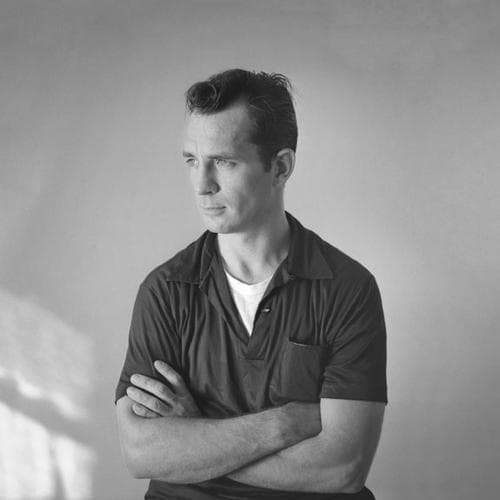
Jean-Louis Lebris de Kérouac, known as Jack Kerouac, was an American novelist and poet who, alongside William S. Burroughs and Allen Ginsberg, was a pioneer of the Beat Generation.







