“The shop assistants, who were always in a state of sleepy confusion, moved about like automatons, with fixed stares and slow, deliberate gestures.”
— Describing the atmosphere and staff in the shops of the Street of Crocodiles.

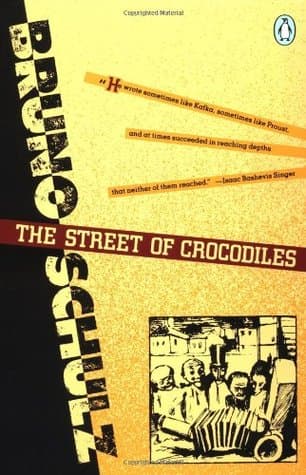
Bruno Schulz (1963)
Genre
Fantasy
Reading Time
240 min
Key Themes
See below
Sign in to track this book
Bruno Schulz's Drogobych is a dreamlike world where a father's bird obsession and the city's streets blur the line between memory and surreal nightmare, all with chilling intensity.
Józef describes the start of summer, or 'August,' as a time of intense heat and idleness. His father, Jakub, a textile merchant, begins to withdraw from his shop's daily routines, going to the attic. There, he conducts strange experiments, mainly with birds, hatching exotic eggs and building an odd aviary. The house itself seems to expand and contract, filled with the sound of wings and the Father's increasingly strange statements about reality and creation. Józef watches these changes with awe and confusion, marking the start of his father's move into a world of pure imagination and obsession, separate from the practical world below.
During one of the Father's more private periods, a silent visitor arrives at the house. This figure, described as a 'shadow' or 'presence,' watches the Father's erratic behavior without speaking. The family, especially the women, are disturbed by its presence, but the Father seems unaware or indifferent. The visitor's role is unclear; it could be part of the Father's subconscious, an outside observer, or a sign of approaching decay. Its silent observation highlights the Father's growing isolation in his own world and the family's inability to understand or stop his unusual changes.
Jakub's interest in birds grows, leading him to import rare and exotic species. He fills the attic with these creatures, creating a chaotic, lively, and unsettling menagerie. He begins to identify with the birds, imitating their movements and sounds, and tries to 'educate' them, believing they hold deep, hidden wisdom. This obsession becomes a spectacle for Józef, who witnesses his father's physical and mental change. The birds, initially beautiful, become symbols of the Father's wild creativity and his retreat from human society into an animalistic state. The attic becomes a cage for both the birds and the Father's sanity.
The Father's philosophical thoughts turn to inanimate objects, especially tailors' dummies in his shop. He suggests that these mannequins have a basic form of life, an 'inferior species.' He treats them with strange respect, believing they can develop consciousness and even emotions. This belief challenges common ideas of life and creation, blurring the lines between living and artificial. Józef watches his father's interactions with these dummies, which are both tender and unsettling, as Jakub tries to give them a soul, reflecting his own wish to animate the world according to his unique vision.
Józef describes the Street of Crocodiles, a district of Drogobych that contrasts sharply with the family's more traditional neighborhood. It is a place of cheap goods, questionable businesses, and a general sense of artificiality. The shops are full of flashy merchandise, and the people who visit are depicted as shallow. The Father views this district with disdain, seeing it as a symbol of the 'degenerate' modern world, where true creativity and spiritual depth have been replaced by cheap imitation. Józef, however, is drawn to its forbidden appeal, feeling a complex mix of fascination and disgust for its atmosphere of commercialized fantasy and moral ambiguity.
One evening, Józef's mother sends him to retrieve his father's forgotten wallet from the shop. This simple task becomes a dreamlike journey through Drogobych's winding streets. He gets lost, finding a surreal, deserted city where familiar landmarks are changed and strange sights appear. His search for the 'cinnamon shops'—mythical places of exquisite smells and forgotten wonders—becomes a metaphor for his search for lost innocence and childhood magic. The episode highlights how fluid reality is in Józef's mind, where the ordinary can suddenly open into a realm of deep, almost spiritual, discovery and memory.
The Father's eccentricities end in a disturbing physical change. After spending much time with insects and believing himself similar to them, he begins to shrink, eventually taking on the form of a large, grotesque cockroach or crab-like creature. This change is not just symbolic; it is presented as a horrifying, real event. He scurries across the floor, hides in dark corners, and communicates only with clicking sounds. The family is disgusted and frightened, unable to see this creature as the man he once was. This final change signifies his complete withdrawal from humanity and his ultimate embrace of a non-human, primal existence.
The story describes a night of extraordinary, almost cosmic, events. The house is invaded by an unprecedented swarm of insects—cockroaches, spiders, and other crawling creatures—creating a cacophony of rustling. Outside, the sky is full of strange lights and celestial phenomena, as if the universe itself is changing. This 'great season' is a time of heightened senses and existential dread, blurring the line between the domestic and the cosmic. The family, especially the women, are overwhelmed by the chaos, while the changed Father seems at home, perhaps even directing the insect invasion as a manifestation of his altered reality.
Józef finds a hidden book, ancient and filled with strange drawings and unreadable texts. This book helps him understand his father's bizarre ideas and obsessions. It seems to contain the Father's private view of the cosmos, detailing his theories about creation, the nature of matter, and the hidden lives of inanimate objects. The book fascinates and frightens Józef, opening his eyes to the deep, unsettling nature of his father's inner world. It represents forbidden knowledge, a glimpse into a reality beyond common understanding, and further solidifies Józef's role as the sole interpreter of his father's legacy.
The Father gives a series of passionate, rambling talks on his 'Treatise on Tailors' Dummies,' explaining his belief in the hidden life of inanimate objects. He argues against the idea of a single, divine creation, proposing instead a 'demiurgy'—a lesser, flawed creation by humans. He sees the mannequins not as mere copies but as new forms of life, capable of evolving. These talks, often given to a confused and shrinking audience (mainly Józef), are a central part of his worldview. They highlight his rejection of conventional reality and his strong desire to give life to the overlooked and discarded parts of existence, reflecting his own struggles with meaning and creation.
Józef visits a sanatorium where his father is supposedly getting treatment. However, the sanatorium operates on its own distorted timeline, existing in a kind of suspended reality where the past is present and the dead might still live. Józef encounters his father in various states, sometimes as a frail old man, sometimes as the lively, eccentric figure of his youth. The sanatorium is a metaphor for memory itself, where the past is not truly gone but simply reconfigured. It challenges Józef's idea of linear time and stable identity, immersing him in a world where the lines between life and death, and past and present, are fluid.
The story ends with a sense of return, as if a new 'spring' is coming after the long, strange 'August.' There is a hint of renewal, but it is mixed with the lingering presence of the Father's fantastical world. The lines between reality and imagination remain blurred. Józef continues to deal with his father's eccentricities and their deep impact on his view of the world. The ending suggests that while the Father may be physically gone or changed, his spirit of creative rebellion and his unique way of seeing the world endure, imprinted on Józef and the very fabric of Drogobych.
The Protagonist/Narrator
Józef's arc involves a gradual deepening of his understanding of his father's singular vision, moving from childhood awe to a more mature, though still bewildered, acceptance of the fluidity of reality.
The Antagonist/Supporting
Jakub's arc is one of progressive physical and mental metamorphosis, culminating in his complete transformation into an insect-like being, signifying his ultimate liberation from human constraints.
The Supporting
Adela remains largely static, serving as a consistent force of reality against the Father's escalating fantasies.
The Supporting
The Mother's character remains largely consistent, representing the enduring force of domesticity and practicality.
The Supporting
Aunt Perasia's role is static, providing a background presence in the family's life.
The Supporting
The Silent Visitor remains a mysterious, static presence, serving as an observer and an omen.
The Mentioned
Bianca is a static character, appearing only in memory or allusion.
The Supporting
The birds' role evolves from subjects of fascination to symbols of the Father's ultimate transformation.
Schulz blurs the lines between reality and imagination, showing the world through Józef's memory and his father's fantastic visions. Events are not strictly factual but have dreamlike qualities, where objects come alive and people change. This appears in 'Cinnamon Shops,' where a simple errand becomes a surreal journey through a city that shifts, or in 'The Street of Crocodiles,' which is shown as a cheap, artificial place yet has its own strange appeal. The past is not fixed but constantly re-imagined, making the whole story a testament to the power of subjective perception.
“''In this way, my father, inimitable and unique, would sometimes perform the miracle of the multiplication of essences, and at other times the miracle of their reduction.'”
A main theme is the Father's rejection of a single, perfect creation for a 'demiurgy'—a lesser, flawed, yet endlessly creative process. He believes in the hidden life of inanimate objects, especially tailors' dummies, and tries to give them life, as seen in 'Treatise on Tailors' Dummies.' His experiments with birds and his own changes show this drive to create and re-create, to challenge the established order of existence. This theme explores the artist's role in shaping reality and the inherent imperfection and strangeness of any creative act, reflecting Schulz's own artistic philosophy.
“'We have always had a demiurgy on our hands. The demiurge has no monopoly of creation, for creation is the privilege of all spirits.'”
Transformation, both physical and metaphorical, is common. The Father undergoes many changes, from a man obsessed with birds to an insect-like creature, as detailed in 'The Father's Last Transformation.' These changes are not just fantastical; they represent a move away from human norms and a return to a more primal, animalistic state. This theme explores the fragility of identity and the boundaries between human and animal, rational and irrational. It suggests that decay and grotesque transformation are natural parts of existence, often leading to a strange, new form of vitality or freedom.
“'My father, as you know, had a passion for birds. He had a whole host of them in the attic, in cages, and they were the object of his most loving care.'”
The stories are built around the tension between the Father's vast imagination and the everyday realities of life, often personified by Adela. The Father's attic is a sanctuary for his fantastical experiments, while the shop below represents the practical, commercial world. This conflict appears when Adela dismisses the Father's birds or his theories about dummies. The story constantly navigates this divide, showing how Józef struggles to balance his father's surreal visions with the demands of the tangible world. It highlights the inner world's power to reshape or even override external reality.
“'Adela, with a single sweep of her hand, would clear the whole table, bundle up the Father's birds, and put an end to his fantastic games.'”
The entire collection is filled with a nostalgic longing for a lost childhood and a vanished world. Józef's memories are colored by the intense emotions and vivid perceptions of youth, where the ordinary becomes extraordinary. The 'cinnamon shops' in 'Cinnamon Shops' symbolize this yearning for lost magic and the unique sensory experiences of childhood. The stories are not just a record of events but an attempt to recapture the essence of a particular time and place, filtered through the distorting yet enriching lens of memory and imagination, giving a melancholic yet beautiful tone to the narrative.
“'The world, as I remember it, was full of extraordinary and marvelous things, and the most marvelous of all was my father.'”
Blends realistic settings with fantastical elements, presented as ordinary.
Schulz employs magical realism by integrating highly improbable or impossible events into a realistic narrative setting without explanation or questioning. For instance, the Father's physical transformations into a bird or an insect, or the animate nature of tailors' dummies, are presented as matter-of-fact occurrences within the story's world. This device blurs the boundary between the real and the imaginary, inviting the reader to accept the fantastical as a natural part of existence, reflecting the subjective and often dreamlike quality of Józef's memories and perceptions.
Objects and characters represent deeper, abstract concepts.
Symbolism is extensively used to imbue everyday objects and characters with profound meaning. The exotic birds symbolize the Father's untamed creativity and his desire for transcendence. The tailors' dummies represent his theories on demiurgy and the latent life in inanimate objects. The 'Street of Crocodiles' symbolizes commercial tawdriness and moral decay, contrasting with the more authentic (though bizarre) world of the family home. These symbols enrich the narrative, allowing Schulz to explore complex philosophical and psychological themes without explicit exposition.
Events unfold in a fragmented, often chronological, but associatively linked manner, resembling dreams.
The stories do not follow a strict linear plot, but rather operate on a dreamlike, associative logic. Chapters often feel like vignettes or episodes, connected by themes and characters rather than a rigid causal chain. Time itself is fluid, with past and present often overlapping, particularly in 'Sanatorium Under the Sign of the Hourglass.' This non-linear structure mirrors the nature of memory and dreams, where events are recalled and reordered according to emotional and psychological significance, rather than strict chronology, creating a sense of timelessness and subjective experience.
Uses exaggerated, often disturbing, imagery to evoke a sense of the uncanny and the bizarre.
Schulz frequently employs grotesque imagery to create a sense of the uncanny and the unsettling. The Father's transformations into an insect or a bird-like creature are described with vivid, often disturbing detail, emphasizing their unnaturalness while simultaneously presenting them as part of his 'natural' evolution. The descriptions of the 'Street of Crocodiles' with its cheap, gaudy goods and the 'Night of the Great Season' with its insect swarms also fall into this category. This device serves to challenge conventional notions of beauty and order, highlighting the inherent strangeness and often repulsive aspects of existence.
“The shop assistants, who were always in a state of sleepy confusion, moved about like automatons, with fixed stares and slow, deliberate gestures.”
— Describing the atmosphere and staff in the shops of the Street of Crocodiles.
“My father, a man of profound erudition and a somewhat eccentric disposition, was prone to strange passions and even stranger experiments.”
— Introducing the narrator's father, a recurring and central figure in Schulz's work.
“The Street of Crocodiles was a district of dark, dilapidated shops, their windows filled with an assortment of cheap, tawdry goods.”
— Setting the scene for the titular street, emphasizing its decay and commercialism.
“He would spend hours in his study, poring over ancient tomes, his face illuminated by the flickering gaslight, lost in a world of his own making.”
— Detailing the father's scholarly pursuits and his withdrawal into his intellectual world.
“The mannequins, those silent, motionless figures, seemed to harbor a secret life, a hidden sorrow within their painted smiles.”
— Reflecting on the lifelike yet inert quality of mannequins in shop windows.
“We lived in a world of endless Sunday afternoons, where time stretched out, elastic and dreamlike, without beginning or end.”
— Conveying the subjective experience of time in the narrator's childhood.
“The whole world seemed to be made of a flimsy, theatrical paper, ready to be torn and rearranged at will.”
— Expressing a sense of the world's malleability and unreality.
“There was something infinitely sad and infinitely alluring about these back alleys, these forgotten corners of the city.”
— Describing the allure of the less-traveled, more decayed parts of the urban landscape.
“He transformed reality into a kind of myth, a personal mythology that was both strange and profoundly true.”
— Summarizing the father's unique way of perceiving and interpreting the world.
“The days were filled with a peculiar, golden dust, as if the very air was shimmering with forgotten memories.”
— Evoking a sensory and emotional atmosphere of the past.
“Every object seemed to possess a hidden soul, a secret language that only a true dreamer could understand.”
— Highlighting the animistic quality of objects in the Schulzian world.
“The autumn winds brought with them a sense of melancholy, a premonition of winter's long, silent reign.”
— Describing the seasonal change and its emotional impact.
“Our lives were a series of small, domestic rituals, repeated endlessly, each one imbued with a strange, almost sacred significance.”
— Reflecting on the routines and rituals of family life.
“He saw the world not as it was, but as it could be, a canvas for his boundless imagination.”
— Further elaborating on the father's imaginative and transformative vision.
Ready to see how well you understood this book? Take our interactive quiz with 10 questions.

Bruno Schulz was a Polish Jewish writer, fine artist, literary critic and art teacher. He is regarded as one of the great Polish-language prose stylists of the 20th century. In 1938, he was awarded the Polish Academy of Literature's prestigious Golden Laurel award. Several of Schulz's works were lost in the Holocaust, including short stories from the early 1940s and his final, unfinished novel The Messiah. Schulz was shot and killed by a Gestapo officer, in 1942 while walking back home toward Drohobycz Ghetto with a loaf of bread.







