“Do or do not. There is no try.”
— The very first message Origami Yoda gives Tommy, establishing his wisdom.

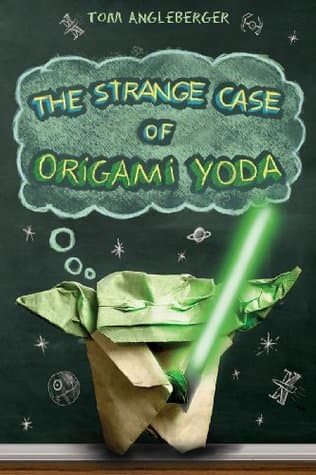
Tom Angleberger (2010)
Genre
Children's / Young Adult
Reading Time
120 min
Key Themes
See below
Sign in to track this book
When a weird sixth-grader's origami Yoda puppet starts dispensing eerily accurate advice, a skeptical classmate launches an investigation to uncover the truth behind its perplexing wisdom before trusting it with his own romantic fate.
Tommy, a sixth-grader, starts his 'case file' by introducing his friend, Dwight, an eccentric and often socially awkward classmate. Dwight does many peculiar things, like wearing the same shirt for a month. One day, Dwight creates an origami finger puppet of Yoda. To Tommy's surprise, this Origami Yoda starts giving surprisingly wise and accurate advice to students dealing with typical middle school problems, from bullies like Harvey to social situations. Tommy is confused about how a paper puppet, manipulated by the often clueless Dwight, can have such insight. He wonders if there's a real mystery or if Dwight is just incredibly lucky.
Tommy collects accounts from various classmates describing how Origami Yoda's advice helped them. Kellen, for instance, learned how to deal with the school bully, Harvey, by following Yoda's suggestion to 'find a different path.' Quavondo received advice on how to improve his basketball game, and Sara got guidance on dealing with a mean girl. These early successes begin to convince many of the skeptical students, including Tommy's friend Harvey, who initially calls Yoda 'stupid.' The growing number of accurate predictions and helpful solutions makes it harder for Tommy to just dismiss it as coincidence, pushing him to investigate the puppet's true nature.
Harvey, a major skeptic and a bit of a bully, wants to expose Origami Yoda as a fraud. He plans to ask Yoda a trick question about the lunch menu, believing a paper puppet cannot know. However, Dwight (as Yoda) gives a surprisingly specific and correct answer about the menu, further strengthening Yoda's reputation among the students. Harvey also tries to catch Dwight in a lie about how Yoda knows things, but Dwight always avoids the question or gives vague, Yoda-like answers, which only adds to the mystery. Harvey's attempts to disprove Yoda actually make Yoda seem more powerful and mysterious.
One case involves Rhondella, who struggles with a pop-up video project for school. Origami Yoda advises her to 'use the Force... to make it work.' While confusing at first, Dwight (as Yoda) clarifies that she should focus on her strengths and simplify her approach. Rhondella follows this advice, creating a more modest but effective project that earns her a good grade. This incident shows that Yoda's advice is not always magical or prophetic, but often practical common sense, presented in a Star Wars-themed way. It makes Tommy's understanding of whether Yoda is truly magical or if Dwight is just clever more complicated.
Tommy includes an interview with Dwight, asking about the creation of Origami Yoda. Dwight explains that he made the puppet after seeing a Star Wars movie and simply started giving advice through it. He does not offer any supernatural explanation, instead attributing it to 'the Force' in a vague, childlike manner. This interview does not clarify the mystery for Tommy, as Dwight's simple explanation does not account for the puppet's consistent wisdom. It leaves Tommy to wonder whether Dwight genuinely believes the Force is at work or if he's deliberately being evasive, adding another layer to the 'case.'
Tommy's main personal problem involves a girl named Sara, whom he likes. He is trying to decide whether to ask her to the upcoming school dance. He is nervous and unsure, considering asking Origami Yoda for advice. This personal stake makes his investigation into Yoda's authenticity more urgent. He wants to know if Yoda's advice is reliable enough to trust with something as important as his feelings for Sara. His internal conflict drives much of the story, as he weighs the evidence presented by his classmates against his own skepticism and desire for a clear answer.
As Tommy continues his investigation, more students contribute to the 'case file' with their own experiences of Origami Yoda's wisdom. Some stories are simple, like Yoda helping a student find a lost item, while others involve more complex social problems. Each account, whether ordinary or significant, adds to the growing evidence of Yoda's effectiveness. The sheer volume and consistency of positive outcomes make it harder for Tommy to dismiss Yoda as a fluke or a simple trick. He begins to consider that there might be something genuinely extraordinary about the paper puppet, or at least about Dwight's connection to it.
The school dance approaches, and Tommy is still undecided about asking Sara. He debates whether to ask Origami Yoda directly for advice on this matter. After much thought and reviewing all the evidence in his case file, Tommy decides to make his own choice. He realizes that while Yoda's advice is often good, some decisions are his to make. He approaches Sara and asks her to the dance himself, without consulting the puppet. This moment shows Tommy's personal growth, as he learns to trust his own judgment.
Tommy concludes his case file by reflecting on the events. Sara says yes to the dance, and they have a good time. He does not definitively prove whether Origami Yoda is truly magical or if Dwight is simply a very observant and clever kid. Instead, Tommy suggests that the 'magic' of Origami Yoda might be how it encourages people to think differently and act with more confidence. He implies that Dwight, through Yoda, provides a safe and fun way for kids to hear good advice, making them more receptive to it. The book ends with Tommy still not having a concrete answer, but having gained a deeper understanding of friendship and self-reliance.
The Protagonist
Tommy learns to trust his own judgment and to appreciate the value of friendship and unconventional wisdom, even if its source remains a mystery.
The Supporting
Dwight, through Origami Yoda, indirectly helps himself and others navigate social challenges, finding a unique way to connect with his peers.
The Plot Device/Character
Origami Yoda remains a consistent source of wisdom, its 'character' defined by its consistent helpfulness and enigmatic nature.
The Supporting
Sara's arc is less central, but she represents a positive influence and a goal for Tommy's personal growth.
The Supporting
Harvey slowly moves from staunch skepticism to grudging acceptance, even if he never fully believes in the 'Force.'
The Supporting
Kellen's arc is brief but serves to illustrate the immediate positive impact of Yoda's advice.
The Supporting
Rhondella successfully completes her project, demonstrating the practical application of Yoda's seemingly cryptic advice.
The Mentioned
Quavondo's arc is not detailed, but his experience contributes to the overall narrative of Yoda's helpfulness.
The book explores what wisdom is and how people receive it. Is it from a magical source, or simply common sense delivered in an appealing way? Origami Yoda's advice is often practical, but its delivery through a quirky puppet makes students more open to it. This theme asks whether the source of advice matters as much as how well it works, and if unusual methods can sometimes be more effective in reaching people, especially middle schoolers.
“''Sometimes you just gotta listen to what's inside you. That's what the Force is, you know.'”
Tommy's journey is one of self-discovery as he struggles with trusting his own judgment versus relying on outside advice. His decision to ask Sara to the dance without Yoda's direct input is a key moment in his growth. Similarly, Dwight finds a unique way to express himself and connect with peers through Origami Yoda, quietly shaping his own identity. The book suggests that finding one's own 'Force' or inner wisdom is important for dealing with life's challenges.
“'Maybe the Force isn't just about magic. Maybe it's about what you already know, but you just need a little push to believe it.'”
A central theme is how belief shapes reality. Students who believe in Origami Yoda's wisdom are often successful, whether the advice is truly 'magical' or simply gives them power to act. Harvey's skepticism, while reasonable, often prevents him from seeing the good outcomes. The book quietly suggests that the perceived power of Yoda might be as important as any actual power, leading students to act more confidently and achieve what they want.
“'Whether it was real Force or just Dwight being super smart, it worked. And that's all that really mattered, right?'”
The book shows the social world of middle school, including crushes, bullies, and the desire for acceptance. Origami Yoda helps students navigate these challenges, often bringing them together and creating a sense of community. Tommy's friendships with Dwight and Harvey are central, showing the importance of understanding and accepting differences, even with quirky behaviors or strong doubts. The shared experience of Yoda creates bonds among the students.
“'A true friend, you have. Always there to guide you, even when you do not know it.'”
The story is presented as Tommy's investigative 'case file,' compiling evidence.
The entire book is framed as Tommy's personal 'case file' on 'The Strange Case of Origami Yoda.' This device allows for multiple perspectives, as Tommy includes interviews, observations, and accounts from various classmates. It creates a sense of mystery and objective investigation, even though Tommy is personally invested. This structure also provides a natural way to introduce different character voices and experiences, giving a comprehensive view of Origami Yoda's impact on the school.
Different characters contribute their experiences, offering varied viewpoints.
While Tommy is the primary narrator, the 'case file' format incorporates direct testimonies from numerous other students. Each student recounts their specific interaction with Origami Yoda and the outcome of the advice they received. This allows the reader to hear diverse voices and perspectives on Yoda's effectiveness, showcasing a range of problems and solutions, and contributing to the reader's own judgment about the puppet's true nature. It also adds depth to the middle school setting by presenting a variety of character types.
A physical symbol of wisdom, mystery, and unconventional communication.
The Origami Yoda puppet itself serves as a central plot device. It is both a tangible object and an enigmatic symbol. As a physical object, it's a simple paper puppet made by Dwight, which grounds the story in reality. As a symbol, it represents wisdom, the unknown, and a unique way for an awkward kid like Dwight to connect with his peers. Its very existence drives the mystery, forcing characters (and readers) to question the nature of intelligence, advice, and even magic.
The interplay between Harvey's skepticism and the students' growing belief.
The conflict between Harvey's staunch skepticism and the increasing belief of the student body (and Tommy's internal struggle) is a key dynamic. Harvey's attempts to debunk Yoda provide narrative tension and force the 'evidence' to be stronger. This dynamic allows the book to explore themes of faith, critical thinking, and how individuals interpret unexplained phenomena. It also highlights the social pressures and groupthink that can occur in a middle school environment.
“Do or do not. There is no try.”
— The very first message Origami Yoda gives Tommy, establishing his wisdom.
“A great Jedi must be humble. And a great Jedi must share his wisdom.”
— Origami Yoda's advice to Tommy about leadership.
“Origami Yoda is probably just a paper puppet. But even if he is, he's a paper puppet that gave me good advice.”
— Tommy reflecting on the ambiguity of Origami Yoda's sentience.
“The Force is not just for fighting, Padawan. It is for helping.”
— Origami Yoda explaining the true purpose of the Force to Tommy.
“Sometimes the right thing to do is not the easy thing to do.”
— Origami Yoda's guidance when Tommy faces a difficult choice.
“If you are not brave, then you are not a Jedi.”
— Origami Yoda encouraging Tommy to be courageous.
“Fear is the path to the dark side. Fear leads to anger. Anger leads to hate. Hate leads to suffering.”
— Origami Yoda's classic warning about the dangers of fear.
“Many questions you have. The answers, you must find yourself.”
— Origami Yoda's way of encouraging self-discovery in Tommy.
“Always remember, the Force is with you, always.”
— A comforting reminder from Origami Yoda to Tommy.
“Sometimes you have to make your own luck.”
— Origami Yoda's advice on taking initiative.
“Even a small thing can make a big difference.”
— Origami Yoda's encouragement that even small actions matter.
“The greatest teacher, failure is.”
— Origami Yoda's perspective on learning from mistakes.
“Patience you must have, my young Padawan.”
— Origami Yoda reminding Tommy of the importance of waiting.
“Believe in yourself, you must.”
— Origami Yoda's core message of self-belief.
Ready to see how well you understood this book? Take our interactive quiz with 10 questions.

Biography coming soon.

Dan Gemeinhart
4.5

Kate O'Hearn
4.4

Jeanne Birdsall
4.4

Jen Wang
4.4

Wendelin Van Draanen
4.3

John Marsden
4.3

Chris Van Allsburg
4.3

Jennifer A. Nielsen
4.2