“The Master is not a man. He is a force of nature. A plague.”
— Ephraim Goodweather realizes the true nature of the vampire threat.

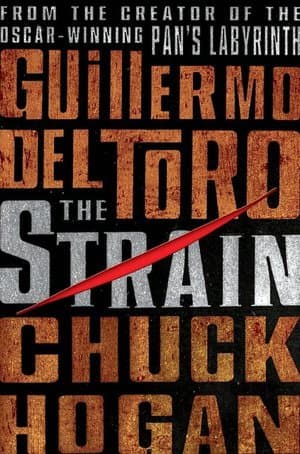
Guillermo del Toro (2009)
Genre
Thriller / Fantasy / Science Fiction
Reading Time
600 min
Key Themes
See below
Sign in to track this book
When a silent, dark plane lands at JFK, a CDC doctor uncovers a chilling vampiric contagion that forces him to join a Holocaust survivor and an unlikely team in a desperate fight to save New York City from an ancient, bloodthirsty evil.
A Boeing 777 lands at JFK International Airport from Berlin and goes dark on the tarmac. All power is out, and all 210 passengers and crew appear to be dead. Dr. Ephraim 'Eph' Goodweather, head of the CDC's Canary Project, and his colleague Dr. Nora Martinez investigate. They find no signs of an attack or a struggle, but a strange, pale worm-like parasite is discovered in the blood of the victims. Meanwhile, an elderly pawn shop owner in Spanish Harlem, Abraham Setrakian, recognizes the signs of an ancient evil returning and attempts to warn authorities, but is dismissed.
While Eph and Nora examine the bodies, four of the presumed-dead passengers mysteriously revive. They are released from quarantine against Eph's objections by the powerful and secretive Eldridge Palmer. Captain Redfern, rock star Gabriel Bolivar, lawyer Joan Luss, and an unnamed elderly man are the 'survivors.' Eph and Nora observe them, noting their extreme sensitivity to light, a rapidly dropping body temperature, and an insatiable hunger for blood. Setrakian, witnessing these events, knows exactly what is happening and prepares for the inevitable fight.
Abraham Setrakian, having followed the news of the plane, confronts Eph and Nora at the hospital. He attempts to explain that the 'virus' is an ancient form of vampirism, controlled by an entity known as 'the Master.' He details how the infected are not merely sick, but transforming into 'strigoi,' creatures of the night. Eph, a man of science, dismisses Setrakian's supernatural claims. However, the four survivors quickly begin to infect their loved ones and others, spreading the parasitic contagion throughout New York City, turning them into pale, bloodthirsty creatures with retractable stingers.
As the strigoi outbreak intensifies, Eph's estranged family becomes a target. His ex-wife, Kelly Goodweather, becomes infected by one of the original survivors, Joan Luss, and slowly transforms. She attempts to abduct their son, Zach, from Eph's home, but Eph fights her off, though Kelly escapes. This personal attack forces Eph to confront the reality of Setrakian's warnings and the monstrous nature of the threat. It pushes him towards an alliance with the old man to protect Zach and the city.
Eph and Nora, now convinced of the plague's supernatural nature after witnessing the strigoi's rapid transformation and unique physiology, reluctantly join forces with Setrakian. They are also aided by Gus Elizalde, a street-smart gang member who initially helped transport the Master's coffin and later witnesses the outbreak firsthand. Setrakian reveals his lifelong vendetta against the Master, providing them with knowledge about the strigoi's weaknesses – UV light, silver, and decapitation. Their goal is finding and destroying the Master before the entire city is overrun.
It is revealed that billionaire Eldridge Palmer, seeking immortality and a cure for his terminal illness, has made a pact with the Master. He facilitates the strigoi's arrival in New York. His human right-hand man, Thomas Eichhorst, a former Nazi officer and a powerful strigoi himself, acts as the Master's primary agent. He orchestrates the outbreak and protects the Master. Palmer uses his influence to obstruct the CDC's efforts and maintain public ignorance, ensuring the strigoi can spread. Eichhorst, in turn, acts as a direct antagonist to Setrakian, recalling their past encounters in concentration camps.
Guided by Setrakian's knowledge of strigoi behavior and the locations of historical outbreaks, the team deduces that the Master is establishing a new nest in a central, hidden location. They learn that the Master relies on a human intermediary, Vasily Fet, a city exterminator with extensive knowledge of New York's underground tunnels and infrastructure, whom they eventually recruit. Fet's expertise helps them navigate the city's hidden passages, tracking the strigoi movements and searching for the Master's elusive lair, facing increasing numbers of the bloodthirsty creatures.
The team, now including Vasily Fet, tracks the Master to a hidden lair deep within abandoned subway tunnels beneath New York. They arm themselves with silver weapons and UV lamps, ready for a direct confrontation. They face a horde of newly turned strigoi, including some of the original survivors, now fully transformed. During the battle, they damage the Master's coffin, forcing him to flee. While they do not destroy him, they inflict a significant blow and temporarily disrupt his plans, reaffirming their commitment to fighting the growing darkness.
Despite the team's efforts, the strigoi outbreak escalates rapidly. The Master, recovering from his injury, coordinates a widespread attack on New York's infrastructure. Power grids fail, communication networks collapse, and emergency services are overwhelmed. The city descends into chaos and darkness, creating ideal hunting conditions for the strigoi. The government, manipulated by Palmer and still largely unaware of the true threat, cannot effectively respond, leaving the citizens vulnerable and isolated. Eph, Setrakian, Nora, and Fet realize the battle has shifted from containment to a desperate fight for survival.
Overwhelmed by the numbers of strigoi and the collapse of society, Eph, Setrakian, Nora, and Fet retreat from their immediate positions, seeking a safer haven for themselves and Zach. They witness New York's transformation into a hunting ground for the strigoi. Despite the dire circumstances, Setrakian maintains his resolve, reminding them that the fight is far from over. The book ends with the team regrouping, understanding the task ahead, and preparing for the next phase of their war against the Master, with humanity's fate in the balance.
The Protagonist
Transforms from a cynical scientist to a hardened warrior, accepting the reality of ancient evil to protect his family and the world.
The Supporting
Evolves from a CDC scientist to a pragmatic survivor, adapting her medical expertise to combat a supernatural threat.
The Protagonist
A lifelong hunter of the Master, he finally gets his chance to fight the ancient evil he has prepared for his entire life.
The Antagonist
Remains a loyal, unyielding servant of the Master, actively working to spread the strigoi infection.
The Antagonist
Returns to New York to establish a new dominion, unleashing his ancient plague upon humanity.
The Supporting
Transitions from a cynical exterminator to a dedicated strigoi hunter, using his unique skills for a greater purpose.
The Supporting
His desperate pursuit of immortality leads him to betray humanity and become a willing accomplice to the Master.
The Supporting
Starts as an unwitting accomplice to the Master, then becomes a vengeful fighter after his family is destroyed by the strigoi.
The Supporting
Remains largely a child caught in the conflict, serving as Eph's emotional anchor and motivation.
The Supporting
Transforms from a human struggling with divorce to a strigoi, becoming a weapon used by the Master against her family.
The book explores evil not just as a moral failing but as an ancient, parasitic force that corrupts and consumes. The strigoi are inherently malevolent, driven by an insatiable hunger. The Master embodies this pure, ancient evil. The theme also appears in human collaborators like Eldridge Palmer, whose fear of death leads him to align with monstrous forces, blurring the lines between human and supernatural evil. Setrakian's experiences in the Holocaust provide a real-world parallel to the systematic dehumanization carried out by the strigoi.
“Evil is like a virus. It breeds, it mutates, and it will not die until you kill it.”
Initially, Ephraim Goodweather represents the scientific, rational mind, dismissing Setrakian's 'superstitious' claims about vampires. The narrative details the scientific aspects of the 'strain' – its biological mechanisms, parasitic nature, and spread – before gradually revealing the ancient, supernatural origins. This theme highlights the limitations of purely scientific understanding in the face of an extraordinary threat. It forces characters like Eph and Nora to expand their worldview and accept that some phenomena defy conventional explanation. The convergence occurs when scientific methods are applied to supernatural weaknesses (e.g., UV light, silver).
“This isn't a virus, Eph. It's a curse. An ancient, unholy curse.”
The disintegration of Eph's family due to his work and his subsequent fight to protect his son, Zach, forms a core emotional arc. Kelly's transformation and her attempts to turn Zach highlight the personal stakes of the outbreak. Gus Elizalde's devotion to his own family, which tragically leads to their infection, further shows this theme. Characters make sacrifices, not just for the greater good, but for their loved ones, demonstrating the primal instinct to protect one's kin even in the face of overwhelming horror.
“He would burn the world down if it meant saving Zach.”
The transformation into a strigoi is not just a physical change but a complete loss of humanity and individual identity. The infected become part of a hive mind, their memories and personalities subsumed by the Master's will. This theme is explored through characters like Kelly Goodweather and Captain Redfern, who are robbed of their former selves, becoming grotesque parodies. The human survivors struggle not just against the strigoi, but against the despair and fear of losing what makes them human.
“They are not sick, Eph. They are dead. And then they become something else. Something that wears their face, but is not them.”
Reimagining traditional vampires as a parasitic, viral infection.
The book grounds the supernatural concept of vampires in scientific terms, presenting them as 'strigoi' infected by a parasitic worm-like organism. This allows for a more plausible and terrifying outbreak scenario that can be investigated by the CDC, blending horror with a medical thriller. This device makes the threat feel more immediate and real, as it's something that can be studied, tracked, and potentially understood through scientific means, even as its ancient origins hint at something far older and more sinister than a mere virus.
The telepathic control the Master exerts over all strigoi.
The Master's ability to telepathically control all his progeny creates a formidable, unified antagonist. This hive mind makes the strigoi more than just individual monsters; they are extensions of a single, malevolent will. This device enhances the horror, as it means every newly turned strigoi immediately becomes an intelligent, coordinated threat, and it also adds a layer of psychological terror as victims' loved ones are used as puppets by the Master.
A historical parallel providing context for the Master's ancient evil.
Setrakian's past as a survivor of the Holocaust, where he first encountered Eichhorst and the Master, provides a chilling historical context for the strigoi's evil. This device draws parallels between the systematic dehumanization of the concentration camps and the strigoi's consumption of humanity, grounding the supernatural horror in real-world atrocities. It imbues Setrakian with a deep, personal vendetta and a unique understanding of the enemy, making him an indispensable guide for Eph and Nora.
A rapid-response team for biological threats, providing a scientific entry point to the horror.
Eph and Nora's roles in the CDC's Canary Project serve as the initial, scientific framework for investigating the mysterious plane incident. This device establishes a grounded, procedural starting point for the story, allowing the reader to experience the unfolding horror through the eyes of trained medical professionals. It highlights the inadequacy of conventional science against an unconventional threat, forcing the characters and the narrative to evolve beyond typical epidemiological responses.
“The Master is not a man. He is a force of nature. A plague.”
— Ephraim Goodweather realizes the true nature of the vampire threat.
“We are not fighting a disease. We are fighting an intelligent, malevolent force.”
— Ephraim discussing the vampire outbreak with his team.
“The old world is gone. The rules have changed.”
— Abraham Setrakian reflecting on the collapse of society.
“Fear is the most ancient of human emotions. It is what keeps us alive.”
— Abraham Setrakian explaining human survival instincts.
“They are not dead. They are undead. There is a difference.”
— Abraham Setrakian correcting misconceptions about vampires.
“In darkness, we find our true selves.”
— Nora Martinez contemplating the psychological impact of the outbreak.
“The virus is just the vehicle. The destination is much worse.”
— Ephraim Goodweather analyzing the biological aspect of the strain.
“We must burn the bodies. It is the only way.”
— Abraham Setrakian insisting on destroying vampire remains.
“The city is a tomb, and we are the ghosts walking through it.”
— Descriptive passage about New York City during the outbreak.
“Every monster was once a man. Remember that.”
— Abraham Setrakian reflecting on the humanity of vampires.
“The light is our only weapon. Use it wisely.”
— Abraham Setrakian advising on fighting vampires with UV light.
“This is not a war we can win with guns. It is a war of knowledge.”
— Ephraim Goodweather discussing the need for understanding the threat.
“The silence of the city is more terrifying than any scream.”
— Descriptive passage highlighting the eerie quiet of the outbreak.
“We are all infected. Some of us just don't know it yet.”
— Ephraim Goodweather realizing the scale of the vampire plague.
Ready to see how well you understood this book? Take our interactive quiz with 10 questions.

Biography coming soon.







