“I'm Tracy Beaker. I'm a an expert on everything.”
— Tracy introduces herself and her self-proclaimed omniscience at the start of her story.

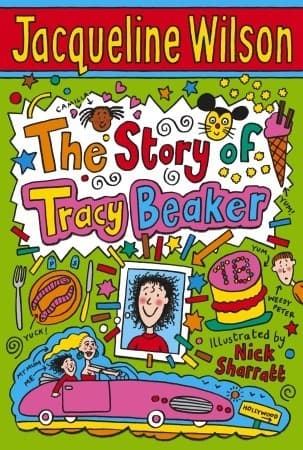
Jacqueline Wilson (1991)
Genre
Children's / Young Adult
Reading Time
240 min
Key Themes
See below
Sign in to track this book
A spirited ten-year-old in a children's home navigates life, dreaming of a family while narrating her often hilarious, sometimes heartbreaking, story.
Tracy Beaker, a spirited and imaginative ten-year-old, introduces herself and her life at 'The Dumping Ground,' a children's home. She describes the other children and carers, especially her rivalry with Justine Littlewood, a bossy girl she often fights with. Tracy describes her daily life, filled with arguments, games, and the constant hope of being fostered or adopted. She often exaggerates her past and present to make her life sound more exciting or tragic, hinting at a complicated relationship with truth and a deep desire for attention and love. She often talks about her 'famous film star' mother, who she believes will return for her.
A new visitor arrives at The Dumping Ground: Cam Lawson, a young writer. Cam is researching for a book and chooses Tracy as her subject, spending time with her, listening to her stories, and recording her thoughts. Tracy is wary at first but quickly likes Cam, seeing her as a potential friend and even a mother figure. She enjoys the attention and the chance to share her elaborate tales and fantasies, especially about her glamorous mother. Cam, however, gently encourages Tracy to be more honest about her feelings and experiences. This leads to a growing bond between them that goes beyond their professional relationship.
Justine Littlewood, Tracy's rival, becomes increasingly jealous of the attention Tracy gets from Cam. This jealousy leads to more frequent arguments and attempts to undermine Tracy. Meanwhile, Tracy continues to tell elaborate stories about her mother, claiming she is an international film star constantly on location, which explains her absence. She creates a vivid fantasy world where her mother sends her postcards and gifts, detailing these imagined interactions. Cam listens patiently, trying to understand the truth behind the stories, recognizing them as a way Tracy copes with her deep longing for a family and a sense of belonging.
Cam takes Tracy out for a special day, treating her to activities like going to the cinema and having ice cream. These are experiences Tracy rarely has. This outing is important for Tracy, as it gives her a glimpse into a more normal family life and strengthens her emotional connection to Cam. She feels special and loved, increasing her hope that Cam might become her foster parent. During their time together, Tracy opens up more, sharing some true vulnerabilities amidst her usual tough talk. Cam, in turn, sees beyond Tracy's tough exterior, understanding the lonely and longing child beneath.
Tracy's elaborate fantasy about her film star mother is challenged when she 'receives' another postcard. This time, the postcard is found to be one she wrote herself, forging her mother's signature. This discovery leads to public embarrassment for Tracy at The Dumping Ground, especially when Justine Littlewood mocks her. Tracy is deeply upset, not just by being caught, but by the shattering of her carefully built fantasy. Cam comforts her, understanding that the lies come from pain and longing rather than malice. She gently encourages Tracy to confront her true feelings about her mother's absence.
To Tracy's great delight and surprise, Cam Lawson begins the process of applying to foster her. This news fills Tracy with joy and anticipation. She starts imagining her new life with Cam, planning their future and picturing a stable, loving home. This is a huge turning point for Tracy, offering real hope that her dreams of a family might finally come true. She begins to see Cam not just as a friend, but as a genuine prospect for a forever family, and her behavior shows her excitement and desire to make a good impression.
Tracy moves in with Cam for a trial fostering period. This experience is a mix of excitement and challenges. Tracy enjoys having her own room and Cam's full attention, but also struggles with adapting to a new routine and the responsibilities of living in a 'normal' home. She occasionally misbehaves, tests boundaries, and struggles with sharing Cam's attention with her work. Despite these difficulties, Tracy feels a deep sense of belonging and happiness, appreciating the small, everyday moments of family life she had always wanted. Cam, in turn, learns about the realities of caring for a child with Tracy's complex needs.
An unexpected event occurs: Tracy's biological mother, whom she has idealized for so long, makes a brief appearance. Tracy is overjoyed at first, believing her fantastical stories have come true. However, her mother is not the glamorous film star Tracy imagined; she is somewhat disheveled and clearly struggling. The reunion is short-lived and leaves Tracy feeling confused and disappointed, as her mother quickly leaves again, unable to commit to raising her. This experience is a harsh dose of reality for Tracy, forcing her to confront the truth about her mother's inability to care for her and the fragility of her long-held fantasies.
Following her mother's departure, Tracy is left with sadness, anger, and a new understanding. The fantasy she had held onto for so long is shattered, and she must accept the reality that her mother is not coming back for her in the way she imagined. Cam provides much-needed comfort and support during this difficult time, helping Tracy process her emotions. This experience, though painful, marks a significant step in Tracy's emotional growth. She begins to let go of her idealized past and focus on her present and future with Cam, acknowledging the love and stability Cam offers.
Despite the emotional turmoil, Tracy eventually settles into her new life with Cam. She still has her moments of mischief and drama, but there is a new sense of security and belonging. While she might still occasionally exaggerate or dream of grand adventures, she now has a stable home and a loving adult who genuinely cares for her. The book ends with Tracy looking towards the future with optimism, having found a place where she feels truly wanted and understood. Her relationship with Cam is solidifying, providing the foundation she needs to grow and thrive, leaving The Dumping Ground behind.
The Protagonist
Tracy learns to confront the reality of her past and slowly lets go of her idealized fantasies, embracing the genuine love and stability offered by Cam.
The Supporting
Cam evolves from a detached observer to a committed foster parent, embracing the challenges of caring for Tracy.
The Supporting
Justine's character remains largely consistent, serving as a recurring antagonist and a reflection of the challenges of communal living.
The Supporting
Elaine consistently strives to find a stable home for Tracy, eventually facilitating her fostering by Cam.
The Supporting
Peter's character remains largely static, serving as a catalyst for Tracy's protective instincts.
The Mentioned
Her brief appearance shatters Tracy's idealized image, forcing Tracy to confront reality and move towards acceptance.
Tracy uses her imagination and elaborate fantasies, especially about her 'famous film star mother,' to cope with her difficult reality. These stories give her a sense of control, identity, and hope in a life where she often feels powerless and unwanted. For example, her detailed descriptions of her mother's 'postcards' and 'gifts' (which she often invents) show her longing for love and attention. While these fantasies offer comfort, the book also explores the pain and disappointment that happen when fantasy meets reality, as seen when her real mother makes a brief, underwhelming appearance.
“I often tell terrible fibs and sometimes I believe them myself.”
At its core, the story is Tracy's desperate search for a 'real' family and a place where she truly belongs. Living in a children's home, Tracy constantly wants the stability, love, and individual attention that a family provides. Her initial doubt about Cam, followed by her strong attachment and hope, clearly shows this deep longing. Every interaction, every outing, every kind word from Cam is examined by Tracy for signs that she might finally be wanted. Cam's eventual fostering of Tracy resolves this search, offering Tracy the secure attachment she has always wanted.
“I want a proper mum and dad. I want a proper home.”
Tracy's identity is heavily influenced by her circumstances and her coping methods. She presents herself as tough, mischievous, and unique, often using her dramatic flair to get attention. Her self-perception is tied to her fantasies; believing her mother is famous makes her feel special, even in a children's home. The book's journey shows Tracy gradually shedding some of these fabricated layers as she faces the truth about her past and begins to build a more authentic identity based on her real relationship with Cam. This growth allows her to see herself as truly loved, not just as a character in her own elaborate story.
“I'm Tracy Beaker. This is a book all about me. I'd read it if I were you. It's the most incredible dynamic heart-rending story. Honest.”
The book offers a clear look into life within the children's care system, often called 'The Dumping Ground' by Tracy. It highlights the challenges faced by children in care, including feelings of abandonment, rivalry among residents (like with Justine), and the constant hope and disappointment linked to potential fostering. While carers like Elaine are shown as well-meaning, the institutional setting cannot fully provide the individual attention and emotional security of a family home. The narrative subtly critiques the system's limits by emphasizing Tracy's deep need for a personal, loving connection beyond its structured environment.
“The Dumping Ground is what we call it. It's not a real home.”
The story is told entirely from Tracy Beaker's perspective.
This device immediately immerses the reader in Tracy's unique world, allowing direct access to her thoughts, feelings, and often unreliable interpretations of events. Her distinctive voice, filled with slang, exaggerations, and emotional honesty, makes her a highly engaging and memorable character. It emphasizes her subjectivity and her coping mechanisms, particularly her use of fantasy and storytelling to make sense of her life. The reader experiences the children's home and the adults through her eyes, highlighting her perspective on the care system and her longing for a family, making her journey deeply personal and relatable.
Tracy often embellishes or fabricates events, particularly about her mother.
Tracy's narration is deliberately unreliable. She frequently exaggerates, tells 'fibs,' and creates elaborate fantasies, especially concerning her 'famous film star mother.' This serves multiple purposes: it highlights her vivid imagination, her deep-seated desire for attention and a special identity, and her coping mechanisms for dealing with abandonment. The reader is encouraged to read between the lines, understanding that Tracy's stories, while untrue in a literal sense, reveal deeper emotional truths about her pain and longing. This device adds depth to her character and makes her emotional journey more compelling when she finally confronts reality.
Cam is writing a book about Tracy, mirroring the structure of the novel itself.
Cam Lawson's project to write a book about Tracy functions as a meta-narrative device. It provides a plausible reason for Cam to spend time with Tracy and listen to her stories, directly facilitating their bond. More subtly, it reflects the very act of the reader engaging with 'The Story of Tracy Beaker,' implying that Tracy's life is indeed worthy of being documented and understood. This device also allows for moments of self-awareness, where Tracy comments on being a 'character' in Cam's book, blurring the lines between fiction and reality within the story and emphasizing Tracy's perspective as the central focus.
The ongoing feud between Tracy and Justine drives much of the immediate plot.
The constant rivalry between Tracy Beaker and Justine Littlewood serves as a significant plot device, providing immediate conflict and drama within the confines of The Dumping Ground. Their squabbles, insults, and attempts to one-up each other create tension and often reveal aspects of both girls' personalities – Tracy's quick wit and Justine's jealousy. This rivalry often acts as a distraction from Tracy's deeper emotional struggles, but also highlights her need for connection, even if it's through conflict. It grounds the story in the everyday realities of communal living for children and adds a layer of relatable, childish antagonism.
“I'm Tracy Beaker. I'm a an expert on everything.”
— Tracy introduces herself and her self-proclaimed omniscience at the start of her story.
“They call it a children's home but it's not a home. It's just a house full of children.”
— Tracy reflects on the nature of the care home she lives in.
“My mum's coming to get me one day. She just has to sort things out first.”
— Tracy often talks about her absent mother, holding onto hope for her return.
“I'm not a pest. I'm just a bit... lively.”
— Tracy defends herself against being labeled by adults.
“Sometimes I pretend I'm a princess and this is my castle. But it's not.”
— Tracy uses imagination to cope with her reality.
“Just because you live in a children's home doesn't mean you're not a proper person.”
— Tracy asserts her worth despite her circumstances.
“I can do anything if I put my mind to it. Except maybe fly.”
— Tracy's boundless confidence and a touch of realism.
“It's hard to make friends when you keep moving.”
— Tracy reflects on the challenges of her transient life.
“I hate being told what to do. Especially by someone who's not even grown up properly yet.”
— Tracy expresses her disdain for authority, especially from older children or less experienced adults.
“My mum's a film star. Or a supermodel. Or a secret agent.”
— Tracy frequently invents glamorous stories about her mother.
“I'm going to be famous one day. Everyone will know my name.”
— Tracy's strong desire for recognition and a brighter future.
“Sometimes I wish I could just disappear. But then who would cause all the trouble?”
— Tracy's mischievous nature comes through, even when expressing a desire to escape.
“You have to be tough to survive in a place like this.”
— Tracy's pragmatic view of life in the children's home.
“I drew a picture of my mum. She looked a bit like a queen, but with curlier hair.”
— Tracy's artistic interpretation of her idealized mother.
Ready to see how well you understood this book? Take our interactive quiz with 10 questions.

Biography coming soon.

Dan Gemeinhart
4.5

Kate O'Hearn
4.4

Jeanne Birdsall
4.4

Jen Wang
4.4

Wendelin Van Draanen
4.3

John Marsden
4.3

Chris Van Allsburg
4.3

Jennifer A. Nielsen
4.2