“Once upon a time, in a galaxy far, far away... wait a minute, that's a different story.”
— Opening line of 'The Stinky Cheese Man', immediately subverting expectations.

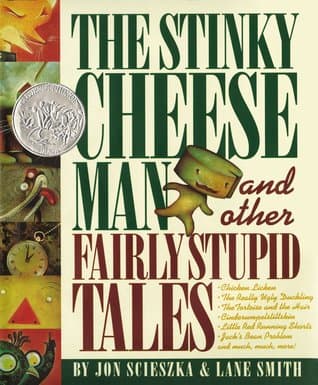
Jon Scieszka (1992)
Genre
Fantasy / Children's
Reading Time
15 min
Key Themes
See below
Sign in to track this book
Classic fairy tales are turned upside down with silly characters and a strong-smelling cheese man in this funny, chaotic collection.
The story opens with a giant creating a Stinky Cheese Man, who immediately runs off, similar to the Gingerbread Man. He meets a cow, a pig, and a village of people, all of whom chase him because of his strong smell. The Stinky Cheese Man repeatedly teases his pursuers with, 'Run, run, as fast as you can! You can't catch me, I'm the Stinky Cheese Man!' He eventually reaches a river where a fox offers to carry him across. The fox, unable to stand the smell, lets him go. The Stinky Cheese Man's end is unclear; the narrator suggests he might have dissolved or simply disappeared into the air.
Little Red Running Shorts walks to her sick grandmother's house with a basket of food. She meets the Big Bad Wolf, who simply tells her he will eat her, instead of tricking her. Little Red, being very fast, outruns the wolf to her grandmother's house. She warns her grandmother, and they make a plan. When the wolf arrives, Little Red and her grandmother trick him into falling into a pot of boiling water. He escapes, scalded and defeated. The story changes the traditional tale by giving Red more power and a modern, athletic personality.
A prince searches for a real princess to marry. Many princesses come, but none seem right. Following an old custom, the queen places a pea under mattresses to test their sensitivity. This story, however, has a twist: the prince, not impressed by the usual method, uses a bowling ball instead of a pea. A true princess, he believes, would be so delicate that even a bowling ball under the mattresses would keep her awake. A princess arrives, and the bowling ball test happens, leading to a funny and unexpected outcome that questions the traditional fairy tale's logic.
A mother duck's eggs hatch, and one duckling is very ugly. Its siblings and other farm animals make fun of it. The ugly duckling leaves home, looking for a place to belong. It meets different animals, but none accept it. Finally, it finds a group of other equally ugly birds. Instead of turning into a beautiful swan, the ugly duckling discovers it is simply a 'really ugly duckling' and finds acceptance among its own kind, embracing its unique look. This tale offers a funny and self-accepting version of the classic story.
Cinderumpelstiltskin is a servant girl treated badly by her wicked stepsisters and stepmother. She wants to go to the ball, and a fairy godmother appears, granting her wish with magic. However, instead of a simple time limit, Cinderumpelstiltskin meets a small creature (Rumpelstiltskin) who offers to help with chores and attend the ball, but demands her firstborn child in return. Cinderumpelstiltskin must deal with the ball, the prince, and the creature's deal, combining two classic fairytales into a chaotic and humorous new story.
A princess loses her golden ball in a well. A frog offers to get it in exchange for her friendship, sharing her meals, and sleeping in her bed. The princess reluctantly agrees, but after getting her ball back, she tries to go back on her promise. The frog insists. Instead of a kiss turning him into a prince, the disgusted princess throws the frog against the wall. To her surprise, he changes, but not into a prince; he becomes something else and just as unappealing, changing the romantic expectations of the original story with dark humor.
Jack trades his cow for magic beans, which his mother angrily throws out the window. A giant beanstalk grows overnight. Jack climbs it, expecting the usual adventure with a giant and gold. However, the beanstalk in this version is unstable and breaks easily. Jack repeatedly falls, gets tangled, and faces various slapstick problems during his climb. The story focuses on the physical comedy and the pointlessness of his attempts, humorously frustrating the traditional story of Jack's successful climb and heroic deeds, suggesting some adventures are not meant to happen.
The Little Red Hen finds a grain of wheat and asks her friends—the Dog, the Cat, and the Mouse—for help in planting it, harvesting it, taking it to the mill, and baking the bread. Each time, her friends say, 'Not I!' The Little Red Hen, annoyed, does all the work herself. When the bread is baked, her friends are eager to help. However, the Little Red Hen, instead of sharing, eats the entire loaf herself, teaching her lazy friends a harsh, funny lesson about responsibility and consequences, made stronger by the narrator's comments.
This short part comes after 'The Really Ugly Duckling.' It features the narrator and a character (often a chicken or a duck) talking about the previous story. The character points out that the Ugly Duckling did not turn into a beautiful swan, questioning the traditional ending. The narrator defends the 'really ugly' outcome, saying that not every story needs a conventional happy or transformative ending. This section comments on the book's revised approach, showing its deliberate change of fairy tale ideas and encouraging a different view of beauty and acceptance.
The Tortoise and the Hair (a clump of hair, not a rabbit) decide to race. The Hair is very fast but easily distracted and vain. The Tortoise, slow and steady, starts the race. The Hair, confident, stops to admire itself and get styled. Meanwhile, the Tortoise moves along. The story plays on the pun of 'hair' versus 'hare,' leading to a literal interpretation where a piece of hair is the competitor. The Tortoise, through persistence, wins the race, while the Hair is still busy with its looks, showing the moral in a silly, literal way.
Chicken Licken is hit on the head by an acorn and immediately thinks the sky is falling. He sets out to tell the King, gathering foolish animals along the way: Henny Penny, Cocky Locky, Ducky Lucky, Goosey Loosey, Turkey Lurkey, and Foxy Loxy. Foxy Loxy, the only clever one, leads them all into his den, presumably to eat them. The story has chaotic energy, frequent interruptions, and a sense of coming trouble that is both funny and a dark twist on the traditional ending, with the narrator often commenting on the absurdity.
The book returns to the Stinky Cheese Man, giving a final, clear (and unpleasant) end to his tale. After escaping the fox, the Stinky Cheese Man continues to run, but his smell becomes so strong that he simply falls apart, dissolving into a puddle of foul-smelling cheese. This ending shows the book's disrespectful tone, denying the character a conventional escape or change. Instead, it leans into the literal meaning of his name. The narrator, often speaking directly to the reader, confirms the unpleasant end, providing a final, funny anti-climax.
The Meta-storyteller
The Narrator remains consistently cheeky and disruptive, evolving only in their increasingly bold meta-commentary.
The Minor antagonist/annoyance
He remains fixated on his untold story, his arc being one of comical, unfulfilled desire.
The Protagonist of his own tale
He runs from creation to disintegration, never changing his nature.
The Protagonist
She demonstrates her inherent capability, confirming her cleverness.
The Antagonist
He consistently attempts villainy but often fails or is outmaneuvered.
The Protagonist
Her struggle is to navigate conflicting fairytale expectations, rather than a clear personal transformation.
The Antagonist/Magical Helper
He remains consistently focused on his demanding bargain.
The Protagonist
She begins as a worker and ends as a satisfied, self-rewarding individual.
The main theme is the playful breaking down of classic fairytale stories. Scieszka and Smith take familiar tales and change their plots, characters, and morals in unexpected, often absurd ways. For example, the Ugly Duckling stays ugly but finds acceptance, and the Frog Prince does not turn into a prince but something unappealing. This makes readers question their ideas of how fairytales 'should' end, showing the artificiality of storytelling itself, as seen in the narrator's constant interruptions.
“And they all lived happily ever after. Yeah, right.”
The book constantly highlights that it is a story. The narrator often talks directly to the reader, argues with characters, and comments on the book's structure and layout. This meta-narrative explores the storytelling process, questioning rules, character reasons, and audience expectations. The Little Old Man's repeated demand for his story, which is never fully told, is a good example, as is the narrator's direct address to the reader about the 'stupid' tales.
“And here's another story that doesn't really belong.”
While often funny, the book touches on identity and acceptance, especially in 'The Really Ugly Duckling'. Instead of changing into a beautiful swan, the duckling finds a place among other 'really ugly' birds, accepting its unique appearance rather than fitting into standard beauty ideas. This offers a message about self-acceptance and finding one's own kind, regardless of what society expects, though it uses humor. The Stinky Cheese Man, too, is defined entirely by his unique (and unpleasant) identity.
“He was just a really ugly duckling. And he lived happily ever after.”
Several tales show the theme of consequences, often with a funny or dark twist. The Little Red Hen's friends, who refuse to help, face the consequence of not getting any bread. Little Red Running Shorts and her grandmother make sure the Big Bad Wolf faces the consequences of his actions. Even the Stinky Cheese Man's strong smell leads to his messy end. This theme shows that actions have results, often in ways that defy traditional fairytale justice or kindness.
“And the Little Red Hen ate up the bread all by herself.”
Characters and narrator directly address the reader or comment on the book itself.
This is a pervasive device, with the Narrator constantly interjecting, commenting on the page layout, the book's title, and the stories themselves. Characters like the Little Old Man also break the fourth wall by demanding their story be told. This device creates a highly self-aware and interactive reading experience, drawing attention to the artificiality of the narrative and engaging the reader in the book's meta-humor.
Humorous imitation and exaggeration of classic fairytales.
The entire collection functions as a parody and satire of traditional fairytales. Each story takes a well-known narrative ('Little Red Riding Hood', 'The Princess and the Pea', 'The Gingerbread Man') and exaggerates or twists its elements for comedic effect. This device relies on the reader's prior knowledge of these tales, making the subversions all the more effective and humorous. The Stinky Cheese Man's fate and the Princess and the Bowling Ball are prime examples.
Repeated jokes or elements that recur throughout the book.
Several running gags contribute to the book's comedic rhythm. The most prominent is the Little Old Man's repeated appearances, demanding his story 'The Little Old Man Who Lived in a Shoe', which is never fully told. Other gags include the Narrator's constant interruptions and the repeated use of certain phrases or visual motifs. These gags build familiarity and anticipation, reinforcing the book's playful and chaotic tone.
Elements out of their proper historical or chronological order.
The book often features anachronisms that add to its modern, irreverent feel. Little Red Running Shorts wears 'running shorts' and is athletic, a distinctly modern concept for a classic fairytale character. The prince uses a 'bowling ball' instead of a pea. These anachronisms playfully clash with the traditional fairytale settings, highlighting the blend of old and new that defines the book's unique style.
“Once upon a time, in a galaxy far, far away... wait a minute, that's a different story.”
— Opening line of 'The Stinky Cheese Man', immediately subverting expectations.
“The Stinky Cheese Man woke up with a bad feeling. He smelled like... well, you know.”
— Introduction of the titular character and his defining characteristic.
“And the moral of the story is: Never trust a talking frog. Unless he gives you money.”
— Concluding moral for 'The Frog Prince, Continued', a twisted version of the classic.
“Little Red Running Shorts was taking a shortcut through the woods when she saw a wolf wearing a designer suit.”
— Opening of 'Little Red Running Shorts', a modern take on the classic tale.
“The Ugly Duckling was not just ugly. He was ugly and had bad breath. And he couldn't sing.”
— A particularly harsh and funny description of the Ugly Duckling.
“The Princess and the Pea? Forget the pea. She slept on a stack of encyclopedias and still couldn't feel it.”
— A humorous dismissal of the original 'Princess and the Pea' premise.
“Goldilocks tried the first bowl of porridge. 'Too hot!' she cried. She tried the second bowl. 'Too cold!' she shivered. She tried the third bowl. 'Just right!' she said. Then she ate all three bowls and felt sick.”
— A more realistic and less idealized outcome for Goldilocks.
“The Gingerbread Man ran as fast as he could. 'Run, run, as fast as you can! You can't catch me, I'm the Gingerbread Man!' he yelled. Then he tripped.”
— A sudden and comical end to the Gingerbread Man's famous chase.
“The Giant was so big, he had to take two steps just to get out of bed.”
— A simple but effective description of the Giant's immense size.
“The Little Old Woman who lived in a shoe had so many children, she didn't know what to do. So she bought a bigger shoe.”
— A pragmatic and funny solution to the classic rhyme's problem.
“The Tortoise and the Hare had a race. The Hare got tired and took a nap. The Tortoise won. The End. (Unless you count the rematch, which the Hare won easily.)”
— A funny and realistic addendum to the classic fable.
“This book is not for you. Go read something else. Like a phone book.”
— A direct and humorous address to the reader, often found on the end pages or in the middle of a story.
“And they all lived happily ever after. Except for the wolf, who got a stomachache.”
— A typical fairy tale ending, but with a humorous, less-than-perfect twist.
Ready to see how well you understood this book? Take our interactive quiz with 10 questions.

Biography coming soon.







