“The place where you made your stand never mattered. Only that you were there... and still on your feet.”
— Narrator reflecting on the survivors' resilience after the pandemic.


Stephen King (1978)
Genre
Thriller / Fantasy / Science Fiction
Reading Time
25-35 hours
Key Themes
See below
Sign in to track this book
After a plague kills most people, the few survivors are drawn into a fight between good and evil, led by a kind prophet and a demonic figure, for the future of a new world.
In a secret biological warfare lab in Stovington, Vermont, a very contagious and deadly flu strain, called 'Project Blue' or 'Captain Trips,' is accidentally released. Charles Campion, a guard, leaves the facility with his family, unknowingly carrying the virus. As they travel, they spread the infection, which kills 99.4% of people. The U.S. government tries to hide the outbreak, but the virus spreads fast, causing panic, society to break down, and billions of deaths worldwide. Military attempts to stop the virus fail, and within weeks, civilization ends, leaving only a few survivors.
As the plague kills many people, the remaining survivors start having clear, repeated dreams. Some are drawn to Mother Abagail, a kind 108-year-old Black woman in Nebraska, who represents hope. Others are drawn to Randall Flagg, an evil being who appears in different forms and calls them to Las Vegas. These dreams guide people like Stu Redman, Frannie Goldsmith, Larry Underwood, and Nick Andros towards Mother Abagail, while others, like Lloyd Henreid and Donald Merwin Elbert (Trashcan Man), go towards Flagg.
Led by their dreams, different groups of survivors travel across the empty United States. Stu Redman escapes a CDC facility and meets Glen Bateman and Fran Goldsmith, who is pregnant. Larry Underwood, a musician, meets Rita Blakemoor and later Nadine Cross. Nick Andros, who is deaf and cannot speak, becomes friends with Tom Cullen, a mentally disabled man. These people, with others like Ralph Brentner, meet in Boulder, Colorado, where Mother Abagail has made a safe place. They start the big job of rebuilding a simple society, forming a committee to govern their new community and restarting basic services.
At the same time, Randall Flagg sets up his base in Las Vegas. He gathers his own followers, many of whom are criminals, crazy people, or those drawn to his strong, evil power. Flagg rewards loyalty with power and punishes disagreement harshly. He uses his supernatural powers to control his followers, including Lloyd Henreid, a convicted murderer, and Trashcan Man, who loves fire. Flagg plans to make his power stronger, bring back old technology (especially military equipment), and eventually fight against the Boulder Free Zone, seeing them as a threat to his rule.
Feeling she has become too important to the Boulder community, Mother Abagail goes alone into the wilderness for spiritual guidance. Her absence causes worry and a temporary lack of leadership in Boulder. During her trip, she faces difficulties and receives a divine message. When she returns, weak but determined, she gives an important message: a small group of men from Boulder must go to face Randall Flagg in Las Vegas, not to fight with weapons, but to make a 'stand' against evil, trusting in God's plan.
Following Mother Abagail's instruction, four men are chosen for the mission to Las Vegas: Stu Redman, Larry Underwood, Glen Bateman, and Ralph Brentner. Their journey is full of danger. Stu breaks his leg early, forcing the others to leave him behind with Tom Cullen, who was sent to spy on Flagg. The remaining three continue, facing the empty land and the mental stress of their mission. Meanwhile, Nadine Cross, corrupted by Flagg, goes to Las Vegas, fully giving in to his evil and becoming his partner.
Larry, Glen, and Ralph finally arrive in Las Vegas, where Flagg's forces capture them. Flagg makes them suffer publicly and holds a fake trial, planning to kill them to show his complete power. During the confrontation, Glen Bateman speaks out against Flagg, refusing to be quiet. Just as Flagg prepares to act, Trashcan Man, driven by his love of fire and a twisted loyalty, arrives with a stolen nuclear bomb. He drops it directly into the middle of Flagg's compound, causing a huge explosion.
As the nuclear bomb falls, a mysterious 'Hand of God' appears from the sky, described as a flash of light and energy, which causes the bomb to explode. The nuclear blast completely destroys Randall Flagg, Nadine Cross (who dies with a moment of clear thought and defiance), Lloyd Henreid, and all of Flagg's remaining followers in Las Vegas. Larry Underwood, Glen Bateman, and Ralph Brentner also die in the explosion, fulfilling Mother Abagail's prophecy that the stand would be made, but not by their own hand. The destruction ends Flagg's rule of terror.
Stu Redman, left behind with a broken leg, is cared for by Tom Cullen. They were spared the nuclear blast because they were far from Las Vegas. Guided by instinct and Tom's clear moments, they begin the long, difficult journey back to Boulder. Their trip shows human strength as they fight hunger, bad weather, and the mental toll of their experiences. They eventually meet Kojak, Glen Bateman's dog, who leads them towards Boulder, signaling their return to the surviving community.
Stu and Tom finally return to Boulder, where the community, including Fran Goldsmith, who has given birth to her son, Peter, welcomes them as heroes. The survivors in Boulder continue the slow, hard process of rebuilding society. While Randall Flagg is gone, the experience leaves them with questions about good and evil, human nature, and divine involvement. Fran and Stu, now a couple, think about how fragile their new world is and the lasting presence of both light and darkness, understanding that the 'stand' against evil is a continuous, inner struggle that will always exist.
The Protagonist
From a reluctant survivor of scientific containment to a spiritual leader and a symbolic figure of hope for a new humanity.
The Protagonist
From a frightened, pregnant survivor to a strong, maternal figure who helps shape the new world.
The Protagonist
Transforms from a selfish, drug-addled musician into a selfless leader and martyr.
The Antagonist
Flagg's character arc is less about development and more about the escalation of his evil and his ultimate, fiery defeat by divine intervention.
The Supporting
From a seemingly ordinary old woman to a revered prophet whose faith guides humanity's last hope.
The Antagonist/Supporting
From a bullied, intelligent loner to a bitter, murderous traitor consumed by jealousy and evil.
The Supporting
Rises from a solitary drifter to a respected leader, symbolizing the value of quiet strength and empathy.
The Supporting
From a solitary academic to a courageous truth-teller who defies evil with his intellect.
The Supporting/Antagonist
From a woman fighting inner demons to a tragic figure fully consumed by evil, achieving a brief moment of redemption in death.
The Supporting/Antagonist
From a deranged wanderer to an unwitting instrument of divine judgment, whose destructive tendencies lead to the antagonist's downfall.
The main idea of 'The Stand' is the constant fight between good and evil, shown by Mother Abagail and Randall Flagg. The plague removes civilization, forcing survivors to choose sides, not just physically, but morally and spiritually. The Boulder Free Zone shows humanity's ability to work together, be kind, and have faith, while Flagg's Las Vegas represents strong rule, selfishness, and bad behavior. The book explores how individual choices, even in tough situations, add to the larger fight, ending with a divine act that changes the outcome.
“''The world had been wiped clean, and in the stillness that followed, good and evil had begun to grow again, like weeds and flowers in a garden.''”
With 99% of people gone, 'The Stand' looks at what happens when society's structures break down. It examines human tendencies towards both building and destroying. The Boulder Free Zone tries to rebuild a fair, caring society, facing challenges of leadership, justice, and sharing resources. On the other hand, Flagg's Las Vegas shows the dark side: how fear, desire for power, and basic urges can lead to harsh rule and cruelty. The book asks if humanity, given a fresh start, can learn from past mistakes or is bound to repeat cycles of conflict and control.
“''No one can tell what goes on in between the person you were and the person you become. No one can chart that blue and lonely section of hell. There are no maps of the change. You just... change.''”
Faith is important, especially for survivors drawn to Mother Abagail. Their trip to Boulder is guided by dreams, and the final meeting with Flagg is not a military fight but a 'stand' based on spiritual belief. Mother Abagail's direct talks with God and the final 'Hand of God' act show a higher power at work, suggesting that humanity's fight against evil is not only its own, but part of a divine plan. This idea explores the limits of human action and how miracles happen in extreme situations.
“''The only way to win is to make a stand. Not with guns, not with bombs, but with what's in your hearts.''”
Many characters, especially Larry Underwood and Harold Lauder, change morally. Larry, at first a selfish musician, finds goodness through selflessness and sacrifice, dying bravely in Las Vegas. Harold, however, gives in to his bitterness and chooses evil, showing the sad failure to find goodness. The Boulder envoys' sacrifice in Las Vegas, even if their actions don't directly cause Flagg's death, is a strong act of faith and a symbolic win for good. This idea shows how choices can change people and the cost of moral honesty.
“''If you don't have a place to stand, you don't have a prayer.''”
Dreams guide survivors towards good or evil.
After the plague, survivors across the country begin to experience vivid, recurring dreams. These dreams serve as a supernatural beacon, drawing individuals either towards the benevolent Mother Abagail in Nebraska/Colorado or the malevolent Randall Flagg in Las Vegas. The dreams are not merely symbolic; they are direct, divine, or demonic instructions, acting as a powerful narrative device to gather the scattered characters and establish the two opposing factions. They bypass conventional communication and emphasize the spiritual nature of the conflict.
Survivors embark on physical and spiritual journeys.
The narrative is structured around multiple arduous journeys undertaken by the survivors. Initially, characters like Stu, Fran, and Larry embark on long treks across a devastated America to reach Mother Abagail in Boulder. Later, the chosen envoys undertake a perilous quest to Las Vegas to confront Randall Flagg. These journeys are not just physical movements across a landscape but also profound spiritual and psychological ordeals, serving as a crucible for character development and a means to explore the vast, empty post-apocalyptic world. Each journey builds suspense and highlights the resilience required for survival.
The superflu as a cleansing fire and a catalyst for moral choice.
Captain Trips, the superflu that wipes out most of humanity, functions as more than just a plot trigger; it's a profound symbol. It acts as a 'cleansing fire,' eradicating the old, flawed world and paving the way for a new beginning. However, it also serves as a catalyst, forcing the remaining survivors to confront their fundamental natures and make stark moral choices. The plague strips away the veneers of civilization, revealing the raw potential for both good and evil within humanity, setting the stage for the ultimate 'stand' between these forces.
Divine intervention resolves the climax.
At the climax of the novel, when the Boulder envoys are about to be executed by Randall Flagg, the situation is resolved by the sudden, miraculous appearance of a 'Hand of God' that detonates Trashcan Man's nuclear bomb. This divine intervention, a classic deus ex machina, abruptly ends Flagg's reign and the lives of the envoys. It emphasizes the theme of faith and the idea that the ultimate victory over evil is not solely achieved by human effort but by a higher power, reinforcing Mother Abagail's prophecy that the 'stand' would be made, but the outcome was in God's hands.
“The place where you made your stand never mattered. Only that you were there... and still on your feet.”
— Narrator reflecting on the survivors' resilience after the pandemic.
“No one can tell what goes on in between the person you were and the person you become. No one can chart that blue and lonely section of hell. There are no maps of the change. You just come out the other side. Or you don't.”
— Narrator describing the transformation of survivors after Captain Trips.
“Show me a man or a woman alone and I'll show you a saint. Give me two and they'll fall in love. Give me three and they'll invent the charming thing we call 'society'. Give me four and they'll build a pyramid. Give me five and they'll make one an outcast. Give me six and they'll reinvent prejudice. Give me seven and in seven years they'll reinvent warfare. Man may have been made in the image of God, but human society was made in the image of His opposite number, and is always trying to get back home.”
— Narrator musing on human nature and society's formation.
“The world had moved on, and it was a meaner, darker place.”
— Describing the post-apocalyptic landscape after the superflu.
“I don't believe in happy endings, but I do believe in happy travels, because ultimately, you die at a very young age, or you live long enough to watch your friends die. It's the secret of the universe: nothing lasts.”
— Stu Redman reflecting on mortality and impermanence.
“A man's heart is stonier; a man grows more fields of stones in his heart. A man's heart is a secret garden, and the walls are very high.”
— Narrator describing emotional barriers in the new world.
“We need help and the only help we're going to get is from each other.”
— Frannie Goldsmith advocating for community rebuilding.
“The only thing you have to do is live until you die.”
— Larry Underwood's pragmatic view on survival.
“There was no need to be ashamed of tears, for tears bore witness that a man had the greatest of courage, the courage to suffer.”
— Narrator on emotional vulnerability in harsh times.
“The dark man's coming, and he's bringing the night with him.”
— Prophetic warning about Randall Flagg's rise.
“You can't kill the boogeyman.”
— Character reflecting on the enduring nature of fear and evil.
“We're all just walking each other home.”
— Glen Bateman's philosophical take on human connection.
“The world is coming down around our ears, and you're worried about a little thing like the truth?”
— Character questioning priorities in the crisis.
“Sometimes the things that go wrong in your life are the things that ultimately put you on the right path.”
— Survivor reflecting on post-pandemic changes.
Ready to see how well you understood this book? Take our interactive quiz with 10 questions.
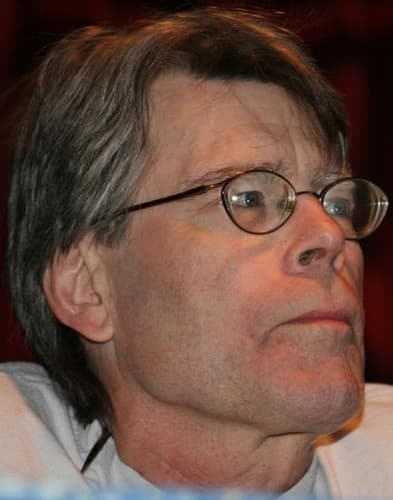
Stephen Edwin King is an American author of horror, supernatural fiction, suspense, crime, science-fiction, and fantasy novels. Described as the "King of Horror", his books have sold more than 350 million copies as of 2006, and many have been adapted into films, television series, miniseries, and comic books. King has published over 65 novels/novellas, including seven under the pen name Richard Bachman, and five non-fiction books. He has also written approximately 200 short stories, most of which have been published in book collections.







