“'Will you walk into my parlour?' said the Spider to the Fly,”
— The Spider's initial invitation to the Fly.

Mary Botham Howitt (2002)
Genre
Fantasy / Children's
Reading Time
10 min
Key Themes
See below
Sign in to track this book
A clever spider, with a sinisterly charming parlor, tricks a naive fly into its web of deceit, all shown with the dramatic, shadowy style of a vintage Hollywood horror film.
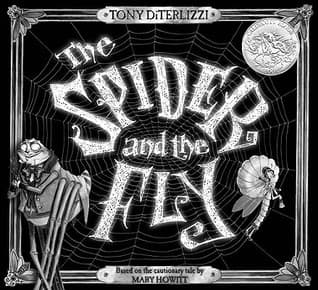
The story begins with a well-dressed Spider, shown in a classic film noir style, talking to a delicate, winged Fly. He tries to tempt her into his fancy parlor with an offer of a 'very pretty parlor' and a 'winding stair' to go up. The Spider highlights the beauty and comfort of his home, suggesting she rest there. His words are sweet and inviting, hiding his true predatory goals. The setting is a grand, old mansion, with the Spider's web subtly built into the architecture, hinting at the danger beneath the charm.
The Fly, though pleased, remembers an old saying and wisely declines the Spider's first invitation. She states that anyone who goes up his winding stair never comes down again, showing she knows the danger, at least a little. Her refusal is polite but firm, showing a hint of self-preservation. The Spider, however, is not stopped by this first rejection and keeps his charming act, already planning his next persuasive move. This interaction sets up the power dynamic and the Fly's risky situation.
Not stopping, the Spider changes his approach, offering the Fly 'some provisions' and a 'nice little bed' in his parlor. He pretends to care for her well-being, suggesting she must be tired and hungry from flying. He promises soft sheets and a comfortable rest, appealing to her physical needs. The Spider's words aim to build trust and comfort, drawing the Fly closer to his web. The visuals show the Spider's persistence and the Fly's thought, as she hesitates between caution and temptation.
The Fly, still careful, again refuses the Spider's offer. She mentions that she has heard of his pantry and knows that he never lets his guests leave once they enter. Her words show a deeper understanding of the Spider's true nature and the fate of those who fall for his tricks. Despite her awareness, the Spider continues his relentless pursuit, shifting his methods to more direct flattery. This resistance from the Fly only seems to make the Spider more determined to trap her.
The Spider, realizing direct appeals to comfort and food are failing, changes his plan to pure flattery. He praises the Fly's 'gauzy wings,' 'brilliant eyes,' and 'gorgeous green and purple hue.' He calls her 'dear friend' and expresses his admiration, trying to appeal to her vanity. His words aim to disarm her caution and make her feel special. The illustrations show the Spider's smooth, persuasive manner and the Fly's subtle reaction to the compliments, showing her guard slowly starting to lower.
To make his flattery stronger, the Spider offers the Fly a chance to see her own beauty reflected in his parlor mirror. He suggests that such a 'rich and rare' creature should be able to admire herself. This is a subtle but strong trick, playing directly into the Fly's vanity and wish to see herself as the beautiful creature the Spider describes. The offer of the mirror serves as a direct invitation into his lair, presented as a helpful act rather than a trap. The Fly begins to show signs of being persuaded.
Won over by the Spider's sweet words and the promise of seeing her own beauty, the Fly's caution finally fades. She 'fluttered her wings so pretty, and she began to draw nigh.' The flattery has worked, and she is now under the Spider's spell, losing her earlier wariness. The illustrations show the Fly slowly, almost hypnotically, moving closer to the Spider's web, her first resistance completely gone because of the clever predator's words. The trap is now near.
The Fly, completely fooled by the Spider's lies, finally enters his parlor. As she steps inside, the Spider, no longer needing his charming act, quickly grabs her. The atmosphere instantly changes from elegant persuasion to stark horror. The 'parlor' is revealed to be a deadly web, and the Spider's true nature as a predator is shown. This scene marks the sad end of the Spider's manipulation and the Fly's fatal vanity. The illustrations show the moment of capture with dramatic effect, reflecting the classic horror movie inspiration.
Once the Fly is caught, the Spider quickly carries her up his 'winding stair' to his 'dismal den.' He wastes no time in eating her, showing the swift and brutal end to her life. The earlier warnings of others never returning from the parlor are sadly realized. The Spider's victory is complete, and the moral of the story is delivered with harsh finality. The scene is grim, leaving no doubt about the Fly's unfortunate death and the results of giving in to flattery.
The story ends with a direct message to the reader, especially children, warning them against the dangers of flattery and deceit. The narrator advises not to listen to 'idle, silly, flattering words' and to recognize those with 'wicked heart and evil eye.' The moral highlights the importance of judgment and caution when faced with people who use sweet words to hide harmful intentions. It serves as a cautionary tale, strengthening the lessons learned from the Fly's tragic fate, ensuring the reader understands the main message.
The Antagonist
The Spider remains consistently cunning and predatory throughout the story, his character unchanging in its single-minded goal to capture the Fly.
The Protagonist
The Fly's arc is tragic; she moves from initial caution to fatal vanity, demonstrating a downfall caused by succumbing to external praise.
The Supporting
The Narrator's role is consistent as the teller of the tale and deliverer of the moral, without a personal character arc.
The main theme is the Spider's skillful use of deception and manipulation to trick the Fly. He uses sweet words, false promises of comfort, and flattery to hide his predatory intentions. This is clear from his first invitation to his 'pretty parlor' (plot_summary index 1) to his strategic compliments about the Fly's beauty (plot_summary index 5). The Spider's entire interaction is a calculated act to disarm and trap his victim, showing how charm can be a dangerous disguise.
“'Will you walk into my parlor?' said the Spider to the Fly; 'Tis the prettiest little parlor that ever you did spy.'”
The Fly's sad downfall is mostly due to her vanity and gullibility. Despite initial caution and knowing the Spider's reputation (plot_summary index 2, 4), she eventually gives in to his lavish compliments about her beauty (plot_summary index 5). The Spider's offer of a mirror (plot_summary index 6) is the final, irresistible lure that appeals directly to her self-admiration, causing her to ignore her instincts and fall into the trap (plot_summary index 7, 8). This theme warns against letting pride override good judgment.
“'Oh no, no!' said the little Fly, 'kind Sir, that cannot be; I've heard what's in your pantry, and I do not wish to see.'”
The story highlights the danger of ignoring warnings, both internal and external. The Fly first remembers and states her awareness of the Spider's true nature, saying that those who enter his parlor never return (plot_summary index 2, 4). However, her resolve weakens under the Spider's constant flattery. The story itself warns the reader (plot_summary index 10) not to be swayed by 'idle, silly, flattering words,' reinforcing the idea that ignoring caution can lead to bad results.
“And now, dear little children, who may this story read, To idle, silly, flattering words, I pray you ne'er give heed.”
This theme explores the sharp contrast between the Spider's predatory nature and the Fly's relative innocence (or vulnerability). The Spider represents pure evil hidden in charm, driven by the instinct to consume. The Fly, while not entirely free of vanity, is ultimately outmatched by the Spider's cunning. The story clearly shows the brutal reality of predation when the Fly is finally caught and eaten (plot_summary index 8, 9), serving as a metaphor for how the innocent can become victims of malevolence.
“Then in he dragged her, up his winding stair, Into his dismal den, with none to hear.”
Animals are given human-like qualities and speech.
The central plot device is the personification of the Spider and the Fly. They are given the ability to speak, reason, and exhibit complex human emotions and behaviors, such as cunning, vanity, and politeness. The Spider is depicted as a dapper, manipulative gentleman, while the Fly is a delicate, susceptible lady. This device allows the abstract concepts of deception and gullibility to be explored through an engaging narrative, making the moral lesson more accessible and memorable, especially for a children's audience.
The story serves as a symbolic representation of real-world dangers.
The entire narrative functions as an allegory for the dangers of flattery and the importance of recognizing deceitful intentions in human interactions. The Spider symbolizes manipulative individuals who use charm and sweet talk to exploit others, while the Fly represents those who are vulnerable to such tactics due to vanity or naiveté. The 'parlor' and 'web' symbolize the traps laid by predators, whether literal or figurative, making the story's moral universally applicable beyond the animal kingdom.
The reader is aware of the Spider's true intentions, while the Fly is not.
Dramatic irony is prevalent throughout the story. From the outset, the reader knows the Spider's true, malicious intent to ensnare and devour the Fly, even as the Spider offers seemingly kind invitations and compliments. The Fly, however, is initially cautious but eventually falls prey to the deception. This creates tension and suspense, as the reader anticipates the inevitable tragic outcome, making the Fly's eventual capture all the more poignant and serving to reinforce the cautionary message.
The Spider uses questions to draw the Fly into conversation and consideration.
The Spider frequently employs rhetorical questions as a manipulative tactic. Phrases like 'Will you walk into my parlor?' or 'How can I do aught but praise your gauzy wings?' are not merely questions seeking information, but rather persuasive tools designed to engage the Fly, disarm her, and subtly guide her thoughts towards accepting his offers. These questions create a conversational dynamic that makes the Spider seem less threatening and more inviting, slowly eroding the Fly's defenses.
“'Will you walk into my parlour?' said the Spider to the Fly,”
— The Spider's initial invitation to the Fly.
“'Tis the prettiest little parlour that ever you did spy.”
— The Spider's description of his home to entice the Fly.
“The way into my parlour is up a winding stair,”
— The Spider explaining the path to his home.
“And I've many pretty things to show when you are there.”
— The Spider promising wonders to the Fly.
“'Oh no, no,' said the little Fly, 'to ask me is in vain,”
— The Fly's initial refusal to the Spider's invitation.
“For who goes up your winding stair can ne'er come down again.'”
— The Fly expressing awareness of the danger.
“I'm sure you must be weary, dear, with soaring up so high;”
— The Spider feigning concern for the Fly's well-being.
“Will you rest upon my little bed?' said the Spider to the Fly.”
— The Spider offering a place to rest.
“I've got a little looking-glass upon my drawing-room shelf,”
— The Spider trying to appeal to the Fly's vanity.
“If you'll step in one moment, dear, you shall behold yourself.'”
— The Spider's specific appeal to the Fly's self-admiration.
“At length, up jumped the silly Fly, 'Oh dear, what shall I do?”
— The Fly finally succumbing to temptation.
“I'll take a peep, but quickly fly away again from you.'”
— The Fly's misguided belief in her ability to escape.
“He dragged her up his winding stair, into his dismal den,”
— The Spider capturing the Fly and taking her to his lair.
“Within his little parlour, but she ne'er came out again!”
— The final tragic outcome for the Fly.
“This foolish fly, with flattery's snare, was caught at last, and died.”
— The moral of the story, explaining the Fly's demise.
Ready to see how well you understood this book? Take our interactive quiz with 10 questions.

Biography coming soon.







