“Jesus, Mary, and Joseph,” Sofia said. “The only thing you’ve been doing for the last two days is worrying.””
— Sofia Mendes to Emilio Sandoz as they prepare for the interstellar journey.

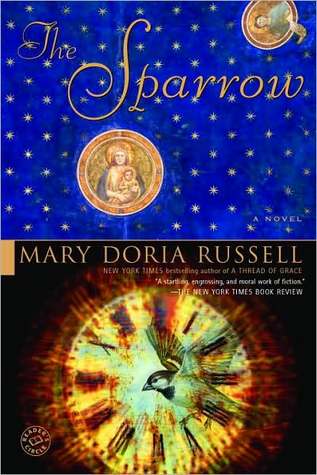
Mary Doria Russell (1996)
Genre
Fantasy / Spirituality / Science Fiction
Reading Time
10-12 hours
Key Themes
See below
Sign in to track this book
A Jesuit mission to a planet of singing aliens finds a universe so beautiful and brutal, it shatters their faith and changes what they think it means to be human.
In 2019, the Arecibo radio telescope detects a complex, musical transmission from the Alpha Centauri system. Dr. Jimmy Quinn, an astrophysicist and Jesuit priest, identifies the source as a planet he names Rakhat. The United Nations discusses a slow, diplomatic approach to first contact. However, a group of Jesuits, led by Father Emilio Sandoz, believes they must respond for spiritual reasons. They decide to launch a secret mission to Rakhat, funded by the Vatican and private donors. The crew includes Sandoz, Jimmy Quinn, linguist Sofia Mendes, doctor George D. Edwards, engineer Alan Pace, and two married couples: botanists Anne and Marc Moskowitz, and astronomer Diane and her husband, musician Manuel (Manny) Ruiz. They embark on the 'Stella Maris' for a one-way trip, hoping to establish peaceful relations and learn about the alien culture.
After a decades-long journey, the 'Stella Maris' arrives at Rakhat. The crew finds a lush world and soon meets the Runa, a gentle, plant-eating species with a unique, melodic language. The Runa live peacefully with nature, growing their food and communicating through song. Emilio Sandoz, with his language skills, quickly learns their language and culture, building a strong connection. The crew also observes the Runa's social structure, noting their communal living and their respect for nature. They believe they have found a paradise, confirming their spiritual belief that this mission had divine guidance. The first interactions are full of wonder and a sense of shared innocence.
The peaceful situation changes when the crew meets the Jana'ata, a taller, more predatory, and technologically advanced species that lives in a hierarchical society. The Jana'ata are meat-eaters who 'farm' the Runa for food. They treat the Runa with a strange respect, seeing them as key to their art and spiritual growth. The Runa are servants, living under the Jana'ata. This discovery deeply troubles the mission team, especially Emilio, who struggles to understand the peaceful Runa's role as livestock. The crew realizes Rakhatan society is complex and morally unclear, challenging their first hopeful views of the planet and its inhabitants. The mission's goals become more complicated, moving beyond simple observation to understanding a deeply unsettling relationship.
Emilio Sandoz, wanting to understand and protect the Runa, decides to live among the Jana'ata. He learns their language and customs. Supaari, a powerful Jana'ata merchant, takes him in, and Emilio learns about their social structure, art, and unique idea of 'vocation.' Meanwhile, the rest of the crew, especially Sofia Mendes, struggles with the moral issues of the Runa's situation. Tensions grow within the human group as they cannot intervene without upsetting the delicate balance. The crew also faces adapting to an alien environment and culture, with homesickness and fear starting to affect them.
Tragedy strikes the mission. Marc Moskowitz dies from an allergic reaction to a local plant. Later, during a violent storm, George D. Edwards, Anne Moskowitz, and Alan Pace die when their shelter collapses. Sofia Mendes, heartbroken, takes her own life. Jimmy Quinn, sick, also dies. Finally, Manny Ruiz, devastated by the loss of his wife Diane to an alien disease, dies of a broken heart. Emilio is the only one left. These losses leave Emilio alone and vulnerable, forcing him to rely completely on the Jana'ata for survival. This further immerses him in their culture, under increasingly desperate conditions.
Supaari notices Emilio's beautiful singing voice (a human trait not found in the Jana'ata) and decides Emilio's 'vocation' is to become a 'singer' for his family. In Jana'ata culture, 'singers' are Runa who are castrated and trained to perform sexually and artistically for their Jana'ata masters, eventually becoming food. Unaware of what this fully means, Emilio is castrated and forced into this role. He suffers terrible abuse and sexual slavery, becoming a living 'instrument' for Supaari and his family. This experience destroys Emilio's faith and his sense of self, changing him from an optimistic priest to a broken, traumatized person.
Years later, a rescue mission finds Emilio Sandoz, the sole survivor, on Rakhat. He is brought back to Earth, physically and mentally scarred. His hands have been altered to look like Jana'ata hands, and his voice, once beautiful, is now hoarse and damaged. The Vatican, needing answers about the failed mission and the silence from Rakhat, questions Emilio intensely, especially Father General Candotti and Sister Claire. They want to know what happened, why the mission failed, and what became of the rest of the crew. Emilio, deeply traumatized, struggles to describe the horrors he endured; his memory is broken, and his spirit is shattered.
During his questioning and recovery, Emilio struggles with deep guilt and a crisis of faith. He blames himself for his crewmates' deaths, believing his first spiritual conviction led them to disaster. He struggles to reconcile his suffering with the idea of a loving God, feeling abandoned. The physical and emotional scars from his time on Rakhat are immense. He is mute for a long time, communicating only by writing, and later speaks with a damaged voice. The world he returns to expects answers and miracles, but Emilio can only offer his brokenness. This forces him to confront the limits of human understanding and the nature of suffering.
Through his broken memories and the persistent questions of his interrogators, Emilio slowly reveals the full horror of Jana'ata culture. He explains the relationship between the Jana'ata and the Runa, the idea of 'vocation,' and that 'singers' are castrated and eventually eaten. He tells of his own forced castration and sexual slavery, detailing the deep violation he experienced. This revelation shocks his interrogators and the Vatican. They struggle to understand such a morally inverted society and the suffering it caused their priest. The first idealized view of alien life is completely shattered.
After therapy and the steady support of some Jesuit brothers, especially Father General Candotti, Emilio slowly begins to heal. He never fully gets back his old self or his firm faith, but he finds a new, more complex understanding of God and suffering. He learns to live with his trauma, finding comfort in small acts of kindness and the enduring human spirit. While the mission failed in its initial goals, Emilio's survival and his story offer a deep, if painful, lesson about the universe's vastness and complexity, and the limits of human understanding. He emerges from his ordeal with a changed perspective, finding a new, though fragile, sense of purpose in his continued existence.
The Protagonist
From an idealistic, devout priest, Emilio is transformed into a traumatized survivor who must rebuild his understanding of God and humanity.
The Supporting
Jimmy begins as the intellectual catalyst for the mission and ends as one of its many tragic casualties, highlighting the dangers of the unknown.
The Supporting
Sofia's journey from hopeful linguist to despairing suicide underscores the profound moral and psychological challenges of first contact.
The Supporting
Candotti moves from a position of institutional inquiry to one of deep personal empathy and support for Emilio's healing.
The Antagonist
Supaari's role remains consistent as the embodiment of Jana'ata cultural norms that are horrifying to humans, directly causing Emilio's trauma.
The Supporting
Their role remains consistent as the exploited yet revered 'others' in the Rakhatan ecosystem, revealing the planet's dark truths.
The Antagonist
The Jana'ata remain a static, yet profoundly impactful, force, representing an insurmountable cultural and moral barrier for the humans.
The Supporting
Manny's arc is one of love, loss, and ultimately, despair, highlighting the emotional toll of the mission.
The Supporting
Diane's arc is cut short by an alien disease, symbolizing the unpredictable and dangerous nature of first contact.
The Supporting
George's arc is that of a dedicated caregiver whose life is tragically cut short by the harsh realities of Rakhat.
The novel explores faith, especially when facing extreme suffering and radical difference. Emilio Sandoz, a devout Jesuit priest, starts the mission with strong belief in a good God and the spiritual meaning of first contact. His experiences on Rakhat—his friends' deaths, his castration, and sexual slavery—destroy his faith. This leads to deep doubt and a feeling of being abandoned by God. The book asks how one can reconcile such suffering with a loving divine presence, and how faith can change or be rebuilt afterward. It's a journey from simple belief to a more complex, painful, and perhaps more real understanding of spirituality.
“What do you do when the God who made the stars, the God who set the universe into motion, the God who spoke to you in the silence of your heart, abandons you?”
The main theme is the deep challenges and dangers of first contact with an alien civilization. The human crew, despite good intentions and scientific preparation, completely misunderstands Rakhatan society. They first see the Runa as ideal and the planet as a paradise, not grasping the complex and morally inverted relationship between the Runa and the Jana'ata. This theme shows the limits of human perception, the biases in our understanding, and how hard it is to truly understand an alien culture without great suffering. It suggests that even with good intentions, radical difference can lead to terrible misunderstandings.
“It was not a paradise. It was a perfectly balanced ecosystem. And balance, as he was learning, was not always kind.”
Emilio Sandoz's journey shows extreme trauma and the long, hard road to recovery. His physical mutilation, sexual slavery, and the loss of his entire crew leave him deeply broken, physically and mentally. The novel details his struggle with mutism, memory loss, and the huge burden of his experiences when he returns to Earth. However, it also shows the slow process of healing through therapy, support from his Jesuit brothers, and the quiet courage to just survive. This theme emphasizes the lasting strength of the human spirit, even when facing unimaginable horror, and the complex nature of recovery.
“He had returned with his hands mutilated, his voice ruined, his body broken, and his soul shattered. But he had returned.”
Meeting the Jana'ata forces a deep look at what it means to be 'human' and how morality can differ. The Jana'ata's culture, which includes 'farming' and eating intelligent Runa, and castrating 'singers,' is completely horrific from a human viewpoint. Yet, within their own framework, these practices are central to their art, spirituality, and societal balance. This challenges the human crew's, and the reader's, understanding of universal moral rules. The novel asks if there are absolute rights and wrongs, or if morality is entirely shaped by culture. It forces a confrontation with the limits of empathy and the potential for deep, irreconcilable differences in alien intelligence.
“There was no evil on Rakhat. There was only difference. And difference could be a killer.”
The entire mission to Rakhat centers on sacrifice and suffering. The crew makes a huge sacrifice by taking a one-way journey, leaving their lives on Earth. This first sacrifice is then made worse by the extreme suffering they endure: the deaths of all but one, and Emilio's terrible experience. The novel questions the purpose and meaning of such suffering, especially in a spiritual context. Was their sacrifice meaningful, or was it a pointless tragedy? It explores the idea that sometimes, great knowledge or spiritual insight can only be gained at a deep personal cost, and that not all suffering leads to redemption or understanding.
“God does not make exceptions. The only difference between a martyr and a fool is the price they paid.”
Narrative shifts between Emilio's past on Rakhat and his present-day interrogation.
The novel employs a dual timeline structure, alternating between Emilio Sandoz's past experiences on Rakhat (leading up to and including his trauma) and his present-day interrogation by the Vatican upon his return to Earth. This frame story creates suspense, as the reader gradually pieces together the horrific events that led to Emilio's broken state. It allows the author to reveal the plot's mysteries slowly, mirroring Emilio's own fragmented memory and his struggle to articulate his trauma. The present-day interrogation provides the context for understanding the profound impact of the past, while the past scenes explain the origins of his suffering.
The one-way journey to Rakhat, symbolizing faith, hope, and eventual tragedy.
The 'Stella Maris' (Star of the Sea) mission itself acts as a significant plot device. It is a one-way journey, emphasizing the irreversible commitment and the immense sacrifice of the crew. The name, a Marian title, imbues the mission with spiritual significance, highlighting the crew's initial faith and the perception of divine guidance. The ship and the mission represent humanity's reach into the unknown, driven by both scientific curiosity and spiritual imperative. Its eventual failure and the fate of its crew underscore the novel's themes of cultural misunderstanding, the limits of human understanding, and the tragic consequences of unprepared first contact.
The initial catalyst for the mission, symbolizing beauty, mystery, and profound misunderstanding.
The exquisite, complex music emanating from Rakhat is the initial plot catalyst, drawing humanity's attention to the planet. It symbolizes beauty, intelligence, and the promise of profound connection. However, it also becomes a symbol of ultimate misunderstanding. What humans perceive as pure artistry and spiritual expression is later revealed to be deeply intertwined with the Jana'ata's predatory culture and their use of the Runa as 'singers' (and eventual food). The music thus functions as a powerful symbol of the deceptive nature of appearances and the vast chasm between human and alien interpretations of art and meaning.
A Jana'ata cultural concept that defines an individual's life purpose and leads to Emilio's suffering.
The Jana'ata concept of 'vocation' is a crucial plot device that drives much of Emilio's personal tragedy. In Jana'ata society, an individual's 'vocation' determines their life's purpose and role, often leading to irreversible physical changes, such as the castration of 'singers.' Supaari assigns Emilio the 'vocation' of a singer based on his unique human voice, leading directly to his mutilation and sexual slavery. This concept highlights the radical cultural differences between humans and Jana'ata and serves as a vehicle for demonstrating the profound moral and physical violations Emilio endures, pushing him to the absolute limits of human endurance and faith.
“Jesus, Mary, and Joseph,” Sofia said. “The only thing you’ve been doing for the last two days is worrying.””
— Sofia Mendes to Emilio Sandoz as they prepare for the interstellar journey.
“And it came to pass that the people of Earth looked up into the night sky and saw a star where no star had been before.”
— The opening lines of the book, describing the initial discovery of Rakhat.
“It was impossible to see the stars clearly, but he knew they were there, vast and indifferent, the way God must be.”
— Emilio Sandoz reflects on the universe during his journey to Rakhat.
“God does not play dice with the universe; He plays an entirely different game, and we are not privy to the rules.”
— A reflection on the unpredictable nature of divine will and human suffering.
“Love is not a feeling, he had told her. It is a decision.”
— Emilio's past advice to Sofia, recalled during a difficult moment.
“There are no atheists in foxholes, Father. But there are a lot of atheists in heaven.”
— A cynical observation about faith and suffering, made to Emilio.
“Sometimes the only way to find God is to lose yourself.”
— Emilio's realization after his traumatic experiences on Rakhat.
“We are a species that requires stories, and the bigger the better. We are never content with the facts alone.”
— A commentary on human nature and the need for narrative.
“The universe is a vast and indifferent place, and humanity is a small, fragile thing.”
— A general reflection on humanity's place in the cosmos.
“It is not the answers that enlighten, but the questions.”
— A philosophical musing on the nature of understanding and wisdom.
“Hope is a choice, not a feeling.”
— Emilio's internal struggle to maintain hope amidst despair.
“God's will is not a blueprint, it's a landscape.”
— A discussion on interpreting divine will and the path of life.
“To be human is to suffer. To be a priest is to suffer for others.”
— Emilio's reflection on his priestly vocation and the nature of human existence.
“There are no accidents in God's plan, only intentions we cannot comprehend.”
— A theological perspective offered during a moment of tragedy.
Ready to see how well you understood this book? Take our interactive quiz with 10 questions.

Biography coming soon.







