“Books were dangerous. Books were the enemy. Books were the reason I was trapped in this library, forced to read and reshelve and reorganize until my fingers bled.”
— Ellie's initial resentment towards books under the government's oppressive regime.

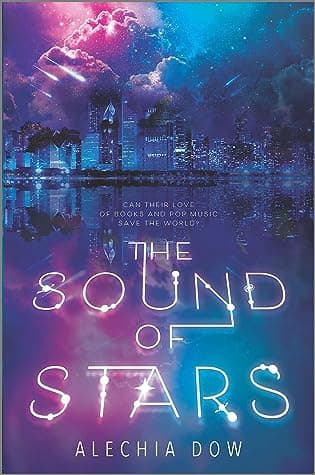
Alechia Dow (2020)
Genre
Fantasy / Science Fiction / Young Adult / Romance
Reading Time
8-10 hours
Key Themes
See below
Sign in to track this book
In a future where alien conquerors outlaw emotions, a human girl who secretly collects forbidden books and an alien boy who secretly loves human music go on a dangerous road trip to save humanity, finding love and art along the way.
Seventeen-year-old Janelle 'Ellie' Baker lives in an Ilori-controlled human processing center in New York City. This is two years after the Ilori invasion, which greatly reduced Earth's population. Humans are now forbidden from showing emotions, and all art, including books, is illegal. Ellie, who loves stories, secretly keeps a library hidden in the facility's ventilation shafts. She carefully organizes and cares for these illegal items, risking execution if caught. Her only friend is Mariah, who works in the medical bay and sometimes helps Ellie get supplies. Ellie believes these stories are vital for humanity's survival, even if most humans have lost hope.
One day, Ellie discovers that a valuable copy of 'The Little Prince' is gone from her hidden library. She panics, fearing the Ilori will trace it back to her and execute her. Soon after, she is called for an 'evaluation' by an Ilori officer named M0Rr1S (Morris). During the questioning, Morris seems to study her closely, asking detailed questions about her activities and interests. Ellie, terrified, tries to remain calm, knowing any sign of emotion could be fatal. She is sure Morris suspects her, but he does not directly accuse her of having the books.
Morris returns to Ellie's room later, surprising her by showing her 'The Little Prince.' He reveals he took it, drawn by its unusual qualities. He then confesses his own secret: he has been collecting human music, especially pop songs, which are also forbidden. He explains that human music brings out strange, new feelings in him, feelings he was not meant to experience. He proposes a dangerous alliance: he needs Ellie's help to understand human art and emotions, and in return, he will protect her and her library. Ellie, at first cautious, feels a spark of hope and curiosity from his confession.
Morris reveals the true extent of his rebellion: he believes human art and emotions are not a weakness, but a strength, and that they hold the key to preventing humanity's complete destruction. He explains that the Ilori leaders, especially his 'mother' Dr. Nul, plan to fully 'pacify' humans by cutting off their emotional connections with new technology. Morris's plan is to travel to the Ilori home world, Xylos, and present human art to the Ilori High Council, hoping to show humanity's worth and convince them to change their destructive policies. He needs Ellie's knowledge and passion for human culture to succeed.
Ellie, after much thought and a heartfelt goodbye to Mariah, agrees to Morris's plan. They carefully prepare for their journey, gathering a collection of books, music, and other human items. Using Morris's access and knowledge of Ilori systems, they plan a secret escape from the processing center. Their destination is a hidden Ilori transport hub thousands of miles away, where Morris believes they can get a ship to Xylos. The escape is tense, and they barely avoid detection by other Ilori patrols. Their road trip across the desolate, Ilori-controlled American landscape begins, full of danger and uncertainty.
As they travel, Ellie and Morris spend hours discussing human art, literature, and the complexities of emotion. Ellie introduces Morris to classic novels, poetry, and the stories behind the music he loves. Morris, in turn, shares details about Ilori culture, their logical thinking, and the sterile environment where he was raised. Their conversations mix intellectual curiosity and a growing personal bond. They share meals, camp under the stars, and slowly begin to trust each other, breaking down species and past conflicts. Morris starts to experience human emotions more deeply, guided by Ellie's explanations.
Their road trip is difficult. They encounter rogue Ilori patrols who are suspicious of Morris's unauthorized movements, forcing them to use stealth and Morris's quick thinking to avoid capture. They also find desperate human survivors outside the Ilori centers, some of whom are hostile or scared. One tense encounter involves a group of scavenging humans who try to steal their supplies, making Ellie face the harsh realities of survival outside the controlled zones. These incidents test their resolve and emphasize the danger of their mission, but also strengthen their bond as they depend on each other.
After weeks of travel, Ellie and Morris finally arrive at the remote Ilori transport hub, a large, heavily guarded facility. Getting inside is a major challenge, requiring Morris to use his fake credentials and navigate complex Ilori rules. They face intense scrutiny from the Ilori staff, who are trained to spot anything unusual. Inside the hub, they must find a specific long-range vessel that can reach Xylos, all while avoiding detection by Dr. Nul's loyalists who might be watching Morris. The pressure builds as their chance to leave Earth shrinks.
Just as they are about to board a ship, Dr. Nul, Morris's creator and the one behind humanity's subjugation, stops them. Dr. Nul reveals her full plan: not only to pacify humans emotionally but to eventually make them a subservient, emotionless workforce in Ilori society. She sees Morris's 'defection' as a flaw in her programming. A tense confrontation follows, with Dr. Nul trying to regain control over Morris and capture Ellie. Morris, now fully experiencing his emotions, defies his 'mother,' protecting Ellie and stating his belief in humanity's worth. The confrontation becomes a desperate fight for their freedom and humanity's future.
With quick thinking and surprise, Morris overpowers Dr. Nul's guards and stops her attempts to capture them. They make a daring escape onto a waiting Ilori starship, leaving Earth behind. As they travel through space toward Xylos, they process their escape and the importance of their mission. Ellie and Morris find comfort in each other, their bond strengthened by the shared danger and their dream of a better future. They prepare for the ultimate challenge: convincing the Ilori High Council to spare humanity, armed only with their collection of human art and their strong belief in its power.
The Protagonist
Ellie transforms from a fearful, secretive librarian to a courageous advocate for humanity, finding her voice and purpose through her alliance with Morris.
The Co-protagonist/Love Interest
Morris evolves from an emotionless, rule-bound Ilori into an individual capable of profound emotion and love, becoming a champion for humanity.
The Antagonist
Dr. Nul remains steadfast in her belief in Ilori superiority and the subjugation of humanity, becoming a direct obstacle to Ellie and Morris's mission.
The Supporting
Mariah remains a steadfast friend and supporter, providing a grounding force for Ellie before her departure.
The Mentioned
Their collective decision-making is the ultimate target of Ellie and Morris's mission.
This theme is central to the entire story. Art—books, music, poetry—is shown not as a luxury but as a vital part of humanity's identity and survival. Ellie risks her life for her secret library, believing stories keep hope alive and connect humans to their past and future. Morris is drawn to human music, which awakens his emotions and starts his rebellion. The entire mission to Xylos relies on the idea that art can show humanity's value and emotional depth to the logical Ilori, potentially saving the species. The novel itself shows this power.
““Stories are what make us human. They’re how we connect, how we remember, how we survive.””
The novel explores what it means to be human, especially compared to the emotionless Ilori. Emotions, which the Ilori see as a dangerous weakness, are presented as humanity's greatest strength—driving creativity, empathy, love, and resilience. Morris's journey from an emotionless being to one capable of deep feeling highlights this theme. Through his interactions with Ellie and human art, he learns to value compassion, anger, joy, and sorrow, ultimately choosing to fight for a species defined by these traits. The Ilori's attempt to suppress human emotion is an attempt to erase their humanity.
““You can’t just turn off what makes a species who they are. Not without destroying them.””
Both Ellie and Morris show resistance against an oppressive government. Ellie's secret library is a quiet act of rebellion, preserving what the Ilori want to destroy. Morris's entire character arc is one of rebellion against his creators and the Ilori's destructive policies. Their alliance is a strong act of defiance, showing that even against overwhelming power, individuals can fight for what they believe in. Their journey shows the courage needed to stand up against injustice and tyranny, even when the odds seem impossible.
““Sometimes, the quietest acts of rebellion are the loudest.””
A main theme is the bridging of two very different cultures: emotional humans and logical Ilori. The story argues for the importance of empathy and understanding between species. Morris, an Ilori, learns to understand and appreciate human emotions and culture through Ellie. Their relationship is a small example of the mission's larger goal: to build understanding between Ilori and humans, preventing more conflict and destruction. The novel suggests that true progress and peace come from a willingness to see the world from another's perspective and value their unique contributions.
““Perhaps the greatest strength is not logic, but the ability to understand what is illogical to you.””
A hidden collection of illegal human art and literature.
Ellie's secret library serves as a central plot device, symbolizing humanity's enduring spirit and resistance. It is the catalyst for Morris's initial interest in Ellie and human culture. The library's existence creates constant tension and danger for Ellie, driving much of the early plot. It also functions as the physical manifestation of the 'evidence' they carry to Xylos, representing the hope for humanity's future. The library is not just a collection of books, but a sanctuary of human identity.
A perilous journey across a desolate, Ilori-controlled Earth.
The road trip from the New York facility to the distant Ilori transport hub is a classic plot device used to foster character development and build their relationship. It forces Ellie and Morris into close proximity, allowing them to learn about each other's cultures and personal histories. The journey is filled with external conflicts (Ilori patrols, desperate human survivors) that test their resolve and strengthen their bond. It also allows for world-building, showcasing the devastated landscape of Earth under Ilori rule.
An alien character designed without emotions who learns to feel.
Morris's initial state as an emotionless Ilori is a crucial plot device that allows for a profound exploration of human emotion from an external perspective. His journey of learning to feel, guided by Ellie and human art, provides a unique lens through which the reader understands the importance and complexity of emotions. This device creates a compelling character arc for Morris and drives the central romantic tension, as his developing feelings for Ellie challenge his very nature and Ilori ideology.
The collection of books and music that drives the entire mission.
While not a traditional MacGuffin in the sense of a purely object-driven plot, the collection of human art (books, music) functions similarly. It is the tangible 'thing' that Ellie and Morris are trying to preserve and use as a tool to save humanity. Its importance lies not just in its physical presence but in what it represents: the essence of human creativity and emotion. The art is the reason for their journey to Xylos and the primary argument they will present to the Ilori High Council.
“Books were dangerous. Books were the enemy. Books were the reason I was trapped in this library, forced to read and reshelve and reorganize until my fingers bled.”
— Ellie's initial resentment towards books under the government's oppressive regime.
“We were all just trying to survive. Some of us just had better tools.”
— Ellie reflecting on the different struggles and advantages people have.
“Music was a weapon, a shield, a balm. It was everything.”
— Ellie describing the power and importance of music to her.
“Hope was a dangerous thing, but sometimes, it was all you had.”
— Ellie grappling with the concept of hope in a bleak world.
“Stories were how we understood the world, how we connected, how we remembered.”
— Ellie realizing the profound impact of stories, even forbidden ones.
“Silence was a luxury. Noise was a necessity.”
— Ellie's observation about the constant need for vigilance and communication.
“Fear was a constant companion, but it didn't have to be the only one.”
— Ellie learning to not let fear consume her entirely.
“The stars didn't care about our petty human squabbles. They just shone.”
— Ellie looking at the stars and feeling both small and connected.
“Sometimes the greatest acts of rebellion are the quietest ones.”
— Ellie realizing that small, personal acts can be powerful forms of resistance.
“Love wasn't a choice; it was a surrender.”
— Ellie reflecting on her growing feelings for M0RR1S.
“Even in the darkest places, there was always a flicker of light, if you knew where to look.”
— Ellie finding moments of beauty and hope amidst the harsh reality.
“Being different wasn't a weakness; it was a superpower.”
— Ellie embracing her unique qualities and the qualities of others.
“The past wasn't something to be forgotten; it was something to learn from.”
— Ellie understanding the importance of history and memory.
“Every song was a story, and every story deserved to be heard.”
— Ellie's belief in the universal right to expression and sharing.
Ready to see how well you understood this book? Take our interactive quiz with 10 questions.

Alechia Dow is the author of the acclaimed young adult science fiction novel, The Sound of Stars. Her work is celebrated for its unique blend of heartfelt storytelling and imaginative world-building. Dow's writing often explores themes of identity, connection, and resilience within speculative fiction settings.







