“She was a girl who could walk a trapline, skin a fox, and shoot a rifle with the best of them, but she also knew how to make a sourdough starter sing.”
— Describing Mabel's resilience and practical skills in the Alaskan wilderness.

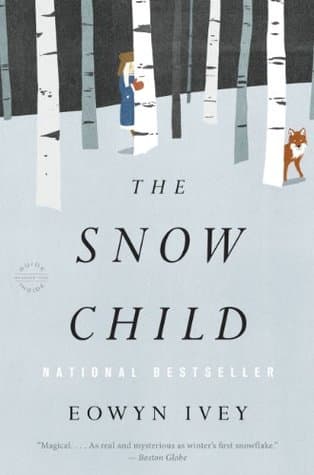
Eowyn Ivey (2012)
Genre
Literary Fiction / Fantasy / Historical Fiction
Reading Time
480 min
Key Themes
See below
Sign in to track this book
In 1920s Alaska, a childless homesteader couple's despair changes with the sudden arrival of a wild, mysterious girl, born from snow and myth, who redefines their ideas of family, nature, and the line between reality and fairy tale.
In 1920, Jack and Mabel, a childless couple in their late thirties, move to the remote Alaskan wilderness. They seek a new life after the stillbirth of their only child. They homestead near the fictional town of Palmer, enduring harsh conditions and the hard physical work of clearing land and building a cabin. Mabel struggles deeply with loneliness and depression, made worse by the isolation and her desire for a child. Jack, though tough, is often emotionally distant, focused on survival. During the first snowfall of winter, in a rare moment of shared happiness, they build a snow child in their yard, with a scarf, mittens, and berries for eyes. Mabel even names it Faina. The act gives them a brief sense of connection and hope.
The next morning, Jack and Mabel wake to find the snow child gone, its accessories neatly piled where it stood. Later that day, while hunting, Jack sees a young, blonde-haired girl running through the trees with a red fox. She wears animal skins and seems wild, disappearing quickly. Mabel, at first doubtful, sees the girl herself a few days later, leaving a small animal on their doorstep. The couple is captivated and puzzled. They begin to leave food out for her, hoping to draw her closer. They learn her name is Faina, the same name Mabel gave the snow child, and she seems to have an otherworldly connection to the wilderness, surviving the brutal Alaskan winter easily.
Faina gradually begins to interact with Jack and Mabel, but always with a wildness and some detachment. She speaks little, preferring to communicate through actions and her connection to nature. She helps Jack with trapping, showing an unusual knowledge of the woods and its creatures. Mabel, at first cautious of Faina's wild nature, grows to love her deeply, finding in her the daughter she always wanted. Faina's presence fills the emptiness in their lives, bringing laughter and purpose back to their lonely homestead. However, her unusual habits, like her discomfort with warmth and her preference for sleeping outdoors, remain a constant source of wonder and concern for Jack and Mabel, confirming her mysterious origins.
The Bensons, Jack and Mabel's nearest neighbors and friends, learn of Faina's presence. Esther Benson, practical and motherly, worries about Faina's upbringing, while Garrett Benson, a trapper, finds her hunting skill interesting. Other settlers in Palmer whisper about the strange, wild girl. Mabel, while protective of Faina, also notices unsettling details: Faina never seems to age, she avoids direct sunlight and warmth, and she dislikes being touched. One day, Mabel finds a small, faded photograph among Faina's things — a picture of a young woman who looks a lot like Faina, hinting at a past before her arrival.
Years pass, and Faina becomes an important part of Jack and Mabel's lives. She grows into a young woman, though her youthful appearance largely stays the same. She continues to show her unique traits: her red fox, now an old companion, is always nearby; she thrives in the cold and snow but becomes tired and sick in the summer heat; she communicates more freely but keeps a spiritual connection to the wilderness. Jack teaches her to read and write, and she learns quickly, yet her heart remains tied to the wild. Jack and Mabel, despite their lasting love, are always aware of the delicate balance of her presence, knowing she is not entirely of their world.
As Faina gets older, she attracts the attention of a young homesteader named Allan. They fall in love, and Allan, accepting of Faina's unusual ways, proposes marriage. Jack and Mabel are happy but also worried, understanding what it means for Faina to enter a more conventional life. They worry about her ability to adapt, especially her weakness to warmth and her natural wildness. Faina, though she loves Allan, expresses her own fears about losing her connection to the snow and the wild. Her physical condition seems to worsen as summer approaches and the idea of a settled life, suggesting a difficult choice.
Faina and Allan marry in a simple ceremony. However, as the Alaskan summer continues, Faina's health gets much worse. She becomes increasingly frail, weak, and has a constant fever. Her skin feels cold, and she struggles to breathe in the heat. Mabel tirelessly cares for her, seeing the link between Faina's illness and her dislike of warmth. Jack, too, is very concerned, remembering folk tales of snow maidens. The joy of the wedding is overshadowed by the growing fear that Faina cannot survive the summer, her life force draining with the melting snow and the prolonged warmth.
Realizing she is dying, Faina makes a desperate choice. One hot summer night, she slips away from Allan and her parents, heading into the deepest parts of the wilderness. She is weak but determined, driven by an instinct to return to her true element. Jack and Mabel, along with Allan, are distraught. They search for her for days, their hearts heavy with dread. They know, deep down, that Faina is returning to where she came from, a place where she might find peace, even if it means leaving them forever. Her departure confirms her magical, temporary nature.
Driven by an unexplained urge, Mabel continues searching even after others stop. She eventually finds a secluded, abandoned cabin in a remote part of the woods. Inside, she finds a very old, frail woman, nearly skeletal, who says her name is Galina. Galina reveals she is Faina's mother, explaining that Faina was indeed a snow child, brought to life from snow and ice, just as the fairy tales say. She had built her own snow child years ago, who vanished and reappeared as Faina. Galina explains the conditions of Faina's existence: her need for cold, her weakness to warmth, and her eventual return to the snow. This revelation confirms Jack and Mabel's deepest suspicions and fears about Faina's true nature.
Mabel brings Galina back to their homestead, where she lives out her final days, sharing more of Faina's history. Eventually, Galina dies peacefully. As the first snows of winter begin to fall, Jack and Mabel find Faina, transformed back into a snow child, lying peacefully in a clearing, the red fox curled beside her. Her body is pure snow, beautiful and calm. They understand that she has returned to her original form, completing her cycle. While heartbroken, they also feel a deep sense of peace and thanks for the years they had with her. Faina's memory forever connects them, their love for her showing the magic and mystery of the Alaskan wilderness.
The Protagonist
Mabel transforms from a despairing, childless woman into a loving, accepting mother, finding peace despite loss.
The Protagonist
Jack evolves from a stoic, pragmatic homesteader to a loving, accepting father figure, embracing the magic in his life.
The Central Figure
Faina lives a transient existence between human and natural worlds, ultimately returning to her original elemental form.
The Supporting
Esther remains a steadfast and supportive friend, offering practical wisdom and emotional comfort.
The Supporting
Garrett remains a consistent and supportive friend, representing the practical wisdom of the wilderness.
The Supporting
Allan experiences the joy and heartbreak of loving a magical being, growing in acceptance and grief.
The Supporting
Galina provides the crucial exposition about Faina's origins, bringing closure and understanding to Mabel.
The Supporting
The fox remains a constant, unwavering companion, embodying Faina's wild essence.
The novel begins with Jack and Mabel dealing with the deep sadness of losing their child. Mabel's depression and loneliness are key to her character. Faina's arrival, though mysterious, helps them heal, filling the emptiness left by their loss. The story explores how love, even for a magical being, can mend broken hearts. Ultimately, Faina's departure brings a new kind of loss, but one softened by understanding and the lasting love she brought, allowing Jack and Mabel to find some peace and acceptance.
“Perhaps it was the way of life, she thought, to make small gains and losses, to move and change, and to love what could not be held.”
The harsh, beautiful Alaskan wilderness is a strong force in the novel, always challenging the human desire for control. Faina embodies the wild, thriving in the cold and resisting the limits of home life. Her struggle to adapt to human warmth and societal expectations shows the conflict between untamed nature and settled life. Jack and Mabel's homesteading efforts show their attempt to make a life in the wild, while Faina's existence reminds them of the wilderness's lasting power and mystery, showing that some things cannot be controlled.
“The wilderness was a great, indifferent beast, and it devoured both the weak and the strong.”
The novel smoothly combines the tough realities of historical homesteading with elements of a fairy tale. Faina's origin as a snow child comes directly from Russian folklore, challenging what characters and readers think is possible. The story explores the power of belief and imagination in a world that demands practical thinking. Jack and Mabel's slow acceptance of Faina's magical nature changes their lives, suggesting there is wonder and mystery beyond rational explanation, and that sometimes, the deepest truths are found in stories and legends.
“Perhaps the world was not a place for logic, but for magic. Perhaps a child could be born of snow.”
A main theme is the deep and unconditional love Jack and Mabel develop for Faina, despite her mysterious origins and unusual nature. They accept her wildness, her unique needs, and her eventual fate, loving her as their own daughter. Their journey shows the power of parental love, which goes beyond normal limits and expectations. They learn to care for, protect, and eventually let go, embracing the bittersweet reality of loving a child not entirely of their world, finding joy and meaning in the time they have together.
“To love her was to accept what she was, to accept the wildness in her, and to know that she would always belong to the snow.”
The extreme isolation of the Alaskan wilderness greatly affects Jack and Mabel, especially Mabel, leading her into depression. The novel shows the human need for connection. The gradual formation of a small community with the Bensons and later Allan, provides important support, friendship, and a sense of belonging. These relationships contrast with the deep solitude Jack and Mabel first face, showing how community, even in a harsh environment, can support people and help them handle life's challenges, though Faina's ultimate fate reminds them of the unique isolation of her own existence.
“The silence was a presence, sometimes a comfort, sometimes an enemy.”
Faina's character is directly inspired by Russian folklore.
The entire premise of 'The Snow Child' is built upon the Russian folk tale of Snegurochka, or the Snow Maiden. Faina embodies this archetype: she is born of snow, thrives in cold, and weakens with warmth, eventually returning to her elemental state. This device establishes a magical realism framework for the narrative, allowing the reader to accept the fantastical elements within a historical setting. It also foreshadows Faina's fate, creating a sense of bittersweet inevitability throughout the story. The explicit mention of the 'snow child' tale by Galina at the end directly confirms this literary device.
The Alaskan wilderness shapes the characters and drives the plot.
The Alaskan wilderness in the 1920s is far more than just a backdrop; it is a powerful, active force that dictates the lives of Jack and Mabel. Its harshness leads to their isolation and struggle, while its beauty and mystery allow for Faina's existence. The cycles of winter and summer directly impact Faina's health and ultimately her fate. The wilderness provides sustenance, challenges, and a sense of awe, deeply influencing the characters' resilience, their relationship with each other, and their understanding of the world. It is the crucible in which their lives are forged and transformed.
Faina's animal companion symbolizes her wildness and connection to nature.
The red fox that accompanies Faina from her first appearance serves as a potent symbol. It represents Faina's untamed nature, her deep connection to the animal world, and her origins in the wilderness. The fox is a silent, constant presence, mirroring Faina's own elusive and mysterious qualities. It never fully integrates into domestic life, just as Faina never fully sheds her wildness. Its loyalty to Faina underscores her unique bond with nature and reinforces the magical, primal essence of her character, acting as a visual manifestation of her true spirit.
The changing seasons subtly hint at Faina's vulnerability and eventual fate.
The progression of seasons, particularly the contrast between the brutal Alaskan winter and the brief, warm summer, serves as a significant foreshadowing device. Faina thrives in winter, embodying its spirit, but visibly weakens and becomes ill as summer approaches and the temperatures rise. This cyclical pattern subtly but consistently hints at her elemental nature and her eventual demise if exposed to prolonged warmth. The dread of summer's arrival becomes a growing concern for Jack and Mabel, signaling the inevitable conflict between Faina's snow-bound existence and the natural world's changing temperatures.
“She was a girl who could walk a trapline, skin a fox, and shoot a rifle with the best of them, but she also knew how to make a sourdough starter sing.”
— Describing Mabel's resilience and practical skills in the Alaskan wilderness.
“The wilderness had its own way of measuring time, not in hours or days, but in seasons, in the rise and fall of rivers, the migration of animals.”
— Reflecting on the unique perception of time in the isolated Alaskan setting.
“Sometimes, when a person is too much alone, they make a friend of their own heart.”
— Mabel's internal thought about the loneliness that can lead to self-reliance or even delusion.
“It was a wild, strange land, and it demanded a wild, strange heart to live in it.”
— A general observation about the harsh beauty and challenging nature of Alaska.
“The line between what was real and what was imagined often blurred in the vast, silent stretches of the territory.”
— Hinting at the magical realism element and the psychological effects of isolation.
“Love was not a thing to be found, but a thing to be made, and remade, and made again, each day, with the person you chose.”
— Mabel's evolving understanding of her relationship with Jack.
“A person could starve from loneliness as easily as from hunger.”
— Mabel's realization about the profound impact of social isolation.
“The snow child was a whisper of hope in a land that could be brutally unforgiving.”
— Describing the significance of the snow child's appearance to Mabel and Jack.
“There was a kind of peace in giving up, a quiet acceptance of what was, instead of fighting for what might be.”
— Mabel's internal struggle with resignation and acceptance in difficult times.
“Winter was not just a season; it was a way of life, a test of endurance, a canvas for the soul.”
— Reflecting on the pervasive and transformative nature of winter in Alaska.
“Stories were not just entertainment; they were the way people made sense of the world, the way they kept the past alive.”
— Highlighting the role of storytelling and folklore in the characters' lives.
“The greatest sorrow was the one you carried alone, the one you had no words for.”
— Mabel's reflection on unspoken grief and the burden of silent suffering.
“Nature didn't care about human plans; it had its own rhythms, its own merciless beauty.”
— An acknowledgment of humanity's insignificance in the face of nature's power.
“Perhaps the world was not a place of facts, but a place of possibilities, and a person had to choose which ones to believe.”
— Mabel's philosophical musing on the nature of belief and reality in a world where the fantastical can seem real.
Ready to see how well you understood this book? Take our interactive quiz with 10 questions.







