“The Slynx is a creature that lives in the forest, and it's very dangerous. It can kill you just by looking at you.”
— Early description of the mythical creature that gives the book its title, reflecting the post-apocalyptic fear and superstition.

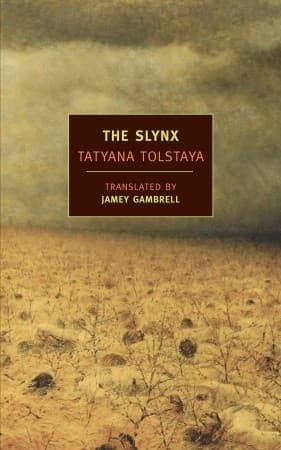
Tatyana Tolstaya (2003)
Genre
Fantasy / Science Fiction
Reading Time
360 min
Key Themes
See below
Sign in to track this book
In a post-apocalyptic Russia where mutated humans scavenge for mice and knowledge is a controlled, dangerous commodity, one man's transcription job unveils a world far more complex and perilous than his seemingly mundane existence suggests.
Two hundred years after the Blast, Benedikt lives in a mutated, post-apocalyptic Moscow, now called Fyodor-Kuzmichsk. He is a 'golubchik' (scribe) in the household of Fyodor Kuzmich, the supposed 'Glorybe' leader who claims to have written all the surviving books. Benedikt's job involves copying and slightly altering pre-Blast texts, attributing them to Fyodor Kuzmich. He lives a simple life, primarily concerned with finding enough mice to eat, avoiding the oppressive Saniturions who hunt 'Freethinkers,' and steering clear of the mythical Slynx. He is physically unmutated, a rare blessing in a world where many people have extra fingers, gills, or cockscombs. He wants a wife and a more meaningful existence, despite the widespread ignorance and fear that define his society.
Olenka, a beautiful young woman with unmutated features, arrives in Fyodor Kuzmich's household as a new servant. Benedikt immediately likes her beauty and her apparent lack of mutations, which sets her apart from most other women he encounters. He begins to watch her, developing a quiet affection and a desire for her attention. Olenka, however, seems somewhat distant and busy, often doing tasks for Fyodor Kuzmich or interacting with other household members. Benedikt's desire for her becomes a significant part of his daily life, contrasting with his otherwise monotonous and fear-driven existence. He dreams of a future with her, imagining a simple domestic life that seems almost impossible in their harsh world.
As a golubchik, Benedikt spends his days copying old books, which are then presented as the original works of Fyodor Kuzmich. He notices inconsistencies and strange words in these texts, which he struggles to understand because of his limited education and the corrupted language of his time. His fellow golubchiks, especially the older ones, occasionally hint about the 'old world' and the true nature of the books, but their insights are fragmented and often hidden by fear. Benedikt's curiosity grows, and he starts to suspect that Fyodor Kuzmich is not the true author of all these works. This leads to a nascent 'Freethinking' within him, a dangerous path in their society. He secretly tries to understand the real meaning of the ancient words.
Benedikt frequently encounters Nikita Ivanovich, a seemingly ordinary old man who sometimes visits Fyodor Kuzmich's household. Nikita Ivanovich, one of the few who remembers fragments of the pre-Blast world, speaks in riddles and subtle hints about knowledge, art, and a different way of life. He talks about 'culture' and 'books' in a way that suggests they are more than just Fyodor Kuzmich's pronouncements. While Benedikt doesn't fully grasp what Nikita Ivanovich means, his words plant seeds of doubt and curiosity in his mind, further fueling his nascent desire to understand the world beyond the immediate propaganda. Nikita Ivanovich is a fading link to the lost civilization, a quiet source of genuine knowledge in a world of manufactured ignorance.
Benedikt eventually marries Olenka, fulfilling his long-held desire for companionship. Their initial domestic life is relatively peaceful, with Benedikt enjoying the simple joys of having a wife and a home. However, Olenka remains somewhat mysterious. She is often withdrawn and seems to possess a knowledge or awareness that Benedikt lacks. She has a peculiar attachment to a small, hidden room in their house, which she keeps locked and secret. Benedikt's initial happiness is gradually tinged with suspicion and confusion as he observes Olenka's strange habits and veiled expressions. He feels a growing distance between them, despite their shared life, and her secrets begin to trouble him.
The Saniturions are the feared enforcers of Fyodor Kuzmich's regime. They identify and punish 'Freethinkers' – anyone who thinks independently, questions the established order, or shows signs of pre-Blast knowledge. They are ruthless and often arbitrary in their judgments, creating an atmosphere of constant fear and suspicion. Benedikt, like everyone else, lives in dread of them, always careful to conform and avoid any behavior that could be interpreted as 'Freethinking.' The Saniturions' presence is a constant reminder of the regime's strong control over the populace, ensuring that the mutated, ignorant society remains subservient and unquestioning. Their methods are brutal, often involving public humiliation and disappearance.
Beyond the 'golubchiks' and 'Murzas' (the privileged class), society has 'Degenerators' – heavily mutated individuals with animalistic features, often used as beasts of burden or kept in subservient roles. These four-legged creatures, some with multiple heads or other grotesque deformities, are a stark reminder of the devastating effects of the Blast and the regression of humanity. Benedikt views them with a mix of pity and revulsion, grateful that he is not one of them. Their existence shows the harsh realities of survival in this new world and the rigid social hierarchy, where mutations dictate one's place. They are the lowest rung, treated as property rather than people, further showing the loss of human dignity.
Driven by his growing suspicion and curiosity, Benedikt eventually breaks into Olenka's locked room. Inside, he discovers a hidden library filled with actual pre-Blast books, carefully preserved. This revelation shatters his understanding of his world and Fyodor Kuzmich's deception. He realizes that Olenka has been secretly hoarding and reading these forbidden texts, making her a dangerous 'Freethinker.' The books are a direct link to the past, filled with knowledge, art, and culture that have been suppressed and distorted. This discovery is a turning point for Benedikt, as he now has direct access to the truth, forcing him to confront the lies he has lived under and the true nature of his society.
Through Olenka's hidden books and further interactions with Nikita Ivanovich, Benedikt slowly puts together the truth. He learns that Fyodor Kuzmich is not a great author but a charlatan who merely collects and rebrands pre-Blast literature as his own. He also learns about the 'old world' – a time of advanced civilization, art, science, and genuine knowledge, which was destroyed by the Blast. The books reveal a world of beauty and complexity that is almost unimaginable to Benedikt. This knowledge is both liberating and terrifying. It exposes the vast ignorance and deliberate deception that define his current reality. He begins to understand 'culture' and 'history'.
Throughout the story, the Slynx is a pervasive mythical creature, a screeching, invisible entity that preys on those who venture too far into the wilderness or engage in 'Freethinking.' It is said to 'eat thoughts' and cause madness. As Benedikt's own knowledge expands, the Slynx takes on a more symbolic meaning, representing the terrifying consequences of independent thought and the unknown dangers of the world beyond Fyodor-Kuzmichsk. The fear of the Slynx keeps people tied to their ignorance and subservience. It is the ultimate boogeyman, used by the regime to control the populace and prevent them from questioning their reality or seeking forbidden knowledge. Its presence is a constant threat.
As Benedikt continues to read Olenka's hidden books, he changes internally. The crude language and limited understanding that once defined him begin to give way to a growing intellect and a grasp of complex ideas. He starts to speak with more eloquence and questions the world around him with greater insight. This newfound knowledge, however, is a heavy burden. It isolates him from the ignorant populace and puts him in grave danger from the Saniturions. He struggles with knowing the truth but being unable to share it openly. He feels increasingly alienated from his society and even from Olenka, who seems to have accepted the secret. He is no longer the simple golubchik.
Benedikt's 'Freethinking' is eventually discovered. It is implied that Olenka, for self-preservation or a darker motive, betrays him to the Saniturions. He is captured and dragged into the wilderness to face the Slynx. In a harrowing confrontation, Benedikt discovers the true nature of the Slynx. It is not a mythical beast but a manifestation of his own uncontrolled knowledge and the trauma of the Blast. It is a creature born of the human mind, of the forbidden thoughts and memories of the old world. The Slynx 'eats' his thoughts, leaving him a blank slate. He is stripped of his newfound intellect and returned to a state of primal ignorance, fulfilling the regime's ultimate goal of mental subjugation. He is effectively 'cured' of Freethinking.
After his encounter with the Slynx, Benedikt returns to Fyodor-Kuzmichsk, physically unharmed but mentally devastated. He has lost all his acquired knowledge, his ability to understand complex ideas, and his capacity for independent thought. He is reduced to his former, ignorant self, content with the simple, crude existence of the other inhabitants. The cycle of ignorance and control is complete. He is no longer a threat to the regime, having been effectively lobotomized by the Slynx. His story ends with him rejoining the populace, a poignant symbol of humanity's regression and the triumph of deliberate ignorance in the post-Blast world. The 'Slynx' ensures that no true knowledge can flourish.
The Protagonist
Benedikt transforms from an ignorant, contented drone into a 'Freethinker' burdened by knowledge, only to be stripped of it by the Slynx and returned to a state of primal ignorance.
The Supporting
She remains largely static, a mysterious figure who holds the keys to the past but chooses to keep them hidden, ultimately leading to Benedikt's exposure.
The Antagonist
He remains the static, unchallenged ruler, symbolizing the enduring power of ignorance and authoritarianism.
The Supporting
He serves as a catalyst for Benedikt's awakening, a static figure representing the vanishing past.
The Antagonist
They remain a constant, unyielding force of oppression throughout the narrative.
The Mentioned
They remain in their subservient, mutated state, symbolizing the irreversible damage of the Blast.
The Supporting
He remains a static character, representing the average, unthinking citizen.
The Supporting
Cheburashka remains a static symbol of mutation and the grotesque.
This is the central theme of 'The Slynx.' The post-Blast society is deliberately kept ignorant by Fyodor Kuzmich, who controls information by claiming authorship of all books. Benedikt's journey is one from blissful ignorance to the painful burden of knowledge, gained through Olenka's hidden library and Nikita Ivanovich's hints. The novel explores how ignorance can be a form of control and how knowledge, while freeing, can also be terrifying and isolating in an unready world. The Slynx itself embodies the fear and suppression of true understanding.
“What had been books before the Blast? Just books. But now, after the Blast, books were a special thing. Books were Fyodor Kuzmich. Books were wisdom. Books were power. Books were everything.”
The novel shows the degradation of language and culture after the Blast. Words have lost their original meanings, concepts are misunderstood, and the richness of pre-Blast civilization is reduced to fragmented, often grotesque, interpretations. Benedikt's struggle to understand the old texts shows this linguistic and cultural decay. The deliberate alteration of books by Fyodor Kuzmich symbolizes the destruction of genuine culture and its replacement with a manufactured, simplistic narrative. The re-discovery of true books is a re-discovery of language itself.
“Words, like people, had suffered the Blast. Some were crippled, some were gone entirely, and some were born anew, strange and twisted.”
The society in 'The Slynx' is a stark depiction of a totalitarian regime under Fyodor Kuzmich. The Saniturions enforce conformity and brutally suppress 'Freethinking,' creating an atmosphere of widespread fear. The control over information, the rewriting of history, and the constant surveillance are hallmarks of this oppressive system. The novel explores how such a regime thrives on the ignorance of its populace and the fear of the unknown (symbolized by the Slynx) to maintain absolute power, sacrificing individual freedom for a false sense of order.
“Freethinking was a sickness, a deviation, a sure path to the Slynx.”
The world of 'The Slynx' shows humanity's dramatic regression after a catastrophic event. Physical mutations (extra fingers, cockscombs), intellectual stagnation, and the loss of pre-Blast knowledge are central. People have adapted to a primitive, fear-driven existence, where survival is most important and higher thought is suppressed. The Degenerators represent the extreme end of this physical and mental decay. The novel questions what it means to be human when civilization collapses and how quickly people can revert to a more animalistic state, accepting the grotesque as normal.
“And the people, what were they? Not quite human, not quite beast, but something in between, forged by the Blast.”
Beneath the surface of survival, Benedikt grapples with a yearning for identity and meaning beyond his prescribed role as a golubchik. His desire for Olenka, his curiosity about the books, and his eventual intellectual awakening are all parts of this search. In a world where personal history is erased and individuality is suppressed, finding one's true self and purpose becomes a dangerous act of 'Freethinking.' His journey is a quest to understand who he is in relation to a lost past and a terrifying present.
“He wanted to know, not just to copy. He wanted to understand what was before him, what was behind him, what was inside him.”
The catastrophic event that ended the old world and ushered in the mutated present.
The Blast is the seminal, cataclysmic event that destroyed the pre-existing civilization and led to the mutated, regressed world of 'The Slynx.' Its exact nature is never fully explained, but its consequences are pervasive: physical mutations in humans and animals, the destruction of knowledge, and the rise of a new, primitive society. The Blast serves as a narrative device to justify the post-apocalyptic setting, the societal structure, and the pervasive fear and ignorance. It's the ultimate 'before and after' marker for the world's history.
A mythical, invisible creature symbolizing the fear of knowledge and independent thought.
The Slynx is a legendary, invisible, screeching creature that lives in the wilderness and is said to 'eat thoughts,' driving people mad. It functions as both a literal threat and a powerful symbol. As a plot device, it is the ultimate deterrent against 'Freethinking' and exploration, used by the regime to control the populace. Symbolically, it represents the destructive consequences of forbidden knowledge, the trauma of the past, and the internal struggle with understanding a terrifying truth. Its true nature is revealed to be more psychological than physical, a manifestation of the mind's confrontation with overwhelming information.
Forbidden relics of the pre-Blast world, embodying lost knowledge and culture.
The books, particularly the pre-Blast texts hidden by Olenka, are central plot devices. They are the physical link to the lost civilization, containing genuine knowledge, art, and history. In the hands of Fyodor Kuzmich, they are instruments of deception, rewritten and attributed to him to maintain control. For Benedikt, they are catalysts for his intellectual awakening, challenging his understanding of the world. The act of reading and understanding these books drives the narrative's central conflict between ignorance and knowledge, representing the potential for both liberation and destruction.
Physical deformities resulting from the Blast, symbolizing humanity's regression.
The widespread physical mutations (extra fingers, cockscombs, gills, animalistic features) are a constant plot device, visually defining the post-Blast world and its inhabitants. They serve as a stark reminder of the catastrophe's lasting effects and humanity's physical and genetic regression. The mutations reinforce the social hierarchy (unmutated individuals like Benedikt and Olenka are considered 'normal' and higher status), and their prevalence normalizes the grotesque, highlighting the extent to which humanity has adapted to a deformed reality. They are a constant, visible manifestation of the world's brokenness.
The corrupted and simplified language spoken by the post-Blast populace.
The degraded and simplified language used by the characters is a crucial plot device that reflects the intellectual and cultural regression of the society. Words are often misunderstood, misused, or replaced with crude neologisms. This linguistic decay emphasizes the loss of knowledge and the difficulty of comprehending pre-Blast texts. Benedikt's struggle to decipher the 'old words' highlights the chasm between the past and present. The language itself becomes a symbol of the mind's limitations and the deliberate suppression of complex thought by the regime, reinforcing the theme of ignorance.
“The Slynx is a creature that lives in the forest, and it's very dangerous. It can kill you just by looking at you.”
— Early description of the mythical creature that gives the book its title, reflecting the post-apocalyptic fear and superstition.
“We live in the past, but we don't know it. We think we're living in the present, but it's already gone.”
— Benedikt's reflection on the distorted sense of time and history in the post-nuclear society.
“Books are dangerous. They can make you think things you shouldn't think.”
— A warning from the authorities in the novel about the subversive power of literature and knowledge.
“The old world is gone, but its ghosts are everywhere.”
— Observation about the lingering remnants of pre-apocalyptic civilization in the degraded society.
“We are all mutants here, but some of us are more mutant than others.”
— A darkly humorous comment on the physical and social deformities in the post-nuclear world.
“To remember is to suffer, but to forget is to be nothing.”
— Benedikt's internal conflict between the pain of memory and the emptiness of ignorance.
“The Consequence is always watching. It knows what you do.”
— Reference to the oppressive surveillance and control in the society, personified as 'The Consequence'.
“We eat what we can find, and we call it food. But it's not food, it's just something to put in your mouth.”
— Description of the scarcity and degradation of sustenance in the post-apocalyptic world.
“The past is a book that no one can read anymore.”
— Metaphor for the loss of historical knowledge and the inability to understand pre-apocalyptic times.
“In this world, to be different is to be dangerous.”
— Comment on the conformity and fear of otherness enforced by the society's norms.
“We build our houses out of ruins, and we call them homes.”
— Symbolic statement about constructing a life from the debris of the old world.
“The Slynx doesn't exist, but we fear it anyway. That's what keeps us in line.”
— Insight into how mythical threats are used to control the population through fear.
“To know a word is to have power over it, and over the thing it names.”
— Reflection on the power of language and literacy in a society where most are illiterate.
“We are all waiting for something, but we don't know what it is.”
— Expression of the existential aimlessness and hope in the post-apocalyptic setting.
Ready to see how well you understood this book? Take our interactive quiz with 10 questions.

Biography coming soon.







