“It is a curious thing, the death of a parent. We are told that it is sad, and that is true. But it is also a curious thing, the way that life goes on.”
— Reflecting on the loss of their parents and the continuation of their journey.

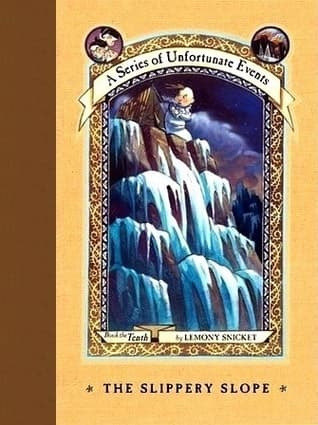
Lemony Snicket (2003)
Genre
Fantasy / Children's / Mystery / Young Adult
Reading Time
2-3 hours
Key Themes
See below
Sign in to track this book
The Baudelaire orphans brave snow-covered mountains, facing deceitful maps, organized youngsters, and a persistent villain, all while finding a secret message that could change their fate.
After escaping the Caligari Carnival, the Baudelaire orphans – Violet, Klaus, and Sunny – are separated from the Quagmire triplets. Count Olaf carries the Quagmires away in a caravan, while the Baudelaires cling to the caravan's outside. They eventually fall into a river and manage to get to shore. Knowing they must reach the V.F.D. headquarters in the Mortmain Mountains, they begin their difficult climb. The tough terrain and freezing temperatures are an immediate challenge, and they are aware of the danger Count Olaf and his friends still pose, especially to the Quagmires.
As the Baudelaires climb the icy slopes, they meet a group of children in white uniforms, called the Snow Scouts. Led by a cheerful man named Bruce, the scouts are on their annual winter camping trip, getting ready for a 'Great Inquisitor' ceremony. The Baudelaires, needing shelter and a way to continue their search for V.F.D., pretend to be new recruits. They quickly learn the Snow Scouts are well-organized, with strict rules and merit badges, but their cheerfulness hides a troubling ignorance of dangers, especially villains like Count Olaf.
While with the Snow Scouts, Violet deciphers a secret message left by the Quagmires: 'V.F.D. VIOLET, KLAUS, SUNNY. MORTMAIN MOUNTAINS. VERMILION. FEAR. DESPONDENCY.' This message, along with a map the Quagmires left, leads them to a hidden cave. The cave, however, is not safe; it is dark, damp, freezing, and full of venomous snow gnats. The Baudelaires realize this is a test or a trap, and they must use their intelligence to get through the dangerous place while still looking for clues about V.F.D.
Sunny, using her climbing skills and a clever disguise, manages to get into Count Olaf's camp, located in a nearby cave. She pretends to be a new, very young helper, earning the trust of Olaf's associates, including the Hook-Handed Man and the Man with a Beard but No Hair and the Woman with Hair but No Beard. Inside the camp, Sunny finds the Quagmire triplets in a birdcage. She overhears Olaf's plans to use the Quagmires to get their fortune and learn V.F.D. secrets, confirming their worst fears about the triplets.
Back in the Snow Scouts' cave, Violet and Klaus, with Sunny's information, know they must act fast to rescue their sister and the Quagmires. Violet, the inventor, uses her skills to build a makeshift toboggan from found materials. Klaus, the researcher, checks the Snow Scouts' rulebook for anything that might help their escape or create a distraction. They plan to use the toboggan to go down the mountain quickly and reach Olaf's camp before the Snow Scouts' 'Great Inquisitor' ceremony begins, knowing their absence will soon be noticed.
The Baudelaires begin a dangerous descent down the Mortmain Mountains on their homemade toboggan. The journey is full of danger, as icy slopes and unexpected obstacles threaten to overturn their fragile craft. The Snow Scouts, who discovered their absence, also pursue them, determined to bring them back for the 'Great Inquisitor' ceremony. The children must use all their combined skills – Violet's engineering, Klaus's knowledge, and Sunny's sharp teeth – to navigate the path and outsmart their relentless, though misguided, pursuers.
Against the odds, the Baudelaires reach Count Olaf's camp. They sneak in, but find the Quagmires are no longer in the birdcage. Instead, they find a mysterious covered casserole dish. The villains are preparing a meal, and the children think the dish might contain a clue or even the Quagmires themselves, in some bad situation. This unexpected event adds more mystery and urgency to their mission; they must uncover the dish's contents without alerting Olaf and his helpers.
While trying to investigate the casserole dish, the Baudelaires face the Man with a Beard but No Hair and the Woman with Hair but No Beard. These two mysterious figures, high-ranking members of Olaf's group, reveal bits of information about the V.F.D. organization, hinting at a deep split within its ranks. They speak of 'volunteers' and 'villains,' blurring the lines between good and evil. The children realize the conflict is more complex than they first thought, and that not all V.F.D. members share the same goals or methods.
Count Olaf, having expected the Baudelaires' arrival, forces them to take part in the Snow Scouts' 'Great Inquisitor' ceremony. It quickly becomes clear the ceremony is a sham, a trap designed by Olaf to question the children and get information about the V.F.D. sugar bowl, which he believes they have. The Snow Scouts, unaware of Olaf's true intentions, unknowingly help him. The Baudelaires must use their combined intelligence to navigate this dangerous interrogation, protect V.F.D. secrets, and escape Olaf's grasp again.
During the chaotic 'Great Inquisitor' ceremony, a surprising event happens. The Baudelaires meet a figure they thought was dead: their guardian, Justice Strauss's sister, Josephine Anwhistle. Josephine, though confused, says she survived the fire and has been hiding. She also speaks of the great importance of the V.F.D. sugar bowl, a mysterious object with vital secrets related to the organization. This revelation deepens the mystery and gives the children a renewed sense of purpose, as they realize the sugar bowl is key to understanding their parents' past and V.F.D.'s true nature.
With Josephine's help, the Baudelaires escape Count Olaf again, fleeing on their makeshift toboggan. However, their escape route leads them toward a large waterfall at the edge of the Mortmain Mountains. The children realize they are in a bad situation, with the rushing water threatening to carry them over the edge. They must quickly plan to avoid certain doom, using their cleverness and teamwork to get past this natural obstacle and continue their journey to the V.F.D. headquarters.
Just as they seem doomed to fall over the waterfall, the Baudelaires find a secret passage hidden behind the water. This passage leads them into a hidden cave, which they realize is the entrance to the V.F.D. headquarters. The children feel both relief and worry, knowing they are finally close to finding the truth about their parents and the mysterious organization. However, the headquarters looks abandoned and damaged, suggesting V.F.D. itself may be in disarray, leaving the children with more questions than answers.
Inside the V.F.D. headquarters, the Baudelaires find signs of a major split within the organization. There are signs of conflict and abandonment, suggesting that the volunteers have divided, with some becoming villains. They discover cryptic notes and damaged equipment, indicating a struggle took place. The headquarters is mostly empty, with no sign of their parents or any other volunteers who might help them. This discovery leaves the children feeling more alone than ever, realizing that the organization they hoped would protect them is itself broken and in danger.
Before leaving the V.F.D. headquarters, the Baudelaires find a final message from their parents, hinting at a 'last safe place' and further stressing the sugar bowl's importance. The message is incomplete and cryptic, leaving the children with more questions than answers. They understand that the sugar bowl holds the key to the entire V.F.D. mystery, but its location and true purpose remain unknown. The children continue their journey, more determined than ever to uncover the truth and protect V.F.D. secrets.
After escaping Count Olaf and navigating the Mortmain Mountains, the Baudelaire orphans descend to the bottom, leaving the icy peaks behind. They are no closer to finding the Quagmire triplets, and the V.F.D. sugar bowl mystery remains unsolved. However, they have learned about the complex and fractured nature of V.F.D. and the extent of Count Olaf's influence. As they move into an unknown future, they are more determined than ever to find the truth about their parents' past, the organization, and the sugar bowl, which they now understand is central to everything.
The Protagonist
Violet's arc in this book focuses on her ingenuity in extreme conditions, building a toboggan and deciphering clues, further solidifying her role as the family's inventor and leader.
The Protagonist
Klaus demonstrates his intellectual prowess by deciphering coded messages and utilizing his knowledge of rules to aid their escape, reinforcing his role as the family's strategist.
The Protagonist
Sunny's arc involves her continued development of language and her brave infiltration of Count Olaf's camp, showcasing her growing independence and crucial contributions to the family's survival.
The Antagonist
Olaf continues his relentless pursuit of the Baudelaires and the Quagmires, revealing more of his connection to the V.F.D. schism and his desire for the sugar bowl, escalating his villainy.
The Supporting
Bruce remains oblivious to the true nature of Count Olaf and the Baudelaires' plight, serving as a foil to the orphans' awareness of danger.
The Supporting
This character's arc further reveals his deep involvement in the V.F.D. schism, cementing his role as a high-ranking villain.
The Supporting
This character's arc further reveals her deep involvement in the V.F.D. schism, cementing her role as a high-ranking villain.
The Supporting
Josephine's arc is her surprising survival and her contribution of vital information about V.F.D. and the sugar bowl, albeit in a confused state.
The Mentioned
Quigley's arc is hinted at through his coded messages and map, suggesting his survival and continued involvement in the V.F.D. mystery, though he does not appear directly in this book.
This theme explores how good and evil become unclear, especially within the V.F.D. organization. The Baudelaires meet 'volunteers' who act like villains and discover that V.F.D. itself has split, making it hard to tell allies from enemies. The Snow Scouts, while seemingly good, unknowingly help Count Olaf, showing how good intentions can be used. This challenges the children's simple view of the world, as seen when the Man with a Beard but No Hair and the Woman with Hair but No Beard hint at the complexities of the V.F.D. conflict.
““The world is a vast and complicated place, and there are many people in it who are neither good nor bad but simply confused or misguided.””
The Baudelaires constantly use their unique skills – Violet's inventing, Klaus's knowledge, and Sunny's sharp teeth – to get past seemingly impossible problems. Violet building the toboggan and Klaus reading the Quagmires' coded messages are good examples. Their combined skills are their most valuable assets, showing that intelligence and cleverness are stronger than force or money. This theme is key to their survival in the Mortmain Mountains and their ability to outsmart Count Olaf.
““Reading is one way to use your imagination, and it's a very good way, because if you read enough, you can imagine anything.””
Despite constant threats and separations, the bond between the Baudelaire orphans stays strong. Their loyalty to each other drives them, motivating them to endure extreme hardships. Sunny going into Olaf's camp to find the Quagmires and Violet and Klaus's desperate efforts to rescue her show their deep family love. This theme highlights that in a world of betrayal and danger, their dedication to one another is their strongest defense and their only true comfort.
““No matter what happens, you will always have each other.””
Throughout their journey up the Mortmain Mountains, the Baudelaires constantly look for answers about V.F.D., their parents, and the sugar bowl. Each clue they find, such as the Quagmires' message or Josephine's partial revelations, only leads to more questions. The V.F.D. headquarters itself, found in disarray, offers no clear solutions. This theme emphasizes the Baudelaires' struggle to find truth in a world full of mystery, deceit, and incomplete information, making their quest increasingly frustrating and dangerous.
““The truth is like a picture, and it can look very different depending on what angle you look at it from.””
A cryptic coded message left by the Quagmire triplets for the Baudelaires.
The secret message, 'V.F.D. VIOLET, KLAUS, SUNNY. MORTMAIN MOUNTAINS. VERMILION. FEAR. DESPONDENCY,' left by the Quagmires, serves as a crucial plot device. It guides the Baudelaires' journey up the Mortmain Mountains, providing them with their next objective and a sense of direction. Its cryptic nature also introduces the concept of coded communication within V.F.D., forcing Klaus to use his deciphering skills and deepening the mystery surrounding the organization and its members.
A map that initially seems helpful but contains misleading information.
The map given to the Baudelaires by the Quagmires is a classic example of a deceitful map. While it points them towards the Mortmain Mountains, it also contains deliberately misleading or incomplete information, forcing the children to rely on their intelligence and observation rather than blindly following instructions. This device heightens the sense of danger and uncertainty, as the Baudelaires realize they cannot trust every piece of information they encounter, even from presumed allies, reflecting the V.F.D. schism.
A seemingly innocent children's organization manipulated by Count Olaf.
The Snow Scouts, led by the oblivious Bruce, and their 'Great Inquisitor' ceremony function as a clever plot device for Count Olaf to trap and interrogate the Baudelaires. The children's innocence and strict adherence to rules are exploited, creating a façade of normalcy that masks a sinister purpose. This device highlights the theme of blurred lines between good and evil, showing how even well-meaning groups can be unwittingly used by villains, and forcing the Baudelaires into a public, dangerous confrontation.
A mysterious object that holds a hidden secret or clue.
The covered casserole dish found in Count Olaf's camp is a classic MacGuffin, acting as a focal point for the Baudelaires' immediate attention and curiosity. Its contents are unknown, leading the children (and the reader) to speculate about what it might contain – perhaps the Quagmires, a secret message, or a vital V.F.D. artifact. This device creates suspense and drives a portion of the plot, as the Baudelaires attempt to uncover its secrets without alerting Olaf, revealing more about his plans.
A recurring, enigmatic object of immense importance to V.F.D. and Count Olaf.
The sugar bowl, though not directly found or explained in this book, is established as a central and highly significant plot device. Its importance is hinted at by Josephine Anwhistle and in the final message at the V.F.D. headquarters. It serves as a powerful motivator for both the Baudelaires and Count Olaf, driving their actions and quests. The sugar bowl represents the ultimate secret of V.F.D. and the key to understanding the entire series' overarching mystery, ensuring its continued relevance in future books.
“It is a curious thing, the death of a parent. We are told that it is sad, and that is true. But it is also a curious thing, the way that life goes on.”
— Reflecting on the loss of their parents and the continuation of their journey.
“The world is a vast and complicated place, and there are a great many things in it that are not fair.”
— A general observation about the injustices the Baudelaire orphans face.
“There are some things that cannot be fixed, but there are also some things that can be. And it is important to know the difference.”
— Considering the limits of their ability to change their circumstances.
“The future is a thing that can be shaped, if you are brave enough to try.”
— As the orphans contemplate their next steps and potential influence.
“It is often the small things, the seemingly insignificant details, that prove to be the most important.”
— Highlighting the importance of observation and attention to detail in their detective work.
“Sometimes, the only way to get through a difficult time is to pretend that you are not in a difficult time at all.”
— A coping mechanism employed by the children to endure their hardships.
“The greatest treasures are not always found in chests of gold, but in the minds of those who seek them.”
— Referring to knowledge and information as a valuable resource.
“A secret, once it is told, is no longer a secret. But a secret, once it is kept, can be a heavy burden.”
— Discussing the nature of secrets and their impact on individuals.
“Even in the darkest of times, there is always a flicker of hope, however small.”
— An enduring theme of optimism despite their grim circumstances.
“It is a rare and precious thing to find someone who understands you, even if they do not always agree with you.”
— About the importance of companionship and understanding among the siblings.
“The truth, like a slippery slope, can be difficult to grasp and even harder to hold onto.”
— Metaphor for the elusive nature of truth in their complex world.
“Reading is one of the greatest pleasures in life, and once you have acquired it, no one can ever take it away from you.”
— The importance of literacy and knowledge as tools for the orphans.
“Sometimes, the most important thing you can do is simply to keep going, even when you feel like giving up.”
— A message of perseverance as the children face overwhelming odds.
Ready to see how well you understood this book? Take our interactive quiz with 10 questions.
Biography coming soon.







