“The greatest weapon against fear is knowledge.”
— Often repeated by various characters, emphasizing the importance of understanding threats.

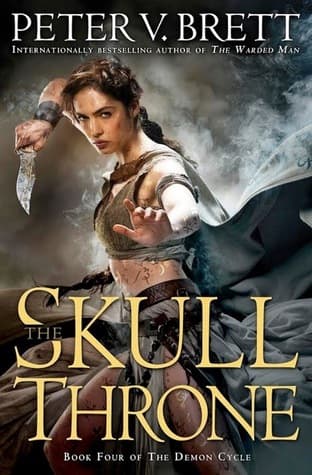
Peter V. Brett (2015)
Genre
Fantasy
Reading Time
15-20 hours
Key Themes
See below
Sign in to track this book
With the Skull Throne empty and its two most powerful contenders vanished, humanity teeters on the brink of civil war and a demonic apocalypse, leaving a fractured world to scramble for a savior while ancient evils grow stronger.
After the cliff-side duel where Arlen Bales, the Warded Man, pulled Ahmann Jardir into the abyss, both are thought dead. This leaves a large power vacuum, especially in Krasia, where the Skull Throne is empty. Jardir's sons immediately begin to compete for succession, threatening to cause civil war. Inevera, Jardir's first wife and a powerful figure, tries to keep order and prevent open conflict among her ambitious children. Meanwhile, in the Free Cities of Thesa, news of their potential saviors' disappearance spreads, leaving humanity open to the growing demon threat. The political situation becomes a dangerous game, with different groups moving for control.
In Krasia, Inevera faces the task of controlling her sons, each a powerful Damajah with a claim to the Skull Throne. Abban, the manipulative merchant prince, advises her, while figures like Ashan, Jardir's eldest son, and Jayan, a more reckless contender, openly disagree. Inevera knows that a civil war would weaken Krasia and leave them defenseless against the corelings. She uses her authority, political skill, and ancient magic to mediate their disputes, setting up trials of skill and leadership to find a worthy successor without resorting to violence. Her main goal is to protect Jardir's legacy and the unity of the desert people.
In Angiers, Leesha Paper, the Herbalist, takes on an important political role. With Duke Thamos unable to rule and her mother, Elona, struggling, Leesha takes responsibility for uniting the Free Cities against the Krasians and the corelings. She travels to Miln, the neighboring duchy, to meet with Duke Gared, hoping to form an important alliance. Leesha faces skepticism and resistance from men, but her intelligence and determination are clear. She tries to convince Gared of the serious threat from the corelings and the need for a united front, all while dealing with the internal politics and rivalries of the Free Cities.
Rojer Inn, the minstrel, goes with Leesha Paper on her diplomatic mission. His ability to connect with people through music and storytelling makes him very useful. While Leesha handles the official talks with Duke Gared, Rojer uses his music to gather information, understand what common people think, and subtly influence opinions. He meets different people and learns about the growing unrest and fear among the Free Cities' people. Rojer's personal struggles with his past and his feelings for Leesha are also explored, adding emotional depth to his journey.
As the leaders argue, the corelings, the demons that trouble humanity, become stronger and more organized. Night attacks happen more often and are more damaging, pushing the Free Cities to their limit. Knowledge of wards, the magical symbols that protect against demons, becomes humanity's most important defense. Leesha, having learned much from Arlen, understands their importance, and her efforts often involve strengthening warding knowledge and practice among the people. The increasing coreling threat is a constant, looming danger, showing the desperate need for unified leadership and a new savior.
Renna Bales, Arlen's wife, is sure that Arlen is not dead. Driven by strong belief and a deep emotional connection, she goes on a dangerous journey to find him. During her search, Renna starts to have powerful, unsettling visions, often showing her glimpses of Arlen and Jardir's fates, or giving insights into the corelings' plans. These visions are often fragmented and hard to understand, but they suggest that Arlen and Jardir might still be alive, though in a place beyond human understanding. Her journey is both physical and spiritual, as she deals with her new abilities.
The wealthy duchy of Lakton, located strategically and relatively unprotected, becomes a central point of conflict. With the Free Cities divided and the Krasians busy with their succession crisis, Lakton is ready for conquest. Different groups, both from the Free Cities and from Krasia, want its resources and strategic position. This situation shows humanity's wider disunity, as internal power struggles prevent a united defense against outside threats. Lakton's fate is uncertain, a symbol of the vulnerability created by the lack of strong, unifying leadership.
A powerful and subtle mind-demon begins to influence things, subtly manipulating key individuals and events. This demon, able to intrude psychically and suggest ideas, makes existing tensions and rivalries worse, especially among Jardir's sons and within the Free Cities. Its goal is to create discord and prevent humanity from uniting, making them easier prey for the corelings. The mind-demon's presence adds psychological warfare to the story, as characters must deal with physical threats and the subtle corruption of their thoughts and emotions, making trust rare.
To prevent an all-out civil war, Inevera plans a series of trials for her sons to prove they are worthy of the Skull Throne. These trials test their leadership, combat skills, and strategic thinking, often involving challenges against corelings or diplomatic missions. Ashan, Jayan, and other sons participate, each with their own strengths and weaknesses. The trials are dangerous and full of political maneuvering, as each son tries to outmaneuver the others, sometimes using dishonest tactics. Inevera hopes a clear successor will emerge, uniting the Damajah and the Krasian people.
Through Renna's clearer visions and other clues, the truth about Arlen and Jardir's fate begins to emerge. It is revealed that they were not killed in the fall but were instead taken to the coreling world, the demons' own dimension. They are alive, but trapped, and their experiences there are changing them. This revelation shifts the story's direction, as the focus moves from finding a successor to possibly rescuing or bringing back the two men who might still be humanity's only hope.
Despite initial skepticism, Leesha Paper's intelligence, courage, and strategic thinking gradually earn her the respect of Duke Gared and other leaders. She successfully brokers the alliance between Angiers and Miln, creating a more united front against the corelings and the encroaching Krasian threat. Her role changes from herbalist to an important political and military strategist. Leesha shows her ability to lead and inspire, proving that even without Arlen, humanity has strong figures able to defend themselves. Her growing influence becomes a source of hope amid the growing chaos.
In a dramatic turn, one of the two presumed-dead leaders, either Arlen Bales or Ahmann Jardir, makes a return from the coreling world. This return has complications, as the individual is greatly changed by their experiences in the demon dimension. Their reappearance shocks both Krasia and the Free Cities, disrupting existing power dynamics and forcing everyone to re-evaluate their positions. The returnee brings new knowledge about the corelings and their world, but also new challenges and questions about their loyalties and ultimate goals.
Taking advantage of humanity's disunity and ongoing power struggles, the corelings launch a large, coordinated attack on multiple fronts. This attack is more sophisticated and damaging than previous ones, showing a new level of organization and intelligence among the demons. Cities and towns are besieged, and humanity is pushed to its limits. This large attack reminds everyone of the true enemy and the desperate need for unity, forcing the warring groups to confront the common threat that hangs over all of them, regardless of their internal disputes.
The increasing coreling attack and the return of one of the lost force different groups to face their differences and consider unexpected alliances. Krasians and Free Cities residents, once enemies, find they need to cooperate to survive. Jardir's sons, despite their rivalries, must decide whether to fight each other or unite against the corelings. Leesha's new alliance is tested, and new leaders appear. The lines between friend and foe blur, as humanity's survival becomes the main concern, leading to difficult choices and surprising partnerships.
Even with the dramatic events, the struggle for the Skull Throne and humanity's ultimate leadership remains unsolved. The return of one of the lost, while impactful, does not immediately fix all problems. The individual may be changed, their authority questioned, and old rivalries still exist. The book ends with humanity facing an uncertain future, still recovering from the coreling attack and dealing with the question of who will lead them against the darkness. The stage is set for continued conflict, both internal and external, as the world's fate is uncertain.
The Protagonist (presumed dead/missing)
Presumed dead, his journey in the coreling world is unseen but his influence and eventual fate drive much of the narrative, hinting at a transformative return.
The Protagonist (presumed dead/missing)
Presumed dead, his unseen journey in the coreling world parallels Arlen's, with his legacy and the succession crisis driving the Krasian plotline.
The Supporting (Krasian leader)
Evolves from a background political force to the central figure of Krasian leadership, striving to maintain order amidst chaos.
The Protagonist (Free Cities leader)
Transforms from an herbalist into a critical political and strategic leader for the Free Cities, forging alliances and gaining respect.
The Supporting (Free Cities minstrel)
Continues to grapple with personal demons while growing in confidence and finding his voice as a vital support to Leesha.
The Supporting (Seeker of Arlen)
Develops a new magical ability (visions) while steadfastly pursuing her lost husband, becoming a key source of information.
The Supporting (Krasian advisor)
Continues to exert influence through cunning and manipulation, navigating the shifting political landscape of Krasia for personal gain and survival.
The Supporting (Krasian contender)
Struggles to prove his worth and assert his claim amidst intense sibling rivalry and his mother's political maneuvering.
The Supporting (Krasian contender)
His aggressive pursuit of the throne fuels internal conflict and tests Inevera's ability to maintain control.
The Supporting (Free Cities leader)
Moves from skepticism and self-interest to a reluctant but necessary alliance with Leesha and Angiers.
The main theme is the struggle for effective leadership when established heroes are gone. With Arlen and Jardir missing, the novel shows how characters like Inevera and Leesha step up to fill the void. Inevera tries to manage her ambitious sons to prevent civil war in Krasia, while Leesha attempts to unite the divided Free Cities. The story asks whether leadership is about individual strength or the ability to inspire and unite others, especially when facing a threat from the corelings. It highlights the immense pressure and hard choices leaders must make.
“The throne was empty, but the world was not without its queens. And queens, Inevera knew, often had to be crueler than any king.”
The novel shows the damaging results of internal conflict and disunity when facing a common, powerful enemy. The power vacuum left by Arlen and Jardir's disappearance leads to immediate fighting among Jardir's sons and continued rivalries among the Free Cities. This division makes humanity vulnerable to the increasingly organized and aggressive corelings. The lack of a united front allows the demons to gain ground, as seen in the crisis in Lakton. The theme emphasizes that small arguments ultimately cause greater suffering for everyone.
“While they squabbled over crowns, the corelings devoured their world.”
This theme explores what it means to be a hero, especially when the usual 'saviors' are absent. The book questions the idea of a single, all-powerful hero by showing how different individuals like Leesha, Rojer, and Inevera, with their varied backgrounds and skills, help humanity survive. Renna's strong belief and search for Arlen also redefine heroism as an act of faith and perseverance. It suggests that heroism can appear in political maneuvering, diplomatic efforts, and personal sacrifice, not just in direct fighting against demons.
“A hero was not just the man who fought the demons, but the woman who held her people together when he was gone.”
The story continues to deal with the role of prophecy, especially in Krasian culture, versus individual choice. Jardir's empire was built on prophecy, and his sons now interpret or manipulate these prophecies to support their claims to the throne. Inevera, while respecting tradition, also uses her free will and strategic thinking to guide events. Renna's visions add another layer to this, suggesting a predetermined path while characters actively fight for their own choices. This theme asks how much of humanity's fate is set and how much they can change it themselves.
“The prophecies were a road map, not a chain. It was up to them to choose their path.”
A powerful symbol of leadership and the central object of conflict.
The Skull Throne, built from the skulls of fallen enemies and infused with ancient magic, represents the ultimate seat of power in Krasia. Its emptiness at the start of the book is a potent symbol of the power vacuum and the resulting chaos. The throne is not just a physical object but a catalyst for the succession crisis, driving Jardir's sons to vie for control and threatening to shatter the fragile unity of Krasia. Its symbolic weight underscores the theme of leadership and the desperate need for a strong, unifying figure.
Renna Bales's ability to see glimpses of the future and past.
Renna Bales develops the ability to experience powerful, often fragmented, prophetic visions. These visions serve as a crucial plot device by providing clues about Arlen and Jardir's fate, the nature of the coreling world, and future events. They build suspense and offer tantalizing hints, guiding Renna's search and informing the reader about unseen developments. This device also ties into the theme of prophecy vs. free will, as characters must interpret and act upon these glimpses of what may come, often with imperfect understanding.
A mysterious alternate dimension inhabited by demons, where Arlen and Jardir are trapped.
The reveal that Arlen and Jardir were not killed but transported to the coreling world is a major plot device. This introduces an entirely new dimension to the story, expanding the lore and raising the stakes. The coreling world is a place of immense danger and unknown rules, offering a setting for their unseen struggles and transformations. It explains their absence and sets the stage for their eventual, potentially altered, return, adding a layer of mystery and intrigue to their fate and the nature of the demons.
The use of negotiation, alliances, and manipulation to achieve goals.
Political intrigue and diplomacy are central plot devices, particularly in the Free Cities with Leesha's efforts and within Krasia with Inevera's maneuvering. Characters like Leesha must use their intelligence, persuasion, and strategic thinking to forge alliances and overcome rivalries. Inevera employs cunning and tradition to manage her warring sons. This device highlights that conflict is not only fought with swords but also with words and alliances, shaping the course of the war against the corelings and the internal struggles for power.
“The greatest weapon against fear is knowledge.”
— Often repeated by various characters, emphasizing the importance of understanding threats.
“A man's worth isn't in what he has, but in what he does.”
— Reflecting on the nature of heroism and duty, particularly relevant to Arlen and Leesha.
“Sometimes the only way to save someone is to let them go.”
— A difficult lesson learned by several characters regarding their loved ones and the dangers they face.
“Hope is a dangerous thing. It can keep you fighting when you should run, and it can blind you to the truth.”
— A more cynical view, often expressed by characters who have seen much suffering.
“The world is not fair, and it never will be. But that doesn't mean we shouldn't try to make it better.”
— A foundational belief for many protagonists striving for a safer world.
“Power is a burden, not a gift. It demands sacrifice.”
— Discussing the responsibilities and costs associated with leadership and extraordinary abilities.
“Even the smallest spark can ignite the greatest fire.”
— Encouraging individuals to believe in their ability to make a difference.
“True strength isn't about how much you can lift, but how much you can bear.”
— Focusing on emotional and mental resilience rather than just physical might.
“The past is a stubborn beast. It clings to you, no matter how far you run.”
— Characters grappling with past traumas, mistakes, and their consequences.
“There are no easy answers, only difficult choices.”
— Reflecting the moral complexities and high stakes faced by leaders and heroes.
“Trust is earned, not given. And once broken, it's almost impossible to mend.”
— Highlighting the fragility and importance of trust in alliances and relationships.
“Sometimes, doing nothing is the hardest choice of all.”
— When characters are forced to wait, or feel powerless to act immediately.
“Victory often tastes bitter, especially when bought with the lives of friends.”
— The somber reality of war and the cost of success.
“The greatest monsters are not always found in the dark, but in the hearts of men.”
— A commentary on human cruelty and the internal struggles against evil.
Ready to see how well you understood this book? Take our interactive quiz with 10 questions.

Biography coming soon.







