“Nancy Drew felt a thrill of excitement. A new mystery! And a young girl in trouble. What could be more intriguing?”
— Nancy's initial reaction to the mysterious circumstances surrounding Emily.

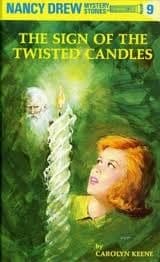
Carolyn Keene (1933)
Genre
Children's / Mystery / Young Adult
Reading Time
240 min
Key Themes
See below
Sign in to track this book
Nancy Drew unravels a decades-old family feud and unearths a hidden birthright, transforming the life of a young woman caught in its bitter grip.
Nancy Drew receives a call from her housekeeper, Hannah Gruen, about a young girl named Carol Wipple. Carol has lived at the Twin Elms orphanage since she was a baby and has recently inherited a substantial estate from her unknown grandfather, Asa Sidney. The will stipulates that Carol must reside at her grandfather's remote mansion, 'Twisted Candles,' with her two great-aunts, Miss Augusta and Miss Abbie Sidney, and their housekeeper, Mrs. Swenk. Carol is terrified of her great-aunts, who are stern and unwelcoming. She suspects Mrs. Swenk is trying to frighten her away from the property. Nancy, intrigued by the unusual conditions and Carol's fear, agrees to visit Twisted Candles to assess the situation.
Upon arriving at Twisted Candles, Nancy Drew is immediately struck by the house's isolated and somewhat dilapidated appearance. She meets Miss Augusta and Miss Abbie Sidney, who are as formidable as Carol described, appearing cold and distant. Mrs. Swenk, the housekeeper, is overly officious and seems to resent Carol. Nancy notices the peculiar 'twisted candles' motif throughout the house, which adds to the general air of mystery. Carol, visibly relieved by Nancy's presence, confides further in her. Nancy begins to discreetly investigate, looking for clues about the Sidney family history and the true nature of the household.
Nancy learns from Carol that the original will, which detailed the inheritance, has disappeared, leaving only a copy. This raises Nancy's suspicions about the true intentions of the great-aunts and Mrs. Swenk. While exploring the old mansion, Nancy discovers a series of cryptic messages hidden in various objects, including a music box and a small, antique book. These messages, written in a simple code, hint at a secret within the house and warn Carol to be cautious. Nancy realizes that someone is trying to communicate with Carol, possibly from beyond the grave, and that the missing will is crucial to understanding the full picture.
The situation at Twisted Candles becomes more complicated with the arrival of Archer Bolton, a distant cousin of the Sidneys. Bolton, a slick and aggressive man, claims he is the rightful heir to Asa Sidney's fortune, asserting that Carol is not a legitimate heir. He tries to intimidate Carol and Nancy, insisting that Carol's claim is baseless. This introduces a new layer to the mystery, suggesting a long-standing family feud over the Sidney inheritance. Nancy realizes that Asa Sidney's will, or lack thereof, is at the heart of the conflict, and that Bolton's sudden appearance is likely connected to the missing original document.
Following a clue from one of the cryptic messages, Nancy Drew discovers a secret passageway hidden behind a bookshelf in Asa Sidney's study. This passage leads to a small, concealed room. Inside, Nancy finds an old, leather-bound diary belonging to Asa Sidney. The diary entries reveal Asa's deep affection for a young woman named Betty, who was Carol's mother, and his desire to ensure Carol's future. The diary also hints at his distrust of some family members and his carefully laid plans to protect his granddaughter's inheritance. This discovery provides crucial insights into Asa's character and his intentions for Carol.
As Nancy continues to read Asa Sidney's diary, a significant revelation comes to light: Carol is not Asa's biological granddaughter. Instead, she is the daughter of Betty, a young woman Asa adopted many years ago after her parents died. Asa loved Betty dearly and considered her his true daughter. This explains why the will was so specific about Carol's inheritance, as Asa wanted to ensure his adopted family was cared for, despite the objections of his more distant relatives. This information is vital in understanding the family dynamics and the motivations behind Archer Bolton's claim.
Through careful investigation and piecing together clues from the diary and observations, Nancy Drew discovers that Mrs. Swenk is actually Archer Bolton's sister. She has been secretly working with her brother to undermine Carol's claim and gain the inheritance for themselves. Mrs. Swenk admits to having hidden the original will, believing that if it couldn't be found, Carol's claim would be invalid, and Archer would inherit by default. Her motive was a combination of greed and a long-standing family grievance against Asa Sidney for favoring his adopted daughter over his blood relatives.
Armed with the evidence from Asa Sidney's diary and Mrs. Swenk's confession, Nancy Drew confronts Archer Bolton and Mrs. Swenk. She presents the overwhelming proof of Asa's intentions and Carol's rightful inheritance. Faced with Nancy's irrefutable evidence, Mrs. Swenk finally reveals the location of the original will. It was hidden in a secret compartment within the base of one of the titular 'twisted candles' that adorned the mansion. The recovered will explicitly states Asa Sidney's wishes, confirming Carol Wipple as the sole beneficiary of his estate.
With the will officially recognized and Archer Bolton's claim dismissed, the atmosphere at Twisted Candles changes. Miss Augusta and Miss Abbie Sidney, having understood Asa's true intentions and the injustice Carol faced, finally soften their demeanor. They express remorse for their initial coldness and begin to embrace Carol as their own. Carol, no longer living in fear, starts to form a genuine bond with her great-aunts. The house, once a place of mystery and fear, transforms into a loving home, and Carol finds the family she never knew she had.
With the mystery solved, the will secured, and Carol happily settled with her great-aunts, Nancy Drew prepares to leave Twisted Candles. She reflects on the journey and the transformation of the Sidney family. Carol expresses her gratitude to Nancy for her help and friendship. Nancy departs, knowing that she has not only solved a complex mystery but has also helped a young girl find her true family and secure her future. The 'Sign of the Twisted Candles' now symbolizes a new beginning and the unraveling of a long-held family secret, leading to a heartwarming resolution.
The Protagonist
Nancy's arc is less about personal development and more about demonstrating her established detective skills and moral compass, solidifying her role as a reliable solver of complex family mysteries.
The Client/Supporting Protagonist
Carol transforms from a fearful, lonely orphan into a confident and loved member of a newly reconciled family, finding security and belonging.
The Deceased Central Figure
Asa's 'arc' is revealed posthumously, as his true character and intentions are unveiled, shifting from an eccentric recluse to a loving and protective figure.
The Supporting Character/Initial Antagonist
Miss Augusta transitions from a stern, unwelcoming guardian to a loving and accepting great-aunt, embracing Carol as part of the family.
The Supporting Character/Initial Antagonist
Miss Abbie, like her sister, evolves from a distant and formidable figure to a warm and caring great-aunt, accepting Carol into the family.
The Antagonist
Mrs. Swenk's arc exposes her as a villain, revealing her true identity and her role in the plot, ultimately leading to her defeat.
The Antagonist
Archer Bolton's arc is one of exposure and defeat, as his fraudulent claims are debunked, and he is thwarted in his attempt to seize the inheritance.
The Supporting Character
Hannah's role remains consistent as a supportive and caring figure in Nancy's life.
This theme explores how family is defined by love, care, and acceptance rather than solely by bloodlines. Asa Sidney's deep affection for his adopted daughter Betty, and subsequently for Carol, highlights this. The initial coldness of Miss Augusta and Miss Abbie, rooted in their adherence to blood relations, contrasts sharply with their eventual acceptance and love for Carol once they understand Asa's true intentions. The story culminates in Carol finding a genuine, loving family in her great-aunts, proving that emotional bonds are stronger than legal or biological ones. This is particularly evident in the transformation of the great-aunts' attitudes towards Carol, moving from distant guardians to caring relatives.
““Blood may be thicker than water, but love is thicker than both.””
The entire mystery revolves around ensuring that Carol Wipple receives her rightful inheritance, as intended by her adopted grandfather, Asa Sidney. Antagonists like Archer Bolton and Mrs. Swenk attempt to subvert the will for their own greedy purposes, showing the struggle for justice. Nancy Drew's relentless pursuit of the truth and the recovery of the original will are central to upholding Asa's wishes and securing Carol's future. The resolution emphasizes that justice, even if delayed, ultimately prevails through diligent investigation and moral fortitude, ensuring that the deceased's intentions are honored.
““A will is a sacred trust, and it is our duty to see that its provisions are carried out.””
The plot is driven by a series of long-held family secrets: Carol's true parentage, Asa Sidney's adoption of Betty, the hidden will, and Mrs. Swenk's true identity. These secrets create tension, confusion, and fear, particularly for Carol. Nancy's investigative process involves systematically unraveling these layers of secrecy, from decoding cryptic messages to discovering hidden passages and diaries. The unraveling of these secrets not only solves the mystery but also brings about reconciliation and understanding among the characters, demonstrating how truth, once revealed, can heal old wounds and forge new bonds. The 'twisted candles' themselves symbolize the convoluted and hidden truths within the family.
““Secrets, like old dust, cling to everything until they are swept away by the truth.””
This theme is evident in multiple aspects of the story. The Sidney mansion, 'Twisted Candles,' initially appears as a forbidding and eerie place, reflecting the perceived coldness of the great-aunts. However, beneath the surface, it holds secrets and eventually becomes a loving home. Similarly, Miss Augusta and Miss Abbie appear to be stern, unfeeling guardians, but are later revealed to be misguided individuals capable of great affection. Mrs. Swenk appears to be a loyal housekeeper but is secretly a manipulative antagonist. Nancy Drew's role is to peel back these layers of deception and illusion to reveal the underlying truth, demonstrating that initial impressions can often be misleading.
““Things are not always what they seem, especially in old, mysterious houses.””
A crucial document that drives the central mystery and conflict.
The missing original will of Asa Sidney is the primary plot device, creating the central conflict and driving Nancy's investigation. Its absence allows Archer Bolton to challenge Carol's inheritance and fuels the fear and uncertainty at Twisted Candles. The search for this document propels the narrative forward, leading Nancy to uncover other secrets and ultimately to its recovery, which resolves the main plot point and ensures justice for Carol.
A posthumous narrative tool that reveals crucial backstory and intentions.
Asa Sidney's diary serves as a vital plot device, allowing the deceased character to communicate his intentions and reveal critical backstory directly to Nancy and the reader. It explains Carol's true relationship to Asa (as his adopted granddaughter), details his love for Betty, and provides clues about the hidden will and his distrust of certain relatives. The diary acts as a voice from beyond the grave, guiding Nancy's investigation and ultimately unraveling the complex family secrets.
A series of hidden notes that guide Nancy's investigation.
Throughout the mansion, Nancy discovers a series of cryptic messages hidden in various objects. These clues, often in a simple code, provide hints about the house's secrets, the location of the will, and warnings for Carol. This device creates suspense and actively engages Nancy's deductive skills, leading her from one discovery to the next, such as the secret passageway and ultimately the diary and the will itself. They are a direct communication from Asa Sidney, subtly guiding the resolution of the mystery.
A hidden architectural feature used to conceal important information.
The secret passageway, leading to a hidden room within the mansion, is a classic mystery device. It serves to conceal Asa Sidney's diary and other important documents, making them inaccessible to those who would misuse them. Its discovery by Nancy highlights her resourcefulness and provides a physical manifestation of the hidden truths within the Sidney family. This device adds an element of adventure and further emphasizes the layers of secrecy surrounding the estate.
A recurring symbolic image that hints at the story's hidden truths.
The 'twisted candles' motif, present throughout the mansion and in the title, serves as a symbolic plot device. Initially, it contributes to the eerie and mysterious atmosphere of the house, hinting at the convoluted and 'twisted' nature of the family secrets and grievances. Ultimately, one of the twisted candles literally hides the missing will, giving the motif a concrete function in the plot. It represents the hidden truths and the intricate, non-straightforward path to uncovering them.
“Nancy Drew felt a thrill of excitement. A new mystery! And a young girl in trouble. What could be more intriguing?”
— Nancy's initial reaction to the mysterious circumstances surrounding Emily.
“It seems to me that when people tell you not to pry, that's exactly when you should start prying the hardest.”
— Nancy's philosophy on investigating when met with resistance.
“The old house itself seemed to hold secrets, its twisted candles a silent testament to a strange and troubled past.”
— Nancy's impression of the mansion and the titular candles.
“Emily was like a bird with a broken wing, yearning to fly but held back by unseen chains.”
— Nancy's empathetic observation of Emily's confined situation.
“Sometimes the most obvious solution is the one we overlook because we're searching for something more complex.”
— Nancy reflecting on a clue or a suspect.
“A will, a secret marriage, and a missing heir – it's a classic setup for trouble.”
— Nancy summarizing the core elements of the mystery.
“Nancy's keen mind was always at work, piecing together fragments of information like a complex jigsaw puzzle.”
— Description of Nancy's deductive process.
“Trust your instincts, Nancy. They've rarely led you astray.”
— Carson Drew's advice to Nancy.
“The truth, like a stubborn cat, eventually comes out of hiding.”
— Nancy's optimistic view on uncovering facts.
“Even in the darkest corners, there's always a flicker of hope if you know where to look.”
— Nancy encouraging Emily or herself during a difficult moment.
“It wasn't just about solving a case; it was about righting a wrong and giving a young girl a chance at happiness.”
— Nancy's motivation beyond mere detection.
“The twisted candles... they're not just decorations, are they? They're a symbol.”
— Nancy realizing the deeper meaning of the novel's title object.
“Some people create their own prisons, even without bars.”
— Nancy's observation about Emily's restrictive environment.
“A good detective doesn't just look for clues; she looks for motives.”
— Nancy explaining her investigative approach.
Ready to see how well you understood this book? Take our interactive quiz with 10 questions.

Carolyn Keene is the pseudonym for the authors of the Nancy Drew Mystery Stories series. Under this pen name, numerous authors have penned over 170 books since 1930, captivating young readers with thrilling mysteries and adventures. The series, including notable titles like "The Secret of Red Gate Farm" and "Mystery of Crocodile Island," has become a cultural phenomenon, selling millions of copies worldwide and inspiring adaptations across various media.

Dan Gemeinhart
4.5

Kate O'Hearn
4.4

Jeanne Birdsall
4.4

Jen Wang
4.4

Wendelin Van Draanen
4.3

John Marsden
4.3

Chris Van Allsburg
4.3

Jennifer A. Nielsen
4.2