“How often have I said to you that when you have eliminated the impossible, whatever remains, however improbable, must be true?”
— Holmes speaking to Watson about his method of deduction.

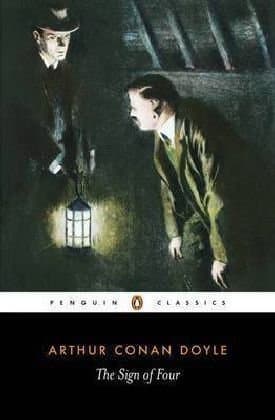
Arthur Conan Doyle (1889)
Genre
Historical Fiction / Mystery
Reading Time
180 min
Key Themes
See below
Sign in to track this book
A mysterious annual pearl, a vanished father, and a wooden-legged ruffian lead Sherlock Holmes and Dr. Watson through London's foggy underbelly to a hidden Indian treasure and a blossoming romance.
The story begins with Dr. Watson observing Sherlock Holmes injecting himself with cocaine at 221B Baker Street, a habit Watson dislikes. Holmes expresses boredom due to a lack of interesting cases. Their boredom ends with the arrival of Miss Mary Morstan, a governess with a confusing problem. Ten years earlier, her father, Captain Arthur Morstan, a retired Indian Army officer, disappeared after arranging to meet her at a London hotel. Four years after he vanished, she began receiving a large, valuable pearl each year from an anonymous sender. Now, she has an invitation to meet her unknown benefactor that evening and asks Holmes and Watson to come along, as she feels nervous.
Holmes, Watson, and Mary Morstan travel by cab to the address, Pondicherry Lodge, in Upper Norwood. They meet Thaddeus Sholto, an unusual, artistic man who immediately admits sending the pearls. He explains that his father, Major John Sholto, was Captain Morstan's only friend in England and recently died in great fear, holding a paper with a strange message. Thaddeus reveals he has a twin brother, Bartholomew, and that they are both involved in a matter concerning a large treasure, which Mary has a right to. He tells them Bartholomew has found the treasure and they are to meet him at their other house.
Thaddeus Sholto, Holmes, Watson, and Mary go to Lyceum Theatre, the Sholto family estate. When they arrive, they find the gates locked and no one answers. After getting inside, they discover a strange scene: a strong, sweet smell in the air, a blowpipe dart stuck in the ceiling, and Bartholomew Sholto dead in his locked room. He seems to have died from fright, his face twisted in horror. The famous Agra treasure, which Bartholomew had recently found in a secret attic compartment, is missing. Inspector Athelney Jones of Scotland Yard soon arrives, immediately suspecting Thaddeus Sholto of murder and theft, despite Holmes's attempts to point out problems with this idea.
While Inspector Jones focuses on Thaddeus, Holmes carefully examines Bartholomew's room. He finds several key clues: the small blowpipe dart, a wooden-legged man's footprint outside the window, a small, bare footprint on the floor near the body, and a rope made of bedsheets. Holmes concludes that two people were involved: a man with a wooden leg and a small, quick accomplice, likely an Andaman Islander. The accomplice climbed the side of the house, entered through a skylight, and used the blowpipe. The treasure was stolen, and Bartholomew Sholto likely died from a poisoned dart, though no wound is immediately visible. Holmes believes the wooden-legged man is the main culprit.
During the initial confusion, Thaddeus Sholto provides important background information. He explains that his father, Major Sholto, and Captain Morstan collected the Agra treasure during their service in India. They were part of a conspiracy involving a rich Indian rajah's fortune. Major Sholto confessed on his deathbed that he and Captain Morstan had gotten the treasure under questionable circumstances. He also revealed that Captain Morstan had died shortly after arriving in England and that his body was hidden to avoid involving Major Sholto in the matter. This confession happened shortly before Major Sholto's own death, which was hastened by his fear of the treasure's rightful owners.
Holmes and Watson continue their investigation, visiting a local dog trainer who identifies the footprints of a specific dog breed, Toby, a 'half-bred, white-and-tan, long-haired lurcher' used by the thieves. They track Toby to a boat rental place on the Thames. Here, Holmes discovers that a man with a wooden leg, with a small native, rented a steam launch called the 'Aurora.' This confirms Holmes's earlier conclusions about the culprits. Holmes immediately organizes a pursuit, hiring a faster police launch to follow the 'Aurora' down the Thames, knowing they must act quickly to get the treasure and catch the murderers.
Holmes, Watson, and Inspector Jones begin a chase down the River Thames in a police launch. The 'Aurora' is a fast boat, and the pursuit is long and difficult, navigating the winding river and dangerous currents in the dark. Holmes skillfully directs their pilot, using his sharp observation skills to keep sight of the fugitives. Watson, armed with a rifle, is ready for a fight. The chase ends in a desperate struggle as the 'Aurora' tries to escape into the open sea. Holmes's determination and strategic thinking are crucial in closing the distance between the two boats.
The police launch finally overtakes the 'Aurora.' During the confrontation, Tonga, the small Andaman Islander, attacks Holmes with a poisoned dart but is shot and killed by Watson. Jonathan Small, the wooden-legged man, tries to throw the Agra treasure chest overboard but is caught. Small is brought back to Baker Street and, under questioning, begins to tell the whole story. He reveals the history of the Agra treasure, his involvement with the Indian Sepoy Mutiny, and Major Sholto and Captain Morstan's role in stealing the jewels. He explains his reason for revenge and the events that led to Bartholomew Sholto's death.
Jonathan Small recounts his past as a former soldier in India who lost his leg in a shark attack and later became involved in the Sepoy Mutiny. He, along with three Sikh allies, found the Agra treasure. During the mutiny, they agreed to share the jewels. Small was imprisoned for his part in the mutiny. Years later, Major Sholto and Captain Morstan, serving in India, found Small and his secret. They blackmailed Small into revealing the treasure's location, promising to help him escape and share the wealth. However, Sholto and Morstan betrayed Small, taking the treasure themselves and leaving Small to remain in prison.
After escaping from prison on the Andaman Islands with Tonga's help, Jonathan Small returned to England to get revenge and reclaim his share of the Agra treasure. He found Major Sholto, who died of fright upon seeing Small at his window. Small then began sending Mary Morstan the pearls as a way to make amends and indirectly pressure the Sholto family. He reveals that Captain Morstan had indeed come to Major Sholto's house that night to demand his share of the treasure. A heated argument followed, and Captain Morstan died of a heart attack, which Major Sholto then hid to avoid scandal and keep all the treasure.
After Jonathan Small's confession, the recovered Agra treasure chest is opened. To everyone's surprise and Mary Morstan's great disappointment, the chest is empty. Small reveals that he threw the jewels into the Thames during the chase, preferring that no one, especially the Sholtos, benefit from the ill-gotten gains. This act of defiance means Mary Morstan, despite her rightful claim, receives nothing from the treasure. The pursuit of wealth ultimately leads to its destruction, leaving all parties empty-handed.
With the case finished and the treasure gone, Dr. Watson realizes his deep feelings for Mary Morstan. He proposes marriage to her, and she accepts. The case's end, however, brings a sense of sadness to Sherlock Holmes. Despite the intellectual challenge, the treasure's loss means that true justice, in terms of rightful ownership, is not fully served, and the moral complexities remain. Holmes, expressing his unhappiness with the lack of further intellectual stimulation and the emotional aspects of the case, returns to his cocaine habit, regretting the return of his 'dull' life.
The Protagonist
Holmes's arc in this story is largely static, reaffirming his dedication to intellectual challenges and his periodic descent into drug use when bored.
The Narrator and Supporting Character
Watson undergoes a significant personal arc, falling in love with and proposing to Mary Morstan, signifying a move towards domesticity.
The Client and Love Interest
Mary's arc involves discovering the truth about her father and finding love with Dr. Watson, bringing resolution to her personal mysteries.
The Antagonist
Small's arc is one of unfulfilled revenge, as he ultimately loses the treasure he sought to reclaim, achieving a hollow victory.
The Mentioned
His arc is presented retrospectively, showing his life consumed by guilt and fear.
The Supporting
Thaddeus's arc is brief but establishes his moral superiority over his family regarding the treasure.
The Mentioned/Victim
Bartholomew's arc is cut short by his death, serving as a catalyst for the main investigation.
The Antagonist
Tonga's arc is one of unwavering loyalty to Jonathan Small, culminating in his death while defending his master.
The Mentioned
His arc is revealed retrospectively, detailing his complicity and sudden death.
The Supporting
Jones's arc shows his initial incompetence giving way to a grudging acceptance of Holmes's superior methods.
The novel looks at different kinds of justice and injustice. Jonathan Small's actions come from a feeling of injustice—his betrayal by Sholto and Morstan over the Agra treasure. While his methods are criminal, his reason is a desire for what he believes is his rightful share. On the other hand, Major Sholto and Captain Morstan's actions in stealing the treasure and hiding Morstan's death are clear injustices. The treasure's ultimate loss, thrown into the Thames by Small, suggests that true justice, regarding rightful ownership, is often hard to find or impossible when built on crime. Holmes's investigation is intellectual, but the moral questions are central to the plot.
“"The papers were signed, and all seemed to be set fair, but as I came away I could not help feeling that I had left a very wronged woman behind me, and that there was a long course of sorrow in store for her.”
Greed is a destructive force throughout the story. The Agra treasure, though beautiful, brings only suffering and death to those who have or seek it. Major Sholto and Captain Morstan's greed makes them betray Jonathan Small, live in fear, and ultimately causes Morstan's death and Sholto's guilt-ridden later years. Bartholomew Sholto's greed makes him unwilling to share the treasure, which contributes to his death. Even Small, though driven by revenge, also wants the wealth he feels is his. The treasure being thrown into the Thames symbolically cleanses it of its corrupting power by destroying it.
“"There is a curse upon the thing, and it will bring a curse upon all who touch it. Money, I consider, is the root of all evil; and the Agra treasure is a treasure of blood.”
The story is deeply set in the context of British colonialism in India. The Agra treasure itself comes from this colonial activity, originally belonging to an Indian rajah. The characters involved—Major Sholto, Captain Morstan, and Jonathan Small—are all former British soldiers who served in India. Their acquisition of the treasure, whether through mutiny or betrayal, shows the exploitative nature of colonial power. Tonga, the Andaman Islander, is a direct result of this colonial interaction, brought to England by Small. The exoticism and violence linked to the treasure and Tonga reflect a Victorian view of the 'other' shaped by imperial expansion.
“"He was a little, black, wizened, deformed creature, with a hideous face, and a cruel, crafty eye. He was a perfect fiend in miniature.”
The novel contrasts Dr. Watson and Mary Morstan's growing romance with Sherlock Holmes's chosen solitude. Watson's ability to love and desire for companionship leads him to propose to Mary, finding personal happiness amid the grim mystery. This acts as a contrast to Holmes, who, despite his intelligence, remains emotionally distant and finds comfort only in intellectual puzzles or, failing that, in drugs. The ending highlights this difference: Watson looks forward to his marriage, while Holmes regrets the return of his 'dull' life and turns back to cocaine, showing his choice of intellectual pursuit over emotional connection.
“"I love you, Miss Morstan... I do not want the treasure. I want you.”
This idea is central to any Sherlock Holmes story. The narrative carefully describes Holmes's process of observation, analysis, and logical deduction. From subtle tobacco ash traces to unique footprints and the smell of creosote, every detail is evidence Holmes skillfully puts together. The story highlights the difference between Holmes's scientific, logical approach and Inspector Jones's more traditional, often mistaken, methods. It emphasizes the power of systematic observation and the importance of looking beyond the obvious to find the truth.
“"Data! Data! Data! I can't make bricks without clay.”
A crime committed in a seemingly impenetrable space.
The murder of Bartholomew Sholto occurs in a room that appears to be locked from the inside, with no obvious means of entry or exit for the killer. This classic device immediately heightens the mystery and challenges Holmes's deductive abilities. Holmes meticulously examines the room, identifying a skylight, a rope of bedsheets, and a blowpipe dart as clues that unravel the seemingly impossible crime, revealing a clever, albeit brutal, method of entry and attack by Tonga.
Characters and elements from non-Western cultures used to create intrigue and danger.
The character of Tonga, the Andaman Islander, and the origin of the Agra treasure in India represent the 'exotic other.' Tonga is depicted as a savage, primitive, and dangerous figure, skilled in the use of poisoned darts, embodying Victorian fears and fascination with non-European cultures. The treasure itself, with its Indian origins and history of violence, adds to this mystique, suggesting that foreign wealth carries a curse. This device serves to create a heightened sense of adventure, danger, and otherworldliness within the London setting, reflecting the imperial mindset of the era.
A plot device that drives the story, but whose specific nature is less important than its effect.
The Agra treasure serves as the primary MacGuffin in 'The Sign of Four.' Its immense value and the mystery surrounding its ownership and history are what propel the entire plot forward. Characters like Major Sholto, Captain Morstan, Jonathan Small, and the Sholto brothers are all motivated by its acquisition or recovery. However, the specific details of the jewels themselves are less important than the desire they ignite and the conflicts they create. Ultimately, the treasure is lost, emphasizing that its true function was to drive the narrative and reveal character, rather than to be a tangible reward.
Watson's perspective occasionally colors the objective truth of Holmes's genius.
While Dr. Watson is generally a reliable narrator, his admiration for Holmes and his occasional misinterpretations or slower deductions subtly highlight Holmes's brilliance. Watson frequently expresses his awe at Holmes's insights, often after failing to see the obvious himself. This dynamic allows the reader to experience the mystery alongside Watson, only to have Holmes unveil the 'simple' solution. It also allows Watson to interject personal feelings, particularly his affection for Mary Morstan, which Holmes, as the primary subject, would never express. This contrast serves to elevate Holmes's almost superhuman intellect.
“How often have I said to you that when you have eliminated the impossible, whatever remains, however improbable, must be true?”
— Holmes speaking to Watson about his method of deduction.
“Data! Data! Data! I can't make bricks without clay.”
— Holmes expressing his need for information to begin his investigation.
“My mind, he said, revolts at stagnation. Give me problems, give me work, give me the most abstruse cryptogram or the most intricate analysis, and I am in my own proper atmosphere.”
— Holmes describing his need for intellectual stimulation.
“What object is served by this circle of misery and violence and fear? It must tend to some end, or else our universe is ruled by chance, which, so far as design goes, is the same thing as an absence of law.”
— Watson reflecting on the nature of the crime and the universe.
“Women are never to be entirely trusted—not the best of them.”
— Jonathan Small expressing his cynical view of women.
“A client is to me a mere unit, a factor in a problem. The emotional qualities are antagonistic to clear reasoning.”
— Holmes explaining his detachment from his clients' emotions.
“For me there is a certain charm in the old forms of evidence.”
— Holmes discussing his preference for traditional investigative methods.
“It is a question of business. You have a thing which I want. I have a thing which you want. The exchange is a simple one.”
— Jonathan Small negotiating with his accomplices.
“It is not my intention to be fulsome, but I confess that I feel the natural pride of a mother when I see so goodly a child.”
— Holmes admiring his own deductions.
“Depend upon it, there is nothing so unnatural as the commonplace.”
— Holmes suggesting that seemingly ordinary events can hide deeper mysteries.
“You see, but you do not observe. The distinction is clear.”
— Holmes critiquing Watson's lack of detailed observation.
“I never remember feeling so utterly helpless and so completely baffled by a situation.”
— Watson expressing his frustration during the investigation.
“There is nothing more deceptive than an obvious fact.”
— Holmes advising against taking things at face value.
“I cannot live without brain-work. What else is there to live for?”
— Holmes reiterating his need for mental challenges.
Ready to see how well you understood this book? Take our interactive quiz with 10 questions.
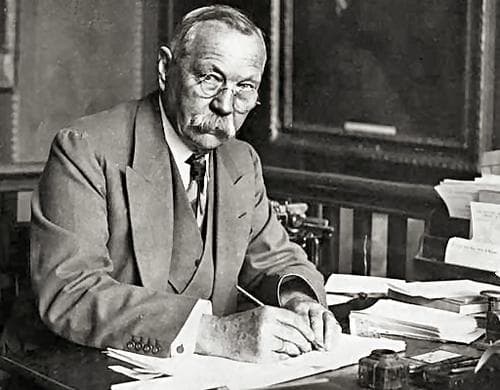
Sir Arthur Ignatius Conan Doyle was a British writer and physician. He created the character Sherlock Holmes in 1887 for A Study in Scarlet, the first of four novels and fifty-six short stories about Holmes and Dr. Watson. The Sherlock Holmes stories are milestones in the field of crime fiction.







