“The thing about being dead is that it doesn't stop you from having a bad day.”
— Magnus Chase reflecting on his afterlife in Valhalla.

Rick Riordan (2017)
Genre
Fantasy / Children's / Young Adult
Reading Time
8 hr
Key Themes
See below
Sign in to track this book
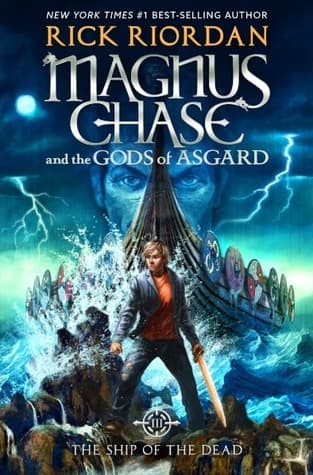
Magnus Chase, a demigod son of Frey, must overcome his non-combative nature and outwit the trickster god Loki to prevent Ragnarok by racing across Norse realms to stop the Ship of the Dead.
Magnus Chase, living in Hotel Valhalla, feels out of place as the son of Frey, a god of peace, not war. Loki visits him in a dream, taunting him with a prophecy: Loki has escaped his magical prison and is preparing Naglfar, the Ship of the Dead, to sail in six weeks, starting Ragnarok. Loki reveals his plan to bring about the end of the world and challenges Magnus to stop him. Disturbed, Magnus asks his cousin, Annabeth Chase, for advice. She brings her boyfriend, Percy Jackson, to Hotel Valhalla. Percy gives Magnus an unusual swimming lesson, focusing on water safety, in preparation for facing the sea god Ran.
Magnus, Samirah al-Abbas, Hearthstone, and Blitzen are called before Odin, who confirms the prophecy. Odin tasks them with finding and stopping Loki from launching Naglfar. He tells them that the only way to defeat Loki is to win a flyting, a traditional Norse poetic duel, and that they will need the whetstone of the god Kvasir. Before they leave, Odin says that Alex Fierro, a genderfluid demigod child of Loki, will join their quest. Alex is sarcastic at first, but her abilities, including shapeshifting and pottery skills, are essential, despite Magnus's initial discomfort with a child of Loki joining the team.
The team needs a ship for their journey across the nine worlds. They get the magical longship, Big Banana, from the goddess Njord, Frey's mother. As they sail the seas of Midgard, the sea goddess Ran ambushes them. She collects drowned sailors in her net. Ran's nine daughters attack their ship. Magnus, remembering Percy's advice, uses his healing powers to create a safe place in the water for his friends, helping them escape Ran's net. During the encounter, Alex Fierro helps them survive with shapeshifting, though they lose some supplies to Ran's net.
After escaping Ran, Big Banana lands on an island that looks like ice and rock. They soon discover it is the domain of the giantess Hler, Ran's sister. Hler is hostile at first, but her desire for entertainment makes her offer them hospitality. During their stay, they learn more about Loki's movements and his plan to gather an army of giants and draugr (zombies) for Naglfar. Hler, despite her reluctant hospitality, gives them some clues and a magical cloak that lets them breathe underwater, which helps them on their next journey.
Guided by Hler's clues, the crew travels to Niflheim, the realm of ice and mist, a land of the dead. Their goal is to find the whetstone of Kvasir, said to be guarded there. The environment is freezing and confusing. They face the dragon Nidhogg, who constantly gnaws at the roots of Yggdrasil and eats the souls of the dishonored dead. Nidhogg is a big threat, and the team must use stealth, magic, and quick thinking to get past him without being caught. Hearthstone's runic magic and Blitzen's dwarven craftsmanship are important in their journey through this frozen land.
The whetstone of Kvasir is deep within Niflheim, guarded by a powerful spell. To get it, Hearthstone must face his traumatic past and the spirit of his father, Alderman, who blames him for his brother Andiron's death. The whetstone is about sacrifice and wisdom from suffering. Hearthstone, using his runic magic and finally facing his grief and guilt, breaks the spell and claims the whetstone. The emotional toll is huge, leaving him shaken but also more powerful in his magic, having accepted his past and gained understanding.
As they leave Niflheim, Loki appears, having expected their movements. He captures them and brings them to a desolate island where Naglfar is being built. Loki, the trickster, suggests a game: a flyting, a contest of insults and poetry, but with a deadly twist. If Magnus loses, Naglfar sails, and Ragnarok begins. If Magnus wins, Loki will return to his chains. Loki tries to cause arguments among the group, particularly targeting Magnus's insecurities and his relationship with Alex, trying to make him doubt his friends and his own abilities to fight a battle of wits.
The flyting begins, with Loki using his rhetoric and manipulative charm to deliver devastating insults, trying to break Magnus's spirit. Loki reveals dark secrets and insecurities about each of Magnus's friends, trying to turn them against him. Magnus, struggling at first, remembers the power of the whetstone of Kvasir, which grants wisdom and the ability to see truth. He uses his healing powers to infuse his words with positive energy and truth, turning Loki's insults back on him by revealing Loki's own fears and weaknesses, especially his fear of being forgotten and unloved. Alex Fierro also helps.
Through wit, truth, and the Kvasir whetstone's influence, Magnus wins the flyting. He shows Loki's true nature as a fearful, desperate being rather than an all-powerful villain. Loki, bound by the ancient rules of the flyting, must admit defeat. With the whetstone's wisdom, Magnus finds a clever way to re-bind Loki. He uses pottery shards created by Alex, infused with magic, to make new, unbreakable bonds for Loki, trapping him again beneath the earth. Naglfar, the Ship of the Dead, is left incomplete and unable to sail, delaying Ragnarok for now.
Magnus and his friends return to Hotel Valhalla, hailed as heroes for stopping Loki and preventing Ragnarok. Odin praises their bravery and cleverness. The whetstone of Kvasir is returned to its place. Despite their victory, the experience changes each of them. Magnus thinks about his identity as a son of Frey, realizing that peace and healing can be strong weapons. His relationship with Alex Fierro has grown, acknowledging their bond and Alex's importance in his life. While Loki is imprisoned again, the threat of Ragnarok is only delayed, not gone, and Magnus knows more challenges await.
The Protagonist
Magnus transforms from a reluctant, self-doubting hero into one who embraces his unique strengths of healing and intellect, learning to trust his own judgment.
The Supporting
Sam learns to navigate her complex identity as a daughter of Loki while reaffirming her loyalty to her friends and her own moral code.
The Supporting
Hearthstone confronts and overcomes his personal trauma, gaining new strength and wisdom in his runic magic.
The Supporting
Blitzen continues to prove his courage and resourcefulness, reaffirming his loyalty to his friends despite his personal fears.
The Supporting
Alex integrates into the team, proving their loyalty and worth despite their parentage, and their relationship with Magnus deepens.
The Antagonist
Loki is defeated in a flyting and re-imprisoned, his plans for Ragnarok temporarily thwarted.
The Mentioned
Provides initial guidance to Magnus, indirectly contributing to his success against Ran.
The Mentioned
Offers initial support and guidance to Magnus at the beginning of his quest.
The Supporting
Acts as an initial obstacle for Magnus, testing his resourcefulness and preparing him for future aquatic dangers.
The Supporting
Serves as a temporary obstacle and then a reluctant helper, providing a crucial magical item.
Magnus struggles with his identity as a son of Frey, a god of peace, in a world of warriors. He questions if he is a hero if he is not primarily a fighter. His journey makes him embrace his unique strengths—healing, empathy, and wit—rather than fitting into Valhalla's expectations. This is clear in the flyting, where his 'peaceful' powers of truth and healing defeat Loki. Alex Fierro's genderfluid identity also explores this theme, as they express their true self despite what society expects.
“'My healing powers were not just about fixing bodies. They were about fixing minds, fixing hearts, fixing the truth.'”
The main conflict of the book is a flyting, a poetic duel, not a physical battle. This shows the power of words, insults, and truth in Norse mythology. Loki, the master of lies, is defeated not by strength, but by Magnus's ability to use words with honesty and insight, helped by the whetstone of Kvasir. The story shows that intelligence, cleverness, and the courage to speak truth can be stronger than any weapon, challenging the idea of a hero as someone who only uses brute force.
“'Words. They were my weapon now. And I had the whetstone of Kvasir to sharpen them.'”
The book explores different kinds of family. Magnus's bond with his chosen family—Sam, Hearth, and Blitz—is central to his success, as they give unwavering support. Hearthstone's story looks at his traumatic relationship with his biological father and his journey towards forgiving himself and accepting his past. Alex Fierro, a child of Loki, also deals with their difficult parentage but finds acceptance and belonging within Magnus's group. The story shows that true family is built on loyalty, acceptance, and mutual support, not just blood ties.
“'Sometimes, your family are the people you choose to fight for, not just the ones you're born to.'”
Magnus Chase often goes against the typical hero type. As a son of Frey, he is a healer, not a warrior, and often feels inadequate in Valhalla's violent world. His victory over Loki comes through a battle of wits and words, using his intelligence and empathy rather than physical combat. This theme questions what truly makes a hero, suggesting that courage can be seen in many ways, and that compassion, strategic thinking, and finding peaceful solutions are as valuable, if not more so, than brute strength and fighting skill.
“'I was a son of Frey, a god of peace. Maybe my power wasn't to destroy, but to make things better.'”
A poetic duel serving as the climactic confrontation.
The flyting is a traditional Norse poetic contest of insults and boasts, which serves as the ultimate showdown between Magnus and Loki. Instead of a physical battle, the fate of Ragnarok hinges on this verbal duel. This device cleverly uses Magnus's strengths (wit, truth, and the whetstone of Kvasir's wisdom) against Loki's manipulative mastery of words, making the climax a battle of intellect and character rather than brute force. It directly challenges the traditional fantasy trope of a sword fight as the ultimate resolution.
A magical item granting wisdom and truth-telling abilities.
The whetstone of Kvasir is a magical artifact sought by Magnus and his friends. It is imbued with the wisdom of Kvasir, a god whose blood was mixed with honey to create the Mead of Poetry. When used by Magnus during the flyting, it grants him the ability to discern truth and infuse his words with wisdom, allowing him to counter Loki's lies and manipulations effectively. It acts as a crucial plot device that empowers Magnus to win the verbal battle, symbolizing that true strength often comes from knowledge and honesty.
A sentient, magical longship that transports the heroes across realms.
Big Banana is a magical longship that serves as the primary mode of transportation for Magnus and his crew across the nine worlds. It is sentient, capable of navigating on its own, and provides a mobile base for the heroes. Its magical properties allow it to travel through different realms and withstand various magical attacks. As a recurring element, it symbolizes the team's journey and their shared purpose, becoming almost a character in itself as it carries them through perilous waters and lands.
A symbol of Loki's imprisonment and the ongoing threat of Ragnarok.
Loki's chains represent his ancient punishment and the temporary containment of the threat of Ragnarok. His escape at the beginning of the book signals the imminent danger, and his re-binding at the end signifies the heroes' success in delaying the apocalypse. The nature of his re-imprisonment (using Alex's pottery and Magnus's wit) underscores the themes of creativity and non-traditional solutions. The temporary nature of these chains also reminds the reader that Ragnarok is merely postponed, not permanently averted, maintaining a lingering sense of future conflict.
A character trait exploring identity and challenging gender norms.
Alex Fierro's genderfluidity is a significant character trait and a plot device that introduces themes of identity, acceptance, and challenging societal norms into the narrative. Alex's ability to shift between male and female pronouns and presentation is integral to their character and contributes to the diversity of the cast. It also subtly reinforces the idea that identity is fluid and personal, mirroring Magnus's own journey of self-acceptance outside of traditional warrior ideals. Alex's shapeshifting abilities, tied to their genderfluidity, are also directly useful in various plot situations.
“The thing about being dead is that it doesn't stop you from having a bad day.”
— Magnus Chase reflecting on his afterlife in Valhalla.
“You can't spell 'massacre' without 'mass.' It's a party, people!”
— Blitzen making a sarcastic comment during a difficult situation.
“Sometimes the only way to win is to not play the game.”
— Hearthstone offering a piece of wisdom to Magnus.
“Being a hero isn't about being perfect. It's about being brave enough to try.”
— Samirah al-Abbas encouraging Magnus.
“The world is full of monsters, Magnus. But it's also full of people trying to stop them.”
— Alex Fierro explaining the nature of their quest.
“Even the smallest spark can light the greatest fire.”
— A metaphor for the power of small actions.
“Family isn't always blood. It's the people who stand by you when no one else will.”
— Magnus realizing the strength of his chosen family.
“Fear is a powerful weapon, but hope is even stronger.”
— A thematic statement about overcoming adversity.
“Never underestimate a dwarf with a sewing machine.”
— Blitzen showcasing his unexpected skills.
“Sometimes the hardest battles are the ones fought within yourself.”
— Magnus grappling with his own doubts and fears.
“The gods may be powerful, but they are also incredibly flawed.”
— Magnus reflecting on the nature of the Norse gods.
“Silence can be louder than any scream.”
— Hearthstone communicating a profound message without words.
“It's not about avoiding danger. It's about facing it head-on, even when you're terrified.”
— Samirah's pragmatic approach to their quest.
“Every ending is just a new beginning, if you're brave enough to see it.”
— A hopeful message about change and new opportunities.
Ready to see how well you understood this book? Take our interactive quiz with 10 questions.
Biography coming soon.







