“Are you afraid of me, little wildcat? Don't be. You are mine now, and I shall keep you safe.”
— Ahmed Ben Hassan's initial assertion of possession over Diana.

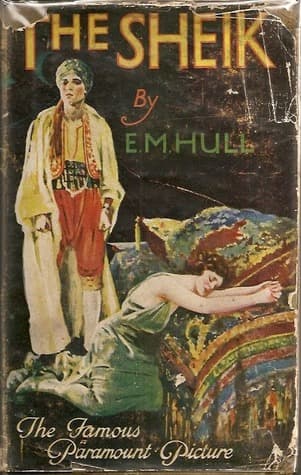
Genre
Historical Fiction / Romance
Reading Time
250 min
Key Themes
See below
Sign in to track this book
An independent Englishwoman seeking adventure in the Algerian desert is kidnapped and unexpectedly falls for the commanding Sheik who holds her captive, in a scandalous tale that started the modern romance novel.
Lady Diana Mayo, an orphaned English aristocrat, is independent and dislikes marriage and societal expectations. She decides to go on a solo horseback riding tour through the Algerian desert, with only native guides, despite warnings from her brother, Sir Aubrey Mayo, and her friend, Ryder. Diana wants to experience life on her own terms and escape the conventions of her upbringing. Her journey is an act of rebellion against the passive role expected of women in her era, setting the stage for her encounter with the Sheik.
Two days into her desert trek, Sheik Ahmed Ben Hassan and his men ambush and capture Diana. Sheik Ahmed, a commanding figure, tells her he desires her and intends to keep her. Diana is furious and defiant, trying to escape and resist him at every turn. Her first encounters with the Sheik are marked by conflict and her refusal to submit, showing the clash between her Western ideas of freedom and his absolute authority in the desert.
Held captive in the Sheik's tent, Diana continues to defy him, even trying to stab him. The Sheik, amused by her spirit, forces her into submission through physical dominance and manipulation. Despite her initial hatred and fear, Diana begins to feel a confusing mix of emotions, including an attraction to her captor. She observes his leadership and the respect he commands, starting to see beyond his brutality, though she still resents her lost freedom.
Sir Aubrey Mayo, worried about his sister, tracks her to the Sheik's camp, with Raoul de Saint-Hubert, a French doctor and friend. Aubrey demands Diana's release, but the Sheik refuses. Raoul, however, recognizes the Sheik and exchanges a knowing glance, hinting at a past connection. Diana, though still captive, is torn between her desire for rescue and a developing loyalty to the Sheik. The presence of these outsiders creates a dilemma for Diana and further isolates her.
The Sheik takes Diana on a hunting trip, where they encounter a lion. The Sheik protects Diana from the attacking animal, saving her life. This act of heroism impacts Diana, showing her a different, more protective side of his character. Her fear and hatred begin to lessen, replaced by admiration and gratitude. This incident marks a turning point in their relationship, as Diana starts to question her initial judgments and acknowledge the Sheik's deeper qualities.
A sandstorm forces Diana and the Sheik to take shelter in a small cave. During their confinement, Diana becomes ill, and the Sheik tends to her with unexpected tenderness. This shared vulnerability and his gentle care further reduce her resistance. She begins to acknowledge her developing love for him, a love she finds both terrifying and exhilarating. The isolation of the desert and the intensity of their situation accelerate their emotional bond.
While Diana and the Sheik are apart, Omar, a rival chieftain, abducts Diana to humiliate the Sheik. This second captivity is more brutal and terrifying than her time with the Sheik. Omar's intentions are malicious, and Diana faces real danger. The Sheik, discovering her abduction, is enraged and worried. This event forces him to acknowledge the depth of his love for Diana, realizing she is more than just a possession.
The Sheik, driven by his love, pursues Omar and rescues Diana after a confrontation. Diana is overjoyed and relieved to be back with the Sheik, realizing she truly loves him. In the aftermath of her ordeal, both Diana and the Sheik confess their mutual love. This confession marks the culmination of their journey, transforming their relationship from captor and captive to devoted partners.
Raoul de Saint-Hubert, the French doctor, reveals the Sheik's true identity: he is not a pure-blooded Arab but the son of an English nobleman, Lord Glencaryll, and a Spanish woman. His father abandoned him in the desert after his mother's death, where the current Sheik's father raised him. This explains the Sheik's fluency in English and his understanding of Western customs. The news shocks Diana and provides context for the Sheik's character and actions, bridging the cultural gap between them.
The revelation of the Sheik's English heritage removes the final barrier to Diana's acceptance of their love. She realizes their union transcends cultural boundaries, as he is not entirely alien to her world. The Sheik, now known as Donald, embraces his dual identity, choosing to remain in the desert with Diana. They commit to a life together, having navigated challenges and personal transformations. Their love story ends with a promise of a future where their different worlds can coexist.
The Protagonist
Diana transforms from a proud, independent woman who despises male dominance into a woman who embraces love and submission, finding a new kind of freedom and fulfillment in her relationship with the Sheik.
The Antagonist/Protagonist
The Sheik evolves from a possessive captor who views Diana as a conquest to a man deeply in love, willing to fight and risk everything for her, ultimately revealing his vulnerability and true identity.
The Supporting
Aubrey remains largely static, representing the societal constraints Diana rejects, but he ultimately accepts Diana's choice to stay with the Sheik.
The Supporting
Raoul serves primarily as a plot device and a source of exposition, his character arc is less pronounced, but he facilitates the resolution of the central mystery.
The Antagonist
Omar acts as an external force driving the plot and solidifying the Sheik and Diana's bond, ultimately being defeated.
The novel explores the tension between a woman's desire for independence and the pressures towards submission. Diana begins as an independent woman who rejects marriage and societal norms, choosing a solo adventure. Her abduction by the Sheik forces her into submission, yet the narrative suggests that through this experience, she finds a new form of fulfillment and love. This theme is central to Diana's character arc, as her initial resistance transforms into a willing surrender, leading her to question her own definitions of freedom and happiness. The controversy surrounding the book often centers on whether this transformation is empowering or problematic.
“She was a free woman, she thanked God, and she would remain free.”
A core theme is how love can transform individuals and overcome barriers. Both Diana and the Sheik change due to their evolving relationship. Diana, initially hateful and fearful, learns to love her captor, finding a passion she never anticipated. The Sheik, initially dominant and possessive, discovers the depth of his feelings, evolving from seeing Diana as a conquest to viewing her as an indispensable partner. Their love forces them to confront their own identities and prejudices, leading to a union that bridges their worlds.
“She hated him, she hated him! But a thrill of something that was not hate ran through her.”
The story highlights the clash between Western and Eastern cultures through Diana and the Sheik. Diana represents English aristocracy and its values of independence, while the Sheik embodies the authority and traditions of the desert tribes. The narrative explores how these two different worlds collide and, through love, find a way to coexist. The revelation of the Sheik's English heritage complicates this theme, suggesting the divide may not be as absolute as it appears, and that understanding can emerge from unexpected places.
“He was a Sheik, a desert barbarian, and she was Lady Diana Mayo, an Englishwoman. How could it be?”
Both Diana and the Sheik grapple with questions of identity and belonging. Diana seeks to define herself outside of societal expectations, embarking on a journey to find her true self. The Sheik, revealed to be of English and Spanish descent, lives as an Arab chieftain, navigating a dual identity. His secret parentage challenges the idea of fixed identity and highlights the complexities of heritage and upbringing. Their journey together becomes one of mutual discovery, where they ultimately find a sense of belonging with each other, transcending their individual pasts and cultural origins.
“He knew that he was an Englishman, but the desert was his home, and its blood ran in his veins.”
Diana's kidnapping serves as the primary event to initiate the central conflict and relationship.
The abduction of Lady Diana by Sheik Ahmed is the foundational plot device. It immediately removes Diana from her familiar world and forces her into a situation where her independence is challenged. This act creates the initial power imbalance and conflict necessary for the romance to develop. Without the abduction, Diana would not have encountered the Sheik in such an intense and transformative way, making it essential for setting up the core dynamic of the story and enabling her character arc.
The isolated and exotic desert environment enhances themes and intensifies character interactions.
The Algerian desert serves as more than just a backdrop; it is a crucial plot device. Its vastness, isolation, and inherent dangers (sandstorms, wild animals, rival tribes) intensify the characters' experiences and accelerate their emotional development. The desert environment strips Diana of her societal protections and forces her to confront her true self and her feelings for the Sheik. It also provides the Sheik with his power base and mystique, emphasizing the cultural clash and the untamed nature of their romance.
The revelation of the Sheik's true English parentage provides a resolution to cultural barriers.
The Sheik's secret identity as the son of an English lord is a significant plot device. This revelation, delivered by Raoul de Saint-Hubert, serves to bridge the cultural gap that initially seems insurmountable between Diana and the Sheik. It makes their eventual union more palatable for Diana (and perhaps for contemporary Western readers), suggesting that their love is not purely a transgression across racial lines but rather a reunion of compatible, albeit culturally distinct, individuals. It removes a major obstacle to their 'happily ever after' and solidifies their connection.
“Are you afraid of me, little wildcat? Don't be. You are mine now, and I shall keep you safe.”
— Ahmed Ben Hassan's initial assertion of possession over Diana.
“I hate you! I hate you! I hate you!”
— Diana's frequent exclamations of defiance and frustration towards Ahmed.
“You are like a desert flower, fragile yet strong, and I shall not break you.”
— Ahmed's observation of Diana's delicate yet resilient nature.
“She was like some beautiful, untamed creature, and he was the only one who could tame her.”
— Narrator's description of Diana's wild spirit and Ahmed's perceived role.
“I would rather die than submit to you!”
— Diana's passionate refusal to yield to Ahmed's will.
“There is a wildness in you that calls to the wildness in me.”
— Ahmed recognizing a shared untamed spirit with Diana.
“He held her as if she were the most precious thing in the world, and for the first time, she did not struggle.”
— Diana's gradual acceptance of Ahmed's affection.
“The desert had claimed her, just as the Sheik had claimed her.”
— Metaphorical connection between Diana's capture and her immersion in the desert.
“You are a child, Diana, a beautiful, spoiled child who needs a strong hand.”
— Ahmed's assessment of Diana's immaturity and need for guidance.
“She had come to him a girl, and he had made her a woman.”
— Narrator's summary of Diana's transformation under Ahmed's influence.
“Love, she found, was not always gentle. Sometimes it was fierce, demanding, and utterly consuming.”
— Diana's evolving understanding of love through her relationship with Ahmed.
“He was her captor, her tormentor, and her salvation.”
— Diana's conflicted feelings towards Ahmed.
“The desert was a place of stark beauty and harsh realities, much like the man who ruled it.”
— Diana's comparison of the desert landscape to Ahmed's character.
“She knew then that her heart, once so free and untamed, now belonged irrevocably to him.”
— Diana's final realization of her deep love for Ahmed.
Ready to see how well you understood this book? Take our interactive quiz with 10 questions.

E.M. Hull was a British author known for her popular romance novels. Her most famous work, "The Sheik" (1919), became a literary sensation and a foundational text in the genre, spawning sequels and a highly successful film adaptation. Hull's writing captured the public imagination with its tales of exotic romance and adventure.







