“Stella took the shawl. She folded it in half, and then in half again. She tucked it under her arm. When she came out of the shed, Rosa was gone.”
— After Rosa is taken away by the guard, Stella takes the shawl.

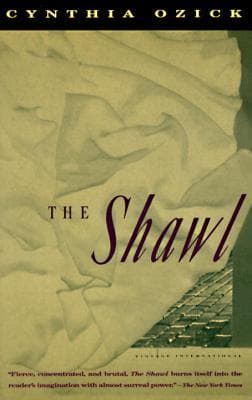
Cynthia Ozick (1989)
Genre
Historical Fiction
Reading Time
60 min
Key Themes
See below
Sign in to track this book
In Cynthia Ozick's 'The Shawl,' a mother's desperate, illusionary comfort for her infant in a concentration camp becomes a haunting, lifelong scar that defines her shattered existence.
In a concentration camp, Rosa, a young Jewish woman, struggles to survive while secretly caring for her infant daughter, Magda. Magda, a 'miracle,' is hidden from the guards, sustained only by Rosa's milk and, more importantly, by a magical shawl. This shawl acts as a protective cocoon, shielding Magda from the cold, hunger, and the constant threat of discovery. It becomes a symbol of life and an almost supernatural source of comfort, allowing Magda to remain silent and unnoticed amidst the horrific conditions. Rosa believes the shawl possesses a life-giving power, essential for Magda's survival, and she clings to this belief with desperate intensity.
One day, Magda, now a toddler, is drawn by the sun and wanders out of the barracks, leaving her mother's shawl. Her sudden appearance in the open field, a bright and innocent figure, instantly draws the attention of a Nazi guard. Rosa, witnessing this horror from a distance, is paralyzed by terror and helplessness. She sees Magda, a symbol of purity and life, exposed to the brutal reality of the camp. The guard, without hesitation or emotion, seizes Magda and swings her against an electric fence, killing her instantly. Rosa's scream is silent, swallowed by the camp's pervasive dread.
Earlier, before Magda's tragic death, Rosa's niece, Stella, also imprisoned in the camp, steals the magical shawl from Magda. Stella is driven by the extreme hunger and desperation that define their existence, believing the shawl might offer some small comfort or warmth to her own emaciated body. This act of theft, born of survival instinct, leaves Magda exposed and vulnerable, inadvertently setting the stage for her later discovery and murder. Rosa, consumed by grief and the immediate horror of Magda's death, does not immediately process the full impact of Stella's actions, but the loss of the shawl is a crucial element in the chain of events that leads to her daughter's demise.
Thirty years after the Holocaust, Rosa Lublin lives a desolate existence in Miami, Florida. She is a woman consumed by the past, her mind a constant battlefield of memories from the concentration camp. She lives in a dilapidated hotel room, surrounded by piles of unsent letters addressed to various intellectuals and historical figures, filled with her rambling, often incoherent thoughts about the Holocaust and her lost daughter, Magda. Rosa views herself as a 'lunatic' and struggles to connect with the present world, her identity inextricably linked to her trauma. Her only real companion is the spectral presence of Magda, who she believes still exists, sometimes even appearing to her.
Rosa is obsessed with the shawl, believing it still contains Magda's essence and magical power. She frequently writes to Stella, her niece, demanding the return of the shawl, convinced that it is the key to bringing Magda back or at least reconnecting with her spirit. Stella, now a successful academic, has long moved on from the concentration camp, and views Rosa's obsession as a symptom of her mental illness. For Rosa, however, the shawl is not just a piece of fabric; it is a tangible link to her lost child and a symbol of everything that was stolen from her. Her letters to Stella are filled with pleas, accusations, and fragmented memories, all revolving around the mythical power of the shawl.
Stella, now a professor, visits Rosa in Miami, bringing her a financial gift. However, her visit is marked by a deep disconnect. Stella, having seemingly adapted to life after the Holocaust by focusing on intellect and logic, finds Rosa's obsessive behavior and constant dwelling on the past frustrating and embarrassing. She tries to offer practical advice and financial assistance, but her attempts to rationalize or dismiss Rosa's pain only highlight the vast chasm between them. Stella represents a different kind of survivor, one who has tried to compartmentalize the horror, while Rosa embodies the unyielding, all-consuming nature of trauma. Stella's impatience shows the difficulty of bridging the gap between those who remember differently.
Rosa, desperate for a tangible connection to Magda and a release from her torment, seeks out a man named Dr. Tree, whom she believes to be a magician. She hopes he can use his supposed powers to bring Magda back to her, or at least provide some form of closure that conventional therapy cannot. Dr. Tree, a con artist exploiting the vulnerable, offers no real help, but Rosa clings to the illusion of his potential. This interaction highlights Rosa's desperate need for a magical, almost supernatural intervention, a reflection of her belief in the shawl's power and her inability to accept the finality of Magda's death. She searches for a miracle to undo the irreversible.
In a moment of financial desperation, Rosa tries to pawn a valuable brooch she possesses. The pawnbroker, a practical and somewhat cynical man, offers her a meager sum, which Rosa initially rejects, then reluctantly accepts. This brief interaction shows Rosa's precarious financial situation and her general detachment from worldly possessions, which hold little meaning compared to her internal world of grief and memory. The brooch itself, a beautiful and intricate piece, contrasts with her squalid living conditions, highlighting the disparity between her past life and her present reality. The pawnbroker's mundane concerns are a stark counterpoint to Rosa's deep spiritual suffering.
Throughout the story, Rosa frequently experiences vivid hallucinations and conversations with Magda. She sees Magda as a living, breathing entity, sometimes as a child, sometimes as a young woman, and she speaks to her as if she were present. These interactions are not just memories; they are an active, ongoing presence in Rosa's life, blurring the lines between reality and delusion. Magda's ghostly presence is Rosa's way of keeping her daughter alive, a coping mechanism for unimaginable loss. These hallucinations are both a comfort and a torment, preventing Rosa from truly moving on, but also providing her with a constant, albeit imagined, connection to her deepest love.
Rosa's deep-seated resentment towards Stella, stemming from the theft of the shawl in the camp, comes to a head. During one of their interactions, Rosa confronts Stella, accusing her of being responsible for Magda's death by taking the shawl. This accusation, while rooted in Rosa's trauma and distorted perception, reveals the depth of her pain and her desperate need to find a reason for the inexplicable horror. Stella, overwhelmed by Rosa's intensity and unable to fully grasp the symbolic weight of the shawl for Rosa, retreats, further cementing the emotional distance between them. This confrontation highlights the lasting impact of individual actions within a collective tragedy.
Rosa visits a Holocaust museum, hoping to find some solace or external validation for her experiences, but instead, the exhibits only intensify her trauma. The artifacts, photographs, and testimonies bring back the horrors of the camp with vivid clarity, overwhelming her senses and reinforcing her inability to escape the past. The museum, intended to educate and remember, becomes a painful echo chamber for Rosa, confirming that her suffering is not unique but also emphasizing its permanence within her own psyche. She finds no peace, only a renewed sense of the indelible mark the Holocaust has left on her soul.
At the story's close, Rosa continues to write her endless, unsent letters, a ritual that has become central to her existence. These letters, filled with her fragmented memories, philosophical musings, and desperate pleas, are her only means of expressing the depths of her suffering and her unwavering connection to Magda. They are addressed to various historical and intellectual figures, as if she is pleading with the world to understand her pain. The act of writing is both a burden and a lifeline, keeping her memories alive, even as it prevents her from truly engaging with the present. Her final state suggests an enduring, unresolvable grief, a life forever defined by what was lost.
The Protagonist
Rosa begins as a desperate mother fighting for her child's survival, and evolves into a deeply traumatized woman whose life is a testament to unresolvable grief, never truly healing or moving on.
The Central Symbol/Memory
Magda's physical life is brief and tragic, but her presence as a memory and symbol grows in power, becoming the central anchor of Rosa's post-Holocaust existence.
The Supporting Character
Stella transitions from a desperate, starving inmate to an outwardly successful, rational academic, but struggles to reconcile her own survival with Rosa's persistent suffering.
The Minor Character/Symbolic
Dr. Tree's role is static; he exists only as a brief encounter that reveals Rosa's psychological state.
The Minor Character
The pawnbroker's role is static, serving as a foil to Rosa's character.
The most prominent theme, explored through Rosa's unyielding grief and mental instability. The Holocaust is not just a past event but a perpetual present for Rosa, manifesting in her hallucinations of Magda, her obsession with the shawl, and her inability to engage with contemporary life. Her constant writing of unsent letters filled with fragmented memories and philosophical despair shows how the trauma has consumed her entire being, preventing any form of healing or closure. The story emphasizes that for some survivors, the psychological scars are as devastating and permanent as any physical wound, extending across decades and defining their very existence, as seen in Rosa's desolate life in Miami.
“''Magda, come out, my darling, come out of your shawl, come out of your mother's body, come out of my womb, my child, my child, my child, come out!''”
Rosa's narrative is deeply intertwined with her memories and delusions, particularly her vivid hallucinations of Magda. Memory is not a passive recall but an active, consuming force that shapes her reality. The blurry line between what is real and what is imagined allows Magda to remain a living presence for Rosa, a coping mechanism for unimaginable loss. This theme explores how the mind, when faced with unbearable trauma, can construct alternative realities to survive, even if those realities isolate the individual from the present world. Rosa's inability to distinguish between her past and present is central to her character, highlighting the mind's complex response to extreme suffering.
“''She was sure Magda was alive. She was sure Magda was not alive. She was sure of nothing except that Magda was the only one who truly existed.''”
Magda's death, an innocent child murdered by a Nazi guard, symbolizes the Holocaust's obliteration of innocence and humanity. Her silent, almost ethereal presence in the camp, contrasted with the brutal manner of her death, shows the senseless cruelty of the regime. The shawl, initially a symbol of protection and magic, becomes a poignant reminder of what was lost. This theme extends to Rosa, whose own humanity and capacity for normal life are shattered, leaving her a shell of her former self. The story suggests that the Holocaust not only took lives but also stripped away the very essence of human dignity and hope, leaving an indelible void.
“''Magda was not born, she was delivered from the shawl, like a butterfly from its chrysalis.''”
The shawl is the central object-as-symbol, representing life, protection, magic, and later, deep loss and obsession. In the camp, it is a life-sustaining talisman for Magda; in Rosa's later life, it becomes the physical embodiment of Magda's presence and Rosa's enduring grief. The brooch, which Rosa tries to pawn, contrasts with the shawl, symbolizing her detachment from conventional value and her focus on spiritual, rather than material, worth. These objects are imbued with deep emotional and psychological significance, serving as tangible anchors for intangible suffering and memory. They are not mere props but extensions of the characters' internal worlds.
“''The shawl was a magic garment, it could make you invisible, it could make you fly.''”
A multi-layered symbol representing life, magic, protection, and devastating loss.
The shawl is the most significant symbolic object. Initially, it represents life and protection for Magda in the concentration camp, imbued with an almost magical quality that keeps her safe and silent. After Magda's death, it transforms into a symbol of profound loss, an object of obsession for Rosa, who believes it still contains Magda's essence. Its theft by Stella complicates its symbolism, highlighting the brutal choices forced upon individuals in extreme circumstances. The shawl embodies the fragility of life, the power of maternal love, and the enduring nature of trauma, serving as a tangible link between past horror and present grief.
Rosa's fragmented thoughts and letters reveal her internal world, blurring reality and delusion.
The narrative often delves into Rosa's stream of consciousness, particularly through her unsent letters. This device allows the reader direct access to her fractured mind, showcasing her philosophical musings, her fragmented memories, and her ongoing conversations with the spectral Magda. It blurs the lines between reality and delusion, immersing the reader in Rosa's subjective, trauma-informed perception of the world. This technique effectively conveys the disorienting and all-consuming nature of her grief, making her internal world as real and impactful as any external event, and highlighting her isolation from conventional reality.
Subtle hints that Magda's existence is precarious and her fate is doomed.
In the initial 'Shawl' section, there are subtle hints that foreshadow Magda's tragic end. Her extreme silence, her reliance on the shawl, and the constant fear of discovery create an atmosphere of impending doom. The narration emphasizes the fragility of her existence and the ever-present threat of the camp. For instance, the descriptions of the guards and the electric fence, even before Magda wanders out, subtly prepare the reader for the inevitable. This device builds tension and underscores the pervasive danger of the setting, making Magda's eventual death feel both shocking and tragically unavoidable within the horrific context.
Contrasting elements highlight the stark realities of suffering and the disconnect of survivors.
Juxtaposition is used to highlight stark contrasts: Magda's innocence against the camp's brutality, Rosa's profound internal suffering against Miami's mundane reality, and Rosa's unyielding grief against Stella's more pragmatic approach to survival. For example, Rosa's dilapidated hotel room filled with letters stands in stark contrast to the vibrant, indifferent city outside. This device emphasizes the profound disconnect between Rosa's internal world of trauma and the external world that has moved on, underscoring the enduring isolation of her suffering. It effectively illustrates how the past continues to intrude upon and dominate the present for her.
“Stella took the shawl. She folded it in half, and then in half again. She tucked it under her arm. When she came out of the shed, Rosa was gone.”
— After Rosa is taken away by the guard, Stella takes the shawl.
“She was not a baby anymore. She was a shawl.”
— Rosa is reduced to a symbolic object, the shawl, after her death.
“The shawl was a magic shawl, it could hide you. Rosa had been hidden in it for three days.”
— Anya, Rosa's mother, believes the shawl possesses protective qualities.
“Rosa, being a baby, had a completely useless will.”
— Anya reflects on Rosa's helplessness as an infant in the camp.
“She was a wisp, a bird’s bone, a scrap of white fluff.”
— Description of Rosa's fragile physical state.
“The shawl was her baby, her food, her milk, her blood.”
— Anya's desperate attachment to the shawl as a substitute for her lost child.
“She went on thinking she was alive, she went on thinking she was dead.”
— Anya's dissociative state and inability to fully process her reality.
“The shawl was her baby. The shawl was her shield.”
— Anya's dual perception of the shawl as both a child and a protective barrier.
“She was not a person, she was a hunger.”
— Anya describes her overwhelming physical need in the camp.
“The shawl was the only thing that was real.”
— Anya's perception of the shawl as the sole tangible link to her past and her child.
“Rosa did not cry. She was a silent baby. She was a good baby.”
— Anya's memory of Rosa's quietness, which was a survival mechanism.
“The shawl was a thing of magic, a thing of power, a thing of life.”
— Anya's belief in the shawl's mystical properties.
“Stella was afraid of the shawl. She hated it, but she needed it.”
— Stella's complex relationship with the shawl after Rosa's death.
“The shawl was a ghost. It was Rosa.”
— Anya's enduring belief that the shawl embodies her lost child.
Ready to see how well you understood this book? Take our interactive quiz with 10 questions.

Cynthia Ozick is a celebrated American author known for her intricate prose and exploration of Jewish identity and history. Her most acclaimed works include the novella "The Shawl," a finalist for the Pulitzer Prize, and the novel "The Messiah of Stockholm." Ozick's writing is characterized by its intellectual depth, stylistic brilliance, and engagement with complex philosophical and cultural themes.