“The first brother could hear the faintest whisper from a hundred miles away.”
— Introducing the first brother's extraordinary hearing ability.

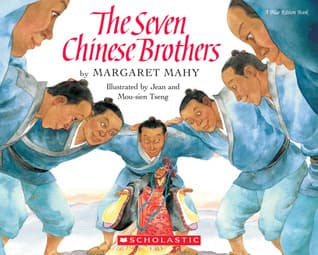
Margaret Mahy (1990)
Genre
Children's / Historical Fiction
Reading Time
10 min
Key Themes
See below
Sign in to track this book
Seven brothers, each with a unique supernatural gift, must unite their powers to outwit a tyrannical emperor and save their village in this illustrated retelling of a Chinese legend.
In ancient China, seven brothers live together. Each one has an unusual and unique ability. First Brother can swallow the sea, Second Brother has eyes that can see very far, Third Brother has bones of iron, Fourth Brother is not hurt by fire, Fifth Brother can breathe underwater, Sixth Brother can grow very large, and Seventh Brother can fix anything that is broken. They live a calm life, their gifts making them special but also different. They are content until the Emperor arrives, bringing challenges that will test their individual strengths and their bond.
The Emperor, a greedy and cruel ruler, hears about First Brother's ability to swallow the sea. Curious and wanting to use this power, he orders First Brother to empty the ocean so he can collect its treasures. First Brother feels he has no choice and swallows the sea, holding it in his mouth. However, when he releases the water, the Emperor is angry, thinking First Brother hid some treasures. The Emperor, in his anger, accuses First Brother of theft and treason and sentences him to death by beheading. This sets a bad example for how the brothers will interact with the imperial power.
On the day of the execution, the brothers make a plan. Because they all look exactly alike, First Brother is secretly replaced by Third Brother, who has bones of iron. The executioner's sword hits Third Brother's neck, but it bounces off, leaving him unharmed. The Emperor is confused and angry by this failure. He cannot understand how his executioner failed and orders a different way to kill him, unknowingly helping the brothers' plan. This switch starts their clever resistance against the Emperor.
Angry that the sword failed, the Emperor orders the 'culprit' to be drowned in the deepest part of the sea. Again, the brothers switch places. This time, Fifth Brother, who can breathe underwater, takes Third Brother's place. He is thrown into the ocean, and the Emperor's guards watch, expecting him to die. However, Fifth Brother simply swims comfortably at the bottom of the sea, which confuses and frustrates the Emperor even more. After a long time, he comes out completely unharmed, making the Emperor furious because his punishments are failing.
The Emperor, now desperate and sure that there is magic involved, decides to burn the brother alive. He orders a huge bonfire to be built. Once more, the brothers carry out their plan, and Fourth Brother, who is not hurt by fire, steps forward. He is tied to a stake and the fire is lit, roaring around him. The Emperor and his court watch, but Fourth Brother is completely unaffected, even enjoying the warmth. He eventually walks out of the flames, singed but unharmed, leaving the Emperor speechless and defeated by the brothers' ability to survive.
Driven mad by his failures, the Emperor decides on one last, harsh attempt: he orders the brother to be crushed by a large stone. Sixth Brother, who can grow very large and is strong, takes the place of his sibling. He is placed under a giant rock, which is then dropped on him. To the Emperor's disbelief, Sixth Brother simply holds up the stone with his strength, then pushes it aside as if it were a small rock. He comes out from under it, unharmed, his power making the Emperor's cruelest plans seem foolish.
The Emperor, having used all his cruel methods and seen each one fail, is finally forced to give up. He is humiliated and scared by the brothers' seeming invincibility. Realizing he cannot harm them, and perhaps fearing their combined power, he stops. The Emperor gives up his attempts to kill them and, in his shame, leaves them alone. The seven Chinese brothers return to their calm lives, their bond and individual gifts having won over the Emperor's tyranny. They continue to live happily, their story becoming a legend of survival and brotherly love.
The Protagonist
He initiates the conflict by using his gift, then relies on his brothers' identical appearance and unique powers for survival.
The Supporting
His ability to see far helps the brothers anticipate danger, though he doesn't face direct execution attempts.
The Supporting
He endures the first execution attempt, showcasing the brothers' physical invulnerability.
The Supporting
He calmly survives being burned at the stake, further frustrating the Emperor.
The Supporting
He survives being drowned in the sea, showcasing another unique power against death.
The Supporting
He withstands being crushed by a giant stone, proving his immense strength and invulnerability.
The Supporting
His ability to mend reinforces the idea of the brothers' ultimate invincibility and unity, even if not directly demonstrated in an execution.
The Antagonist
He begins as an all-powerful tyrant, but his repeated failures lead to his humiliation and eventual defeat.
The main idea of the story is the power of unity and brotherhood. The seven identical brothers, with their individual gifts, work as one team. Their identical look allows them to swap places easily, while their unique powers are used well to overcome the Emperor's cruel punishments. This group action, driven by their loyalty to one another, defeats the Emperor. The story shows that their combined strength is much greater than any one person's, making them unbeatable.
“For they were all exactly alike, and no one could tell one brother from another.”
The story shows the brothers' quiet but strong resistance against the cruel Emperor. Instead of fighting him directly, they use their intelligence and unique abilities to undermine his authority and make his punishments useless. Each failed execution, arranged by the brothers' clever substitutions, reduces the Emperor's power and pride, leading to his humiliation and retreat. This idea shows that even people who seem powerless can overcome tyranny through smart thinking and working together.
“But the Emperor was a very cruel Emperor indeed, and he was not going to give up so easily.”
Each brother has a distinct supernatural gift, which, when combined, creates a strong defense. From swallowing the sea to being safe from fire and growing very large, these unique powers are the tools for their survival. The story celebrates individual skills within a group, showing how different strengths, when coordinated, can achieve great things. It makes clear that every person's contribution, no matter how specific, is valuable and needed for the group to succeed.
“One could swallow the sea, one had eyes that could see for a thousand miles, one had bones of iron...”
While the Emperor is not directly harmed, the story offers a symbolic form of justice. The Emperor's cruelty and greed are met with failure and public humiliation. His inability to harm the brothers, despite his increasing harshness, is his ultimate punishment. The story suggests that real power is not in force or tyrannical rule, but in survival, unity, and the smart use of unique abilities. The Emperor's defeat is a moral victory for the brothers and a symbolic win of good over evil.
“The Emperor gave a great sigh. 'I will give up,' he said.”
Allows the brothers to swap places and deceive the Emperor.
The fact that all seven brothers look exactly alike is the pivotal plot device that enables their survival. This physical similarity allows them to seamlessly substitute one brother for another during the Emperor's execution attempts, making it impossible for the Emperor or his guards to identify the 'culprit.' This device creates the central tension and the mechanism for the brothers' repeated escapes, directly facilitating their strategic defiance of the Emperor's tyranny. Without it, their individual powers would not be enough to collectively outsmart the ruler.
A repetitive structure that escalates the Emperor's frustration and highlights the brothers' invincibility.
The story employs a repetitive structure where the Emperor attempts a new, increasingly brutal method of execution for each perceived failure. This serial repetition serves multiple purposes: it builds suspense, showcases the range of the brothers' unique powers, and, most importantly, emphasizes the Emperor's escalating frustration and ultimate futility. Each failed attempt reinforces the brothers' invincibility and highlights the Emperor's escalating cruelty and eventual humiliation, driving the narrative towards his inevitable defeat.
Used to emphasize the extraordinary nature of the brothers' powers and the Emperor's cruelty.
The story uses exaggeration to describe both the brothers' supernatural gifts (e.g., swallowing the entire sea, seeing a thousand miles, bones of iron) and the Emperor's escalating cruelty (e.g., ordering beheading, drowning, burning, crushing). This hyperbole creates a fantastical and larger-than-life atmosphere, making the brothers' abilities truly wondrous and the Emperor's tyranny undeniably wicked. It underscores the folktale quality of the narrative and enhances the dramatic impact of each challenge and escape.
The seven brothers collectively symbolize the power of solidarity against oppression.
The seven identical brothers, acting as one, symbolize the strength derived from unity and collective action. Individually, their powers are remarkable, but it is their coordinated effort and unwavering loyalty to each other that makes them invincible. They represent the idea that even against overwhelming odds (a cruel emperor), solidarity can overcome tyranny. Their identical appearance reinforces this symbolism, visually representing their shared identity and purpose, rather than just individual prowess.
“The first brother could hear the faintest whisper from a hundred miles away.”
— Introducing the first brother's extraordinary hearing ability.
“The second brother had bones of iron that could not be broken.”
— Describing the second brother's unbreakable strength.
“The third brother could stretch his legs to reach the highest mountain.”
— Explaining the third brother's ability to extend his limbs.
“The fourth brother never felt the heat, even in the fiercest fire.”
— Highlighting the fourth brother's immunity to heat.
“The fifth brother could drink the sea dry in a single gulp.”
— Showcasing the fifth brother's immense capacity for water.
“The sixth brother could grow as tall as the sky when he chose.”
— Depicting the sixth brother's ability to increase his height.
“The seventh brother had tears that could flood the land.”
— Revealing the seventh brother's emotional and powerful tears.
“Together, they were stronger than any army the emperor could send.”
— Emphasizing the collective power of the brothers when united.
“The emperor feared their power and sought to destroy them one by one.”
— Explaining the emperor's motivation to eliminate the brothers.
“But the brothers used their gifts to protect each other and escape.”
— Describing how the brothers collaborate to evade capture.
“In the end, they lived free, their bond unbroken by the emperor's wrath.”
— Concluding the story with the brothers' triumph and unity.
“Each brother's gift was a piece of the puzzle that saved them all.”
— Reflecting on how their individual abilities contributed to their collective success.
Ready to see how well you understood this book? Take our interactive quiz with 10 questions.

Biography coming soon.

Dan Gemeinhart
4.5
Kate O'Hearn
4.4

Jeanne Birdsall
4.4

Jen Wang
4.4

Wendelin Van Draanen
4.3

John Marsden
4.3

Chris Van Allsburg
4.3
Jennifer A. Nielsen
4.2