“History is that certainty produced at the point where the imperfections of memory meet the inadequacies of documentation.”
— The narrator's reflection on the nature of history and personal memory.

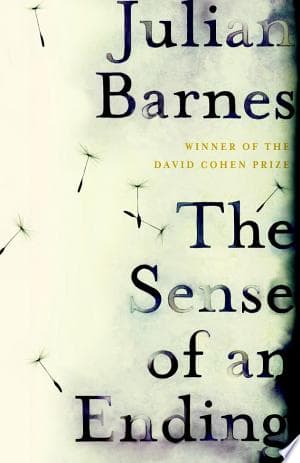
Julian Barnes (2011)
Genre
Literary Fiction / Mystery
Reading Time
160 min
Key Themes
See below
Sign in to track this book
A retired man's carefully built memories of youth and a past betrayal fall apart when a lawyer's letter forces him to face how unreliable his own history is and the crushing weight of forgotten truths.
As an older man, Tony Webster thinks back to his time in sixth form with his friends Colin, Alex, and Graham. They spent their days talking about ideas, sex, and feeling superior. This changed when Adrian Finn arrived, a new student who was clearly smarter and more thoughtful than the others. Adrian quickly joined their group, questioning their ideas and starting deeper talks about history, philosophy, and life. Tony, though impressed at first, felt a bit uneasy with Adrian's deep insights and serious nature, which was different from Tony's more casual way. The group, especially Tony, started to compare themselves to Adrian's intelligence.
Tony meets Veronica Ford, a girl from a different, seemingly richer and more complicated background. Their first meetings were awkward, without much deep feeling, but they started dating. Tony introduced Veronica to his friends, including Adrian, during a double date at a pub. The evening was tense; Veronica seemed quiet and a bit dismissive, while Adrian talked to her in a more intellectual way than Tony did. Tony felt more and more inadequate and uncomfortable, noticing the small but important differences in how Adrian and Veronica interacted compared to his own relationship with her. The date showed the growing problems in Tony and Veronica's connection.
Veronica broke up with Tony during their university years, saying he lacked emotional depth and was a 'coward.' Upset and angry, Tony wrote a cruel letter to Veronica, insulting her and her family, and suggesting Adrian would be a better match for her. He sent the letter, thinking it was a final, satisfying act of revenge. Soon after, Tony learned that Adrian and Veronica had started a relationship, a fact that hurt him deeply and confirmed his worst fears, solidifying his anger toward both of them. This letter became an important, long-forgotten event that would reappear with serious results years later, showing Tony's immaturity and meanness at the time.
Years later, at university, Tony received the shocking news of Adrian Finn's suicide. Adrian had ended his own life, leaving a puzzling note without a clear explanation. This event deeply affected Tony, making him rethink his understanding of Adrian and their shared past. Tony struggled with why Adrian did it, remembering Adrian's sharp mind and philosophical thoughts about life and death. He felt a sense of loss and regret, wondering if he had ever truly understood his friend. The suicide left a lasting mark on Tony, shaping how he saw memory, truth, and the unknown parts of human nature, a theme he would think about throughout his life.
Decades later, a retired Tony Webster received a letter from a lawyer. The letter said that Veronica Ford's mother, Sarah Ford, had left him £500 and two personal items in her will. This unexpected inheritance disrupted Tony's quiet, orderly life. He was confused by Sarah Ford's gift, as he had only met her a few times and hadn't seen Veronica in years. The items mentioned were Adrian Finn's diary and a photograph. This letter immediately brought back many memories and questions for Tony, making him face his past and how unreliable his own memories were about Veronica, Adrian, and the events of their youth. It started his journey into the past.
Tony contacted the lawyer to get his inheritance, specifically Adrian's diary, only to be told that Veronica Ford had it and wouldn't give it up. This refusal made Tony determined to get the diary, believing it held the answer to Adrian's suicide and his past with Veronica. He began a series of frustrating emails and phone calls with Veronica, who was evasive and unhelpful. Their talks were tense, marked by old grudges and unspoken history. Tony's pursuit of the diary became an obsession, pushing him to meet Veronica in person and look deeper into the confusing, broken memories of their shared youth. He felt a strong need to get back this piece of his past.
Tony arranged to meet Veronica Ford in person to talk about the diary. Their meetings were awkward and full of unspoken history. Veronica was intentionally vague, giving fragmented comments and holding back information, which further frustrated Tony. She hinted at deeper truths and challenged his version of events, making him doubt his own memories. Veronica's behavior was often dismissive and mocking, but she also showed moments of vulnerability. Tony found himself constantly trying to figure out what she meant, feeling that she held an important secret. These meetings deepened his confusion and started a lasting feeling of unease, as he realized his understanding of their past was far more incomplete than he had imagined. He felt like he was being deliberately provoked.
As Tony continued to talk with Veronica, his long-held memories of his youth, his relationship with Veronica, and Adrian's character were steadily broken down. Veronica's puzzling remarks and clear contradictions made Tony rethink what he thought he knew. He began to question how accurate his own memories were, realizing how much he had forgotten, made better, or purposely suppressed over the decades. He looked back at key moments, such as his breakup with Veronica and the letter, seeing them in a new, more critical way. This process was confusing and painful, as Tony struggled with how unreliable memory is and how subjective truth is, realizing his past was not as settled as he believed.
In a powerful and painful meeting, Veronica finally told Tony the full, shocking truth. She explained that Adrian Finn did not die by suicide because of deep despair, but because of a disturbing relationship with Veronica's mother, Sarah Ford. Veronica revealed that Adrian had gotten her mother pregnant, and his suicide was the desperate act of a young man caught in a scandalous and emotionally complex situation. She implied that Tony's cruel letter, written when he was angry after their breakup, might have added to Adrian's despair by making him feel even more alone and judged. This revelation shattered Tony's carefully built version of the past, forcing him to face the serious results of his youthful actions and the true, tragic nature of Adrian's end.
Veronica eventually revealed that the 'diary' was not a traditional journal but a letter. She gave Tony a copy of his own spiteful letter, the one he wrote to her after their breakup, in which he had cruelly suggested that Adrian would be better off with her or her mother. The full impact of his forgotten words hit Tony with overwhelming force. He realized the deep irony and tragic consequence of his casual cruelty. The letter, sent decades ago, had not only insulted Veronica but also, by accident, planted a seed or confirmed a path for Adrian, who then became involved with Sarah Ford and ultimately died by suicide. Tony is left to deal with the crushing weight of his past actions and the unreliable nature of his memory, which had conveniently hidden this crucial, incriminating piece of his personal history. The ending is unclear, leaving Tony to face the serious implications of his own unexamined past.
The Protagonist
Tony's arc is one of brutal self-reckoning, as he moves from complacent certainty about his past to a painful awareness of his own fallibility, complicity, and the unreliability of his memory.
The Central Catalyst (Deceased)
Adrian's arc is revealed posthumously, transforming from a figure of intellectual admiration and tragic loss into a deeply flawed individual whose hidden life had devastating consequences.
The Antagonist/Truth-Teller
Veronica's arc is one of deliberate revelation, moving from a mysterious, uncooperative figure to the reluctant bearer of a painful truth, forcing Tony to confront his past.
The Supporting
Margaret's arc is largely static; she serves as a stable point of reference against Tony's internal turmoil.
The Mentioned (Deceased)
Sarah Ford's character is revealed posthumously, transforming from a peripheral, intimidating figure into a central, morally complex individual whose actions had tragic repercussions.
This is the main theme, shown through Tony Webster's journey. Tony first believes his memories are correct and complete, but as he looks at the past, he realizes how much he has forgotten, exaggerated, or purposely hidden. His talks with Veronica constantly challenge his memories, making him face how subjective and rebuilt memory is. The novel shows that memory is not a factual record but a story we create, often to protect our self-image. For example, Tony's first memory of his breakup with Veronica is cleaned up, while his cruel letter is entirely forgotten until Veronica makes him remember.
“How often do we tell our own life story? How often do we adjust, embellish, make slight changes? And the longer we do it, the more confidently we tell it, until, in the end, it is the truth.”
The novel suggests that history, both personal and shared, is not fixed but a story constantly reinterpreted. Tony's search to understand Adrian's suicide is a search for a definite historical truth, but he eventually finds that such a truth is hard to grasp and often painful. The 'ending' of Adrian's story, as Tony understood it for decades, is completely changed by Veronica's reveals. The book proposes that our understanding of the past is always partial, filtered through our own biases, and can change when new information appears. This theme is clear in Tony's realization that 'history is the lies of the victors, the self-delusions of the defeated, and the memories of the survivors.'
“What do you do when you are not sure what you know? When you are not sure what you remember?”
The novel shows how seemingly small actions and attitudes in youth can have serious and unexpected results decades later. Tony's youthful arrogance, his emotional fear in his relationship with Veronica, and especially his spiteful letter, are at first dismissed by him as teenage mistakes. However, the climax reveals that this letter, combined with Adrian's vulnerability, led to a tragic series of events. The book argues that even small acts of unkindness or judgment can spread through time, affecting lives in ways the person never intended or even remembered. Tony's journey is a reckoning with his past moral failings and their far-reaching impact.
“I thought: this is what it means to be a grown-up. To have a past, and to have to live with it.”
From the start, the novel explores the idea of acting and being real, especially among the teenage boys who try to seem smart and cynical. Adrian Finn, while seeming more genuine, is also shown to have a hidden life that goes against his public image. Tony, too, plays the role of the 'sensible' and 'reliable' man, both in his youth and retirement, avoiding real emotional connection. The story eventually removes these acts, forcing Tony to face the hard, uncomfortable truths of his own and others' lives, showing the often-painful gap between the face we show the world and our inner reality. Veronica's puzzling behavior is also a form of acting, meant to provoke Tony.
“It strikes me that I have spent my life in a state of mild pretentiousness, always slightly aware of the effect I am having, even on myself.”
Tony Webster's subjective and flawed recounting of events.
The entire novel is narrated from Tony Webster's first-person perspective, making him an inherently unreliable narrator. His memories are shown to be selective, biased, and prone to self-justification, particularly regarding his own actions and character. This device is crucial as it creates suspense and forces the reader to question Tony's version of events, mirroring his own eventual realization. The gap between what Tony remembers and what truly happened forms the core of the mystery, leading to a profound re-evaluation of his character and the plot's events. The reader, like Tony, is constantly re-evaluating the narrative as new information surfaces.
A crucial, forgotten letter that serves as a catalyst and ultimate revelation.
Tony's spiteful letter to Veronica, written in his youth and subsequently forgotten by him, acts as a powerful epistolary device. It is initially a symbol of youthful cruelty, then a forgotten piece of personal history, and finally, the devastating key to understanding Adrian's tragic end. The letter's existence and its eventual re-discovery by Tony serve as the ultimate proof of his unreliability and the tangible link between his past actions and their profound consequences. It is the 'diary' he sought, a physical manifestation of a crucial, suppressed truth.
Non-linear narrative structure that gradually reveals past events.
The novel heavily utilizes anachrony, particularly through Tony's extensive flashbacks to his youth. These flashbacks are not presented chronologically or as complete memories, but rather as fragmented recollections that are continually re-evaluated and re-contextualized as the present-day narrative unfolds. Foreshadowing is subtle, often through Veronica's cryptic remarks or Tony's vague feelings of unease about his past, hinting that there is more to the story than he (or the reader) initially understands. This non-linear approach enhances the theme of unreliable memory and builds suspense, as the true 'ending' is only revealed in the final chapters.
An object that drives the plot forward, but whose true nature is different than expected.
Adrian Finn's diary serves as a classic MacGuffin. Tony's relentless pursuit of the diary is the primary external driver of the plot, compelling him to reconnect with Veronica and delve into his past. He believes it will contain Adrian's philosophical musings and provide answers about his suicide. However, the diary itself is ultimately revealed to be something entirely different – Tony's own forgotten letter. The true significance lies not in the object itself, but in the journey it precipitates and the devastating truths it indirectly uncovers about Tony's own complicity and the nature of Adrian's death.
“History is that certainty produced at the point where the imperfections of memory meet the inadequacies of documentation.”
— The narrator's reflection on the nature of history and personal memory.
“What did I know of life, I who had been fortunate enough to have a happy childhood, and had never been hungry, or cold, or afraid?”
— Tony Webster's internal monologue, questioning his own understanding of the world.
“You get to a certain age, and you realise that, in the end, it's not about what you say, it's about what you do.”
— A realization Tony has later in life.
“How often do we tell our own life story? How often do we adjust, embellish, make slight changes? And not just for an audience, but for ourselves.”
— Tony pondering the malleability of personal narrative.
“I thought of this as a kind of moral algebra. If you did something bad, you were punished. If you did something good, you were rewarded. Life was fair.”
— Tony's youthful, simplistic view of morality.
“We are not always what we think we are, nor do we always remember what we have done.”
— A core theme of the book, about self-perception and memory's unreliability.
“The past is not a foreign country; it is a contiguous state, and we are all its citizens.”
— A twist on a famous literary quote, emphasizing the past's continuous influence.
“It seems to me that what you remember is not what happened, but what you remember remembering.”
— Tony's ongoing struggle with the reliability of his own recollections.
“There is an age when you are young enough to believe that you can change the world, and old enough to know that you can't.”
— A reflection on the passage from youthful idealism to mature realism.
“Sometimes you just have to give in to the fact that you might be wrong.”
— Tony's grudging acceptance of a difficult truth.
“You live your life, you go along, you think you're pretty self-aware, and then something happens and you realize you know nothing.”
— A moment of profound self-discovery and disillusionment for Tony.
“Isn't it odd, how much of the past we forget? And how much of it we invent?”
— Tony musing on the selective and creative nature of memory.
“Life is a matter of accumulation. Of things, of experiences, of memories. And then, at the end, it's all about loss.”
— A melancholic reflection on the journey of life.
Ready to see how well you understood this book? Take our interactive quiz with 10 questions.

Julian Patrick Barnes is an English writer. He won the Man Booker Prize in 2011 with The Sense of an Ending, having been shortlisted three times previously with Flaubert's Parrot, England, England, and Arthur & George. Barnes has also written crime fiction under the pseudonym Dan Kavanagh. In addition to novels, Barnes has published collections of essays and short stories.







