“The wind was rising, and the sky was darkening, and Arthur knew, with a certainty that chilled him, that something momentous was about to happen.”
— Arthur observes the weather and senses impending change.

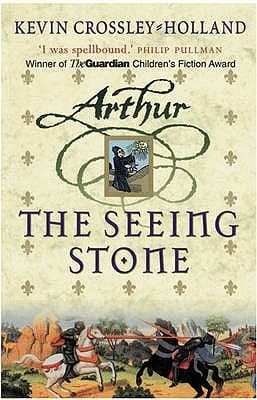
Kevin Crossley-Holland (2002)
Genre
Fantasy / Children's / Young Adult
Reading Time
338 min
Key Themes
See below
Sign in to track this book
A young Arthur de Caldicot's ordinary medieval life as a page turns into a mystical journey when a seeing stone from Merlin connects his fate with the legendary King Arthur.
In 1199, twelve-year-old Arthur de Caldicot lives at Caldicot Castle in the Welsh Marches. He trains as a page under his father, Sir John, and dreams of knighthood and adventure. One day, an old man named Merlin, a friend of Sir John, visits. Merlin watches Arthur closely and, before leaving, gives him a smooth, black stone. He tells Arthur it is a 'seeing stone' and will show him things if he looks into it with an open mind. Arthur is at first doubtful and disappointed, expecting a more exciting gift, but he keeps the stone.
Arthur soon finds the stone is magical. When he looks into it, he sees clear images and scenes. These are not from his own world but from another boy, also named Arthur, who lives in a different time. This other Arthur is younger, lives in a simpler place, and faces different challenges. The visions are at first scattered and confusing, but they become clearer, showing the other Arthur's daily life, his struggles, and his interactions with his foster family, Sir Ector, and his foster brother, Kay. Arthur de Caldicot feels increasingly drawn into these parallel stories.
Along with his visions, Arthur de Caldicot continues his training as a page. His days are full of lessons in Latin, French, history, and courtly manners from Master John. He practices sword fighting, archery, and horsemanship, often under Sir John and Sir William, the castle's master-at-arms. Arthur also learns about falconry and hunting. He sees the social order of the castle, from the lord and lady to the servants. He experiences daily chores, grand feasts, religious events, and occasional tensions among the castle residents, including his cousin, Gawain.
Through the seeing stone, Arthur de Caldicot watches the early life of the legendary Arthur. He sees Arthur's humble upbringing with Sir Ector and his wife, Lady Eleanor, alongside their son, Kay. The visions show the boys' training, their arguments, and their growing skills. Arthur learns that this other Arthur does not know his true parents, believing Sir Ector is his father. The stone shows details of their everyday life: hunting, practicing with wooden swords, and the strong, sometimes difficult, bond between Arthur and Kay. These glimpses contrast with Arthur de Caldicot's own noble upbringing.
Arthur de Caldicot goes with his father, Sir John, on a trip to London. This trip is because King Richard I has died, and preparations for his funeral are underway. In London, Arthur is overwhelmed by the busy city, its size, and its many sights, very different from his castle. He sees the seriousness and grandeur of the royal court and the sadness for the late king. This journey shows Arthur the wider politics of England and the duties of loyalty to the crown, deepening his understanding of the world beyond Caldicot.
The visions in the seeing stone reach a key point, showing a tournament in London. Sir Ector, Kay, and the young Arthur travel to the city for the jousting. In an emergency, Kay realizes he forgot his sword. The young Arthur, wanting to help his foster brother, tries to get a sword he sees in an anvil in a churchyard. To everyone's surprise, he pulls the sword free easily. This act makes him the rightful king, a destiny he at first does not know about and does not want to accept, to the wonder and confusion of those present, including Sir Ector and Kay.
As Arthur de Caldicot watches the legendary Arthur's destiny unfold, he thinks about his own future and identity. He continues his training, hoping to become a knight and join the Crusades, a common goal for young nobles then. However, the stone's visions make him question heroism, leadership, and the responsibilities of power. He sees the legendary Arthur's initial reluctance and eventual acceptance of his fate, which makes Arthur de Caldicot think about his own desires versus what his family and society expect of him. He feels a growing connection to his namesake.
Arthur de Caldicot faces challenges at Caldicot Castle. He struggles with his studies, especially Latin, and deals with occasional teasing and rivalry from other squires. He also learns about managing the estate and the well-being of the common people, watching his father's duties as a lord. Through the stone, he sees the legendary Arthur beginning to face the challenges of ruling a kingdom, dealing with jealous lords, and establishing his authority. These parallel stories show the universal themes of responsibility and the difficulties in leadership, whether on a small estate or a new kingdom.
Inspired by tales of chivalry and religious passion, Arthur de Caldicot wants to join the Crusades. He sees it as the ultimate test of knighthood and a path to glory and spiritual salvation. He discusses this ambition with his father and other knights, who share stories of their own experiences or dreams of pilgrimage and holy war. This goal is deeply rooted in the medieval mindset, where fighting for Christendom was seen as noble. The visions of the legendary Arthur's growing responsibilities as a leader also make Arthur de Caldicot think about different forms of service.
Merlin eventually returns to Caldicot Castle. He observes Arthur's growth and listens to his accounts of the seeing stone's visions. Merlin confirms the visions are real and explains that the stone links times and destinies. He offers advice, encouraging Arthur to keep looking into the stone for guidance. Merlin hints that Arthur de Caldicot has his own path to make, one that will require wisdom and courage, like his legendary namesake. This meeting confirms Arthur's understanding of the stone's purpose and his own potential.
As the visions of the legendary Arthur becoming king become more complete, Arthur de Caldicot feels the weight of this extraordinary destiny. He understands the great responsibility, sacrifices, and trials awaiting his namesake. This understanding deepens his own self-reflection. He continues to train, learn, and grow, but the seeing stone has changed his perspective. He sees that his own path, though different, also has meaning, and that lessons from the legendary Arthur's story apply to his own life and the choices he will make as he grows into manhood and knighthood. The stone becomes a constant companion and guide.
Toward the end of the story, Arthur de Caldicot, now more mature, makes a decision about his future. While the exact details are somewhat open, it is clear that his experiences with the seeing stone and the legendary Arthur's story have shaped his view. He has learned about leadership, loyalty, love, and loss, both from his own medieval world and from the story of King Arthur. He is now ready to begin his own journey, whether knighthood, the Crusades, or another path, with a unique perspective and a deeper understanding of himself and the world.
The Protagonist
Arthur transforms from an eager but unformed boy into a more mature and reflective young man, guided by the parallel narrative of his legendary namesake.
The Supporting
Merlin serves as a consistent, though infrequent, guide, his presence reinforcing the magical and destined aspects of Arthur's journey.
The Supporting
Sir John remains a steadfast figure of authority and tradition, grounding Arthur in his own world.
The Supporting
Lady Alice provides emotional support and stability for Arthur throughout his formative years.
The Mentioned/Parallel Protagonist
He begins as an ordinary boy and is revealed to be the destined King Arthur, a journey witnessed by Arthur de Caldicot.
The Supporting
Kay remains a relatively static character, serving as a contrast and catalyst for the legendary Arthur's destiny.
The Supporting
Sir Ector's arc centers on his realization and acceptance of the legendary Arthur's true identity and destiny.
The Supporting
Gawain remains a relatively static character, serving as a foil and a peer for Arthur de Caldicot.
The novel explores how people find who they are and their purpose, often through outside influences and inner thought. Arthur de Caldicot deals with his own identity as a medieval page who will become a knight, while also seeing the legendary Arthur find his royal destiny. The seeing stone acts as a mirror, making Arthur consider if destiny is set or made through choices. The difference between the two Arthurs shows that while situations differ, the journey of self-discovery and accepting one's path is universal. Arthur de Caldicot's dreams of the Crusades are part of his own search for meaning.
““The stone shows you what you need to see, Arthur. Not always what you want.””
The story shows how stories, both personal and legendary, shape understanding and inform the present. The visions in the seeing stone are a form of ancient storytelling, connecting Arthur de Caldicot directly to the legend of King Arthur. This connection blurs the lines between history, myth, and personal experience. The novel suggests that legends are not just old tales, but living stories that can offer guidance and insight to those now. Arthur's own life becomes a story, influenced by the ancient one he sees.
““The past is a story, Arthur, and stories have power.””
Arthur's journey is a coming-of-age story. He moves from childhood innocence to a more mature understanding of the world, its complexities, and his place in it. His training as a page, his travels to London, and his experiences with the seeing stone make him face moral problems, understand different viewpoints, and develop a sense of responsibility. He learns about loyalty, courage, justice, and the results of actions, both through his own life and the legendary story. The legendary Arthur's initial hesitation to become king helps Arthur de Caldicot understand the burdens of leadership.
““A knight must be brave, Arthur, but he must also be just.””
A main theme is the contrast between Arthur de Caldicot's realistic medieval world and the legendary world of King Arthur. The novel details the daily life of a 12th-century castle, its customs, difficulties, and social structures. This historical accuracy contrasts with the magical parts of the legendary Arthur's tale. The seeing stone connects these two worlds, allowing Arthur de Caldicot to experience both, showing how myth can be based in human experience and how reality can contain wonder. The legendary Arthur's story offers an ideal vision of chivalry that Arthur de Caldicot tries to reach in his own, more ordinary, life.
““The stone shows you a world that was, and a world that might yet be.””
A magical, polished black stone that allows Arthur de Caldicot to witness the life of the legendary King Arthur.
The seeing stone is the primary magical artifact and plot device in the novel. Gifted by Merlin, it functions as a portal through time and legend, enabling Arthur de Caldicot to observe the parallel narrative of his namesake. It is not merely a passive viewing device; its visions prompt Arthur to reflect on his own life, identity, and future. The stone serves as a catalyst for his personal growth and moral development, linking his mundane medieval reality to the grander, mythical past. It also acts as a subtle mentor, guiding his introspection without direct instruction.
The simultaneous unfolding of Arthur de Caldicot's life and the legendary King Arthur's story.
This device involves telling two distinct but interconnected stories concurrently. One narrative follows Arthur de Caldicot's coming-of-age in 12th-century England, detailing his training, family life, and aspirations. The other, experienced through the seeing stone, recounts the legendary King Arthur's youth, his upbringing, and his eventual pulling of the sword from the stone. These parallel narratives allow for thematic comparisons, character development through contrast, and a deeper exploration of destiny, leadership, and heroism. The legendary story provides context and inspiration for Arthur de Caldicot's own journey.
Merlin's cryptic advice and foreknowledge that subtly steers Arthur de Caldicot's understanding.
Merlin's role as a prophetic guide is a key plot device. He doesn't directly tell Arthur what to do but offers enigmatic statements and hints about the stone's purpose and Arthur's own potential. His reappearances punctuate Arthur's journey, providing validation for the visions and encouraging Arthur to trust his intuition and the lessons learned. Merlin's wisdom connects Arthur de Caldicot's personal experiences to a larger, more mystical understanding of fate and history, reinforcing the idea that Arthur's path, while different, is no less significant than that of his legendary namesake.
The story is told through Arthur de Caldicot's personal entries, creating intimacy and immediacy.
The novel is structured as Arthur de Caldicot's personal journal or diary entries. This first-person perspective provides intimate access to Arthur's thoughts, feelings, and observations. It allows the reader to experience events, both real and visionary, directly through his eyes, fostering empathy and a deep connection with the protagonist. This device also emphasizes Arthur's introspective nature and his process of making sense of the extraordinary events unfolding around him, lending authenticity to his medieval world and his encounters with the magical. It highlights his journey of self-discovery as he records his experiences.
“The wind was rising, and the sky was darkening, and Arthur knew, with a certainty that chilled him, that something momentous was about to happen.”
— Arthur observes the weather and senses impending change.
“Magic, like everything else, had its own rules, and to break them was to invite disaster.”
— Merlin instructs Arthur on the nature of magic.
“A true knight did not boast of his strength, but showed it in his deeds.”
— Arthur reflects on the qualities of a knight.
“It was not the sword that made the king, but the king who made the sword significant.”
— Arthur ponders the meaning of the sword in the stone.
“Fear was a cold companion, but courage was a fire that could burn away the shadows.”
— Arthur faces a daunting challenge.
“The past was not a dead thing, but a living root that fed the present.”
— Merlin explains the interconnectedness of time.
“Sometimes, the greatest battles were fought not with swords, but within one's own heart.”
— Arthur struggles with an internal conflict.
“The world was full of wonders, if only one knew where to look.”
— Arthur discovers a hidden magical place.
“Loyalty was a bond stronger than steel, and betrayal a wound that never truly healed.”
— Arthur considers the importance of his companions.
“Even the smallest pebble could start an avalanche, if it fell in the right place.”
— Merlin hints at the ripple effect of small actions.
“To truly see, one must look beyond what the eyes perceived.”
— Arthur learns about the deeper meaning of the seeing stone.
“The road ahead was long and uncertain, but Arthur knew he would not walk it alone.”
— Arthur looks towards his future with newfound resolve.
“A king's duty was not to rule, but to serve his people.”
— Arthur grasps a fundamental principle of kingship.
Ready to see how well you understood this book? Take our interactive quiz with 10 questions.

Biography coming soon.







