“It was a wonderful day for adventures, the kind of day that seemed to hum with secrets and possibilities.”
— Describing the beginning of the children's journey into the unknown.

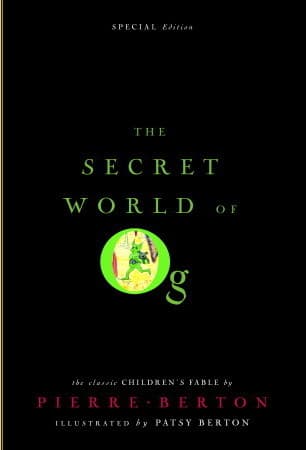
Pierre Berton (1961)
Genre
Fantasy / Children's / Young Adult
Reading Time
160 min
Key Themes
See below
Sign in to track this book
Five adventurous siblings fall through a trapdoor into a hidden, underground world of tiny green Ogs, beginning a journey of discovery, friendship, and shared wisdom.
The five Berton children, Penny, Pamela, Peter, Patsy, and their baby brother Paul ("The Pollywog"), play in their backyard clubhouse. Penny, the oldest, tries to keep things in order, but Peter, the adventurous one, finds a loose board in the floor. Curious, they open it to see a dark hole. Though Penny is hesitant, the unknown is too tempting. Peter, followed by his siblings, decides to go down, thinking it will be a simple, short adventure, not knowing about the strange world below.
The children fall down a long, twisting tunnel, landing in a large, dimly lit cavern. The air is cool and damp, and strange glowing fungi light the area. They quickly realize this is not a normal basement. The Pollywog, surprisingly calm, babbles at something in the shadows. Soon, they meet the first residents of this world: small, green-skinned creatures with large, innocent eyes, who use simple gestures and few words. These creatures, who the children will later call Ogs, seem both curious and confused by the human children's sudden arrival.
The children quickly learn to communicate simply with the Ogs. They find that the Ogs live a very basic, childlike life, with no complex language, tools, or even basic cleanliness. Their world is always dim, lit by glowing mushrooms, and they mostly eat these fungi. The Ogs are fascinated by the children's clothes, their ability to speak full sentences, and especially their toys. The Berton children, particularly Penny, become protective and teach the Ogs about their own world and introduce new ideas, like 'sky' or 'sun'.
As the Berton children spend more time with the Ogs, they become more aware of the Ogs' deep lack of knowledge. The Ogs have no names, calling each other only 'Og,' and their understanding of the world is very limited. They do not grasp abstract ideas like 'up' or 'down' in the same way, and their memory seems short. The children try to explain the sun, stars, and the vastness of the surface world, but the Ogs struggle to understand. This shows the clear difference between the two groups and the problems the children face in bridging this knowledge gap, often leading to funny misunderstandings.
A problem arises when The Pollywog's favorite toy, a small, red rubber ball, rolls away into a dark crack. The Pollywog becomes upset, and the Ogs, seeing his distress, try to help. This event pushes the children to go further into Og-land's winding tunnels than they had before. Peter, always the explorer, leads the way, determined to get the ball back. This search acts as a trigger, forcing them to face new dangers and learn more about the size and nature of the underground world, which is much larger and more complex than they first thought.
During their search for the lost toy, the children and their Og friends explore different parts of the underground world. They travel through underground rivers, cross glowing caverns, and see strange, glowing plants and animals unique to this hidden place. They are amazed by the beauty and mystery of the environment, which is both alien and captivating. These new discoveries help them understand Og-land's ecology and geography, showing that the Ogs' simple life is supported by a surprisingly diverse and self-contained ecosystem, far from the surface world they know.
Throughout their adventures, the Berton children try to teach the Ogs. Pamela, with her artistic talent, tries to teach them about colors and drawing. Penny, practical, tries to introduce ideas of organization and problem-solving. Peter, the most active, shows them how to build simple things or play games. The Ogs, though slow to grasp complex ideas, are eager and curious, copying the children's actions and sounds. This sharing of knowledge builds a growing bond between the two groups, with the children finding joy in being teachers.
The big language difference between the children and the Ogs often causes both humor and frustration. The Ogs' vocabulary is very small, mostly just the word 'Og' and simple grunts or gestures. The children struggle to explain complex ideas, often using charades and repeating demonstrations. For example, explaining 'name' or 'family' is very hard. These communication struggles show the large cultural and intellectual differences between the two species, but also the children's patience and cleverness in trying to connect.
Slowly, the Ogs start to copy the Berton children. They begin to use more descriptive words, try to play games, and even try to organize their living spaces. They especially like the names the children give them, like 'Green Og' or 'Tall Og,' showing a beginning understanding of individual identity. This imitation is a big step in their growth, showing that the children's efforts are having a lasting effect. The Ogs' growing ability to learn and adapt gives the children a sense of accomplishment and hope, suggesting a better future for the underground inhabitants.
After some time in Og-land, the children, especially Penny, start to miss their own world. They miss the sun, their parents, and the comforts of home. The adventure, though exciting, has run its course, and the responsibility of the younger siblings weighs on Penny. They realize they cannot stay in Og-land forever and must find a way back through the trapdoor. This realization changes their focus from exploring and teaching to the practical challenge of finding their way and climbing out, making them retrace their steps to find an exit.
With help from the Ogs, who have now learned enough to assist, the children find their way back to the entrance tunnel. Saying goodbye to their green friends is a mix of sadness and happiness. The Ogs, though still simple, have certainly changed because of the children, gaining a glimpse of the outside world and a base for more development. The children, too, have grown, gaining wisdom, patience, and a deeper appreciation for their own world. They climb back through the trapdoor, leaving the Ogs to their changing world, promising to remember their unique adventure.
The Berton children come out of the clubhouse, blinking in the sunlight, back in their familiar backyard. Their parents, who had barely noticed their absence (or thought they were just playing), know nothing of their amazing journey. The children, however, are deeply changed. They carry memories of Og-land, the lessons they learned, and the bond they formed with the little green creatures. The adventure has given them a greater sense of responsibility, empathy, and a broader view of the world, both above and below ground.
The Protagonist
Penny learns to balance her responsibility with a sense of wonder and adapts to leadership in an unfamiliar world.
The Protagonist
Peter hones his adventurous spirit, learning to channel his curiosity productively and responsibly.
The Protagonist
Pamela uses her creativity to connect with others and finds new ways to express herself.
The Protagonist
Patsy develops her observational skills and empathy, finding her voice in gentle interactions.
The Protagonist
The Pollywog experiences a fantastical journey that subtly shapes his earliest perceptions of the world.
The Supporting
The Ogs evolve from a state of complete ignorance to a rudimentary understanding of language, identity, and the outside world, thanks to the Berton children.
The book's entire idea relies on the children's imaginative jump into the unknown. Finding the trapdoor and going down into Og-land is driven by curiosity and a willingness to believe in worlds beyond their immediate reality. This theme appears as the children embrace the fantastical parts of the underground world, from glowing mushrooms to the green Ogs. Their initial fear turns into wonder, showing how imagination can open new experiences and understanding. The clubhouse, a typical childhood place, becomes a door to an extraordinary adventure, highlighting the power of a child's mind.
“It was a dark, mysterious hole, and the lure of the unknown was too strong to resist.”
A main theme is the Berton children teaching the Ogs, who are like blank slates. The children, despite being young, take on the job of teaching the Ogs basic things like language, names, and even the idea of a 'sky' or 'sun.' This shows the basic human desire to share knowledge and the power of education. The communication problem between the two groups also highlights the importance of finding ways to bridge differences, whether through gestures, simple words, or art, as Pamela shows. The Ogs' slow learning shows the deep effect of even basic teaching.
“The Ogs had no names for themselves, referring to each other only as 'Og,' and their understanding of the world was extremely limited.”
Penny, as the oldest, shows the theme of responsibility, always watching out for her younger siblings and worrying about their safety. This extends to her interactions with the Ogs, where she acts as a caregiver, trying to guide them and ensure their well-being. The children together feel responsible for the Ogs' growth, acting as their teachers and protectors. This theme explores the idea that with more knowledge or ability comes a duty to care for and help those who are less fortunate or informed, reflecting a universal human instinct to nurture and guide.
“Penny, the eldest and most responsible, tried to keep order, but the lure of the unknown was too strong.”
The interaction between the Berton children and the Ogs shows a deep cultural exchange. The children bring their surface-world knowledge, customs, and language to the Ogs, who, in turn, offer a look into a simpler, untouched way of life. This exchange forces both groups to face differences and find common ground. The children learn patience and empathy, while the Ogs begin to grasp new ideas, slowly developing their own culture. The story subtly suggests that understanding and respect for different ways of life can lead to mutual growth and enrichment, even between very different species.
“The Ogs, though slow to grasp complex ideas, were eager and curious learners, mimicking the children's actions and sounds.”
A literal and symbolic portal to another world.
The trapdoor in the clubhouse floor serves as the central plot device, acting as a direct physical portal between the familiar surface world and the fantastical subterranean realm of Og-land. Symbolically, it represents the gateway to imagination, discovery, and the unknown. Its hidden nature emphasizes the idea that extraordinary adventures can lie just beneath the surface of everyday life. The trapdoor initiates the entire journey and allows for the eventual return, framing the adventure within a clear beginning and end, while also highlighting the children's courage to step into the dark.
A safe, familiar space transformed into a launchpad for adventure.
The clubhouse, a common childhood trope, acts as a 'liminal space' – a threshold between the ordinary and the extraordinary. Initially a symbol of childhood play and security, it is transformed into the launchpad for a grand adventure. Its familiarity grounds the fantastic journey in a relatable context, making the transition to Og-land more impactful. The clubhouse reinforces the idea that wonder can be found even in the most mundane settings, and that children's games can lead to profound experiences. It is a place of both departure and return, anchoring their journey.
A seemingly trivial object that drives significant plot progression.
The Pollywog's lost red rubber ball serves as a classic 'MacGuffin' – an object that, while seemingly trivial in itself, acts as a primary motivator for the characters' actions and drives the plot forward. Its disappearance prompts the children to venture deeper into Og-land, leading to new discoveries and challenges. This device effectively propels the narrative beyond the initial exploration, forcing the children to confront more of the unknown world and further develop their relationships with the Ogs in pursuit of a simple, yet emotionally resonant, goal.
A challenge that creates both conflict and opportunities for growth.
The profound language barrier between the Berton children and the Ogs is a crucial plot device. It generates both humorous misunderstandings and genuine challenges, forcing the children to be creative in their communication and teaching methods. This device highlights the theme of communication and education, as the children strive to impart knowledge despite the Ogs' limited vocabulary. The gradual overcoming of this barrier signifies the Ogs' development and the deepening bond between the two groups, making their eventual connection more meaningful.
“It was a wonderful day for adventures, the kind of day that seemed to hum with secrets and possibilities.”
— Describing the beginning of the children's journey into the unknown.
“The world of Og was not a place you found on any map, but a place that found you.”
— Introducing the mysterious nature of the land of Og.
“Sometimes, the biggest heroes are the ones who are just trying to get their little brother back.”
— Reflecting on the motivations behind the children's quest.
“Fear, they discovered, was a strange creature. It grew in the dark and shrank in the light of a good idea.”
— The children confronting their anxieties about the unknown.
“There's a difference between being lost and being on an adventure. One is a problem, the other is an opportunity.”
— Peter trying to reassure his siblings during a confusing moment.
“The Ogs were not evil, merely misunderstood, like most things that live underground.”
— The children's realization about the true nature of the Og people.
“Imagination is a powerful thing, stronger than any wall or lock.”
— The children using their creativity to overcome obstacles.
“Even the smallest among us can have the biggest ideas.”
— Nicky's role in solving a crucial problem.
“A good story, like a good map, can show you where you've been and where you might go.”
— Thinking about the importance of narratives and shared experiences.
“Sometimes, you have to go a long way to find out what was right in front of you all along.”
— The journey leading to a simple, yet profound, realization.
“The greatest treasures are not always gold, but the experiences you share and the friends you make.”
— Reflecting on the true rewards of their adventure.
“Home isn't just a place; it's a feeling you carry with you, even in the most secret of worlds.”
— The children's longing for and eventual return to their home.
“Never underestimate the curiosity of a child, especially when there's a mystery to solve.”
— The driving force behind the children's initial exploration.
Ready to see how well you understood this book? Take our interactive quiz with 10 questions.
Biography coming soon.







