“Nancy Drew felt a shiver of anticipation. Another mystery was brewing, and she was right in the middle of it.”
— Nancy's initial reaction to the strange events surrounding the Golden Pavilion.

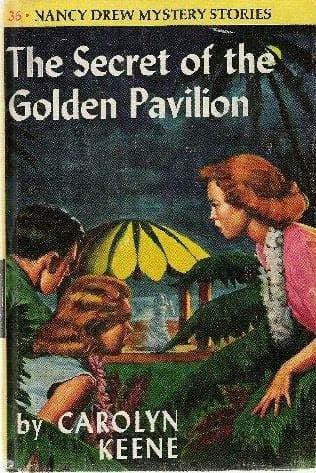
Carolyn Keene (1959)
Genre
Children's / Mystery / Young Adult
Reading Time
160 min
Key Themes
See below
Sign in to track this book
Nancy Drew must unmask a ghost, expose a criminal gang, and decipher the true heir to a Hawaiian estate before a sacred king's cape is stolen from the mysterious Golden Pavilion.
Nancy Drew arrives in Hawaii after her father, Carson Drew, takes on a case for Mr. Sakamaki. Mr. Sakamaki's grandfather, the owner of the Kaluakua estate and its Golden Pavilion, has recently died. The estate now experiences strange events, including a ghost seen dancing near the pavilion at night. Two people, Mr. Tanaka and Mrs. Sato, claim to be long-lost grandchildren of the elder Sakamaki, threatening to take over the estate. Mr. Sakamaki worries their intentions are not good and that they might be connected to the mysterious events.
Nancy, with her friends Bess Marvin and George Fayne, travels to the Kaluakua estate. They notice the eerie feel around the Golden Pavilion. They watch Mr. Tanaka and Mrs. Sato, who show unusual interest in the pavilion and its contents, not the family history. Nancy sees small differences in their stories and actions, making her suspect they are imposters. The local staff are wary and fearful, often talking about the ghost and the possible theft of a sacred artifact believed to be hidden in the pavilion.
One night, Nancy, Bess, and George see the ghostly figure dancing near the Golden Pavilion. Nancy realizes the 'ghost' is a person in disguise, likely a distraction. Further investigation leads Nancy to find evidence of a criminal group called the 'Double Scorps,' who seem interested in the Kaluakua estate. She learns that the Double Scorps are known for their heists and ability to get into wealthy families. Nancy suspects Mr. Tanaka and Mrs. Sato might be members of this gang, using the inheritance claim as a cover for their real goal.
By talking with Mr. Sakamaki and local historians, Nancy learns about a very sacred and valuable king's cape, believed to be hidden in the Golden Pavilion. This cape is an important cultural artifact and a target for thieves. Nancy starts searching the pavilion carefully, looking for clues beyond what the 'ghost' and the claimants are revealing. She finds intricate carvings and hidden compartments, which she thinks hold a coded message or a map related to the cape's location or the Sakamaki family's secrets. Tanaka and Sato's suspicious actions constantly hinder her efforts.
As Nancy investigates, she uncovers a truth: there were two Grandfather Sakamakis, one in Hawaii and another, less known, in California. The claimants, Mr. Tanaka and Mrs. Sato, are the grandchildren of the California Sakamaki, not the Hawaiian one who owned Kaluakua. This explains their focus on the estate itself rather than real family ties to the Hawaiian branch. Nancy realizes their claim to the Kaluakua estate is false. They are using this pretense to get into the Golden Pavilion and take its treasures, likely for the Double Scorps.
Nancy confronts Mr. Tanaka and Mrs. Sato with her findings, leading them to admit their connection to the Double Scorps. Their plan was to legally inherit the Kaluakua estate, giving the gang full access to the Golden Pavilion to steal the sacred king's cape. The 'ghost' was a gang member, creating a distraction and keeping real visitors away while they searched for the cape. Nancy realizes the gang used the 'haunting' mystery to hide their illegal activities, making it seem that any missing items were due to supernatural forces, not theft.
Knowing the Double Scorps are close to finding the king's cape, Nancy plans to trap them. She uses the information from the hidden clues in the pavilion to predict their next move. With help from Bess and George, and quiet communication with Mr. Sakamaki and the local police, Nancy sets up surveillance. When the Double Scorps, including Tanaka and Sato, try to take the king's cape, the police ambush them. The gang members are caught, and the sacred king's cape is safe.
With the Double Scorps in jail, Nancy reveals the full 'secret' of the Golden Pavilion. It was not just beautiful, but a carefully designed place for family history and cultural artifacts, including the king's cape. The clues she found were about the cape and the Sakamaki family's history and their role in preserving Hawaiian heritage. The 'haunting' was a clever trick by the criminals, using local beliefs to their advantage. Mr. Sakamaki is very grateful for Nancy's quick thinking and bravery, which saved his family's legacy.
With the imposters exposed and the Double Scorps stopped, the Kaluakua estate is safe. The sacred king's cape is returned to its place, and Mr. Sakamaki's claim to the estate is secure. The mystery of the two Grandfather Sakamakis is clear, ensuring the Hawaiian branch keeps its heritage. The 'ghost' no longer dances by the pavilion, and the eerie atmosphere is gone, replaced by peace and security. Nancy, Bess, and George leave Hawaii, having solved another case and preserved a piece of history.
The Protagonist
Nancy's arc in this story reinforces her established reputation as a top-tier detective, showcasing her ability to navigate cultural complexities and expose sophisticated criminal plots.
The Supporting
Initially fearful and uncertain, Mr. Sakamaki gains confidence and clarity through Nancy's investigation, ultimately securing his family's legacy.
The Supporting
Bess, despite her initial fears, consistently supports Nancy, demonstrating her courage when it truly matters.
The Supporting
George consistently provides practical assistance and a grounded perspective, proving her invaluable support to Nancy's investigations.
The Antagonist
Tanaka's deception is exposed by Nancy, leading to his capture and the failure of his criminal scheme.
The Antagonist
Sato's elaborate disguise and criminal intentions are revealed by Nancy, resulting in her arrest.
The Mentioned
His legacy is nearly compromised by criminals but is ultimately preserved through Nancy's intervention.
The Mentioned
His existence is uncovered, clarifying the false claims of the imposters and solidifying the true lineage of the Hawaiian estate.
The story shows how important it is to protect historical and cultural items from theft. The sacred king's cape is not just valuable; it represents Hawaiian history and identity. Nancy's goal is more than solving a crime; it is about protecting a community's legacy. Mr. Sakamaki's deep concern for the cape and estate, and Nancy's work to keep these items with their rightful owners, show this theme.
““The Golden Pavilion holds more than just beauty; it guards the very soul of our family’s history and the precious artifacts of Hawaii.””
A main theme is using trickery to achieve illegal goals. The Double Scorps' plan relies on imposters, with Mr. Tanaka and Mrs. Sato falsely claiming to be heirs to the Sakamaki estate. The 'ghost' dancing by the pavilion adds another layer of deceit, meant to scare away visitors and hide the criminals' actions. Nancy's skill is in seeing through these elaborate schemes, as she uncovers the real identities of the claimants and the person behind the 'ghostly' figure, showing that appearances can be misleading.
““It's amazing how easily people can be fooled when they want to believe in something, or when they're simply afraid.””
Nancy Drew uses her sharp mind and observation skills to solve the mystery. She does not believe in supernatural explanations but systematically looks for inconsistencies and physical evidence. Her ability to notice small details, like differences in the claimants' stories or the 'ghost's' pattern of appearances, helps her put together the truth. This theme highlights how rational thought can overcome superstition and how important critical thinking is for finding facts, as seen when she realizes the 'ghost' is a person in disguise.
““A good detective doesn't just see what's there; she sees what's missing, and what doesn't quite fit.””
The mystery connects to family legacy and true identity. The dispute over the Sakamaki inheritance requires looking at lineage and what truly makes a claim to a family's history and possessions. The discovery of the 'two Grandfather Sakamakis' shows how identity can be manipulated or misunderstood, and how vital it is to confirm one's true heritage. The solution ensures that the correct branch of the Sakamaki family keeps its connection to the Kaluakua estate and its history, confirming the value of real family ties.
““A name can be shared, but a legacy belongs to those who truly understand and honor its past.””
A misleading clue or distraction to divert attention from the true culprit or plot.
The 'dancing ghost' by the Golden Pavilion serves as a prominent red herring. It is initially presented as a supernatural entity, leading characters and readers alike to believe the estate is genuinely haunted. This diverts attention from the human criminals, the Double Scorps, who are actually using the 'ghost' as a diversion to conduct their search for the king's cape. Nancy's investigation eventually exposes the 'ghost' as a person in costume, revealing the deceptive nature of this plot device.
Information concealed within the environment or objects, requiring deciphering.
The Golden Pavilion itself is filled with hidden clues and possibly coded messages left by the elder Sakamaki. These are not immediately obvious but require careful observation and interpretation by Nancy. These clues lead her to understand the true value of the king's cape, its location, and the history of the Sakamaki family. This device allows for a layered mystery, rewarding Nancy's diligence and providing a logical path to the solution, rather than relying on chance discoveries.
Characters assuming false identities to deceive others.
The entire premise of the inheritance dispute is built on mistaken identity, or more accurately, deliberate imposture. Mr. Tanaka and Mrs. Sato claim to be grandchildren of the Hawaiian Grandfather Sakamaki, but Nancy discovers they are actually descendants of a different branch of the family (the Californian Grandfather Sakamaki) and are working for the Double Scorps. This device creates significant conflict and confusion, as Nancy must first prove their false identities before she can uncover their true criminal intentions and affiliations.
An object or device that serves merely as a trigger for the plot.
The sacred king's cape functions as a MacGuffin in the story. While it is a culturally significant artifact, its specific properties or history are less important than its role as the ultimate target for the Double Scorps. It is the driving force behind the criminals' actions and the central object Nancy must protect. Its value and sacredness provide a strong motive for the villains and a clear objective for Nancy, propelling the narrative forward.
"The Secret of the Golden Pavilion" by Carolyn Keene is a classic Nancy Drew mystery. It shows both the strengths and weaknesses of juvenile detective stories. The story, about Nancy investigating the Sakamaki Estate, uses familiar plot devices to keep young readers interested. It includes a 'dancing ghost,' hidden clues, and 'double imposters,' providing many small reveals that build suspense, which is a key reason for the series' lasting popularity.
One of the book's main strengths is its clear writing and straightforward plot. This makes it good for young readers who are starting to read longer books. Nancy Drew is smart, resourceful, and independent, making her a good role model. Her logical thinking, simplified for a younger audience, encourages readers to think critically. The Hawaiian setting, though not deeply explored, adds an exotic feel that sets it apart from more common mystery settings, offering a sense of adventure. The themes of order and justice provide a satisfying ending.
However, the book also has weaknesses common in the series. Character development, especially for supporting characters, is often shallow. Characters often serve as plot tools rather than fully formed individuals. The 'double imposters' and 'dancing ghost' elements, while exciting for children, can feel forced and lack the depth found in more complex mysteries. The way clues are presented and the Double Scorps' scheme is revealed sometimes feels too convenient, with solutions appearing easily instead of requiring complex detective work. This simplification, though necessary for the audience, can make the intellectual challenge less engaging for older readers. While these series offer important reading experiences, they often prioritize plot excitement over detailed characters and themes.
Compared to other juvenile mystery series, "The Secret of the Golden Pavilion" is engaging but sometimes lacks complexity. For example, Donald J. Sobol's Encyclopedia Brown series offers a more interactive mystery, often giving clues and asking the reader to solve the puzzle with the main character. While Nancy Drew has a strong story, Encyclopedia Brown's format directly encourages deductive reasoning. The mysteries in Encyclopedia Brown are often smaller but focus on detailed logic puzzles, while Nancy Drew's adventures are usually bigger, involving travel and more complex criminal plans. However, Nancy is a much more developed and active character than Encyclopedia Brown, who mostly helps the reader solve problems.
Another comparison is to Franklin W. Dixon's The Hardy Boys series, which comes from the same publisher and aims at the same age group. The Hardy Boys often have more physical action and emphasize male friendship and teamwork, which differs from Nancy Drew's independent investigative style. Both series share similar plot structures (initial suspicions, hidden clues, unmasking villains). However, The Hardy Boys often involve more direct conflict and less reliance on subtle deduction. "The Secret of the Golden Pavilion" highlights Nancy's intelligence and quick thinking more, while the Hardy Boys often use strength and daring acts. Nancy's mysteries also tend to explore slightly more exotic places and cultural elements, even if briefly, compared to the often more local adventures of Frank and Joe Hardy. In short, while both series offer engaging mysteries, Nancy Drew often provides a more thoughtful and independent female protagonist, appealing to readers looking for a different kind of adventure.
“Nancy Drew felt a shiver of anticipation. Another mystery was brewing, and she was right in the middle of it.”
— Nancy's initial reaction to the strange events surrounding the Golden Pavilion.
“The ancient carving depicted a scene of forgotten grandeur, a clue perhaps to the pavilion's true secret.”
— Nancy examining a significant piece of art within the Golden Pavilion.
“Bess and George exchanged glances. They knew Nancy's determination when they saw it, and this mystery was clearly not going to solve itself.”
— Bess and George observing Nancy's resolve early in the investigation.
“There's always a logical explanation, no matter how strange things appear at first.”
— Nancy reassuring her friends when faced with an unusual occurrence.
“The hidden compartment wasn't just a clever trick; it was a testament to the ingenuity of its creator.”
— Nancy discovering a secret feature within the pavilion.
“Danger often lurks beneath the most beautiful surfaces.”
— Nancy reflecting on the deceptive beauty of the pavilion and the threats it holds.
“A true detective never gives up, even when the trail seems to go cold.”
— Nancy's internal monologue during a difficult phase of the investigation.
“The glint of gold in the flickering torchlight seemed to mock her, hinting at a treasure just out of reach.”
— Nancy's frustration when a vital clue remains elusive.
“It wasn't just about solving the mystery; it was about righting a wrong.”
— Nancy realizing the moral implications of the case.
“The whisper of the wind through the eaves seemed to carry ancient secrets, waiting to be uncovered.”
— Nancy's atmospheric observation of the pavilion's surroundings.
“Sometimes the most obvious answer is the one we overlook.”
— Nancy having a sudden realization about a key piece of information.
“The satisfaction of piecing together the final clues was a reward in itself.”
— Nancy's feeling of accomplishment as the mystery nears its resolution.
“Every mystery, no matter how intricate, has a solution waiting to be found.”
— Nancy's concluding thought on the nature of mysteries.
Ready to see how well you understood this book? Take our interactive quiz with 10 questions.

Carolyn Keene is the pseudonym for the authors of the Nancy Drew Mystery Stories series. Under this pen name, numerous authors have penned over 170 books since 1930, captivating young readers with thrilling mysteries and adventures. The series, including notable titles like "The Secret of Red Gate Farm" and "Mystery of Crocodile Island," has become a cultural phenomenon, selling millions of copies worldwide and inspiring adaptations across various media.

Dan Gemeinhart
4.5
Kate O'Hearn
4.4

Jeanne Birdsall
4.4

Jen Wang
4.4

Wendelin Van Draanen
4.3

John Marsden
4.3

Chris Van Allsburg
4.3
Jennifer A. Nielsen
4.2