“The three boys stared at the house. It was a big, old Victorian mansion, with a tower and a widow's walk.”
— The boys' first impression of the house they are to investigate.

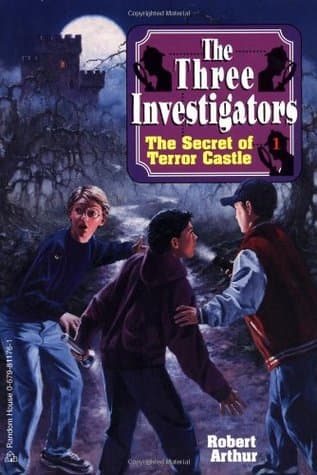
Robert Arthur (1964)
Genre
Children's / Mystery / Young Adult
Reading Time
150 min
Key Themes
See below
Sign in to track this book
Three young detectives searching for a genuinely haunted house for a film set find more than they bargained for when an overnight stay at a deceased horror actor's 'Terror Castle' reveals its chilling namesake.
Jupiter Jones, a brilliant but portly boy, establishes 'The Three Investigators' detective agency with his friends, athletic Pete Crenshaw and studious Bob Andrews. Their headquarters is a cleverly concealed mobile home hidden within a junkyard owned by Jupiter's eccentric Aunt Mathilda and Uncle Titus. For their first official case, they receive a mysterious call from Mr. Hitchcock, a famous movie director, who is looking for a genuinely haunted house to film a movie. Intrigued, Jupiter accepts the challenge, seeing it as an excellent way to launch their agency with a high-profile case. The boys are tasked with finding a truly eerie location that can provide authentic atmosphere for a horror film, setting the stage for their first adventure.
Jupiter researches potential haunted locations and uncovers the history of Terror Castle, a dilapidated mansion once owned by the reclusive and eccentric silent film horror star, Stephen Terrill. Terrill, known for his macabre roles, was said to have filled his home with elaborate hidden passages, booby traps, and spooky mechanisms, creating a real-life horror set. After his death, the castle fell into disrepair, and local legends claim it is genuinely haunted by Terrill's restless spirit. The current owner, Terrill's nephew, has been trying to sell it, but its reputation and the strange occurrences reported by potential buyers have made it impossible. This makes Terror Castle the perfect candidate for Mr. Hitchcock's movie, despite the inherent dangers.
The Three Investigators, accompanied by Mr. Hitchcock and his assistant, arrive at Terror Castle for an overnight stay to determine its suitability. The castle is dark, dusty, and full of cobwebs, immediately living up to its name. During their first night, they experience a series of strange events: disembodied moans, flickering lights, objects moving on their own, and the chilling sensation of being watched. Pete, the most easily spooked, is particularly unnerved, while Bob tries to find logical explanations. Jupiter, however, views these occurrences as clues, believing someone is deliberately orchestrating the 'haunting' to scare them away, rather than a genuine ghost.
Undeterred by the spooky events, Jupiter devises a plan to methodically search Terror Castle for hidden passages, secret rooms, and mechanical devices that could be creating the ghostly effects. Using their detective skills and Jupiter's encyclopedic knowledge, they start exploring the castle's vast and intricate layout. They discover a hidden lever behind a portrait, a secret passage leading to a dusty attic, and a series of interconnected rooms. Bob meticulously takes notes, while Pete, despite his fear, helps test various areas. Their investigation reveals that Stephen Terrill was not only a master of cinematic horror but also a genius at creating practical effects within his own home.
During their exploration, the boys encounter the 'ghost' of Stephen Terrill directly. A spectral figure, glowing faintly, appears in a hallway, emitting an eerie wail. Pete is terrified, but Jupiter, despite a moment of shock, quickly analyzes the phenomenon. He notices the figure's movements and the faint hum of machinery. The 'ghost' seems to be trying to herd them away from a particular section of the castle. This encounter solidifies Jupiter's belief that a living person is behind the hauntings, using Terrill's old tricks to protect a secret within the castle. The boys decide to set a trap to unmask the perpetrator.
While searching Terrill's study, Bob discovers a hidden compartment in a desk. Inside, they find an old diary and a series of cryptic notes and drawings left by Stephen Terrill. These documents aren't just ramblings; they contain clues and references to a hidden treasure or inheritance within the castle. Terrill, it seems, had foreseen that someone might try to exploit his secrets after his death and had left a trail for someone worthy to follow. The notes are written in a coded language, requiring Jupiter's intellect to decipher, pointing towards a specific location within the castle where something valuable is concealed.
The Investigators set a trap, using themselves as bait, to catch the person behind the hauntings. They strategically place tripwires and observation points. When the 'ghost' appears again, they manage to corner it, revealing it to be Terrill's disgruntled former handyman, Harmon. Harmon confesses that he had been secretly living in the castle, using Terrill's hidden mechanisms to scare away potential buyers so he could have the castle to himself and search for the hidden treasure that he believed Terrill had left behind. He had been trying to decipher Terrill's clues for years, unaware that the boys were much closer to solving the puzzle.
Following the final clues from Terrill's notes, the Investigators discover a hidden vault beneath a loose floorboard in the castle's main hall. Inside, they don't find gold or jewels, but instead a collection of rare and valuable silent film reels, including Terrill's lost masterpieces and unreleased footage. This was Terrill's true 'treasure' — his artistic legacy, which he wanted to protect from those who might not appreciate its cultural value. Harmon is disappointed but also relieved that the mystery is finally solved. Mr. Hitchcock is thrilled, as these films are invaluable and will provide a huge boost to his studio, and he now has a truly unique location for his movie.
With the mystery solved and Terrill's film legacy secured, Mr. Hitchcock is incredibly impressed by The Three Investigators' ingenuity and bravery. He pays them handsomely and promises to recommend their services, effectively launching their detective agency into prominence. The castle, no longer 'haunted,' now holds a new kind of value for Mr. Hitchcock, who plans to restore it and use it as a film archive and a unique set. The boys return to their junkyard headquarters, proud of their first successful case, having proven their abilities and solidified their bond as a team. They eagerly anticipate their next adventure, confident in their collective skills.
The Protagonist
Jupiter starts as a confident, somewhat eccentric leader and solidifies his role as the mastermind, learning to trust his instincts and the skills of his friends.
The Supporting
Pete confronts and largely overcomes his initial fears, demonstrating courage and loyalty despite his anxieties.
The Supporting
Bob hones his research and observational skills, proving his essential role in the team's success.
The Supporting
Hitchcock moves from a curious observer to a satisfied and impressed client, becoming a benefactor for the agency.
The Mentioned
His past actions and cleverness are revealed, shaping the central mystery of the story.
The Antagonist
Harmon is revealed as the human 'ghost' and is outwitted by the boys, his plans foiled.
The Supporting
Her initial skepticism about Jupiter's detective agency gradually turns into cautious pride.
This theme is central to the mystery genre, emphasizing logical deduction over belief in the supernatural. The 'haunting' of Terror Castle initially appears to be the work of a ghost, playing on Pete's fears and local legends. However, Jupiter consistently seeks rational explanations, believing that every seemingly supernatural event has a mechanical or human cause. This is exemplified when Jupiter meticulously searches for hidden passages and mechanisms, eventually exposing Harmon's elaborate ruse. The story champions the scientific method and critical thinking, showing how apparent magic can be demystified by observation and logic.
“There are no such things as ghosts, Pete. Only people who want you to believe there are.”
The success of The Three Investigators hinges on each member's unique strengths complementing the others. Jupiter provides the intellectual ability and leadership, Bob contributes meticulous research and observation, and Pete offers physical strength and a grounded, if sometimes fearful, perspective. No single boy could have solved the mystery alone. For example, Jupiter's brilliant deductions are useless without Pete's willingness to brave spooky corridors or Bob's ability to decipher Terrill's notes. Their collaboration highlights how diverse talents, when combined, can overcome complex challenges, creating a stronger unit than the sum of its parts.
“We're a team, Pete. Each of us has his part to play.”
Stephen Terrill's 'treasure' is not material wealth but his artistic legacy: a collection of rare and lost silent films. This theme explores the importance of preserving art and cultural heritage. Terrill, a master of his craft, went to great lengths to protect his work from being lost or exploited by those who wouldn't appreciate its true value. The discovery of these films by The Three Investigators and Mr. Hitchcock ensures that Terrill's contributions to cinema will be recognized and preserved for future generations, transforming a simple treasure hunt into a mission of cultural significance.
“His real treasure wasn't gold or jewels, but his art.”
The story thrives on the human fascination with the unknown and the thrill of solving puzzles. From the initial call from Alfred Hitchcock to the final unraveling of Terrill Castle's secrets, the narrative constantly draws the reader into a world of intrigue and excitement. The boys, particularly Jupiter, are driven by curiosity and a love for adventure, embracing the challenge of a 'haunted' house rather than shying away. This theme celebrates the spirit of exploration and the satisfaction derived from uncovering hidden truths, making the detective agency's work inherently exciting.
“This is exactly the kind of case we need to make a name for ourselves!”
Misleading clues that divert attention from the true explanation.
The primary red herring in 'The Secret of Terror Castle' is the pervasive belief that the castle is genuinely haunted by the ghost of Stephen Terrill. All the initial spooky occurrences—disembodied moans, flickering lights, moving objects—are designed to make the characters (and the reader) believe in a supernatural presence. This diverts attention from the possibility of a human perpetrator using mechanical means. The local legends and Terrill's reputation as a horror actor further reinforce this misconception, making the eventual reveal of Harmon as the 'ghost' more impactful.
A crime or mystery that seems impossible to solve because the perpetrator has seemingly vanished from a sealed location.
While not a traditional locked-room murder, Terror Castle itself functions as a variation of this device. The 'hauntings' occur within a seemingly secure and isolated environment, making it appear as if a spectral entity is responsible, as no living person should be able to move about unseen or activate the strange phenomena. The castle's hidden passages and secret rooms provide the 'escape routes' for the human 'ghost,' Harmon, making his movements appear supernatural until the boys uncover the castle's true, intricate layout. The mystery lies in how the 'ghost' operates within such a contained space.
Hidden messages or puzzles left by a character to guide the protagonists.
Stephen Terrill, the deceased owner, leaves behind a series of cryptic notes, drawings, and a coded diary. These serve as crucial plot devices, guiding The Three Investigators towards his hidden 'treasure.' Jupiter's intellect is essential in deciphering these complex clues, which are often symbolic or require a deep understanding of Terrill's eccentric mind. These clues not only advance the plot but also showcase Jupiter's deductive abilities and reinforce Terrill's cleverness, making the treasure hunt a genuine intellectual challenge rather than a simple search.
A wise and influential character who guides or provides opportunities for the protagonists.
Alfred Hitchcock serves as a mentor figure for The Three Investigators. He is a renowned professional who provides the boys with their first major case, giving them a platform to prove their skills. His initial skepticism and subsequent impressed validation not only provide narrative tension but also act as a stamp of approval for the fledgling detective agency. He offers guidance, resources (like the opportunity to stay in the castle), and ultimately rewards their success, effectively launching their careers and giving them credibility in the adult world.
“The three boys stared at the house. It was a big, old Victorian mansion, with a tower and a widow's walk.”
— The boys' first impression of the house they are to investigate.
“It was dark and dusty inside, with long shadows that seemed to dance in the corners.”
— Describing the interior of Terror Castle.
“We're the Three Investigators. We investigate anything.”
— Jupiter Jones introducing their detective agency.
“A good investigator never overlooks the obvious, but never trusts it either.”
— Jupiter Jones's philosophy on investigation.
“There's always a logical explanation for everything, no matter how strange it seems.”
— Jupiter's belief in rational solutions.
“The secret of Terror Castle isn't a secret at all. It's a puzzle.”
— Jupiter reframing the central mystery.
“Sometimes the biggest mysteries are hidden in plain sight.”
— A key insight from Jupiter about solving cases.
“Bob was the researcher, Pete was the muscle, and Jupiter was the brains.”
— Describing the roles within the Three Investigators.
“The voice was raspy, like dry leaves scuttling across a stone floor.”
— Describing a mysterious, unsettling voice.
“It's not enough to find clues; you have to know what they mean.”
— Jupiter emphasizing interpretation over mere discovery.
“Even a ghost can have a motive, if you look hard enough.”
— Jupiter's humorous, yet serious, approach to the supernatural.
“The old house groaned and creaked around them, as if it were alive and watching.”
— Personifying Terror Castle to enhance the eerie atmosphere.
“We're not afraid of ghosts, only of what people pretend are ghosts.”
— Jupiter's stance on the supposed supernatural.
“The greatest trick the villain ever pulled was convincing the world he didn't exist.”
— A variation of a famous quote, applied to the mystery's antagonist.
Ready to see how well you understood this book? Take our interactive quiz with 10 questions.
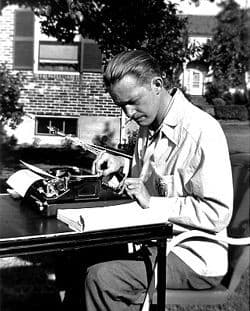
Biography coming soon.

Dan Gemeinhart
4.5
Kate O'Hearn
4.4
Jeanne Birdsall
4.4

Jen Wang
4.4
Wendelin Van Draanen
4.3

John Marsden
4.3

Chris Van Allsburg
4.3
Jennifer A. Nielsen
4.2